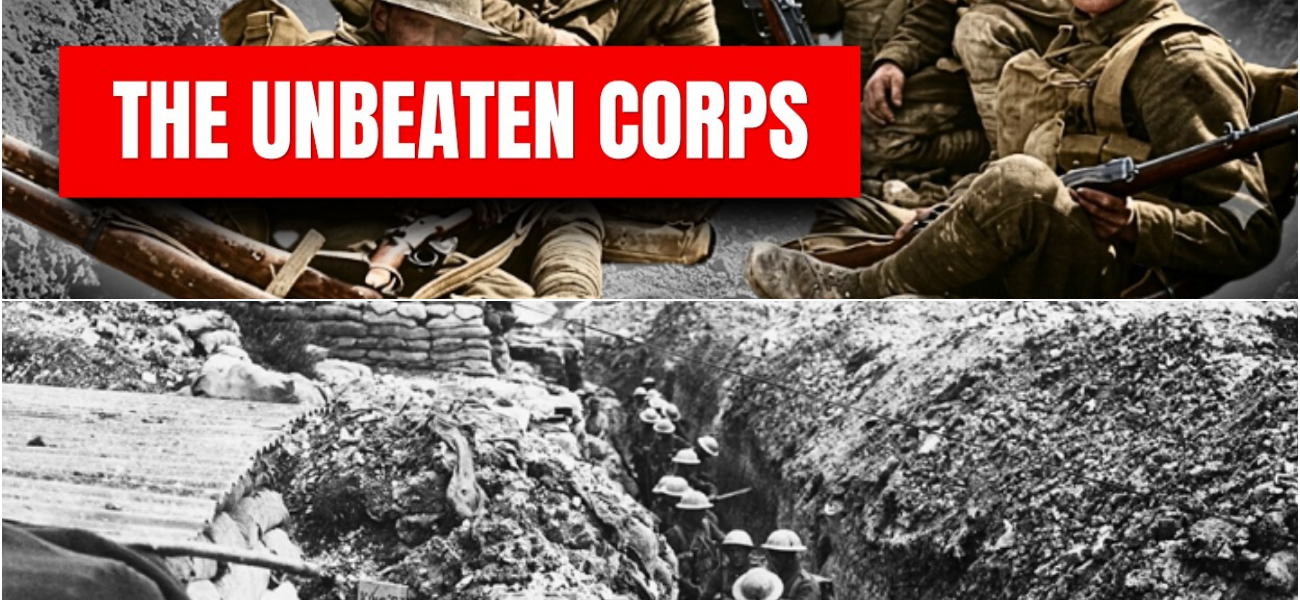
“We Cannot Beat Them” — The German Admission That Australia Had Already Won the Western Front. nu

“We Cannot Beat Them” — The German Admission That Australia Had Already Won the Western Front
On the morning of the 9th of August, 1918, Erich Ludendorff walked into the presence of Kaiser Wilhelm the Second went and said the war was over. The German First Quartermaster General, the man who had directed the German military machine for the length of the war, who had authorized the spring offensive, dismissed the warnings of his own commanders, and refused every suggestion that the German position was deteriorating beyond recovery, stood before his emperor and said the war must be ended.
24 hours earlier, the Australian Corps had driven 11 km into the German line. The Kaiser replied that they had reached the limits of their capacity. Tell me in the comments, had you ever heard, before today, of the Australian Corps and what it did in 93 days to make those words necessary? Because what you are about to discover will change what you thought you knew about who actually won the First World War.
Now, let’s go. To understand why that conversation happened in the way that it did, you must first understand what the German army believed about itself in the spring of 1918, and why that belief was correct. The surface version is easily told. Following Russia’s collapse in late 1917, the German High Command transferred 50-plus divisions from the Eastern Front to France, achieving for the first time in four years genuine numerical superiority over the Allied armies on the Western Front.
Ludendorff convened his Chiefs of Staff on the 11th of November, 1917, and devised a plan to use that superiority before the Americans arrived in France in decisive numbers. The Kaiserschlacht began on the 21st of March, 1918, when 63 German divisions attacked along 60 miles of front between Saint Quentin and Arras, in 5 days the Germans recaptured more ground than the allies had taken in 2 years of Somme fighting.
The British Fifth Army collapsed. The road to Amiens, the key railway junction that connected and supplied both the British and French armies, opened before the German advance. Had it fallen, the Allied line might have split in two. The reality the surface version does not address is what happened in the places where the road did not open.
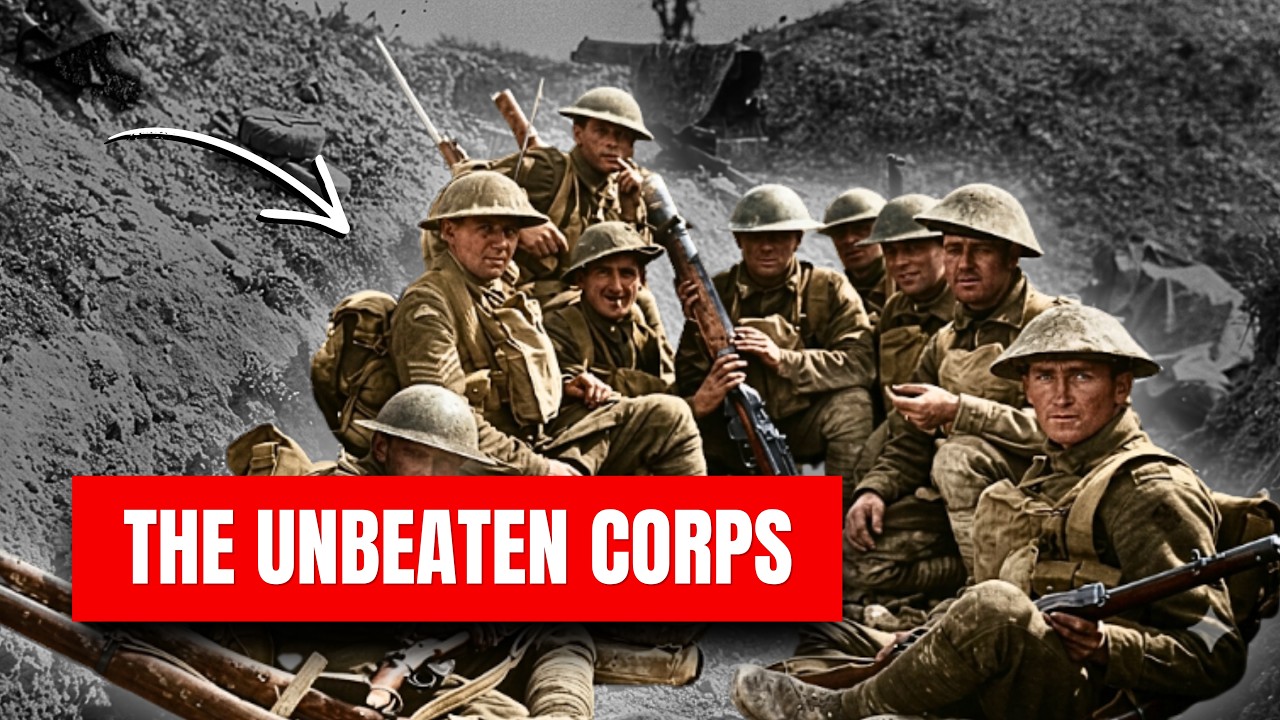
Australian divisions had been fighting in Belgium through the winter, holding positions in the Flanders mud. When the Fifth Army collapsed, they were pulled from those positions and moved south by train. In some cases, directly into the gap where British formations had been pushed back and could not be reconstituted in time.
They arrived into a situation of crisis, of retreating British units moving through their positions, of the tactical logic of the entire northern front unraveling around them. What they didn’t do in the ground they occupied was give it back. The town of Villers-Bretonneux sits on a low ridge east of Amiens. From its height, an observer could direct artillery fire onto the rail junction the Germans needed to seize to sever the Allied supply line.
On the 30th of March, the German advance struck the positions around the town and the Ninth Australian Infantry Brigade went into the line to hold them. Between the 30th of March and the 4th of April, Australian and British forces stopped the German advance. The railway survived. The Germans came back on the 23rd of April with 13 German tanks and this time took the town.
What followed on the night of the 24th of April was a counter-attack by two Australian brigades and a British Brigade that partly encircled the town in the dark and drove the Germans out by morning. The date was the 25th of April 1918 the third anniversary of the Gallipoli landing. The phrase that would later appear above every classroom blackboard in the town had not yet been written.
The lesson it would commemorate had been demonstrated. Crown Prince Rupprecht of Bavaria commanding the German Army Group covering the Somme front wrote in his diary on the 20th of July 1918 that they stood at the turning point of the war that the necessity to go over to the defensive had arrived ahead of schedule and that all the gains of the spring such as they were had been lost again.
He was writing for himself. And what he wrote was that the offensive that had looked like Germany’s last chance to win had already spent itself without winning anything that would endure. Germany held more territory in the summer of 1918 than at any point since the war began. And yet the ground gained was not the ground that mattered.
Amiens had not fallen. The railway had not been cut. In the places where the Allied line had bent least Australians had been standing in front of it. What the German High Command did not yet understand studying its maps that summer was that the formation it had been failing to push aside for the past four months was not merely a defensive obstacle.
It was an army that had been learning across the same period exactly how to attack. On the 1st of June 1918 Lieutenant General John Monash took command of the Australian Corps. Born in Melbourne on the 27th of June, 1865, the son of Jewish migrants from Prussia, he had not followed the professional military path.
What his family produced was a scholar of considerable range, then a civil engineer of significant achievement. Monash had worked on major Melbourne infrastructure projects that demanded holding an intricate system in mind, identifying the consequences of each decision for every other component of the design, and bringing a complex program in on schedule through the coordination of competing demands from men who could not simply be ordered to comply.
A militia officer’s commission had run alongside the engineering career, and by the time war came in 1914, he held the rank of colonel with broad artillery, staff, and field experience. None of this was standard preparation for commanding an army corps in northern France. In practice, it proved to be exactly the right preparation.
His record in the field had built the case quietly and continuously. The Fourth Infantry Brigade at Gallipoli, then the Third Australian Division from 1916 through the battles of Messines and Third Ypres. Haig had formed a clear impression of him through those commands, and Rawlinson had been watching closely.
When William Birdwood moved to the Fifth Army in May, creating the corps vacancy, both men had already made their choice. Monash was the senior candidate with proven capability in the field, and he was promoted accordingly. The appointment was also, before it was confirmed, the target of a campaign to prevent it.
Keith Murdoch, the journalist who had made his name reporting on Gallipoli, and was now one of Australia’s most powerful media figures, and Charles Bean, the official historian of the Australian Imperial Force, ran a sustained effort for more than 2 months to have Monash replaced by Major General Cyril Brudenell White before he could prove himself at corps level.
Bean wrote privately that Monash was not straight enough, too ambitious for glory. The anti-Semitic undercurrent of the campaign was never openly acknowledged by either man. Haig and Rawlinson demonstrated their response through their actions. The men who tried to remove John Monash before he could prove himself are remembered today only for having tried.
The army Monash now commanded was unlike any other formation in the British order of battle. At its peak, the Australian Corps numbered 109,881 men across five divisions, the largest single corps fielded by the British Empire in France. The Australian public had voted against conscription in two national referendums, in October 1916 and December 1917.
Every man who served in the corps had chosen to be there across years of accumulating evidence of what that choice would cost. And by 1918, the men still fighting were the ones who had been making that choice since the beginning. The pool of willing men had been thinning for 2 years. The men who remained were the ones who had kept volunteering back, and despite everything the war had given them reason to stop.
German military intelligence had already reached its own formal conclusion about what this produced. The assessment classified Allied shock troops in order of effectiveness, placing Canadians first and Australians second. In 1916, German intelligence had categorized the Australians as militia, the standard term for untested colonial formations of uncertain battlefield value.
By 1918, they occupied the second position on the German army’s threat assessment. What changed them in the interval was what changes any military force, tactical innovation at every level, and the particular freedom of initiative that the Australian Corps’ culture permitted in ways that more formally hierarchical armies did not allow.
Monash understood this quality and built his operational method around it. He described a perfected battle plan as resembling an orchestral score, where the various arms and units were the instruments and the tasks they performed were their respective musical phrases. What this meant in practice was that every officer who mattered had to be in the room before the plan became irrevocable, present, informed, and personally committed to what had been decided.
His coordination conference before the Hamel battle included 250 officers, covered 133 agenda items, and lasted 4 and 1/2 hours. Every conflict was resolved before anyone left the room. No subsequent adjustment to the plan was permitted. What Monash found when he arrived at the Corps in June was that his men had already been running a different kind of operation for 2 months, one that had not been centrally planned, and emerged from the initiative of individual sections who had recognized an opportunity and taken it without waiting for permission.
The invisible war had been underway since April. His men had already been winning it before he arrived to scale it into something history would record. It began with the 58th Battalion on the 5th of April, 1918. The front lines after the spring offensive were not continuous trenches. The German advance had moved too quickly for the standard system of fortification to follow, and the defenses that existed were outpost lines, scattered positions held by small groups with gaps between them.
An Australian section working a night patrol discovered that by approaching one of those outposts, not from the front, but from behind, they could neutralize it before the defenders understood they were under attack. No artillery preparation, no tank support. Men who moved quietly in darkness and understood that initiative belonged to whoever seized it first.
Within weeks of the 58th Battalion’s first successful action, all five Australian divisions were running variations of the same approach. The 3rd Division conducted these operations on three of every five days in April. Companies of the 41st Battalion turned prisoner capture into a competition, a running contest with tallies kept, conducted in the manner of men who have found that the most effective way to maintain morale under sustained pressure is to make the necessary work into a game that rewards results.
The tone on the Australian side of no man’s land in the spring of 1918 was one of aggressive, almost playful, dominance of the hours between midnight and dawn. The effect on the Germans facing them was measurable in a way that no official communique could obscure. In May 1918, a German soldier wrote to his mother from a position near Albert, describing the Australians in front of them as very quick and cunning.

Men who crept up in the night like cats to their trenches without being noticed, who the previous night had entered their trench, killed two men, and dragged one away with them. The letter was captured and translated by the 7th Australian Infantry Brigade and filed as intelligence. Nine German divisions were rotated out of the line along the Australian front during this period because their commanders assessed the men’s morale as too damaged for operational reliability.
Not from a single major defeat, from months of nightly raids and the accumulated terror of an enemy who treated the darkness as home ground. The German Second Army sent its own distress reports to senior command through this period, describing what was happening along the Australian sector with the precision of an intelligence service that understood the difference between routine pressure and something categorically different.
Major von Boes, analyzing the campaign after the war, stated plainly that the warnings were real and the response was inadequate. The intelligence had been provided. What failed was the decision, an institutional refusal at the level where decisions that matter are made to act on information that conflicted with the position the decision makers had already committed to.
By the 8th of July, the Australian Corps had advanced the front line almost 3 miles and captured 1,000 German prisoners without fighting a set piece battle. The tactic had proved itself without the involvement of the man who would be credited with the innovations of the 100 Days Offensive, and its consequences were accumulating in the files of the German Second Army, where they sat, marked, and acknowledged, and unacted upon.
Seven weeks before those files were rendered irrelevant by events, Monash ran a dress rehearsal. He chose the 4th of July deliberately. General John Pershing, commanding the American Expeditionary Force, had issued an explicit order that no American troops would participate in British-commanded operations until he judged them ready.
A threshold he did not expect to reach until 1919. 10 companies of American soldiers went to the Battle of Hamel anyway. They had been attached to Australian units in the preceding weeks, and when the order came, they chose to remain rather than withdraw. Pershing was not pleased. History did not side with Pershing.
At 3:14 in the morning of the 4th of July, three brigades of Australian infantry stepped forward behind a creeping barrage on the Somme’s southern bank. Monash had assembled five Australian infantry brigades, augmented by the American companies, advancing with 60 tanks through a coordinated barrage, supported by 250 artillery pieces, with aircraft conducting reconnaissance, and for the first time in any operation, dropping parachuted ammunition pouches to forward infantry who had outrun their ground supply lines. Every contingency
had been mapped. Every unit had been allocated to a specific tank group. Monash had calculated the battle would be complete in 90 minutes. At 4:47 in the morning, all objectives were secure. 93 minutes, three over the estimate. The assault force had advanced 2 km along a 6-km front, captured 1,600 German prisoners, inflicted approximately 2,000 German casualties, and sustained approximately 1,400 Allied casualties of their own, of which roughly 250 were killed.
Private Henry Dalziel, 25 years old, was awarded the Victoria Cross for his actions with a Lewis gun at a position called Pear Trench, where he had charged under direct fire, put the position out of action, and held it while the advance consolidated around him. Battles that had absorbed weeks of fighting and tens of thousands of casualties earlier in the war fell in 93 minutes to a force with 1,400 casualties total.
The difference was not the bravery of the men. Bravery had never been in short supply on the Western Front. The difference was the method. The British historian John Terrain later described Hamel as a textbook victory, a little masterpiece casting a long shadow behind it. That shadow reached directly into Rawlinson’s planning office, where the framework for something incomparably larger had been under construction since late May.
The problem was keeping it secret long enough for it to work. Any major offensive concentration makes noise. It generates wireless traffic, throws shadows across aerial photographs, produces statements from captured scouts, and creates the kinds of supply buildup that any competent intelligence service will read correctly if it is watching.
The Allied planning team had to eliminate each indicator while assembling the largest force the Australian sector had ever contained. The central operational security problem was the Canadian Corps, commanded by Lieutenant-General Arthur Currie. German intelligence knew that when the Canadians appeared in a new sector, an offensive was imminent.
Moving the Canadian Corps from Arras to the Amiens sector without German detection was the challenge on which the entire enterprise depended. The solution was elaborate in its simplicity. Canadian wireless sets remained active in Arras after the formations had departed. Individual Canadian soldiers were dispatched to hospitals near Ypres, visible to German intelligence networks in that area.
The entire Canadian Corps reached its assembly positions near Villers-Bretonneux without the Germans discovering that Arras was now held by a fraction of the force it appeared to contain. At the same time, the First Australian Division came south from Flanders, rejoining the four divisions already on the Somme, and uniting the full Australian Corps for the first time on the Western Front.
Monash wrote to his soldiers on the eve of the battle that for the first time in the history of the Corps, all five Australian divisions would engage the following day in the largest and most important battle operation ever undertaken by the Corps. The machinery assembled around those five divisions was not assembled in daylight.
Artillery pieces, more than 550 assigned to support the Australian Corps alone, from two 12-in railway mounted howitzers down to the 18-pounders of the field artillery, were moved at night on marshy ground with their wheels muffled. Ammunition was stockpiled under camouflage netting. Aircraft flew low and noisy above German positions each night, their engine noise masking the sound of the Mark V tanks moving into their assembly areas.
In the days before the assault, the infantry were given time to study the new tanks and understand their dimensions, so that no man would be surprised by what was moving alongside him in the dark. On the night of the 7th of August, Gunner J.R. Armitage lay in the marshy ground and wrote in his diary what it felt like to be part of that assembled machine in the final hours before it moved.
He described an utterly still night where vehicles made no sound on the marshy ground, where drivers whispered to their horses, and men muttered curses under their breath, where the silence persisted, broken only by the whine of a stray rifle bullet overhead, and where the sense was inescapable that hundreds of groups of men were doing the same thing everywhere along the line, preparing for the heaviest barrage ever launched.
Corporal Edgar Morrow of the 28th Battalion lay on the approach tape in the last minutes before zero hour. He wrote afterwards that as the time approached, he found himself trembling with nervous excitement and the cold, that not a gun was firing, that his teeth chattered, and he clamped them on his unlighted pipe, and that word passed along that there was half a minute to go.
At 4:20 in the morning of the 8th of August, 1918, the German Second Army found out what had been assembled in the dark. The barrage opened with a sound that veterans of the Western Front described as unlike anything that had come before. More than 2,000 guns fired simultaneously across a 20-km front, and the ground shook from the percussion of the opening volley.
Private John Smith of the 31st Battalion wrote to his mother that the morning was engulfed in fog so thick he could barely see 20 yd, that the row the guns kicked up was terrific, and the whole earth was shaking, and that when their guns started, Fritz started his. But his gunfire was nothing compared to theirs.
Through the fog moved the second and third Australian divisions following the creeping barrage at 90 m. Advancing at a pace calibrated to keep them as close to the curtain of shell fire as they could get without stepping into it. In the dark and the mist, invisible machine gun positions fired from directions the advancing infantry could not immediately identify.
The line kept moving. Direction was maintained by compass in conditions that made landmarks useless and by the sound of the barrage ahead. The fog began to thin approximately 2 hours into the advance. What it revealed was the largest coordinated military movement the Western Front had produced. The official Australian historian Charles Bean recorded what he witnessed at 8:00 in the morning.
Processions of tanks moving like elephants accompanying an army. Their infantry’s colors painted on their sides followed by battery after battery of field and horse artillery arriving at a gallop. Guns unlimbering in minutes to the delight of the troops. While in the opposite direction, droves of prisoners moved wide-eyed through the throng with astonishment evident on their faces.
The fourth and fifth Australian divisions leapfrogged through the second and third driving for the final objective. The tanks moved freely ahead seeking German strong points. German artillery returned fire and killed tanks. Captain Daniel Evans of the 16th battalion described witnessing German gun crews staying at their weapons to the last firing point-blank at the advancing troops.
By afternoon, the main objectives were taken. The advance on the Australian front had reached 11 km, one of the greatest single-day gains of the war. The Canadians advanced 13 km on their front. Allied forces captured 29,144 prisoners, 338 guns, and liberated 116 towns and villages. Among the objectives captured was a massive 28-cm Krupp railway gun that had been shelling the city of Amiens since June.
An enterprising Australian sapper commandeered the locomotive and drove it back to Allied lines. The gun’s barrel is displayed today at the Australian War Memorial in Canberra. 12,000 of the approximately 27,000 German casualties on the 8th of August were prisoners, an unprecedented proportion. Entire formations surrendered without forcing the Australians to fight for them.
The surrender rate was not merely a tactical result. It was the visible expression of months of nightly raids and intelligence ignored and distress reports dismissed. The men raising their hands had been reading those reports from the German side. They had known at unit level what the official document said was not happening.
They had felt the nine replaced divisions. They had faced the men who crept like cats. In the big communications trench at Villers-Bretonneux, one Australian described a captured German party making its way through the advance. Their leader laughed when an Australian called out, “Fini la guerre.” He replied in English that yes, it was over, adding Australian slang he had picked up working on a mine in Western Australia before being called back to Germany in early 1914.
Through the full length of the Western Front campaign, he had been separated from the country where he once worked. And when the moment came to say it was over, he used the language of that country to say so. At 11:05 in the morning, Lieutenant Edward Bice took off from behind the line to conduct a contact patrol above the battle.
He had served in the Australian Imperial Force since Gallipoli. In 1917, he had been shot in the neck while with the Sixth Machine Gun Company at Bullecourt, and had been awarded the Military Cross for conspicuous gallantry in the action. He had wanted to fly, and later that year succeeded in transferring to the Australian Flying Corps, completing his pilot training in Reading, where he was able to visit his wife in London during the course.
He arrived back in France 46 days before this patrol. The remains of his aircraft were found several days after the battle. Reports reached the Australian Flying Corps that he and his observer had been attacked by nine Fokker biplanes and brought down in flames. His daughter was born 3 and 1/2 months after his death.
His remains were reinterred at Heath Cemetery, Harbonnières. His headstone reads, “That eternal honor be given to those who died that we might live.” The victory Ludendorff would call the black day of the German army cost Lieutenant Edward Bice everything he had and thousands of men exactly like him. Men who had survived Gallipoli and Bullecourt and transferred to a new arm of service and training as a pilot.
Men who had wives in London and daughters they would never meet. Men who reached the day that ended the war and did not make it through the day itself. Sapper Harold Grant, hearing of the advance from behind the line, wrote home that it was great news and that the Australians had caught Fritz napping. On the evening of the 8th of August, Erich Ludendorff recorded in his memoirs what the day had meant from the perspective of the man who commanded the machine the Australians had broken.
He described the 8th of August as the black day of the German army in the history of the war, the worst experience he had gone through. Everything he had feared had in one place become a reality. The German war machine was no longer efficient. The decline of German fighting power was now beyond all doubt. The war must be ended.
King George V visited Australian Corps headquarters at the Chateau of Bertangles 4 days later. The following morning, at a conference attended by Field Marshal Haig, General Rawlinson, Marshal Foch, and French Prime Minister Clemenceau, Monash received personal congratulations from all of them. The King knighted him on the Chateau’s steps on the 12th of August, the first time in 200 years that a British monarch had honored a field commander in this way on an active battlefield.
Lieutenant William Carne of the 2nd Division, resting after 11 days of continuous fighting, described the feeling among the men as weary, noting that even victories become exhausting, but sweetened by the knowledge that they had taken part in probably the greatest, most successful blow of the Australian Imperial Force.
The Australians rested 4 days, then they went back to work. The advance continued from the 9th through the 11th of August with progressively heavier resistance for progressively less ground, fewer tanks available, German forces regrouping behind their initial collapse and the fundamental physical limit of how far men carrying full combat loads can advance under fire before exhaustion equals the effect of enemy resistance.
The Allied commanders had learned from every failed offensive of the previous years that the moment a front hardened, it was better to shift the attack elsewhere than to continue pressing a position that had lost its initial momentum. Behind the operational success, a crisis was deepening. The worst month for Australian voluntary enlistment across the entire war was August 1918.
The number of Australians dying in France equaled the number signing enlistment papers at home. The minimum height requirement for the Australian Imperial Force had been lowered to 5 ft. The age range extended to 18 through 45. Three battalions, the 36th, the 47th, and the 52nd, had already been formally disbanded in April.
Their men absorbed into surviving formations and their colors retired. For men who had carried those colors since Gallipoli and Pozières and Passchendaele, the disbandment orders produced grief of a specific kind. The grief of watching the only stable community they had known across years of transient violence officially cease to exist.
Nine more battalions faced disbandment orders in September. The response was not what higher command anticipated. The men refused not to fight. That distinction was made immediately and explicitly. They refused to fight in any battalion other than the one they had been fighting in since the start. What was not said in so many words, but was understood by every officer who looked at those men standing their ground in the barracks was that the battalion was not merely a military unit.
It was the only permanent thing in years of impermanence. The only structure that had remained consistent while every other element of their lives had dissolved into movement and loss and the changing of faces around them. In the 15th Brigade, Brigadier General Harold Pompey Elliott’s personal authority over his troops convinced the 60th Battalion to comply with the disbandment order.
In other brigades, the men simply did not move. Monash deferred the matter knowing the coming battles would resolve it by attrition. He knew this and let it play out. The advance approaching Peronne had created its own tactical problem in the form of Mont Saint Quentin. The fortified hill north of the town had been described by the Fourth Army’s own chief of staff as presenting great possibilities for a stout and prolonged defense with thick belts of wire, old trench systems, and commanding observation of every approach road.
Doctrine required tanks, heavy artillery, and full air support before any sensible commander would attempt it. Monash was not going to wait for doctrine when waiting meant giving the Germans time to consolidate. The autumn was coming. The campaigning weather that remained was finite. Private Albert Golding wrote in his diary on the 23rd of August that the French were pushing Jerry back down south and that the soldiers told each other the war was just about over but that each one knew it would not end for three or four years yet.
He was wrong. He had 37 days. The assault on Mont Saint Quentin began at 5:00 in the morning on the 31st of August, 1918. The 2nd Australian Division’s 5th Brigade went forward over cratered and rubble-strewn ground through belts of rusty wire among old trench systems that dated from an earlier and even more catastrophic phase of the Somme’s history.
The Brigade’s central battalion reached through the village near the crest, then the Germans counterattacked with the weight of the volunteer battalion placed there precisely for this moment forcing the Australians back below the line of the main roadway. They held on through the night in a position the roadway would have made untenable under daylight observation.
Before Amiens, Sergeant Dave Roberts, Tim M of the 17th Battalion, a man who had been fighting since the landing at Gallipoli who had been wounded twice and decorated for bravery who had somehow survived the accumulated mathematics of years of infantry combat had written in his diary that he was just about sick of the game that he had been at it too long and that he prayed it would be a great success and that he would pull through all right.
He had tucked a note into his coat pocket addressed to his mother. The luck he had been running on did not run out at Amiens. Sergeant Roberts survived the 8th of August and declared it a glorious victory. The following day, resting in a captured village, a German artillery shell found the position where he was resting.
He was 21 years old. His was the story of the campaign distilled to its essential truth. The men who made the victories possible did not all survive them and the ones who did lived by margins so slim that the difference between the man who wrote the diary and the man in the grave was in most cases nothing more than which direction they happened to be facing when the shell arrived.
The 6th Brigade renewed the assault on Mont Saint Quentin on the 1st of September. The fighting that followed was close, crawling over rubble, working around machine gun positions that could not be silenced from a distance, forcing the issue with grenades and bayonets in the manner that the original trench warfare doctrine had imagined.
And the combined arms revolution had been specifically designed to make obsolete. By the end of the 1st of September, the summit was in Australian hands. Simultaneously, the 5th Australian Division forced crossings over the Somme and entered Peronne through the ruins. Lieutenant Harold Williams of the 5th Division recorded afterwards that small parties were rushed across footbridges raked with machine gun fire.
Many men were killed. But the few who lived to reach the bridgehead attacked the German machine gunners and cleared the way for others to cross. For the fighting between the 31st of August and the 2nd of September, eight Victoria Crosses were awarded to the Australian Imperial Force, the greatest number for any single Australian operation in the entire war.
Two were posthumous. Private Robert McTier of the 23rd Battalion had enlisted in March 1917 and arrived in France in November, less than a year before the battle that ended him. In the early stages of the Mont Saint Quentin assault, armed with a revolver and a supply of grenades, he attacked a series of German machine gun positions.
He captured the 1st. He captured the 2nd. He captured the 3rd. He was attempting the 4th when another gun, firing at close range, killed him. His battalion’s motto was forward undeterred. He exemplified it in the precise and literal sense. He was awarded the Victoria Cross posthumously. Corporal Alexander Buckley of the 54th Battalion was killed near Peronne on the 1st of September and was similarly honored afterwards.
His photograph with his fiance, taken after his enlistment in 1916, survives in the Australian War Memorial Collection. He is smiling. She is looking at the camera. General Rawlinson, commanding the British Fourth Army, and therefore the man with the broadest operational view of everything every nation under his command had achieved across the full span of the campaign, called the Australian advances of the 31st of August to the 4th of September the greatest military achievement of the war. Charles Bean, the official
historian, wrote that the capture of Mont Saint Quentin and Peronne was held by many Australian soldiers to be the most brilliant achievement of the Australian Imperial Force. Rawlinson was comparing Mont Saint Quentin to Amiens, to Hamel, to every British, French, Canadian, and Australian operation of the entire campaign, and placing one corps’s four days of fighting above all of them.
A German battalion commander in the area filed an operational report during this period that constitutes the most formal document in the trail of German admissions running through the summer. He wrote that the forces confronting them consisted of Australians who were very warlike, clever, and daring. That they understood the art of crawling through high crops in order to capture advanced posts.
And that the enemy infantry had daily proved themselves to be audacious. This was not a private letter. It was a field report, a formal communication from a German commanding officer to his chain of command stating in institutional language that the troops facing him were doing things he could not prevent. The Australians renamed the main street of Perrone.
They called it Rue de Canga. A sign board bearing that name is still there. There was one position left between the Australian Corps and the end of the war. The Germans had spent two years constructing it specifically so that no attacker who reached it would get through it. The Hindenburg Line was not a line in the ordinary sense.
It was a system several kilometers deep in places, incorporating concrete blockhouses, fortified buildings, underground tunnels, thick interlocking fields of barbed wire, and an old canal from the Napoleonic era that passed through a 6-km tunnel, providing virtually bomb-proof shelter for the defenders inside it. Beyond the tunnel and the main defensive positions and the reserve lines, lay open country running east toward the German border.
There was nothing behind the Hindenburg Line that could be defended. If it fell, the war was functionally over in the field before the armistice negotiations could complete it. The 18th of September brought rain and the 1st and 4th Australian divisions into the Hindenburg outpost positions. These were the divisions that had been fighting since the landing at Gallipoli in April 1915.
By that September, they were near the end of their physical capacity. Monash gave them as much support as he could extract from available resources. 256 Vickers machine guns, twice his previous standard allocation, provided suppressive fire across the advance. Unable to obtain enough tanks on the time scale available, he deployed dummy tanks, frames of canvas, hessian, and timber dragged into positions where German observers would count them as part of a much larger armored force.
The advance succeeded. The 1st and 4th Divisions did not fight again before the armistice. For the assault on the main Hindenburg Line itself, set for the 29th of September, Monash was given operational command of the American 2nd Corps, the 27th and 30th Divisions under Major General George Read, 50,000 men.
He distributed a 200-strong Australian advisory mission among their formations down to company level, teaching them the tactical methods the Corps had developed and refined across years of hard experience. These were the same Americans who had appeared at Hamel in defiance of Pershing. Zero hour on the 29th came at 5:55 in the morning.
Early reports from the American formations were encouraging. By mid-morning, they were not. The Americans advanced with courage and without adequate attention to what happened to defensive positions they passed without eliminating. Machine gun nests bypassed rather than destroyed reemerged behind the advancing line and fired into the Australians following through.
By mid-afternoon, the situation was deteriorating and confused, and Monash could not provide artillery support forward of the Australians because he could not determine where the Americans had reached and would not risk firing on them. The saving factor came from the right. The 46th British Division attacking across the open section of the canal at Bellenglise, crossed it with unexpected success, and began working around the German flank.
Monash later acknowledged that the British success materially assisted him in the situation he was placed in later on the same day. By the 1st of October, the Germans fell back. The 2nd Australian Division, the 1st Australian Division to arrive in France in 1916, and now the last one still fighting, attacked the Beaurevoir Line on the 3rd of October.
Among those going forward was Lieutenant Joe Maxwell of the 18th Battalion, who already held the Military Cross and Bar and the Distinguished Conduct Medal from previous actions across years of the Western Front. He was awarded the Victoria Cross for his conduct at Estrees. He wrote afterwards that he still at the time thought the end of the war was yet far off, and that the strain was beginning to tell, that men had begun to reflect it was merely a matter of time before they would all be killed off, and that out of the nearly 300 who had
left Australia in his company, not half a dozen remained. On the 5th of October, the 21st and 24th Battalions of the 6th Brigade, under strength and battle worn, attacked the village of Montbrehain alongside the Division’s Pioneer Battalion, the only formation fit enough to supplement them. They advanced under heavy machine gun fire, fought building to building through the village, drove off a counterattack, and secured their objective by nightfall.
The 2nd Division handed over to the Americans. The Australian Corps had fought its last battle of the war. The 1st and 4th Australian Divisions were reconstituted and moving back toward the front line when the armistice took effect at 11:00 in the morning on the 11th of November 1918. The army that had done more than any other formation on the Western Front to make the armistice possible was still going forward when it came.
The German army left a paper trail of its own defeat. It began in May 1918 and ended in August. And what it records, if read in sequence and without the institutional dishonesty that prevented the German command from acting on it is the progressive accumulation of a recognition that could not be stopped once it started.
The first document is the private letter. A German soldier writing to his mother describing men who crept like cats in the darkness and dragged his comrades away before dawn. This was fear at the individual level. The level closest to the ground. Nine German divisions were subsequently rotated out of the line because that fear had become operationally disabling at the formation level.
Their replacements received the same experience and produced similar accounts. The Second Army translated this into formal distress reports addressed to senior command describing the presence of Canadian and Australian formations with the specificity of an intelligence service that understood the difference between routine pressure and something categorically different.
Those reports were dismissed as excessive anxiety. The formal military assessment followed. German intelligence had classified Allied shock troops in order of effectiveness placing Canadians first and Australians second. In 1916, those same Australians had been assessed as militia. What changed them in the interval was what changes any military force.
Tactical innovation at the junior officer and non-commissioned officer level. And the particular freedom of initiative that the Australian Corps’ culture permitted in ways that more formally hierarchical armies did not allow. Between those two assessments lay the entire record of the Western Front from 1916 to 1918.
And what that record showed was a Corps that had been learning faster at every level than the enemy could adapt to what it was learning. The battalion commander’s field report from the September fighting constituted the ground-level formal version of the same recognition. He wrote that forces confronting them were Australians who were very warlike, clever, and daring.
And that the enemy infantry had daily proved themselves audacious. Filed through the chain of command, received. What was not said in that report but was understood by every officer in a German uniform along the Australian front by the end of the 100 days was the conclusion the words implied. These men could not be stopped.
This is what the German army’s defeat looked like from inside its own chain of command. Not a catastrophic battlefield route. Not a single moment of decisive failure. A paper trail moving upward through the hierarchy from a private soldier’s letter to a field report to a general’s memoirs. Each document saying the same thing in more formal language than the one below it until the language reached the level at which it had to be said to the Kaiser himself.
Five Australian divisions fighting at perhaps a third of their nominal strength without conscripts, without mandatory service, sustained by men who had been choosing to remain across years of accumulating loss, rotated nine German divisions out of the line without fighting a major engagement. Then, in the period from August to October, defeated 39 German divisions in the field.
39 divisions. A full fifth of the entire German strength of 200 divisions on the Western Front. Major von Bose, writing his post-war analysis of Amiens, stated plainly that it should not have happened that the German command was so completely surprised by the enemy attack. The intelligence had existed. The warnings had been sent.
The decision not to act on them had been made at the level where decisions that matter are made by men who had committed to a position and could not bring themselves to revise it in time. Erich Ludendorff’s statement in his memoirs is the supreme command version of every document below it in the chain. He wrote that the 8th of August was the black day of the German army in the history of the war.
The worst experience he had gone through. That everything he had feared had in one place become a reality. That the German war machine was no longer efficient. That the decline of German fighting power was now beyond all doubt. And that the war must be ended. On the morning of the 9th of August, 1918, he delivered that assessment in person to Kaiser Wilhelm II.
He told the Kaiser, “The war must be ended.” The man with ultimate constitutional authority over the German Empire, who had authorized the Kaiserschlacht and every calculation that preceded it, heard what the Australian Corps had done to the German second Army’s position in a single day and replied that they had reached the limits of their capacity.
The war continued for 94 more days. The men who died in those 94 days on both sides didn’t know the decision had been made. They knew only what was immediately in front of them, which was what had always been immediately in front of them. The cost of those 94 days was paid by men told nothing about a private conversation between two men in a room because what is said in private between the man who runs an army and the man who owns it stays private until the archives open decades later and historians begin reading what the participants wrote
about themselves. 46,000 Australians are buried in France and Belgium. Every one of them had chosen to be there. That is the fact at the bottom of everything else. What they achieved was not the product of compulsion. Every man who held the line, who crept like a cat in the darkness, who drove 11 km in a single day, who took Mont Saint Quentin without tanks, had chosen.
Erich Ludendorff said the war must be ended on the morning of the 9th of August, 1918. He was right. It ended 94 days later on the 11th of November at 11:00 in the morning. The first and fourth Australian divisions were marching back toward the front line when it did. 46,000 Australians lie in France and Belgium today under the care of the Commonwealth War Graves Commission in cemeteries maintained on land the French and Belgian governments gave because they understood what had happened on that ground.
They include Lieutenant Edward Bryce whose daughter was learning to walk while his headstone was being carved. They include Sergeant Dave Roberts, 21 years old, who survived Amiens. They include Private Robert McTier, forward undeterred, who captured three positions and fell at the fourth. The Second Australian Division erected a memorial at Mont Saint-Quentin after the war.
A bronze figure of a digger with a fixed bayonet standing over the German eagle. German occupation forces deliberately destroyed it during the Second World War. A new memorial was raised in 1971. The replacement sculpture depicts the same digger in a more reflective pose as if what came between had changed the meaning of the gesture. The school at Villers-Bretonneux still carries the sign above every classroom blackboard, “N’oublions jamais l’Australie.” Never forget Australia.
The barrel of the Amiens guns sits in Canberra. The tactics John Monash built, infantry, armor, artillery, aircraft coordinated as a single system, became the template on which every major offensive operation of the 20th century was modeled. His name is not attached to them in the doctrine manuals. The principle is his regardless.
If you believe those men deserve to be remembered, leave a comment below. And if you want to understand what the other side of that war looked like from the country that lost it, watch this next.
Note: Some content was generated using AI tools (ChatGPT) and edited by the author for creativity and suitability for historical illustration purposes.