
The 3-Minute System That Terrified Germany
Late 1944, in the ruins of Normandy, a German intelligence officer examines a captured American device. It’s a heavy green metal box with a telephone handset and a long whip-like antenna. His initial assessment is predictable. Another example of crude but effective mass production. But the report from his technicians is unsettling.
The internal construction is sophisticated, using frequency modulation to cut through the static of battle. The truly chilling discovery, however, isn’t the technology itself. It’s the sheer number of these radios they are finding on ordinary soldiers. The officer holds the cold metal, and a realization sets in. This wasn’t just a radio.
It was a sign they were fighting a completely different kind of war. That officer’s conclusion went far beyond technology. This is not a story about the technical specifications of a radio. It is the story of the moment the German military machine was forced to confront a terrifying truth. Its own celebrated doctrines of warfare were becoming obsolete.
The SCR 300 revealed an American advantage that had less to do with the size of its factories and everything to do with its philosophy of command. The question it posed was profound. How could a simple box of wires given to a common soldier create a speed and lethality on the battlefield that even the Vermacht couldn’t counter? To understand the revolution this device caused, we first have to understand the brutal chaotic world it replaced.
For the German soldier of 1944, this was the fundamental reality of combat. The battlefield was not a single coherent event. It was a thousand isolated, desperate struggles fought in a storm of noise, dust, and confusion. Imagine a German lieutenant, a platoon leader pinned down with his men in the dense hedros of France.
Through a gap in the foliage, he spots it. An American machine gun crew setting up in a ruined farmhouse 500 m away. A perfect target. An opportunity that could save his platoon or even turn the tide of the local fight. But this knowledge is useless. He is trapped inside a bubble of chaos. How does he act on this intelligence? He could send a runner back to his company commander, but that runner must cross a field swept by fire.
A desperate gamble with a low chance of success. Even if he makes it, the message is already old. 10 minutes could pass. 20 eternity. His platoon might have a field telephone. Its thin copper wire spooled out for a kilometer back to the command post. But this wire, the fragile nervous system of his unit, is the first thing to be severed by an artillery shell or crushed by a passing tank. Most likely, it is already dead.
The handset returns only silence. He is cut off. His platoon, a tiny island of violence, is blind and deaf to the battle beyond its immediate sight. The lieutenant embodies one of the great ironies of the German military. He is trained in offro’s tactic, a doctrine of initiative encouraging him to make bold independent decisions.
He has the authority, the training, and the will to act. But he lacks the means. The gap between seeing the threat and calling in the mortars or artillery needed to destroy it is a chasm of deadly delay. This was the friction of war. a problem as old as war itself. Command was a function of distance and time. Orders were given based on information that was hours old.
Battles were managed, not orchestrated. The Vermacht had mastered the art of fighting within this chaos. Their NCOs were superb, their soldiers resilient. They were accustomed to fighting in a state of sensory deprivation. But in the summer of 1944, frontline reports began to describe an enemy that seemed to defy these laws. German positions that opened fire, were met with impossibly fast and accurate mortar responses.
American infantry, when stalled, seemed to conjure artillery strikes out of thin air, with a precision that suggested the gunners were looking over their shoulders. It felt unnatural, as if the Americans weren’t fighting in the same fog of war, as if somehow they had found a way to see in the dark. Now, picture the other side of this invisible wall, an American platoon, mid July 1944, caught in the green labyrinth of the Normandy Boage.
Ahead dug into a dense hedro, an MG42 opens up. Its tearing thousand round per minute chatter pins them to the mud. The textbook solutions are grim. A frontal assault into that storm of steel. A near certain bloodbath or a painfully slow flanking maneuver man by man through terrain that could hide a dozen more machine guns.
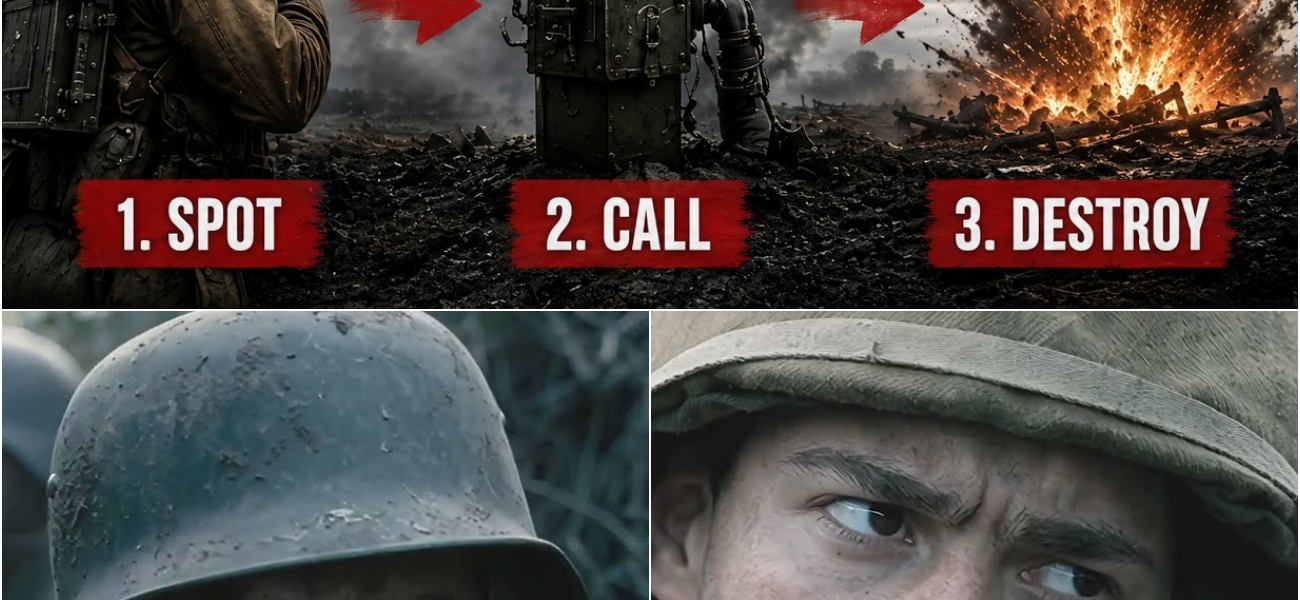
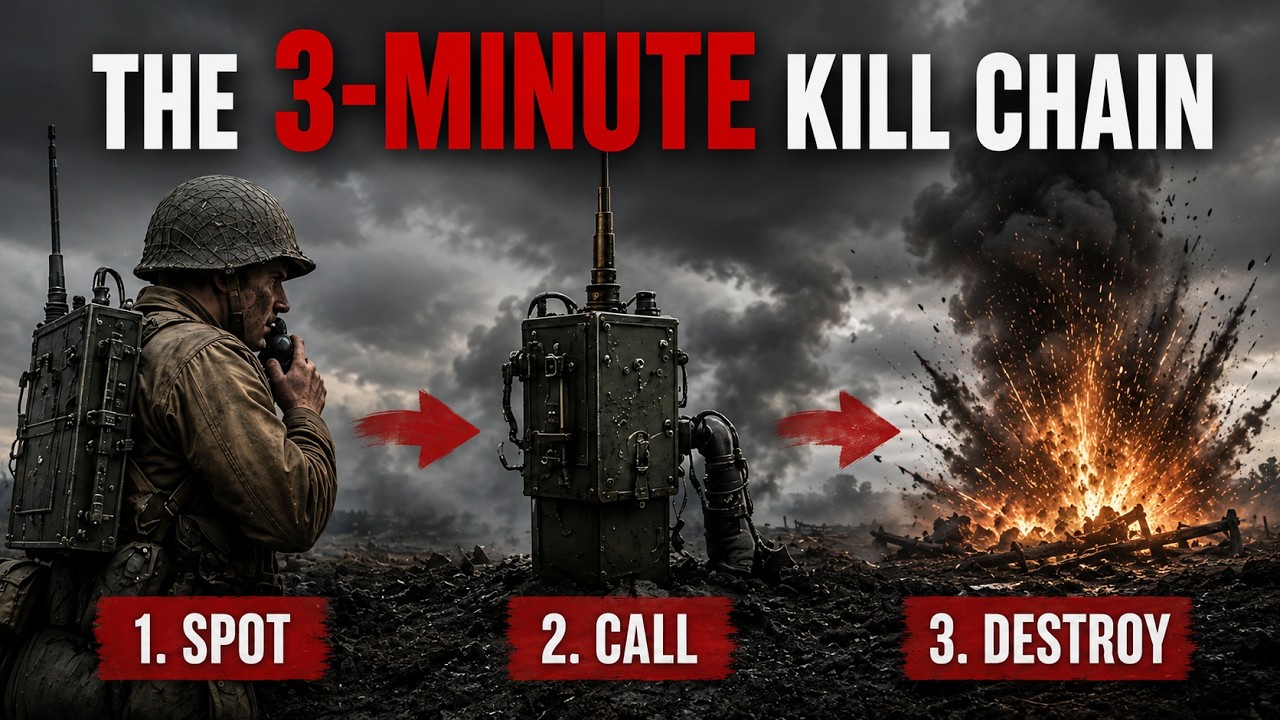
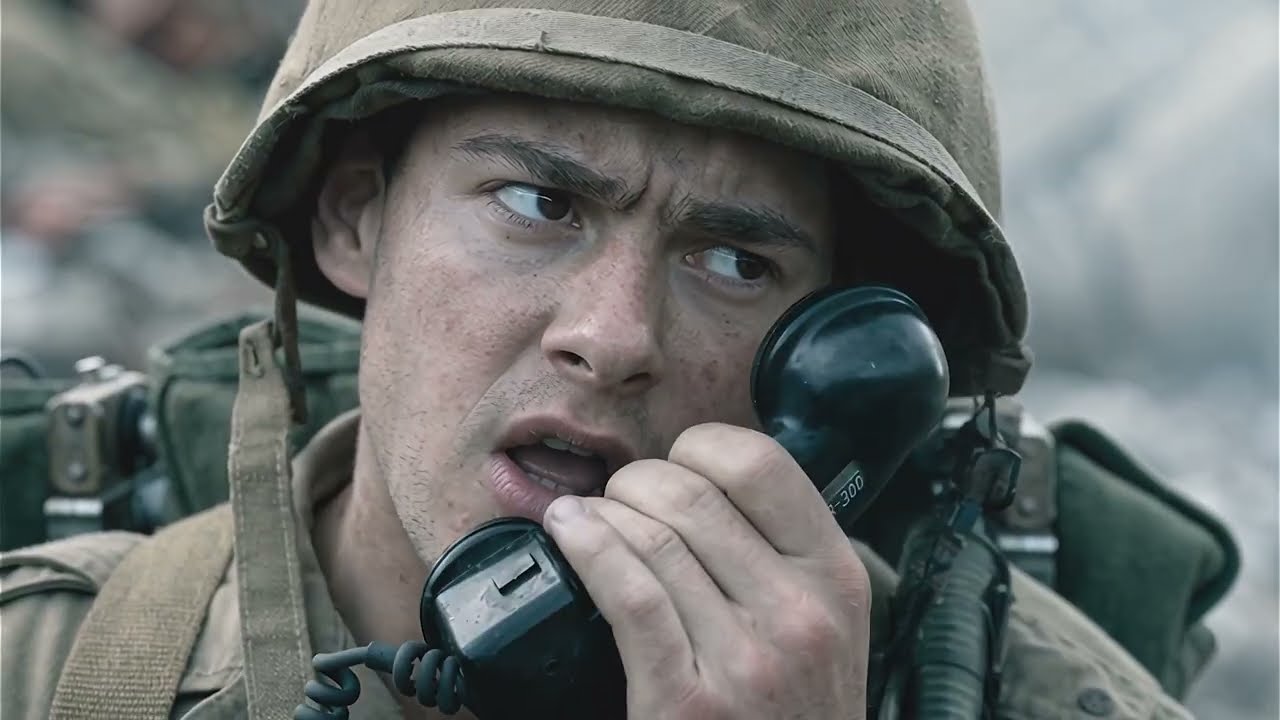
But here something else happens. A private burdened by a 35pound radio on his back, the SCR300, unhooks a telephone handset. He’s not an officer making a grand strategic decision. He’s a link. He speaks a few quiet words into the receiver, a grid coordinate, a target description. Silence for one minute, two, then a sound from above.
Not a plane, but the high-pitched whistle of incoming shells. The barrage isn’t a random pattern fired in hope. It’s a tight, focused cataclysm that lands directly on the German position. The MG42 falls silent. The platoon gets up and moves forward. This was not a lucky shot. It was a system. For the first time in the history of warfare, the man on the ground was no longer just a rifleman.
He had become a living sensor, a forward observer for the entire US Army’s arsenal. And this new capability was about to trigger a devastating chain reaction across the entire front. What had just happened in that muddy field in Normandy wasn’t an isolated incident. It was the new normal. The chain reaction had begun. The SCR300 and its smaller cousin, the SCR 536, Handy-Talkie, didn’t just give the infantrymen a voice.
They rewired the entire battlefield. The artillery forward observer, once a specialist who had to find a high, vulnerable position with a line of sight to the rear, was now obsolete. The new observer was an infantryman walking with the lead squad. When his platoon hit the dirt, he was already there, seeing exactly what the riflemen saw.
His call for fire wasn’t a guess based on a map. It was a live report from the point of contact. This transformed American artillery from a blunt instrument of area bombardment into a surgical tool. The delay between a target being spotted and shells landing on it shrank from 10, 20, or 30 minutes down to three. An eternity in a firefight.
This network of voices quickly expanded. The system grew more complex and more lethal. In the fighting around St. Low, a US infantry platoon finds itself pinned down not by a machine gun, but by a German 75 mm anti-tank gun, a PAK40, hidden in a stone barn. A frontal assault is suicide. But a Sherman tank is lumbering in support 100 yards behind them.
The tank commander, buttoned up inside his steel box, can’t see the threat. His vision is limited to narrow periscopes. For him, the barn is just another building. But the platoon leader has an SCR536. He doesn’t need to send a runner. He doesn’t need to use hand signals across a bullet swept field.
He presses the button on his radio. Jialter 6, this is dog one. Target barn, you’re 11:00. Traverse left up two. Fire. Inside the tank, the gunner adjusts his aim, guided by the calm voice of a man lying in a ditch a 100 yards away. The Sherman’s cannon roars and the barn erupts. The infantry becomes the eyes of the armor.
The tank becomes the fist of the infantry. Two separate units, a platoon of men and a 30-tonon machine, are fused into a single coordinated weapon. On the other side of the hedro, the German experience was one of escalating confusion and fear. Their afteraction reports from the campaigns in Italy and France are filled with a sense of bewilderment.
They describe American artillery that seemed to possess a supernatural precience. A German unit carefully assembling in a covered position for a counterattack would suddenly be annihilated by a perfectly timed barrage before a single man had moved. A machine gun crew would open fire only to have mortars rain down on their exact position moments later.
The initial German analysis grasped for conventional explanations. There must be spies. French partisans must be observing their movements and reporting them. It was the only logical reason for such impossible speed. The Vermacht, a force that prided itself on its methodical planning and operational security, was facing an enemy that seemed to know their intentions before they did.
The psychological effect was devastating. It felt like fighting a ghost. The very ground seemed to be watching them. But as more equipment was captured and more radio traffic was intercepted, German intelligence specialists began to assemble the horrifying truth. The answer wasn’t spies. It was something far more systemic.
A revolution in military affairs happening right in front of them. Analysts like General Eric Felge, Hitler’s chief of army communications, and his subordinates realized they weren’t just listening to orders from high command. They were intercepting a constant, chaotic, and brutally effective flood of communication from the lowest levels of the American army.
They heard sergeants adjusting mortar fire. They heard lieutenants talking directly to tank commanders. They heard forward observers calling for time on target missions where multiple artillery batteries would time their firing so that all shells arrived on a single coordinate at the exact same second. A devastating tactic made possible only by precise realtime communication.
The German analysts understood the Americans weren’t just better supplied. They were fighting on a network. They had built a decentralized realtime nervous system that ran on radio waves. A system that was faster, more flexible, and more resilient than their own. And this revealed the true unbridgegable gap.
It wasn’t about the number of factories or the quality of the steel. It was about philosophy. The German command structure was a pyramid built on a tradition of discipline and centralized authority. A request for artillery support from a German lieutenant had to travel up the chain of command to his company then battalion then to the regimental artillery liaison before an order could be sent back down to the guns.
It was a proven methodical system designed to prevent mistakes and manage resources. The American system embodied by the SC300 was different. It was a system built on a radical idea, trust. The US Army was consciously pushing the authority to make life and death decisions and the power to command immense firepower down the chain of command.
They were handing a tool that could call down a storm of steel to a 22-year-old lieutenant, a 25-year-old sergeant, even a private first class. They trusted that these junior leaders at the point of contact knew the situation better than a general miles away looking at a map. This philosophy flattened the pyramid of command.
It didn’t just make the American army faster. It made every platoon a semi-autonomous killing machine capable of seeing, deciding, and acting in a continuous high-speed loop. The Germans were fighting a war of chess. The Americans had just started playing speed chess on a dozen boards at once. But this constant chatter, the very thing that made the American army so fast and lethal, also made it loud.
And the German military, reeling from this new form of warfare, were masters of one crucial art, listening. They adapted with ruthless efficiency. Specialized signals intelligence units, the horsenian, were deployed along the front. Using sophisticated directionf finding equipment, German technicians could listen to the American radio traffic and from multiple points triangulate the physical location of the transmitter.
The battlefield equation had been inverted. The American radio man calling for an artillery strike was now broadcasting his own coordinates to the enemy. The men with the antennas, the forward observers, the vital links in the command chain became the priority targets. A terrible paradox was born. To use your greatest weapon, you had [clears throat] to reveal your exact position.
To stay safe, you had to stay silent, surrendering the very advantage that kept you alive. Every transmission became a calculated risk, a roll of the dice with a German artillery shell. This lethal game of radio hideand seek would be put to its ultimate test in the frozen forests of the Ardens, where silence meant death.
But talking could be even faster. December 1944. In the snow choked forests of the Ardens, Hitler’s last great offensive shatters the American front. Lines collapse. Units are cut off, fragmented. At the vital crossroads town of Baston, the 101st Airborne Division is completely surrounded. A ring of German steel slams shut.
All telephone lines to the outside world are severed. messengers cannot get through the siege. By every established rule of warfare, the division was doomed. It should have disintegrated into isolated, terrified pockets to be destroyed one by one. But it didn’t. Inside the siege, the invisible network held. When a company of paratroopers on the western perimeter radios that it is being overrun, reserves are shifted from a quieter sector to plug the gap.
The line bends, but it does not break. A lone forward observer shivering in a foxhole spots a column of German tanks grinding through the snow. He has no line to an outside army. He gets on his SCR300 backpack radio and calls his division’s own fire direction center located just a few miles away, but on the other side of an enemy army.
The coordinates are whispered over the air. Minutes later, shells from the 100’s own besieged artillery batteries scream overhead, catching the tanks in the open. The attack falters, broken by the very men it was meant to annihilate. The Germans expected to find panicked, isolated units. Instead, they hit a single coordinated fortress that fought in every direction at once.
The pocket wasn’t a trap. It was a kill zone held together by the constant risky chatter of radio waves. Baston was the ultimate proof. The network was no longer just a tool for attack. It was the lifeline that could hold an army together even in the heart of total disaster. And so we returned to that German intelligence officer holding the captured American radio.
By the winter of 1944, his initial unsettling discovery had become the proven horrifying truth of the front. The American threat wasn’t just its river of tanks and planes. It was a philosophy. The SCR 300 was the physical embodiment of a doctrine that trusted a 22-year-old lieutenant on the front line with the power to command a symphony of destruction.
This was the final intellectual surrender. The realization that the German military machine built on a proud tradition of centralized authority was not just being outproduced, it was being outthought. Its entire command structure was too slow, too rigid to compete with an army that had become a decentralized high-speed network.
It changes our very understanding of what a weapon is. The radio proved that the most decisive weapon isn’t always the one that makes the loudest explosion. It’s the one that allows a single soldier to speak to the vast machine of war at his back and to get an answer in under 3 minutes. The rifle in his hands gave him power over the enemy soldier directly in front of him.
The radio gave him power over the entire battlefield. It proved that for the American GI, the most powerful weapon wasn’t always the one he held, but the voice he heard.
The 3-Minute System That Terrified Germany
Late 1944, in the ruins of Normandy, a German intelligence officer examines a captured American device. It’s a heavy green metal box with a telephone handset and a long whip-like antenna. His initial assessment is predictable. Another example of crude but effective mass production. But the report from his technicians is unsettling.
The internal construction is sophisticated, using frequency modulation to cut through the static of battle. The truly chilling discovery, however, isn’t the technology itself. It’s the sheer number of these radios they are finding on ordinary soldiers. The officer holds the cold metal, and a realization sets in. This wasn’t just a radio.
It was a sign they were fighting a completely different kind of war. That officer’s conclusion went far beyond technology. This is not a story about the technical specifications of a radio. It is the story of the moment the German military machine was forced to confront a terrifying truth. Its own celebrated doctrines of warfare were becoming obsolete.
The SCR 300 revealed an American advantage that had less to do with the size of its factories and everything to do with its philosophy of command. The question it posed was profound. How could a simple box of wires given to a common soldier create a speed and lethality on the battlefield that even the Vermacht couldn’t counter? To understand the revolution this device caused, we first have to understand the brutal chaotic world it replaced.
For the German soldier of 1944, this was the fundamental reality of combat. The battlefield was not a single coherent event. It was a thousand isolated, desperate struggles fought in a storm of noise, dust, and confusion. Imagine a German lieutenant, a platoon leader pinned down with his men in the dense hedros of France.
Through a gap in the foliage, he spots it. An American machine gun crew setting up in a ruined farmhouse 500 m away. A perfect target. An opportunity that could save his platoon or even turn the tide of the local fight. But this knowledge is useless. He is trapped inside a bubble of chaos. How does he act on this intelligence? He could send a runner back to his company commander, but that runner must cross a field swept by fire.
A desperate gamble with a low chance of success. Even if he makes it, the message is already old. 10 minutes could pass. 20 eternity. His platoon might have a field telephone. Its thin copper wire spooled out for a kilometer back to the command post. But this wire, the fragile nervous system of his unit, is the first thing to be severed by an artillery shell or crushed by a passing tank. Most likely, it is already dead.
The handset returns only silence. He is cut off. His platoon, a tiny island of violence, is blind and deaf to the battle beyond its immediate sight. The lieutenant embodies one of the great ironies of the German military. He is trained in offro’s tactic, a doctrine of initiative encouraging him to make bold independent decisions.
He has the authority, the training, and the will to act. But he lacks the means. The gap between seeing the threat and calling in the mortars or artillery needed to destroy it is a chasm of deadly delay. This was the friction of war. a problem as old as war itself. Command was a function of distance and time. Orders were given based on information that was hours old.
Battles were managed, not orchestrated. The Vermacht had mastered the art of fighting within this chaos. Their NCOs were superb, their soldiers resilient. They were accustomed to fighting in a state of sensory deprivation. But in the summer of 1944, frontline reports began to describe an enemy that seemed to defy these laws. German positions that opened fire, were met with impossibly fast and accurate mortar responses.
American infantry, when stalled, seemed to conjure artillery strikes out of thin air, with a precision that suggested the gunners were looking over their shoulders. It felt unnatural, as if the Americans weren’t fighting in the same fog of war, as if somehow they had found a way to see in the dark. Now, picture the other side of this invisible wall, an American platoon, mid July 1944, caught in the green labyrinth of the Normandy Boage.
Ahead dug into a dense hedro, an MG42 opens up. Its tearing thousand round per minute chatter pins them to the mud. The textbook solutions are grim. A frontal assault into that storm of steel. A near certain bloodbath or a painfully slow flanking maneuver man by man through terrain that could hide a dozen more machine guns.
But here something else happens. A private burdened by a 35pound radio on his back, the SCR300, unhooks a telephone handset. He’s not an officer making a grand strategic decision. He’s a link. He speaks a few quiet words into the receiver, a grid coordinate, a target description. Silence for one minute, two, then a sound from above.
Not a plane, but the high-pitched whistle of incoming shells. The barrage isn’t a random pattern fired in hope. It’s a tight, focused cataclysm that lands directly on the German position. The MG42 falls silent. The platoon gets up and moves forward. This was not a lucky shot. It was a system. For the first time in the history of warfare, the man on the ground was no longer just a rifleman.
He had become a living sensor, a forward observer for the entire US Army’s arsenal. And this new capability was about to trigger a devastating chain reaction across the entire front. What had just happened in that muddy field in Normandy wasn’t an isolated incident. It was the new normal. The chain reaction had begun. The SCR300 and its smaller cousin, the SCR 536, Handy-Talkie, didn’t just give the infantrymen a voice.
They rewired the entire battlefield. The artillery forward observer, once a specialist who had to find a high, vulnerable position with a line of sight to the rear, was now obsolete. The new observer was an infantryman walking with the lead squad. When his platoon hit the dirt, he was already there, seeing exactly what the riflemen saw.
His call for fire wasn’t a guess based on a map. It was a live report from the point of contact. This transformed American artillery from a blunt instrument of area bombardment into a surgical tool. The delay between a target being spotted and shells landing on it shrank from 10, 20, or 30 minutes down to three. An eternity in a firefight.
This network of voices quickly expanded. The system grew more complex and more lethal. In the fighting around St. Low, a US infantry platoon finds itself pinned down not by a machine gun, but by a German 75 mm anti-tank gun, a PAK40, hidden in a stone barn. A frontal assault is suicide. But a Sherman tank is lumbering in support 100 yards behind them.
The tank commander, buttoned up inside his steel box, can’t see the threat. His vision is limited to narrow periscopes. For him, the barn is just another building. But the platoon leader has an SCR536. He doesn’t need to send a runner. He doesn’t need to use hand signals across a bullet swept field.
He presses the button on his radio. Jialter 6, this is dog one. Target barn, you’re 11:00. Traverse left up two. Fire. Inside the tank, the gunner adjusts his aim, guided by the calm voice of a man lying in a ditch a 100 yards away. The Sherman’s cannon roars and the barn erupts. The infantry becomes the eyes of the armor.
The tank becomes the fist of the infantry. Two separate units, a platoon of men and a 30-tonon machine, are fused into a single coordinated weapon. On the other side of the hedro, the German experience was one of escalating confusion and fear. Their afteraction reports from the campaigns in Italy and France are filled with a sense of bewilderment.
They describe American artillery that seemed to possess a supernatural precience. A German unit carefully assembling in a covered position for a counterattack would suddenly be annihilated by a perfectly timed barrage before a single man had moved. A machine gun crew would open fire only to have mortars rain down on their exact position moments later.
The initial German analysis grasped for conventional explanations. There must be spies. French partisans must be observing their movements and reporting them. It was the only logical reason for such impossible speed. The Vermacht, a force that prided itself on its methodical planning and operational security, was facing an enemy that seemed to know their intentions before they did.
The psychological effect was devastating. It felt like fighting a ghost. The very ground seemed to be watching them. But as more equipment was captured and more radio traffic was intercepted, German intelligence specialists began to assemble the horrifying truth. The answer wasn’t spies. It was something far more systemic.
A revolution in military affairs happening right in front of them. Analysts like General Eric Felge, Hitler’s chief of army communications, and his subordinates realized they weren’t just listening to orders from high command. They were intercepting a constant, chaotic, and brutally effective flood of communication from the lowest levels of the American army.
They heard sergeants adjusting mortar fire. They heard lieutenants talking directly to tank commanders. They heard forward observers calling for time on target missions where multiple artillery batteries would time their firing so that all shells arrived on a single coordinate at the exact same second. A devastating tactic made possible only by precise realtime communication.
The German analysts understood the Americans weren’t just better supplied. They were fighting on a network. They had built a decentralized realtime nervous system that ran on radio waves. A system that was faster, more flexible, and more resilient than their own. And this revealed the true unbridgegable gap.
It wasn’t about the number of factories or the quality of the steel. It was about philosophy. The German command structure was a pyramid built on a tradition of discipline and centralized authority. A request for artillery support from a German lieutenant had to travel up the chain of command to his company then battalion then to the regimental artillery liaison before an order could be sent back down to the guns.
It was a proven methodical system designed to prevent mistakes and manage resources. The American system embodied by the SC300 was different. It was a system built on a radical idea, trust. The US Army was consciously pushing the authority to make life and death decisions and the power to command immense firepower down the chain of command.
They were handing a tool that could call down a storm of steel to a 22-year-old lieutenant, a 25-year-old sergeant, even a private first class. They trusted that these junior leaders at the point of contact knew the situation better than a general miles away looking at a map. This philosophy flattened the pyramid of command.
It didn’t just make the American army faster. It made every platoon a semi-autonomous killing machine capable of seeing, deciding, and acting in a continuous high-speed loop. The Germans were fighting a war of chess. The Americans had just started playing speed chess on a dozen boards at once. But this constant chatter, the very thing that made the American army so fast and lethal, also made it loud.
And the German military, reeling from this new form of warfare, were masters of one crucial art, listening. They adapted with ruthless efficiency. Specialized signals intelligence units, the horsenian, were deployed along the front. Using sophisticated directionf finding equipment, German technicians could listen to the American radio traffic and from multiple points triangulate the physical location of the transmitter.
The battlefield equation had been inverted. The American radio man calling for an artillery strike was now broadcasting his own coordinates to the enemy. The men with the antennas, the forward observers, the vital links in the command chain became the priority targets. A terrible paradox was born. To use your greatest weapon, you had [clears throat] to reveal your exact position.
To stay safe, you had to stay silent, surrendering the very advantage that kept you alive. Every transmission became a calculated risk, a roll of the dice with a German artillery shell. This lethal game of radio hideand seek would be put to its ultimate test in the frozen forests of the Ardens, where silence meant death.
But talking could be even faster. December 1944. In the snow choked forests of the Ardens, Hitler’s last great offensive shatters the American front. Lines collapse. Units are cut off, fragmented. At the vital crossroads town of Baston, the 101st Airborne Division is completely surrounded. A ring of German steel slams shut.
All telephone lines to the outside world are severed. messengers cannot get through the siege. By every established rule of warfare, the division was doomed. It should have disintegrated into isolated, terrified pockets to be destroyed one by one. But it didn’t. Inside the siege, the invisible network held. When a company of paratroopers on the western perimeter radios that it is being overrun, reserves are shifted from a quieter sector to plug the gap.
The line bends, but it does not break. A lone forward observer shivering in a foxhole spots a column of German tanks grinding through the snow. He has no line to an outside army. He gets on his SCR300 backpack radio and calls his division’s own fire direction center located just a few miles away, but on the other side of an enemy army.
The coordinates are whispered over the air. Minutes later, shells from the 100’s own besieged artillery batteries scream overhead, catching the tanks in the open. The attack falters, broken by the very men it was meant to annihilate. The Germans expected to find panicked, isolated units. Instead, they hit a single coordinated fortress that fought in every direction at once.
The pocket wasn’t a trap. It was a kill zone held together by the constant risky chatter of radio waves. Baston was the ultimate proof. The network was no longer just a tool for attack. It was the lifeline that could hold an army together even in the heart of total disaster. And so we returned to that German intelligence officer holding the captured American radio.
By the winter of 1944, his initial unsettling discovery had become the proven horrifying truth of the front. The American threat wasn’t just its river of tanks and planes. It was a philosophy. The SCR 300 was the physical embodiment of a doctrine that trusted a 22-year-old lieutenant on the front line with the power to command a symphony of destruction.
This was the final intellectual surrender. The realization that the German military machine built on a proud tradition of centralized authority was not just being outproduced, it was being outthought. Its entire command structure was too slow, too rigid to compete with an army that had become a decentralized high-speed network.
It changes our very understanding of what a weapon is. The radio proved that the most decisive weapon isn’t always the one that makes the loudest explosion. It’s the one that allows a single soldier to speak to the vast machine of war at his back and to get an answer in under 3 minutes. The rifle in his hands gave him power over the enemy soldier directly in front of him.
The radio gave him power over the entire battlefield. It proved that for the American GI, the most powerful weapon wasn’t always the one he held, but the voice he heard.
Note: Some content was generated using AI tools (ChatGPT) and edited by the author for creativity and suitability for historical illustration purposes.