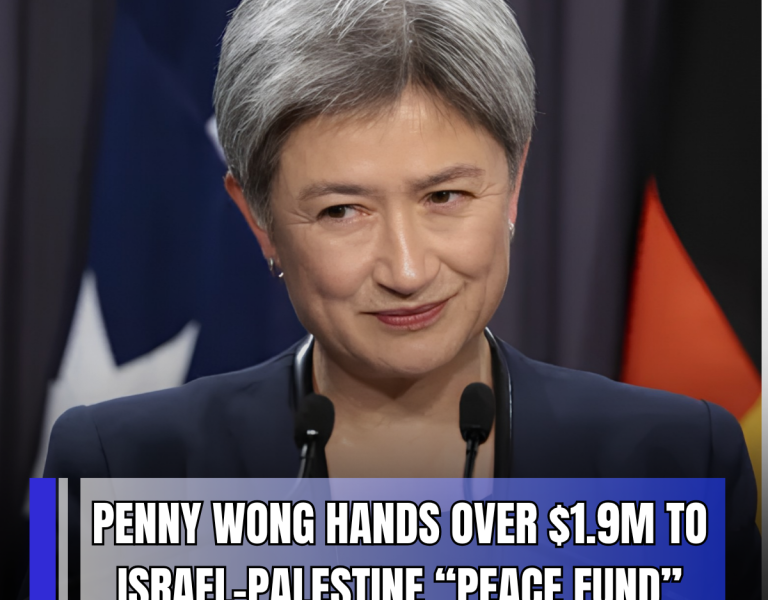

Penny Wong hands over $1.9M to Israel-Palestine ‘peace fund’
Australia Commits $1.9 Million to New Israel–Palestine Peace Fund

Australia has announced a new financial commitment aimed at supporting long-term peace efforts between Israelis and Palestinians, pledging $1.9 million to help establish an international peace fund alongside the United Kingdom and Canada.
The announcement was made by Foreign Minister Penny Wong, who joined her counterparts from the UK and Canada in unveiling the International Peace Fund for Israelis and Palestinians, an initiative designed to create what the three governments describe as the conditions necessary for a lasting peace.
In a joint statement released this week, the foreign ministers said the fund would focus on strengthening moderate voices while reducing the influence of extremist groups, including Hamas. Rather than concentrating solely on political negotiations or security arrangements, the initiative aims to invest in long-term community engagement and grassroots cooperation between Israelis and Palestinians.
According to the statement, each participating country will provide initial seed funding equivalent to £1 million over three years, with the expectation that additional international partners may contribute to the fund in the future.
The ministers argued that experience from other long-running conflicts demonstrates that sustainable peace cannot be achieved through military or political measures alone. Instead, rebuilding trust between communities and encouraging cooperation are viewed as essential components of any successful peace process.

They stated that the Peace Fund would support programs intended to advance the prospect of a two-state solution while reducing divisions between communities. The initiative will also seek to strengthen civil society organisations and encourage dialogue and cooperation both within and between Israeli and Palestinian communities.
The joint statement emphasised that these investments are intended to build the relationships, confidence and mutual understanding necessary for meaningful negotiations in the future. Officials described the project as a complement to existing diplomatic, humanitarian and development efforts already underway in the region rather than a replacement for them.
Supporters of the initiative believe that sustained grassroots engagement can help create an environment where political agreements become more achievable. By investing in local programs that encourage communication and collaboration, the participating governments hope to lay stronger foundations for long-term stability.
Penny Wong made the announcement during an official visit to the United Kingdom and Europe alongside Deputy Prime Minister and Defence Minister Richard Marles. The trip forms part of Australia’s broader effort to strengthen and diversify its international relationships through closer engagement with key partners.

The government has presented the overseas visit as an opportunity to reinforce strategic cooperation with allies while also discussing international security and diplomatic priorities.
However, the announcement comes at a time when Wong has also attracted public attention over separate comments relating to Australia’s history and immigration. She previously sparked criticism after stating that Melbourne was built by Aboriginal people and new migrants in a video responding to the Coalition’s values-based immigration policy.
Those remarks generated significant political debate, with supporters and critics offering sharply different interpretations of her comments. The discussion added to ongoing national conversations surrounding immigration, identity and Australia’s historical narrative.
Against that backdrop, the new peace fund announcement is likely to draw attention from both supporters and opponents of Australia’s foreign policy direction. Advocates argue that investing in dialogue and community-building represents a constructive approach to one of the world’s most entrenched conflicts, while others may question the allocation of taxpayer funds to international initiatives.

For now, Australia, the United Kingdom and Canada have signalled their intention to move beyond traditional diplomatic frameworks by supporting initiatives that operate at the community level. Whether additional international partners join the fund and how effectively it contributes to future peace efforts remains to be seen, but the three governments have made clear that they view long-term trust-building as an essential ingredient in any lasting resolution between Israelis and Palestinians.