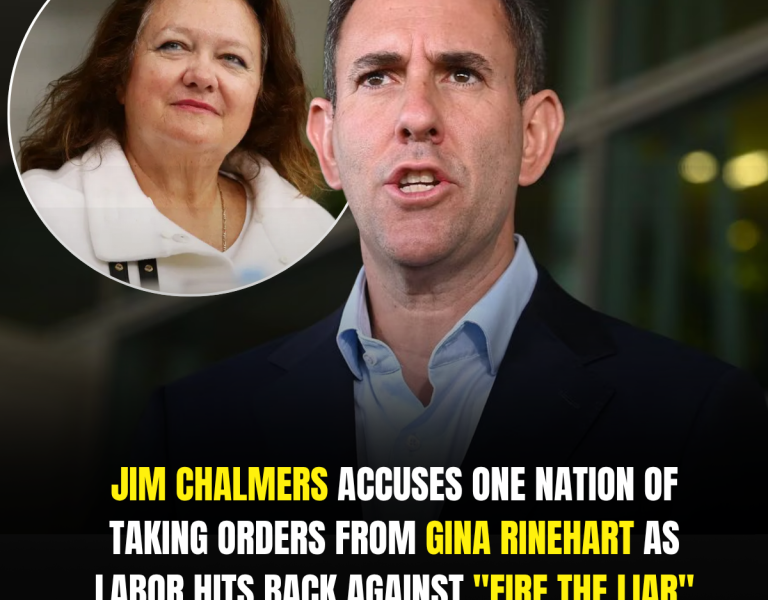
Labor Targets Hanson and Rinehart as Fight for Australia’s Working-Class Vote Intensifies. u1

Labor Targets Hanson and Rinehart as Fight for Australia’s Working-Class Vote Intensifies
Australia’s political battle over who truly represents working people took a dramatic turn as senior Labor figures launched a fierce attack on One Nation and its relationship with mining billionaire Gina Rinehart, reigniting a national debate about money, influence, and political loyalty.

What began as a pointed remark during a gathering of Labor Party delegates quickly evolved into one of the most talked-about political moments of the week. Treasurer Jim Chalmers delivered a line that immediately captured attention across the country, declaring that Labor votes “the way workers need us to, not the way Gina Rinehart tells us to.”
The statement was more than a partisan jab. It was a calculated attempt to frame the political contest between Labor and One Nation as a choice between workers’ interests and billionaire influence. In a political environment where cost-of-living pressures continue to dominate public concerns, the message was designed to resonate with Australians who feel increasingly squeezed by housing costs, inflation, and economic uncertainty.

Prime Minister Anthony Albanese reinforced that message by drawing renewed attention to Pauline Hanson’s widely discussed use of a private jet reportedly donated by Rinehart. The aircraft, valued at approximately $2 million, has become a symbol in Labor’s broader argument that wealthy interests wield outsized influence over parts of Australia’s political landscape.
For Labor strategists, the issue is not simply about a plane. It is about perception. Political campaigns are often won or lost based on how voters interpret relationships between politicians and powerful backers. By highlighting the connection between Hanson and Rinehart, Labor hopes to raise questions about who benefits when policy decisions are made.
The timing of the attack was hardly accidental. Labor has increasingly focused on defending its traditional working-class support base, particularly in regional and outer suburban communities where economic frustrations have fueled support for alternative political movements. One Nation has spent years positioning itself as a voice for Australians who feel ignored by major parties, making it a direct competitor for many of the same voters Labor hopes to retain.
Pauline Hanson has long cultivated an image as a political outsider willing to challenge the establishment. Her supporters often view her as someone who speaks bluntly about issues that other politicians avoid. That reputation has helped One Nation maintain a presence in Australian politics despite repeated predictions of its decline.
Yet Labor believes Hanson’s association with one of the country’s wealthiest individuals presents a vulnerability. Gina Rinehart is one of Australia’s most influential business figures, with enormous interests in mining and resources. Admirers see her as a champion of economic growth, entrepreneurship, and national prosperity. Critics argue that her wealth gives her an outsized voice in public policy debates.
By linking Hanson to Rinehart, Labor seeks to challenge One Nation’s claim of representing ordinary Australians. The argument is straightforward: a movement that presents itself as anti-establishment may struggle to maintain that image when it is closely associated with one of the most powerful figures in Australian business.
The dispute also reflects a deeper ideological struggle taking place across Australia. Increasingly, political debates are being framed not merely as contests between left and right but as battles between ordinary citizens and concentrated wealth. Similar themes have emerged in elections around the world, where questions about inequality and corporate influence have become central political issues.
For Labor, emphasizing workers’ interests remains a cornerstone of its political identity. The party’s history is rooted in organized labor and trade union movements. Although modern economic realities have transformed Australia’s workforce, Labor continues to portray itself as the party most committed to protecting wages, workplace rights, and social protections.
Chalmers’ comments were carefully crafted to reinforce that identity. Rather than focusing exclusively on policy details, he presented the debate in moral terms. The message suggested that political decisions should be driven by the needs of workers rather than the preferences of wealthy donors or influential business leaders.
Such rhetoric has proven effective in many democratic systems because it simplifies complex policy debates into a question of trust. Voters may not follow every detail of economic legislation, but they often pay attention when politicians argue about who truly holds influence behind closed doors.
The controversy surrounding political donations and financial support is not new in Australia. For decades, both major parties have faced scrutiny over their relationships with wealthy individuals, corporations, and industry groups. Public concern often spikes whenever high-profile financial connections become visible.

In that context, the private jet controversy carries symbolic weight far beyond its monetary value. For supporters of Labor’s argument, the aircraft represents a visible reminder of the close ties that can exist between politics and wealth. For Hanson’s supporters, however, the criticism may appear hypocritical or politically motivated.
One Nation has frequently argued that attacks from Labor and other major parties are attempts to silence alternative voices. The party’s supporters often see such criticism as evidence that the political establishment feels threatened by Hanson’s message. That dynamic can sometimes strengthen support among voters who already distrust mainstream institutions.
As a result, Labor’s strategy carries both opportunities and risks. While highlighting billionaire influence may energize Labor supporters and appeal to undecided voters concerned about fairness, it could also reinforce Hanson’s narrative that she is being targeted by political elites.
The broader political significance lies in the changing nature of Australia’s electoral landscape. Traditional party loyalties have weakened over time, creating a more competitive environment in which voter support can shift rapidly. In such circumstances, symbolism matters as much as policy.
Political branding has become increasingly important. Labor wants voters to associate One Nation with wealthy interests. One Nation wants voters to see itself as an independent force challenging the establishment. The battle over public perception is therefore just as important as the battle over legislation.
Meanwhile, economic conditions continue to shape the political conversation. Many Australians remain concerned about housing affordability, rising rents, energy costs, and household budgets. These issues create fertile ground for debates about economic power and who benefits from national prosperity.
Labor’s attack on Hanson and Rinehart taps directly into those concerns. By emphasizing the contrast between workers and billionaires, the party hopes to channel frustration toward a narrative that supports its broader political agenda.
Critics of Labor, however, argue that rhetoric alone is insufficient. They contend that voters ultimately judge governments based on outcomes rather than slogans. If economic pressures persist, they say, attacks on political opponents may have limited impact regardless of how effectively they are delivered.
Supporters of the government respond that highlighting political influence remains an important part of democratic accountability. They argue that voters deserve transparency regarding the relationships between politicians and powerful individuals who may seek to shape public policy.
The dispute has also reignited discussion about the role of wealth in modern democracies. Around the world, citizens increasingly question whether economic power translates into political power. These concerns are not unique to Australia, but they have become more visible as economic inequality attracts greater public attention.
For Gina Rinehart herself, the controversy underscores the complex position occupied by high-profile business leaders. Successful entrepreneurs often become influential voices in national debates, but that visibility can also make them targets during political campaigns. Their involvement in public life inevitably attracts scrutiny from opponents seeking political advantage.

As Australia moves toward future electoral contests, the clash between Labor and One Nation is likely to intensify. Both parties recognize the importance of working-class voters, particularly in regions where economic concerns dominate daily life. Winning those voters may prove decisive in shaping the country’s political future.
The latest exchange between Chalmers, Albanese, and Hanson therefore represents more than a momentary political skirmish. It reflects a larger struggle over identity, influence, and representation in Australian democracy. At its core is a question that continues to resonate with voters across the nation: when politicians make decisions, whose voices are they truly listening to?
That question is unlikely to disappear anytime soon. As long as debates about economic power, political donations, and public trust remain central to Australian politics, the confrontation between Labor, One Nation, and the figures who stand behind them will continue to command national attention.