100 Incredible Photos That Show Life Was Brutal Back Then – Decoding Ancient .V2

History is often remembered through its greatest monuments, its most devastating wars, and the names that changed the world. But the past also survives in stranger, quieter, and more intimate images: an ostrich pulling a sulky, a teenager crying after capture, a miner emerging from the darkness with coal, and a ship’s crew facing a tsunami with seconds to spare. These photographs capture a world constantly reinventing itself—through invention, conflict, protest, entertainment, and ordinary acts of courage. Some moments became milestones; others remained almost forgotten. Together, they reveal something extraordinary: behind every famous event and every changing decade were real people confronting the uncertainties of their own time.
In 1933, an ostrich was photographed attached to a sulky, a small, lightweight vehicle traditionally pulled by an animal. The scene looks almost comical today, but it belongs to a long history of people experimenting with unusual animals, machines, and forms of transportation. Before modern motor vehicles became dominant everywhere, communities relied on a remarkable variety of methods to move people and goods. The ostrich, with its long legs and distinctive appearance, made an unlikely participant in this world of practical transport and public novelty. The photograph preserves an eccentric moment when the ordinary and the absurd briefly occupied the same road.
A very different image from 1967 records workers reassembling the colossal statue of Ramses the Great at Abu Simbel in Egypt. The entire temple complex had been relocated roughly 200 metres inland to protect it from the rising waters associated with the construction of the Aswan High Dam. The operation was one of the most remarkable international archaeological preservation projects of the twentieth century. The temples, originally carved into the rock during the reign of Ramses II, faced the threat of inundation as the new reservoir took shape. Engineers, archaeologists, and construction workers cut the monuments into enormous sections and rebuilt them at a higher location.
The work was not simply a feat of moving stone. It was an effort to preserve a connection with a civilization that had flourished thousands of years earlier. The enormous statues had been designed to endure, yet a modern development project threatened to submerge the very landscape that had protected them. Their relocation demonstrated both the power of human engineering and the growing recognition that cultural heritage could be lost through the unintended consequences of progress.
The twentieth century repeatedly confronted people with this tension between preservation and change. A monument might survive a thousand years only to face danger from a dam, a war, or a political decision. A photograph of the workers at Abu Simbel captures the moment when ancient history depended on modern labor—not on the strength of stone alone, but on the determination to save it.
In 1970, a photograph showed Shari Lewis, the American ventriloquist and puppeteer who created Lamb Chop. For generations of young viewers, the character became associated with humor, music, and the intimate world of children’s television. Lewis’s work depended on an unusual artistic skill: creating the impression that a puppet could speak, react, and possess a personality of its own. The photograph preserves a moment in the career of a performer whose influence was measured not in battlefield victories or political decisions, but in the memories of children who watched her.
Other images capture the changing relationship between popular culture and public symbols. In the 1990s, rapper Ice Cube appeared in a provocative image depicting him choking the Statue of Liberty. The juxtaposition brought a confrontational style of hip-hop imagery into contact with one of America’s most recognizable national monuments. The Statue of Liberty has long symbolized freedom and welcome, but those ideals have also been debated in relation to racial inequality, policing, poverty, and the treatment of marginalized communities. The photograph’s deliberately provocative composition invites viewers to consider the distance that can exist between a nation’s symbols and the experiences of its citizens.
In October 1964, children in New York wore masks for Halloween. Their costumes belonged to a tradition of disguises, neighborhood celebrations, and playful encounters with the frightening. A child’s mask could turn an ordinary face into a monster, an animal, or an imaginary character for one evening. Photographs like this preserve the small rituals that make a city feel familiar across generations. The streets change, buildings disappear, and fashions become dated, but the excitement of dressing up and joining other children remains recognizable.
An older photograph, dating from the 1870s or 1880s, shows a bear trainer. Traveling performers and animal acts were once common features of popular entertainment, drawing audiences who gathered to see animals performing tasks that seemed extraordinary or dangerous. Such spectacles belonged to a time when animal welfare standards differed sharply from those expected today. The image records a historical form of entertainment, but it also raises questions about the conditions in which performing animals were kept, trained, and transported.
The past often looks strange because its assumptions are no longer ours. What one generation regarded as entertainment, another may see as exploitation. Photographs do not resolve those judgments, but they preserve the evidence that allows later generations to examine them.
The industrial world appears in a photograph of a miner pulling a box of coal from a coal face in 1890. Underground mining was physically demanding and dangerous work. Miners labored in confined spaces, often surrounded by dust, poor ventilation, heavy equipment, and the constant risk of collapse. Coal powered railways, factories, heating systems, and the expanding industrial economy, but the energy that transformed modern life depended on workers whose own lives could be consumed by the process.
The miner’s box represented one small unit of a vast supply chain. Once extracted, coal had to be transported, processed, and delivered before it could power a steam engine or warm a home. The finished products of industrial society often concealed the conditions under which their raw materials were obtained. A photograph from the mine restores the human body to the story of industrial progress.
A photograph from an Oregon salmon-canning establishment in 1890 records another kind of industrial labor. Canning helped turn seasonal catches into products that could be transported and stored far from the coast. The industry connected fishermen, processing workers, transport networks, and distant consumers. Yet its growth also depended on demanding factory work and the exploitation of natural resources. The salmon that entered the cans came from ecosystems whose abundance could not be assumed to last forever.
In the nineteenth century, economic transformation also produced immense quantities of material associated with war. Stacked cannonballs, possibly photographed in an arsenal yard in Washington, D.C., during the American Civil War, reveal the scale of the resources required to sustain an industrializing military. Each cannonball represented metal, labor, transport, and the capacity to inflict destruction. Stored in orderly stacks, the ammunition appears almost abstract. Its purpose becomes clear only when we remember the battlefields where such weapons were used.
The Civil War left entire landscapes scarred. In Richmond, Virginia, destruction caused by the conflict was still visible in 1864, and residents walked through the ruins of the city in April 1865, as the Confederacy collapsed. Richmond had served as the Confederate capital, making it both a political center and a major military objective. Fires, military operations, and the withdrawal of Confederate forces devastated parts of the city. The photographs of ruined streets and damaged buildings show the material cost of a conflict that had already killed hundreds of thousands of people.
A photograph of a Federal encampment on the Pamunkey River at Cumberland Landing, Virginia, in May 1862, documents the logistics behind the Union’s campaigns. Armies needed more than soldiers and weapons. They required food, tents, medical supplies, horses, wagons, and access to rivers and roads. Camps spread across fields and riverbanks as temporary settlements built to support operations that could move quickly from one region to another.

Another image shows the camp of the Tennessee Colored Battery during the siege of Vicksburg in 1864, according to the supplied caption. Black soldiers’ service in the Union war effort was an important part of the struggle against the Confederacy and slavery. Their military participation challenged racist assumptions about citizenship and capability, even as they often faced discrimination within the armed forces and in civilian life. Photographs of Black military units help restore their presence to accounts of a war that reshaped the meaning of freedom in the United States.
In 1862, Abraham Lincoln visited a Civil War camp in Maryland. Such visits allowed the president to observe military conditions and meet with the men responsible for carrying out the Union’s war effort. Lincoln’s leadership during the conflict involved an extraordinary combination of military decisions, political negotiation, and the gradual expansion of the war’s purpose toward emancipation. A photograph or record of a presidential visit offers a glimpse of the relationship between political authority and the people expected to carry its decisions into action.
The aftermath of the Civil War also included the destruction of the old Confederate military system. Piles of German helmets shown in a separate caption are described as having been surrendered after an Axis surrender, around May 1943. Whatever the precise circumstances of that particular photograph, images of accumulated military equipment make one thing clear: defeat leaves behind not only prisoners and ruined positions, but also enormous quantities of weapons, uniforms, and supplies that must be collected, stored, reused, or destroyed.
War could turn the most familiar objects into instruments of survival or symbols of defeat. It could also bring together people who had been taught to regard one another as enemies. A photograph from May 1954 shows a Viet Minh soldier shaking the hand of a wounded French prisoner of war after the Battle of Dien Bien Phu. The battle ended with the defeat of French forces in Indochina and became a decisive moment in the collapse of French colonial rule in the region.
The handshake is a brief human gesture within a conflict that had been marked by violence and immense suffering. It does not erase the circumstances of captivity, nor can it represent the full range of relationships between combatants. Yet it shows that even in the aftermath of battle, a moment of recognition could occur between men whose sides had been trying to defeat one another.
Earlier, in August 1943, photographer Robert Capa captured a Sicilian peasant indicating to an American officer which direction German forces had taken near Troina, Italy. Allied troops were fighting their way through Sicily and onward into mainland Italy, facing German and Italian defensive positions across difficult terrain. Local civilians sometimes possessed information about roads, troop movements, and the conditions of nearby settlements. Their knowledge could be valuable to soldiers unfamiliar with the landscape, but cooperating with one side could also expose civilians to retaliation from the other.
The photograph records a practical exchange between a local resident and an advancing army. Behind the simple act of pointing lay the uncertainty experienced by civilians living in an active war zone. Their decisions could be shaped by immediate danger, political conviction, the desire to protect their families, or a combination of circumstances that a single image cannot reveal.

In 1937, British soldiers were photographed congratulating Imperial Japanese troops following their victory over Chinese Kuomintang forces in Shanghai, according to the supplied caption. The scene belongs to a period of profound upheaval in East Asia. Japan’s war against China expanded dramatically in 1937, bringing invasion, occupation, and widespread atrocities. Foreign powers maintained interests and military presences in Shanghai, a city divided into districts under different forms of administration and influence.
A photograph of soldiers from different countries interacting must be understood within this larger setting. A public gesture of congratulations does not, by itself, explain the politics of the individuals involved or the full diplomatic relationships of the period. Nevertheless, the image offers a glimpse into a world in which international military personnel could share the same urban space while events around them were transforming the region.
In 1945, a fifteen-year-old German Luftwaffe anti-aircraft crew member was photographed crying after being captured by American forces. The young age of the prisoner is central to the image’s emotional force. By the final months of the Second World War, Germany’s military was increasingly drawing upon younger and less experienced personnel as the country faced defeat. Teenagers were placed in roles that exposed them to the dangers of a war they had not chosen and may scarcely have understood.
The boy’s tears do not tell us exactly what he feared or what had happened before the photograph was taken. They do, however, remind us that the end of a war could be experienced very differently by different people. For some, capture meant relief that the fighting had ended. For others, it meant terror, uncertainty, separation from family, and the prospect of an unknown future. The photograph reduces the vast machinery of a collapsing military system to one young face.
Other wartime images show soldiers carrying the emotional weight of their experiences in quieter ways. In 1918, wounded First World War soldiers watched as Suzanne Daw, a leading art student at the School of Fine Arts in Paris, sketched a soldier’s portrait. Art and drawing could provide a means of documenting injured servicemen, restoring some attention to their individuality after the military system had classified them by rank, unit, and medical condition.
The First World War had produced unprecedented numbers of wounded men. Machine guns, artillery, gas, and modern industrial weaponry inflicted injuries that overwhelmed traditional systems of treatment. Hospitals and rehabilitation programs struggled to address the physical consequences of combat, while patients faced the long process of learning to live with disability. In such circumstances, a portrait session could offer a different kind of attention: the soldier was not simply a casualty, but a person whose face and presence were worth recording.
In 1940, a British organization known as Our Dumb Friends League developed a special gas mask for horses in anticipation of a possible chemical attack. The device reflected the lingering fear that the poison gas used during the First World War might return in a future conflict. Horses continued to play important roles in military transport, agriculture, and other forms of work, even as mechanized warfare expanded. Preparing protective equipment for animals reveals how broadly the threat of chemical weapons was understood.
The photograph is also a reminder that wars affect more than the people carrying rifles. Animals were used to transport equipment, pull vehicles, and support supply systems. Their vulnerability was often treated as a logistical problem, but it was also a question of animal suffering within a world organized around human conflict.
A photograph from 1917 shows a Canadian soldier playing his fiddle outside a dugout, providing music for his companions. The scene belongs to the First World War, when soldiers spent long stretches in trenches and temporary shelters amid mud, cold, bombardment, and the uncertainty of orders. Music offered a temporary escape from the environment. A familiar melody could connect a soldier with home, provide entertainment for exhausted companions, or simply fill the silence between moments of danger.
The instrument was small compared with the machinery of war, but its purpose was entirely different. The fiddle could not stop artillery fire or change the course of a battle. It could, however, create a moment in which the men listening were not merely soldiers waiting for the next order. They were people sharing an experience that briefly resembled ordinary life.
The economic and technological systems behind warfare continued to evolve. In 1944, a female Lockheed employee worked on a P-38 Lightning aircraft in Burbank, California. During the Second World War, women entered industrial jobs in increasing numbers as male workers served in the armed forces and military production expanded. Women assembled aircraft, manufactured components, operated machinery, and performed skilled tasks essential to the war effort.
Their contributions challenged traditional assumptions about which jobs women could perform. Yet many women faced discrimination, unequal pay, and pressure to leave industrial employment when servicemen returned. Photographs of women working on aircraft are therefore evidence of both opportunity and the limits placed upon it. They show women performing work once considered unsuitable for them, while leaving open the question of how much of that change would survive after the emergency ended.
In September 1919, the United States First Army took part in a victory parade in New York City following the First World War. Parades offered a public way to recognize military service and celebrate the return of soldiers. They also helped transform a complicated and costly conflict into a shared national story. Behind the marching formations were men who had endured combat, disease, separation, and the disorientation of returning to civilian life.

Women workers became even more visible in industrial settings during both world wars. Their labor helped sustain factories, transport networks, and essential services. The photograph of women at work, viewed alongside images of soldiers marching, reveals two sides of the same wartime economy: those who fought and those whose labor made continued military operations possible.
By the mid-twentieth century, the boundary between war and civilian life had become increasingly difficult to separate. In Saigon in 1971, United States Senator George McGovern viewed the wreckage of a bombed nightclub during the Vietnam War. The image places a political figure within the physical aftermath of a conflict that was increasingly controversial in the United States. McGovern was an outspoken opponent of the war, and his visit offered a direct encounter with the destruction associated with it.
A bombed nightclub represents more than damaged property. It suggests how violence could invade spaces normally associated with leisure, conversation, music, and social connection. In wartime cities, ordinary buildings could become targets or casualties of military operations, and civilians could be exposed to dangers far removed from the front lines.
The consequences of conflict extended into public protest at home. In 1967, a picket sign in Montgomery, Alabama, read, according to the supplied transcription, “They say us clans went to the fifth grade, but us don’t burn our draft cards.” The wording appears to preserve a particular protest sign’s spelling and phrasing, though its intended context would need further verification. Draft-card burning became a prominent form of protest against the Vietnam War, symbolizing opposition to compulsory military service and the government’s conduct of the conflict.
Protest was rarely comfortable or without consequences. People who publicly challenged government policy risked social condemnation, arrest, or damage to their careers. The visual language of demonstrations—handwritten signs, raised fists, crowds in public spaces—became part of the historical record of a society arguing with itself about the meaning of duty, patriotism, and dissent.
On May 4, 1970, at Kent State University in Ohio, members of the National Guard opened fire on anti-war protesters, killing four students and wounding others. A photograph shows paramedics and students rushing to move the body of Jeffrey Miller on a gurney after he was shot. The image captures the immediate confusion and urgency following the shooting. Those helping Miller were not acting in the abstract world of political debate. They were responding to a person who had been fatally wounded before their eyes.
The Kent State shootings became one of the defining moments of the American anti-war movement. The deaths intensified public outrage and triggered strikes and protests at colleges across the country. The photograph of Miller being carried away preserves the terrible distance between a demonstration and its sudden transformation into a scene of lethal violence.
A different protest photograph, taken in Olympia, Washington, in February 1969, shows members of the Black Panther Party outside the state Capitol protesting a proposed gun-control bill. The image belongs to a period when debates over policing, armed self-defense, civil rights, and state power were especially intense. The Black Panther Party had emerged in the context of racial discrimination and police violence, and its members used both community programs and confrontational political activism to advance their objectives.
The image cannot explain every dimension of the organization or the legislation being debated. It does show the use of the Capitol grounds as a stage for political expression. Public institutions may embody the authority of the state, but their steps and surrounding spaces can also become places where citizens challenge the decisions made inside.
In another part of the world, a photograph shows Che Guevara with Egyptian peasants during his visit to Egypt in June 1959. Guevara had become internationally recognized after the Cuban Revolution and represented a revolutionary movement that sought to transform existing political and economic systems. His visit placed him within a wider network of international relationships among anti-colonial movements, socialist governments, and leaders seeking alternatives to Western political influence.
The photograph’s depiction of Guevara among rural people offers a glimpse of the way revolutionary figures sought to present themselves as connected to ordinary workers and peasants. Yet the deeper political and economic circumstances of Egypt, Cuba, and the wider postcolonial world cannot be reduced to one encounter. The image is a fragment of a much larger period of ideological competition and political transformation.

Political relationships also shaped the development of science. In 1947, Albert Einstein and J. Robert Oppenheimer were photographed at Princeton University. Einstein had become a global symbol of scientific genius, while Oppenheimer was closely associated with the Manhattan Project, which developed the first atomic bombs during the Second World War. Their meeting brought together two scientists whose public reputations were shaped by the extraordinary power—and consequences—of modern physics.
Oppenheimer’s later career involved debates over nuclear weapons, scientific responsibility, and national security. His lecture at Kyoto University on September 14, 1960, took place in a country whose history had been profoundly affected by atomic bombing. By then, nuclear weapons had become central to the Cold War, creating a world in which scientific discoveries could influence the fate of entire populations.
The scientists who developed new technologies could not always control how governments would use them. Their work became part of military strategy, political rivalry, and public debate about the limits of human power. Photographs of scientists in lecture halls or at universities may appear calm and ordinary, but the knowledge they carried could have consequences far beyond the walls of the institution.
The development of computing also changed the scale of what modern industry could achieve. In 1956, IBM shipped a hard drive with a capacity of five megabytes. The equipment was enormous by later standards, and its storage capacity would now seem almost negligible. Yet it represented a major step in the development of systems that could store and retrieve digital information.
The contrast between the 1956 drive and modern portable devices is striking. Today, vast quantities of photographs, messages, scientific data, and business records can be stored in equipment small enough to fit in a pocket. But the digital world grew from machines that required specialized facilities, careful handling, and considerable investment. The photograph preserves an early stage in a transformation that would eventually reshape communication, commerce, entertainment, and everyday life.
The modern world also produced extraordinary experiments in transportation. Two men posed beside a 1931 Studebaker Giant, described in the caption as the largest car in the world. Large automobiles once represented wealth, power, and the possibilities of industrial engineering. Their scale could make them spectacles in public spaces, where people gathered to examine the sheer size of the machine.
In 1973, industrial designer Luigi Colani posed with his Froghopper motorbike, an example of his distinctive approach to aerodynamic forms and unconventional design. Colani’s work often challenged the conventional shapes of cars, motorcycles, and industrial products. Whether every experimental design entered mass production was less important than the questions it raised about how machines should look and function.
An amphibious vehicle produced in Germany in the 1960s reflects a different engineering ambition: the ability to operate across land and water. Such vehicles have been developed for military, industrial, rescue, and recreational purposes. Their appeal lies in overcoming the boundaries that ordinary vehicles cannot cross. Like many technological experiments, they illustrate the human desire to turn environmental obstacles into engineering problems.
A photograph of Thomas Moore testing a jet vest inventor’s device belongs to the long history of personal flight experiments. The dream of a person lifting off the ground without a conventional aircraft has fascinated inventors for decades. Many devices have demonstrated brief or limited flight, but practical use has remained constrained by issues such as fuel consumption, control, noise, safety, and endurance. Such photographs capture the moment when an ambitious idea leaves the drawing board and meets the physical world.

Fashion and industrial design often developed side by side. In 1965, Braniff International introduced airline uniforms designed by Emilio Pucci. His colorful, modern approach helped turn the appearance of airline staff into part of a company’s visual identity. During the jet age, air travel was marketed as an experience of sophistication and modernity, and uniforms became a visible expression of that image.
In 1970, the first non-white stewardesses employed by an independent United Kingdom-based airline received their wings at the London offices of British Midland Airways, according to the caption. The milestone represented a change in an industry where race and gender had influenced employment opportunities and public expectations. Airline uniforms could symbolize glamour and professionalism, but the people wearing them were also workers entering an industry that was gradually changing who it welcomed into its ranks.
A photograph of a United Airlines stewardess from 1970 similarly evokes an era when cabin crew were prominent symbols of the modern travel experience. The image belongs to a period when commercial aviation was expanding, linking cities and countries through increasingly accessible long-distance travel. Yet the glamour of the cabin could conceal the demanding work involved: long shifts, strict appearance standards, customer service responsibilities, and the physical strain of travel.
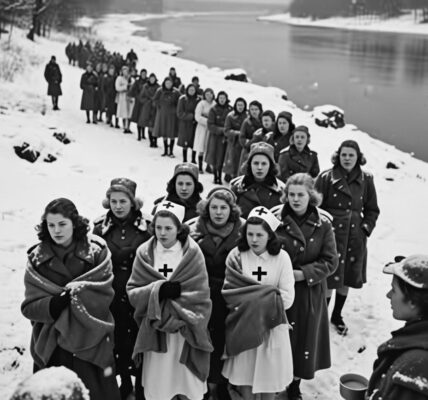
The history of medicine and public health is recorded in quieter images. During the influenza pandemic of 1918, volunteer nurses from the American Red Cross treated patients in the Oakland Municipal Auditorium, which had been converted into a temporary hospital. The pandemic spread through a world already exhausted by the First World War, overwhelming medical services and killing millions of people worldwide.
Large public buildings were repurposed to accommodate the sick, while nurses and volunteers worked under immense pressure. Many patients required care at a time when medical knowledge, available treatments, and hospital resources were limited. The photograph of the temporary hospital illustrates how public health emergencies can transform familiar spaces into places of urgent care.
A health warning about influenza from the Anti-Tuberculosis League, posted inside public transport in the 1910s, reflects the period’s growing efforts to communicate health information to the general public. Posters and notices could reach people during their daily journeys, turning buses and other vehicles into channels for public education. Such campaigns relied on simple messages to encourage people to recognize illness and adopt protective practices.
The manufacturing of influenza vaccine at Merck Sharp & Dohme in 1957 belongs to a later phase of this history, when vaccine production had become an increasingly important part of the response to infectious disease. The connection between public warnings, clinical care, and industrial production shows that public health depends on many layers of work. A vaccine does not appear simply because a scientist discovers a solution; it must be developed, manufactured, tested, distributed, and administered.
A photograph of a Finnish or Swedish newborn-care tradition shows the idea of providing families with a box containing essential items for a baby’s early life. These baby boxes began as support for families in need and developed into a widely recognized social initiative. The box could include clothing and other necessities, while also serving as a symbol of public commitment to maternal and infant welfare.
The concept demonstrates how social policy can take a tangible form. Rather than existing only as a law or a budget, public support arrives at a household’s door as something a family can use. The box represents an approach to welfare that connects government policy with the earliest stages of life, though the specific contents and arrangements have varied over time.
Other photographs reveal how ordinary objects changed alongside social expectations. A device designed to teach a child to walk, photographed in Switzerland in 1939, belongs to a long history of products intended to help parents manage the challenges of raising young children. Such devices can appear strange or even unsafe to modern viewers, whose expectations are shaped by later research and product standards. Yet they reflect the recurring desire to make child-rearing easier through practical invention.
A hair-curling device from 1938 and a photograph of a woman with wet hair combing it in the 1890s preserve different moments in the history of grooming. Hairstyles were shaped by available technology, social conventions, advertising, and changing ideals of beauty. The equipment used to create curls could be cumbersome, while later products made styling more accessible. Even the smallest grooming tool can reveal something about the daily routines and expectations of its era.
A painted knee, described as a forgotten fashion trend of the 1920s, demonstrates how fashion could turn an unexpected part of the body into a space for decoration. During the decade, shorter skirts and changing attitudes toward women’s clothing made the legs more visible in public fashion. Some women experimented with painting designs on their knees, using the body as a playful surface for self-expression. The trend may have been brief, but it illustrates the inventiveness that accompanies changing social norms.
The fashion world could also generate dramatic contrasts between public glamour and private vulnerability. In 1943, Jane Russell posed for a portrait during the filming of The Outlaw. In the 1950s, she appeared in publicity photographs and enjoyed her motorcycle at home in California. Her image was shaped by Hollywood’s publicity system, which carefully constructed and circulated the identities of film stars. The photographs reveal both the glamour of her public career and a more casual side of her life.

In 1957, Kim Novak appeared in Pal Joey, while Anita Ekberg posed in promotional material for Zarak in 1956. In the following decades, Jaclyn Smith became associated with Charlie’s Angels, and Shirley Jones appeared in the entertainment world of the 1950s. These actresses worked in a film and television industry that increasingly used photographs to build public recognition. A publicity image could introduce a performer to millions of people, but it also reduced a complicated career to a carefully chosen visual impression.
In the 1980s, the popularity of big hair turned hairstyles into unmistakable markers of the decade. A photograph of Björk early in her career, associated in the caption with sugar cubes around 1986 or later, belongs to a period when musicians were developing individual visual identities alongside their music. Such images remind us that artistic careers are often shaped by experimentation before the public settles on a familiar version of a performer.
A different kind of celebrity image shows Whitney Houston in 1980, before her later career made her one of the most recognizable voices in popular music. Photographs of young performers carry a particular quality of anticipation: viewers who know what came later can see the beginning of a story whose ending was not yet apparent to the people living it.
A 1979 photograph reportedly shows Farrah Fawcett arriving unexpectedly at a young boy’s confirmation party. If accurately described, the scene offers an unusual meeting between a major television star and an ordinary family celebration. Celebrity often appears distant and carefully controlled, but unexpected encounters can briefly collapse that distance, turning a famous person into a guest in someone’s private world.
In 1963, young Kurt Russell was photographed kicking Elvis Presley in the shin. The image has the character of a playful encounter between a child actor and one of the most famous entertainers of the era. The moment later acquired additional interest because Russell would become a major actor in his own right. Like so many early photographs of famous people, it captures an ordinary instant that only became remarkable in retrospect.
Elvis appears in several other images: holding a ham at the 1962 Seattle World’s Fair, goofing around with an unidentified girl in a photo booth in 1950, and appearing in a photograph connected with his service in Germany. The variety of scenes shows how his public image could shift between entertainer, serviceman, and playful young man. Fame magnified each part of his life, but it did not eliminate the ordinary human behavior visible in these snapshots.
The world of film continued to create unexpected backstage moments. In 1984, Harold Ramis posed with an early Terror Dog maquette for Ghostbusters, offering a glimpse of the miniature design work used to develop a creature for the screen. In 1991, Dustin Hoffman, Dante Basco, and Robin Williams appeared on the set of Hook. A behind-the-scenes photograph from Teenage Mutant Ninja Turtles II: The Secret of the Ooze reveals another side of film production, where costumes, props, rehearsals, and practical effects helped bring fictional worlds to life.
The polished image on a cinema screen is the result of countless decisions made by people whose names audiences may never learn. A monster begins as a design. A fantasy landscape is assembled from sets, models, lighting, and camera work. Actors who seem to inhabit another world are actually working on a set surrounded by technicians and equipment. Behind-the-scenes photographs preserve that hidden labor.
A photograph of Marlon Brando on the set of The Godfather in 1972 is accompanied by the claim that he often refused to memorize his lines and that cue cards were placed around the set, sometimes even on other actors. The specific details of any individual production require care, but Brando was known for unconventional acting methods and an approach to performance that differed from traditional expectations. His career helped shape modern screen acting, while his working habits became part of Hollywood lore.

The image of J. P. Morgan striking a photographer with his cane reveals a different relationship between public figures and the camera. Morgan was reportedly self-conscious about his rosacea and disliked being photographed without permission. The incident illustrates the tension between the growing power of photojournalism and the desire of wealthy or influential individuals to control their public image. Cameras could preserve a moment forever, but they could also intrude upon privacy in ways that subjects found humiliating or infuriating.
By the late nineteenth century, photography was already becoming a tool of public curiosity, documentation, and celebrity. A portrait of Mrs. Yang, wife of the Chinese ambassador to the United States, was inscribed to Miss May H. Morgan by her friend Mrs. Yang in Washington on May 28, 1895. The dedication transforms the photograph from a simple likeness into a personal object exchanged between people. It preserves a connection that official diplomatic records might not reveal: a friendship expressed through a portrait.
A photograph of a delegation of samurai in Washington, D.C., in 1860 records an important moment in Japanese-American contact. The delegation traveled to the United States following the Treaty of Amity and Commerce, part of Japan’s gradual opening to foreign relations in the mid-nineteenth century. The visitors became objects of intense public interest, and photographs helped circulate their image among American audiences. Their journey reflected the pressures and opportunities created by the growing reach of international diplomacy.
The United States was itself undergoing dramatic change. The Civil War had not yet begun when the Japanese delegation arrived, but the tensions that would lead to the conflict were already shaping the country’s political life. Photographs of foreign visitors, political leaders, and military camps reveal a nation whose outward confidence existed alongside deep internal divisions.
A photograph of the Statue of Liberty towering over Paris before it was disassembled and shipped to New York in 1886 records another international collaboration. The statue was a gift from France to the United States, conceived as a symbol of liberty and the shared political ideals associated with the two countries. Before it could rise over New York Harbor, the monument had to be assembled, taken apart for shipment, and reconstructed at its destination.
The statue’s journey transformed it from a work of sculpture into an international symbol. Its image would later become associated with immigration, welcome, and American identity, although the reality of those ideals has often been contested. The photograph in Paris captures the monument at an intermediate stage, when it was neither simply a French project nor yet the familiar landmark of New York.
In 1922, a crowd gathered outside Tutankhamun’s tomb in Egypt’s Valley of the Kings following its discovery by Howard Carter’s team. The discovery captured international attention and helped spark an enduring fascination with ancient Egyptian history. The tomb’s contents provided an extraordinary collection of objects associated with the young pharaoh, whose burial had remained largely intact compared with many other royal tombs.
The crowd outside the tomb represents the public spectacle that surrounded archaeology in the modern age. Excavation was a scientific and historical undertaking, but it also became a media event, drawing reporters, visitors, and audiences around the world. The discovery raised important questions about ownership, preservation, and the responsibilities of those who study and remove artifacts from ancient sites.
The Mahabodhi Temple in India, photographed before its restoration in 1879, belongs to another sacred landscape. The site is associated with the place where Gautama Buddha attained enlightenment. For Buddhists, the temple carries deep religious significance, while for historians it provides evidence of centuries of artistic, architectural, and devotional activity. Restoration efforts sought to preserve the site, but such work also required decisions about how much of the past to reconstruct and how much to leave visible as the product of time.
The preservation of ancient monuments differs from the preservation of living traditions, yet both require care. A stone temple can be repaired, measured, and documented, but its significance also depends on the communities that continue to visit it, worship there, and transmit its meaning to future generations.
In 1936, cotton workers walked along a roadside in Arkansas carrying everything they owned. The photograph evokes the hardships faced by agricultural laborers during the Great Depression, when poverty, falling prices, and unstable employment forced many families to move in search of work. The Great Depression devastated communities across the United States, and agricultural workers were particularly vulnerable to economic shocks, environmental disasters, and unequal labor arrangements.
The image of people traveling with their possessions reveals the fragile nature of security when a family lacks savings, stable employment, or a reliable home. Their belongings may have been few, but each item represented something worth carrying forward. The photograph reminds us that economic crises are not experienced merely as changes in statistics. They are experienced as journeys, separations, uncertainty, and the exhausting task of finding a place to begin again.
A load of lumber photographed in Michigan in 1880 reflects another side of the changing economy. Timber supported construction, shipbuilding, furniture production, and industrial expansion. Logging could generate wealth and employment, but it also transformed landscapes and put pressure on forests. As with coal mining and salmon canning, the photograph of lumber belongs to a world in which natural resources were increasingly extracted to support growing markets.
Industrial expansion also brought new kinds of danger. A photograph of a car that crashed into a tree preserves the blunt consequences of mechanical failure or human error, though the image alone cannot establish the cause. As automobiles became more common, roads were transformed and new systems of traffic regulation, driver training, and safety engineering became necessary. What had once been an unusual machine gradually became an ordinary part of life—and an ordinary source of risk.
The same contrast between innovation and danger appears in the history of aviation disasters. On April 28, 1988, Aloha Airlines Flight 243 suffered a major structural failure when a large section of its upper fuselage tore away during flight. The aircraft made an emergency landing in Maui, and most of those aboard survived, although flight attendant Clarabelle Lansing was killed. The aircraft’s captain and first officer brought the damaged plane down despite the extraordinary danger.
The accident exposed serious questions about metal fatigue, maintenance, and the safety of older aircraft operating frequent short-haul routes. The photograph or account of the damaged aircraft preserves an event that could have ended far worse. Its safe landing was the result of skilled piloting and the aircraft’s remaining capacity to fly, but the disaster also prompted renewed attention to inspection and structural integrity.
A very different aviation tragedy occurred over Lockerbie, Scotland, in December 1988, when Pan Am Flight 103 was destroyed by a terrorist bomb. The explosion killed all 259 people aboard the aircraft and eleven people on the ground. The disaster became one of the most consequential acts of aviation terrorism of the late twentieth century and led to a lengthy international investigation and legal proceedings.
The two aviation events of 1988 reveal opposite outcomes of danger in the air. One aircraft suffered catastrophic damage yet landed, while another was destroyed with devastating loss of life. In both cases, aviation safety depended on more than the aircraft itself. Maintenance, security, training, regulation, and the decisions made by individuals and institutions all mattered.
Natural disasters could be just as sudden. One of the earliest photographs of a tornado shows twin funnels near Elkhart, Indiana, on Palm Sunday. Tornadoes can form rapidly, leaving people little time to respond, and their narrow paths of destruction can tear through communities while nearby areas remain relatively untouched. The photograph preserves an extraordinary atmospheric event, but it also belongs to the development of weather documentation, when cameras began to capture phenomena that had previously been described mainly through eyewitness accounts.
The San Francisco earthquake and fire of April 18, 1906, produced an entirely different scale of urban devastation. A photograph shows the ruins of the Marie Antoinette apartments at the corner of Van Ness Avenue and Bush Street. The earthquake damaged buildings across the city, while fires spread through neighborhoods where water mains had been broken and firefighting efforts were severely hindered. Much of San Francisco was destroyed, and large numbers of residents were left homeless.
The disaster revealed the vulnerability of a modern city whose buildings, roads, and utility systems could fail together. It also demonstrated the importance of urban planning, building standards, emergency response, and public infrastructure. The ruined apartments were not merely a damaged structure. They were part of a neighborhood in which people had slept, eaten, worked, and built daily routines that disappeared in a matter of hours.
Photographs of destroyed cities often emphasize broken buildings, but the most lasting effects of a disaster are carried by survivors. People must find shelter, locate missing relatives, obtain food, and decide whether to rebuild in the same place. Recovery depends on practical labor, public support, and the resilience of communities whose lives have been interrupted.
The 1946 tsunami at Hilo, Hawaii, offered another demonstration of the sea’s destructive power. A photograph taken from the SS Brigham Victory shows a tsunami sweeping over a commercial pier. According to the accompanying caption, the man indicated by an arrow had just cut the line connecting the pier to the ship so that it could escape into open water. That detail captures a split-second decision under conditions where remaining tied to the pier might have placed the vessel at greater risk.
The tsunami was generated by a major earthquake in the Aleutian region of Alaska and caused extensive destruction in Hawaii. Waves struck coastal communities with little of the warning infrastructure available today. People were swept away, buildings were destroyed, and the disaster led to greater attention to tsunami warning systems in the Pacific.
The photograph from the ship’s deck is powerful because it places the viewer close to a decision being made in the face of a force much larger than any person. The ocean, normally the foundation of maritime commerce, had become an immediate threat. The crew’s attempt to reach open water was not an abstract maneuver but a fight to keep the vessel and its people alive.
A photograph of a bus that drove into a bar offers a more bewildering kind of accident. Without further information, the circumstances cannot be reconstructed responsibly. The scene nevertheless belongs to a long history of mishaps in which ordinary vehicles enter spaces where they were never meant to go. Such images often become memorable because of their apparent absurdity, but they also remind us that the boundary between a routine day and an emergency can be remarkably thin.
Humor and tragedy often sit close together in historical photographs. A strongman such as Zigmunt Breitbart, performing in a circus in 1925, represented a form of entertainment built around the spectacle of extraordinary physical strength. His act belonged to a tradition in which performers tested the limits of what audiences believed a human body could do. The stage transformed physical skill into a public event, while the performer assumed the risk of injury and the demands of maintaining a reputation.
Other acts relied on illusion rather than strength. A man in a suit with many arms, as described in one caption, suggests a staged photographic trick or visual effect. Before digital editing, photographers used multiple exposures, careful positioning, props, and darkroom techniques to create images that seemed impossible. The camera was not only a tool for recording reality; it was also a means of inventing visual jokes and mysteries.
The same spirit of invention appeared in photographs of futuristic clothing displayed during Engineering Week around 1965. Models presented garments imagined for the year 2000, reflecting the era’s confidence that technology would transform every aspect of life. Designers and engineers anticipated new materials, automated systems, and styles that would express the futuristic world they imagined.
The future often looks different from the way people predicted it. Some ideas become everyday realities; others remain curiosities of their time. The clothes designed for an imagined year 2000 reveal as much about the 1960s as they do about the future that their creators hoped to predict. Their vision was shaped by the technological optimism of an era fascinated by space exploration, automation, and rapid economic growth.
A photograph of Roman sandals being fashionable in the 1960s similarly shows how the past can return as style. Fashion frequently borrows from earlier centuries, turning historical designs into modern products. The sandals worn in the 1960s were not simply reproductions of ancient footwear; they were part of a contemporary fashion language that used references to classical antiquity to express modern taste.
A puppet show in Paris in 1963 captures another kind of continuity. Puppetry has served as entertainment, satire, storytelling, and education across many cultures. The small stage can create an entire world using fabric, wood, voices, and movement. For children, a puppet show offers an introduction to storytelling; for adults, it can provide humor or social commentary. The photograph records a moment of performance whose significance lies in the shared attention of the audience.
Family and friendship recur as quiet counterweights to the vastness of history. A happy boy photographed in 1993, a photograph captioned “Caring for the future” from the 1930s, and the image of young Sarah Jessica Parker and Brooke Shields in the 1970s all preserve moments that were not necessarily intended to become historical records. The subjects may have been photographed for family albums, publicity, or documentary purposes, but their images now offer glimpses into the visual culture of their eras.
A portrait of an Osage woman and her children, taken around 1918–1922, belongs to a more complicated history. Indigenous families in the United States lived through decades of federal policies that disrupted land ownership, cultural practices, and community life. The Osage Nation had also experienced enormous upheaval and wealth tied to oil leases in Oklahoma, followed by exploitation and violence during the period commonly known as the Osage Reign of Terror. The photograph itself does not establish the family’s particular circumstances, but its subjects should be understood as members of a living community with a history extending far beyond the frame.
A photograph of a Moroccan man described as having microcephaly, taken in 1931, requires similar care. Historical images of people with visible disabilities were sometimes produced for medical documentation, but they were also circulated as curiosities. The label attached to a photograph can turn an individual into an example of a condition while obscuring the rest of their life. Looking responsibly at such images means recognizing both their historical value and the risk of repeating the dehumanizing gaze through which people with disabilities were often presented.
Photographs can also reveal how prejudice was embedded in the structures of everyday life. In 1936, cotton workers walked along an Arkansas roadside carrying their possessions. Elsewhere, children labored in a forge during the Second French Empire in 1865. The two images belong to different societies and different economic systems, but both show people whose labor was shaped by limited choices and unequal power.
Child labor was common in many industrial societies before stronger regulations and broader social protections were introduced. Children worked in mines, mills, workshops, farms, and factories, sometimes performing tasks that exposed them to dangerous machinery and exhausting hours. A photograph of children in a forge captures a world in which childhood was not always protected from the demands of economic survival.
The photograph of a child being taught to walk with a device in Switzerland in 1939 may seem far removed from the forge, but both images raise questions about how societies understand childhood. One reflects the desire to support a child’s development; the other reflects the economic pressures that could force children into work. Across history, childhood has been shaped by family resources, social policy, cultural expectations, and the degree to which communities believe young people should be protected from adult burdens.
Some photographs preserve moments of personal courage that cannot be fully understood from the frame alone. In 1938, an image of a man using an unusual device may invite curiosity; in 1940, a photograph of women in the Air Transport Auxiliary shows women pilots dressed in full gear after a test flight. The British women of the Air Transport Auxiliary ferried military aircraft between factories, maintenance facilities, and operational units during the Second World War. They flew many different aircraft types, often without the same training conditions or status enjoyed by male military pilots.
Their work was essential to the movement of aircraft, but the women faced doubts about their abilities and limits on the recognition they received. They were not typically sent into combat, yet the aircraft they ferried were destined for a war in which mechanical reliability and timely delivery mattered enormously. Their contribution demonstrates that military service can take many forms beyond direct combat.
The women who entered factories during the world wars and the women who ferried aircraft were part of a broader transformation in employment. War created urgent labor shortages, but it also provided women with opportunities to demonstrate skills that had previously been denied or dismissed. Whether those opportunities led to lasting change depended on what happened after the emergency ended.
In 1939, the world was moving toward another global conflict. In 1940, London prepared for the possibility of chemical attack, while Britain also developed its air defense and transport systems. In 1941, civilians sheltered underground during the Blitz. In 1944, women worked on aircraft in California, and soldiers fought in Europe and the Pacific. The photographs from these years show different parts of the same vast mobilization: industry, medicine, transport, civil defense, and military operations all became intertwined.
When the Second World War ended, the physical and emotional consequences did not disappear. Prisoners returned home, families searched for missing relatives, factories shifted toward civilian production, and governments faced the challenge of rebuilding damaged economies. Images of soldiers, workers, and ordinary families captured the uneven transition from wartime emergency to peacetime life.
By the late twentieth century, the meaning of public space had changed again. Times Square in New York drew crowds to celebrate New Year’s Eve on December 31, 1939, as the world entered a new year already overshadowed by war in Europe. A photograph of people gathered outside St. Paul’s Cathedral in London to celebrate New Year’s Eve in 1924 records a different moment of public celebration. Crowds assembled around familiar landmarks, turning urban spaces into places where strangers could share the same event.
Such celebrations reveal a universal desire to mark time collectively. The people in the crowd might have had different occupations, incomes, beliefs, and hopes, but they were gathered around a shared transition. Their photographs preserve the fashions and streets of a particular year, while the human impulse to celebrate the arrival of another remains familiar.
A photograph of New Year’s Eve in 1939 carries an additional historical weight because the Second World War had already begun in Europe. People could gather to celebrate, but the future remained uncertain. The same street could hold both excitement and anxiety, depending on what each person knew and feared. Historical images often preserve these contradictions without explaining them.
The lives represented in this collection are too varied to fit into a single moral or political narrative. Some photographs show suffering caused by war and discrimination. Others document scientific achievement, artistic invention, and cultural change. Some are funny, some disturbing, and some simply ordinary. Their shared value lies in the fact that they preserve moments that would otherwise be lost or remembered only through words.
A photograph freezes a fraction of a second, but history moves around it. The young German anti-aircraft crew member crying after capture would have had a life beyond the moment of surrender. The miner would have left the coal face and returned to the rest of his day. The children at Halloween would eventually remove their masks. The workers at Abu Simbel would continue the painstaking work of rebuilding an ancient monument. The people on the SS Brigham Victory would remember the moment when the tsunami swept across the pier.
What makes these images so compelling is not that every one of them reveals a world-changing secret. It is that each one gives us a small opening into a world that once existed. We can see the clothes people wore, the machines they trusted, the dangers they faced, the people they admired, and the places where they gathered. We can also see how much remains unknown: the thoughts outside the frame, the conversations the camera did not record, and the events that followed.
The responsible way to look at historical photographs is to combine curiosity with caution. Captions can be incomplete or inaccurate. Dates may be uncertain. Images can be staged, retouched, or created to promote a particular political message. A photograph of a person from another culture should not be treated as a complete description of that person’s community, and an image of a dramatic event should not automatically be accepted as proof of every claim attached to it. Historical research helps distinguish what the photograph shows from what later viewers have assumed.
Yet uncertainty does not diminish the value of these images. It gives us a reason to ask better questions. Who took the photograph? Who was meant to see it? What did it communicate at the time? Whose story was preserved, and whose was left out? The answers can turn an interesting old image into a deeper understanding of the people and forces that shaped its world.
From the ancient stones of Abu Simbel to the industrial machinery of the twentieth century, from wartime camps to crowded city squares, these photographs show humanity repeatedly adapting to change. People built monuments and demolished them, invented new machines and learned to fear their consequences, challenged unjust systems, created art, raised children, and found moments of humor in difficult circumstances.
The past was never simply a collection of grand achievements and disasters. It was a world of individual lives, each one unfolding without knowledge of how future generations would interpret it. These photographs allow us to meet that world briefly—not completely, and never without the limits of the camera—but closely enough to recognize something of ourselves in it.
Which photograph from this collection would you most want to know the full story behind, and why?
Some content was generated using AI tools (including ChatGPT) and edited by the author for creativity, storytelling, and historical illustration purposes. Historical facts and key details should be verified against reliable historical sources. Any AI-generated or reconstructed visuals are intended for illustrative purposes and should not be interpreted as original historical photographs or archival evidence.