🔴▶ BANNED World War 2 Photos That History Books Left Out Forever – WWII – WW2 – 400,000 Years .P2

On May 21, 1945, only weeks after the collapse of Nazi Germany, flames rose over what remained of Bergen-Belsen. The camp had already been liberated, its prisoners found among scenes of death and disease that shocked even experienced Allied soldiers. Now the final remaining camp buildings were being destroyed as a sanitary measure. Before the fire, a rifle salute was reportedly fired in memory of those who had died there. Among the objects placed inside was a portrait of Adolf Hitler and a flag of the regime responsible for the camp. Then the fire began.
The flames consumed the structure in less than an hour.
But photographs from the Second World War leave behind something fire could not destroy: faces.
Some faces belong to people whose names became famous. Others belong to people whose names disappeared almost completely from the historical record. Soldiers, prisoners, nurses, factory workers, children, resistance members, civilians and families appear in these photographs without knowing that decades later, strangers would study their expressions and try to understand what they had lived through.
One photograph shows a young Soviet officer whose identity was impossible to separate from the man who ruled the Soviet Union.
His name was Yakov Dzhugashvili.
He was the eldest son of Joseph Stalin.
When Germany invaded the Soviet Union in June 1941, Yakov served as an artillery officer and was captured by German forces during the fighting. His capture created an extraordinary problem for Nazi Germany. The prisoner was not simply another Soviet officer. He was Stalin’s son.
German authorities attempted to exploit his identity for propaganda. Stalin, meanwhile, was faced with an impossible personal dilemma. The Soviet leadership did not generally encourage the idea that captured soldiers should be exchanged, and Stalin himself refused proposals that would have involved exchanging Yakov for senior German prisoners.
In 1943, Yakov died at Sachsenhausen concentration camp. The precise circumstances of his final moments have remained the subject of historical discussion, although surviving German records provide an account of his death.
The photograph does not show any of that.
It shows only a young man.
That is one of the strange powers of wartime photography. The camera records the person before it, but history later places an enormous weight upon the image.
Across occupied Europe, millions of people were photographed without knowing what their images would eventually mean.
Jewish families were loaded onto trains after being told, in many cases, that they were being relocated or transported for labor. They carried suitcases. Parents held children. People brought belongings because they still believed that belongings would have a future.
For many, the trains went toward ghettos, forced-labor sites, concentration camps and extermination centers.
At Auschwitz-Birkenau, deportation trains became part of an industrialized system of persecution and murder. Most of the Jews deported to the killing centers did not survive.
The photographs of those trains are difficult precisely because the people pictured often appear ordinary.
There is no visible boundary between the moment before catastrophe and the moment after it.
Then there are photographs of people who chose to resist.
Elisabeth Gloden, known as Lilo, was a Luxembourgish woman who became involved in resistance activity. During the final years of Nazi occupation, she and her family helped shelter a resistance member who was being hunted by the German authorities. Lilo, her husband Nicolas, and her mother Marguerite were arrested, tried, and executed in 1944.
Their story illustrates a different dimension of the war.
Not every act of resistance involved weapons.
Sometimes resistance meant opening a door.
Sometimes it meant hiding a person.
Sometimes it meant understanding that helping someone could cost you your own life.
In another series of photographs, captured German soldiers appear wearing American uniforms.
These men belonged to Operation Greif, a German commando operation associated with the Ardennes offensive in December 1944. Led by Otto Skorzeny, German personnel were trained to wear Allied uniforms and use captured vehicles and English-language documents in an attempt to disrupt communications and create confusion behind American lines.
The operation became controversial because combatants captured while improperly using enemy uniforms could be denied prisoner-of-war protections under the laws of war. Several German participants were subsequently executed.
The photograph taken before such executions is unsettling because nothing about the faces necessarily reveals what is coming.
The camera freezes a moment.
History supplies the ending.

Few wartime photographs demonstrate the passage of time more powerfully than the paired portraits of Evgeny Stepanovich Kobytev.
The first shows him as a young Soviet man in 1941.
The second shows him in 1945.
Kobytev was an artist who entered military service after Germany invaded the Soviet Union. Four years later, he returned from the Eastern Front with a face dramatically changed by the experience.
The photographs are frequently presented as a visual representation of what four years of war could do to a human being.
The important thing is what the photographs actually show.
A young face.
Then an older face.
Deep lines.
A changed expression.
The rest has to be understood through history rather than invented from the photograph itself.
The Eastern Front was one of the most destructive theaters of the war. Millions of soldiers and civilians died there. Cities were destroyed, prisoners were taken, populations were displaced, and enormous armies fought across thousands of miles.
Kobytev’s photographs do not show every one of those events.
They show one man who passed through them.
Thousands of miles away, the Pacific war produced a different collection of faces.
In February 1944, American Marines came back aboard a Coast Guard-manned assault transport after fighting on Eniwetok Atoll in the Marshall Islands. The official caption described them as exhausted after two days and two nights of fighting. The photograph by Ray Platnick shows several Marines drinking coffee, their faces and clothing covered with grime. (Wikimedia Commons)
It is difficult to imagine a more ordinary object than a cup of coffee.
Yet in that photograph, it becomes almost symbolic.
The men are alive.
They are no longer on the beach.
For a few minutes, they can sit.
They can drink.
The battle is behind them, although the war is not.
The photograph does not need an invented story about what each man was thinking. Their physical condition already says enough.
The Pacific campaign repeatedly placed soldiers in environments where exhaustion was as constant as danger.
Island fighting meant heat, coral, mud, limited cover and repeated assaults.

The camera sometimes captured soldiers immediately after these experiences, before they had time to recover their appearance.
In Europe, the war produced another kind of photograph: civilians confronting liberation.
When German occupation collapsed in France in 1944, accusations of collaboration spread rapidly. In towns and cities across the country, some suspected collaborators were publicly humiliated. Women accused of having relationships with German soldiers were among those who had their heads shaved.
The practice became one of the most recognizable forms of public punishment during the liberation.
But photographs of these women require caution.
Not every accusation was proven.
Not every person subjected to humiliation had received a formal judicial judgment.
The camera records the punishment.
It cannot establish the truth of every accusation made against the person being photographed.
That distinction matters.
War does not end cleanly when armies stop shooting.
Its aftermath can continue through revenge, accusation, punishment and memory.
Meanwhile, thousands of women were serving the Allied war effort in ways that looked completely different.
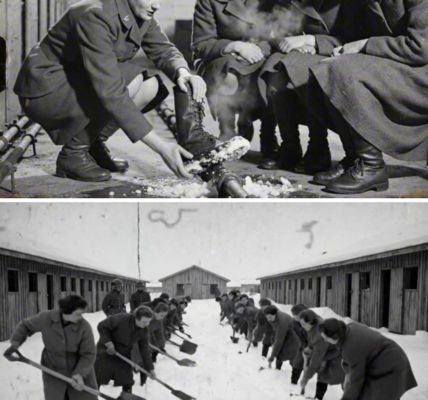
The Women’s Army Auxiliary Corps, created in the United States in 1942 and later converted into the Women’s Army Corps, recruited women for military support positions. They worked in communications, administration, transportation, clerical services and other essential roles.
They were not simply filling empty desks.
Every support position occupied by a woman could potentially allow a trained serviceman to be assigned elsewhere.
The war was an enormous logistical machine, and machines depend on people whose names rarely become famous.
Factories mattered.
Warehouses mattered.
Telephone exchanges mattered.
Transport mattered.
Ammunition production mattered.
The front could not exist without the people behind it.
Paris experienced the return of freedom in August 1944, but liberation did not instantly make the city safe.
German forces were withdrawing, yet fighting and sniper fire continued in some areas. Resistance fighters, civilians and Allied troops occupied streets that had been under German control only days earlier.

Photographs from the liberation therefore contain two emotions at once.
Celebration.
And uncertainty.
Crowds gathered around Allied soldiers. People waved flags. Women embraced troops. Children climbed onto vehicles.
But weapons were still being fired.
The occupation was ending, not yet forgotten.
Among the Allied soldiers were African Americans serving in segregated units.
The United States military remained racially segregated during the Second World War. African American soldiers served in many different formations and performed a wide range of duties, including combat roles.
The 761st Tank Battalion became one of the best-known African American armored units of the war. Constituted in 1942, it eventually fought in Europe after arriving in France in October 1944. The unit participated in campaigns across France, Belgium and Germany, including the Battle of the Bulge. (Lịch Sử Quân Đội)
These soldiers were fighting against Nazi Germany while segregation remained part of American life at home.
That contradiction would not disappear when the war ended.
Many veterans returned to a country where the rights and opportunities promised by military service were still denied or restricted according to race.
The war had exposed one dictatorship’s racial ideology to the world.
It had not automatically eliminated racial injustice elsewhere.
Another photograph shows something even more universal.
A family wearing gas masks.
The image looks almost surreal today.

An adult helps a child fit a mask over the face.
Everyone is practicing.
Nobody appears particularly surprised.
For millions of European civilians, preparing for an air raid became part of ordinary life.
Gas masks were distributed in several countries during the years before and during the war. Children were taught how to use them. Air-raid drills became routine.
The frightening part is not that the family looks terrified.
It is that the procedure has become normal.
Children could learn the movements before they were old enough to understand the reason.
Crouch.
Cover.
Wait for the signal.
Do it again.
In another photograph, members of New Zealand’s 28th Māori Battalion perform the haka.
The image is striking because the men are far from New Zealand.
The haka carried deep cultural meaning and could be performed as a ceremonial expression of identity, challenge and collective strength. Māori soldiers brought that tradition with them into military service during the Second World War.
For these men, culture did not disappear when they entered uniform.
It traveled with them.
Some of the men photographed during training would not return home.
By April 1945, the war in Europe had entered its final days.
Adolf Hitler was photographed in the ruins of the Reich Chancellery shortly before his death.
The building around him had become a physical representation of the collapse of the regime he had ruled for twelve years.
The streets of Berlin were under attack.
Soviet forces were closing in.
German military resistance was collapsing.
Hitler would die in the Führerbunker on April 30.
The photograph therefore captures something unusual.
A dictator standing inside the ruins of the system he had created.
But photographs rarely tell viewers what the person inside the frame knows.
That must come from documents and chronology.
The image itself simply records a man surrounded by destruction.
Months earlier, Allied forces had launched one of the most ambitious airborne operations of the war.
Operation Market Garden began in September 1944.
Aircraft filled the sky over the Netherlands.
Paratroopers descended toward occupied territory while gliders carried troops, vehicles and equipment.
The plan depended upon seizing a chain of bridges and opening a route into Germany.
The operation achieved important local successes but failed to secure the final objective at Arnhem.
The men jumping from those aircraft did not know the outcome as they descended.
For them, history was still undecided.
That is another recurring theme in wartime photographs.
The people inside them almost never know which moments will become turning points.
Soviet soldiers experienced another form of preparation.

Training photographs show men lying in trenches while T-34 tanks pass over their positions.
The exercise was designed to teach soldiers how to maintain their position when armored vehicles approached.
To a modern observer, the scene can look almost impossible.
But the Eastern Front demanded precisely this kind of discipline.
Tanks could overwhelm exposed infantry.
A soldier who panicked and left cover could become vulnerable to machine-gun fire.
Training attempted to replace instinct with practiced behavior.
The purpose was not to make fear disappear.
It was to teach soldiers what to do while afraid.
In April 1940, German forces moved against Norway.
Narvik became strategically important because of its connection to the transport of Swedish iron ore, which was important to Germany’s wartime economy.
German forces seized key Norwegian ports, including Narvik, while Allied forces attempted to intervene.
The campaign demonstrated how quickly the European war was expanding.
A conflict that had begun with the invasion of Poland in 1939 was no longer confined to Central Europe.
By May 1940, German forces had invaded Belgium, the Netherlands, Luxembourg and France.
At railway stations, families watched soldiers depart.
Photographs of those departures are deceptively quiet.
No explosions.
No burning buildings.
Just people standing beside trains.
A mother.
A wife.
A child.
A uniformed man leaving.
Nobody in the frame can know exactly what the next few weeks will bring.
Within weeks, the German advance would force the British Expeditionary Force and other Allied troops into the evacuation from Dunkirk.
Britain itself would then face the Blitz.
From 1940 into 1941, German bombing raids repeatedly struck London and other British cities. Civilian deaths during the Blitz were enormous, and firefighters worked through destroyed streets to extinguish fires and rescue people trapped in damaged buildings.
They were not soldiers.

They carried hoses instead of rifles.
Ladders instead of artillery.
Yet night after night, they entered places where buildings had been struck only minutes earlier.
The photograph of a firefighter walking through ruins does not show heroism as a speech.
It shows a person doing a job.
That was how much of the war was actually experienced.
Not as one continuous dramatic event, but as thousands of necessary tasks repeated under extraordinary conditions.
Children practiced air-raid procedures.
Women produced ammunition.
Men repaired tanks.
Railway workers moved supplies.
Farmers tried to keep fields productive.
Factory workers entered underground production areas.
The enormous machinery of war depended upon ordinary routines continuing despite extraordinary circumstances.
Deep beneath a factory in England, women worked producing munitions.
Their work was dangerous and exhausting.
The shells and ammunition they handled would eventually be transported to armies fighting across Europe.
The names of most of those workers disappeared from public memory.
But the war depended on them.
The same was true for farmers.
One remarkable photograph from France shows British soldiers helping a farmer plow a field using a tank.
The image captures an unusual intersection of agriculture and mechanized warfare.
A machine designed to cross battlefields had temporarily become a farm implement.
The photograph was taken only weeks before Germany’s offensive in the West transformed the strategic situation.
History sometimes looks inevitable when viewed backward.
It never feels inevitable to the people living inside it.
On May 10, 1940, German forces entered Luxembourg as part of the wider offensive against Western Europe.
The country’s small military force could not prevent the occupation.
At the same time, German reconnaissance units and armored formations were beginning the campaign that would rapidly break through Allied defenses.
French soldiers attempted to move artillery through forests as the front collapsed.
The Maginot Line had not been defeated by a direct assault on its strongest positions.

The German offensive moved through the Low Countries and the Ardennes, bypassing the main fortified belt.
The Allied armies were caught in a strategic disaster.
Within weeks, France would seek an armistice.
But the soldiers in those photographs did not know the final chapter.
They were still carrying ammunition.
Still moving guns.
Still digging positions.
Still waiting for orders.
That is why photographs can sometimes communicate the uncertainty of war better than hindsight can.
We know what happened.
They did not.
At Parris Island, Marine recruits trained to make shooting and movement increasingly automatic.
The purpose of military training is not simply to teach a person how to operate a weapon.
It is to create practiced responses that can function under exhaustion, noise and pressure.
For recruits, repetition replaces hesitation.
The individual becomes part of a larger unit.
The process is designed long before the battlefield is ever reached.
Then came December 1941.
Four days after Japan attacked Pearl Harbor, Adolf Hitler declared war on the United States.
Germany was already fighting Britain and the Soviet Union.
The United States had now entered the European war directly.
Hitler’s decision remains a subject of historical analysis because it widened the conflict against a nation with enormous industrial capacity.
Whatever strategic calculations stood behind the decision, its consequences were profound.
American factories would produce aircraft, tanks, ships, ammunition and vehicles on a scale that would eventually transform the balance of the war.
The photographs of the following years show that transformation.
Industrial workers.
Convoys.
Landing craft.
Armored columns.
Aircraft.
And eventually, exhausted soldiers moving through the ruins of Germany.
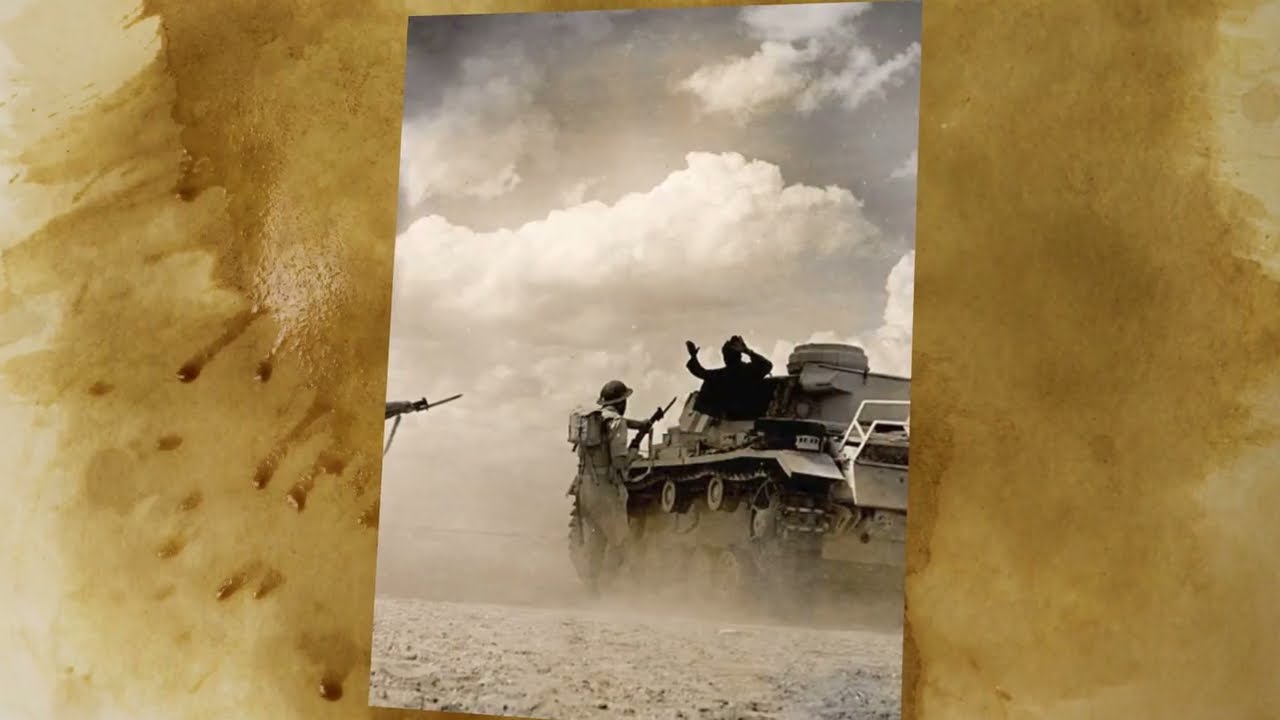
In North Africa, the Battle of El Alamein became one of the major Allied victories of 1942.
British forces under Bernard Montgomery defeated German and Italian forces commanded by Erwin Rommel’s Axis army.
The victory did not end the war in North Africa immediately, but it marked an important change in the campaign.
A photograph of British soldiers standing beside a captured German tank therefore carries more meaning than the casual expressions of the men might suggest.
The tank represents a battlefield reversal.
The vehicle that once represented danger has become evidence of defeat.

Elsewhere, military dogs served alongside human forces.
They carried messages.
Patrolled.
Detected intruders.
Searched areas that were dangerous or difficult for people to enter.
Their work is often absent from conventional narratives of military history because animals do not appear in official command structures the way human soldiers do.
Yet they were part of the machinery of war.
In China, the war had already produced some of the most brutal urban fighting years before Europe entered its largest battles.
Japanese forces fought in Shanghai in 1937.
Photographs show troops moving through devastated streets wearing protective masks.
The destruction was a warning of what modern warfare could do to densely populated cities.
Shanghai was not merely a battlefield between armies.
Civilians lived in the middle of the fighting.
Buildings became positions.
Roads became avenues of attack.
Infrastructure became a military objective.
The war was increasingly becoming a conflict in which the distinction between front and rear was difficult to maintain.
By 1944 and 1945, the same reality was visible across Europe.
American soldiers moved through towns behind Sherman tanks.
Smoke rose from recently fought-over streets.
A soldier could stop for a cigarette, but the war remained only a short distance away.
Photographs like these can look peaceful if viewed without context.
Two men.
A tank.
A cigarette.
A quiet street.
But the quiet was temporary.
The war ended in Europe in May 1945.
It ended in the Pacific months later.
On September 2, 1945, representatives of Japan formally signed the surrender documents aboard USS Missouri in Tokyo Bay.
The ceremony was brief.
The consequences were enormous.
For six years, the world had experienced a conflict that had killed tens of millions of people.
Now the final signatures were placed on paper.
The fighting stopped.
But the photographs remained.
Among them are images of famous people standing beside ordinary soldiers.

Marlene Dietrich was one of the most famous performers of her generation. During the war she supported Allied troops and performed for servicemen through the USO and other wartime programs.
Photographs show her among soldiers far removed from the glamorous world associated with her films.
The contrast is striking.
Hollywood glamour and battlefield exhaustion occupy the same frame.
But perhaps that is exactly what wartime life was.
People continued to sing.
People continued to laugh.
People continued to perform.
People continued to fall in love.
People continued to work.
People continued to live.
Even while millions were dying.
The war also produced an enormous propaganda industry.
Posters portrayed enemy leaders as monsters, criminals or caricatures.
A Japanese wartime poster depicting Franklin D. Roosevelt used imagery intended to associate him with Dracula, turning an opposing political leader into a figure of horror.
The purpose was not historical accuracy.
It was psychological.
Propaganda reduced complicated human beings into symbols.
The enemy became a monster.
The nation became a victim.
Victory became a moral necessity.
The same principle appeared across the conflict.
Words became weapons.
Images became weapons.
Radio became a weapon.
Fear became a weapon.
And finally, there is the photograph—or supposed photograph—that never belonged to the war at all.
For decades, an alleged Nazi “sleep experiment” has circulated online and in popular storytelling.
The story claims that prisoners were subjected to extreme sleep deprivation experiments during the Second World War.
The tale is often accompanied by disturbing images or presented as a suppressed Nazi scientific program.
But the story is an urban legend rather than a documented historical experiment.
There is no reliable historical record establishing the famous version of the story.
Its persistence tells us something important.
The Second World War contained real crimes so vast that fictional atrocities can sometimes appear believable.
The Holocaust was real.
Concentration camps were real.
Medical experiments were really conducted on prisoners.
Mass executions were real.
Forced labor was real.
Starvation was real.
The destruction of entire communities was real.

Because the actual history is already horrifying, there is no need to invent additional horrors.
That distinction matters.
A historical photograph deserves more than an emotional reaction.
It deserves a question.
Who took it?
When?
Where?
Why?
Who identified the people?
What documents survive?
What happened before the shutter closed?
And what happened afterward?
The faces in these photographs cannot answer those questions.
But they can remind us why the questions matter.
The young soldier who left home in 1941 could not know what four years would do to his face.
The Marine drinking coffee after Eniwetok could not know that someone would eventually study the photograph decades later.
The child learning to wear a gas mask could not know whether the next air-raid siren would sound that night.
The women working in munitions factories could not know whether the shells they produced would help bring someone home—or be fired into a place where another family was waiting.
The soldiers jumping from aircraft over the Netherlands could not know that the operation would ultimately fail to achieve its final objective.
The civilians celebrating liberation in Paris could not know that the war would continue elsewhere for months.
And the soldiers standing aboard the USS Missouri on September 2, 1945 could finally know one thing that so many people in these photographs could not.
The war was over.
For those who survived, the next chapter would be difficult in a different way.
They would return home.
Rebuild cities.
Bury friends.
Raise children.
Remember.
Forget.
Argue about what had happened.
And live with photographs that could never capture everything.
That may be the most important lesson hidden inside these images.
A photograph does not contain the whole truth.
It contains a moment.
History begins when we refuse to mistake that moment for the whole story.
The Second World War is often remembered through maps, generals, battles and dates.
But behind every arrow on a map was a person.
Behind every number was a face.
Behind every victory was someone who had survived long enough to see it.
And behind every photograph was a life continuing just beyond the frame.
That is why these images still matter.
Not because they show a world that was completely understood.
But because they show a world that was lived.
Some content was generated using AI tools (including ChatGPT) and edited by the author for creativity, storytelling, and historical illustration purposes. Historical facts and key details should be verified against reliable historical sources. Any AI-generated or reconstructed visuals are intended for illustrative purposes and should not be interpreted as original historical photographs or archival evidence.