Authentic Historical Photos Showing Remarkable People and Strange Moments From the Past_tinp

Authentic Historical Photos Showing Remarkable People and Strange Moments From the Past
Every vintage photograph captures a moment that seemed perfectly normal to the people living through it, yet looks extraordinary through modern eyes. A worker testing an unusual breathing apparatus, a child standing inside an old-fashioned medical support frame, or a group of curious spectators watching a massive machine perform something nobody had ever witnessed before.
Some images reveal forgotten inventions that once promised to transform everyday life. Others preserve strange objects, mysterious contraptions, and historical practices whose true purposes have become blurred with time. There are also photographs of unusual medical treatments, extraordinary individuals, and everyday scenes that are difficult to imagine today.
Together, these authentic images offer a fascinating glimpse into a world that has disappeared, revealing how people lived, experimented, struggled, and adapted to a very different time. What once seemed ordinary has become an unforgettable piece of history.
Behind each image is a story that is usually stranger, and more human, than the picture alone suggests.
 Tutankhamun, Egypt’s famous boy king, shown through his mummified remains and a modern reconstruction of how he may have looked. He died around 1324 BC at about eighteen or nineteen. CT scans and DNA tests point to a bone condition and malaria rather than murder, which had long been the popular theory. His tomb, found almost untouched in 1922, is still the most famous discovery in archaeology.
 .
A woman with bound feet, photographed in China in the early 1900s. For about a thousand years, girls as young as five or six had their toes folded under and their arches broken, then bound tight, to create a ‘lotus foot’ about three inches long. Tiny feet were seen as beautiful and as a ticket to a good marriage. It was officially banned in 1912, but the custom lingered in villages for decades.
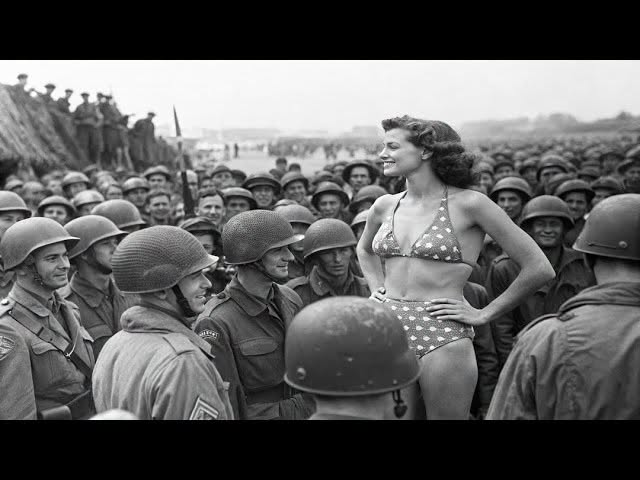
 A crowd of sunbathers on a 1940s beach. Swimwear was about to change: the first bikini was introduced in Paris in July 1946, and it was considered so scandalous that no professional model would wear it. Designer Louis Réard had to hire a nightclub dancer to show it off. Until then, women’s swimsuits covered much more, as in this photo.
 The brazen bull: a hollow bronze bull said to have been built for Phalaris, a cruel tyrant of Akragas in Sicily around 550 BC. Ancient writers tell how its maker, Perillus, was supposedly the first to be shut inside it. No original has ever been found, so no one knows how much of the story is true. This museum model shows the idea that kept the legend alive for 2,500 years.
HE DUG A GRAVE FOR HIS DYING DAUGHTER. YEARS LATER, IT BECAME A GARDEN.
In 2017, Chinese farmer Zhang Liyong learned that his 2-year-old daughter, Xinlei, had severe beta thalassemia, a blood diA ducking stool: a chair on a long beam that could be swung out over a pond or river and dunked. For centuries English towns used one to punish ‘scolds’, usually women accused of nagging, gossiping or brewing bad ale. It was meant to humiliate, though some victims did not survive. The last recorded official ducking in England is usually dated to 1809.

A cutaneous horn: a cone of compacted keratin, the same protein as your fingernails, growing straight out of the skin. Doctors have recorded horns on scalps, faces and hands for centuries, and most look far worse than they are. They are usually removed and tested, because in a noticeable share of cases the skin at the base turns out to be damaged or cancerous.
 HENRY VIII’S LAST VICTIM: The CHILLING, Heartbreaking Saga of Anne Askew – The FEARLESS Woman Who Defied Tudor England’s Most SAVAGE Punishment
 A trepanning set laid out the way it might have looked in the 1800s: drills, instruments and a head clamp, next to cupping glasses, medicine bottles and a mortar. A surgeon’s work was fast and manual, and speed mattered because patients were awake. The skull in the middle shows what the tools were made for. One look at this table is a good reason to appreciate modern anesthesia.
 A rusted helmet with an unexploded shell stuck in it, turned up in a ploughed field. Battlefields keep giving up their leftovers. In northern France and Belgium, farmers still dig up shells from World War I every year, a harvest locals call the ‘iron harvest’. Bomb-disposal teams remove tons of it annually, and some shells still contain explosives or gas.
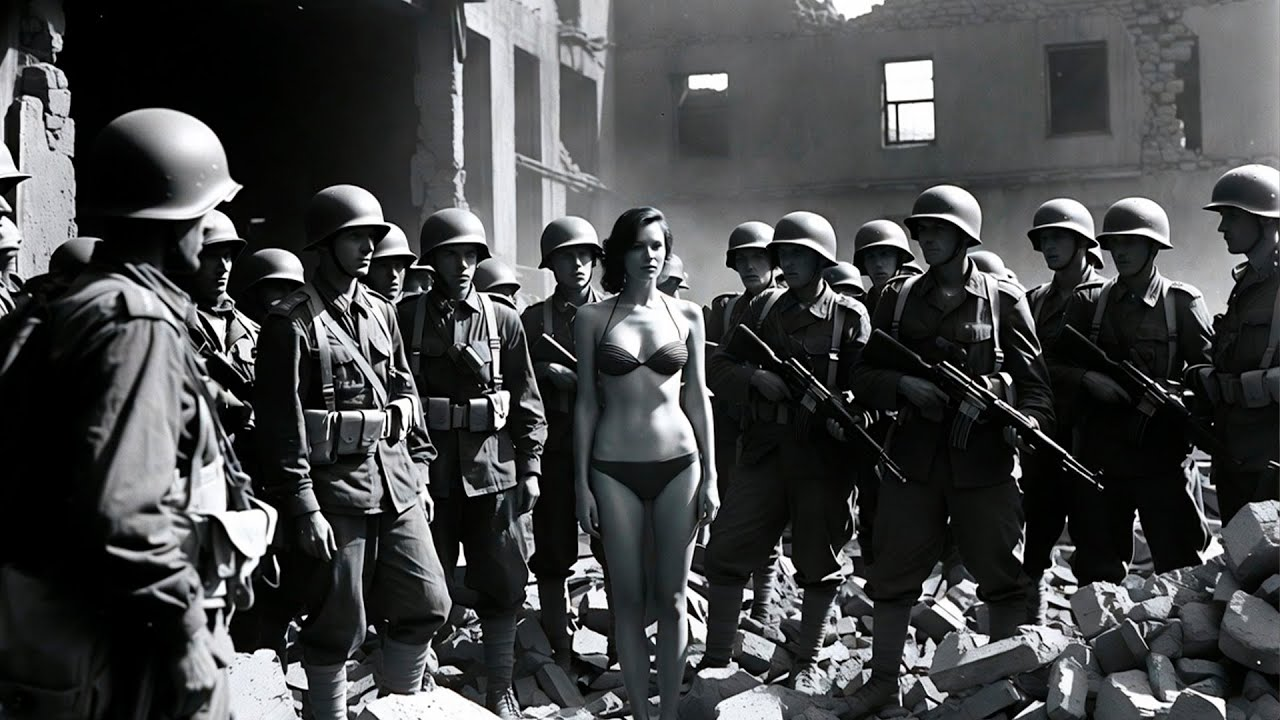
 A general shaking hands with an alien, and a UFO beaming over a city at night. Both are digital fantasies made to look like old photographs, not archive pictures. Their popularity shows how easy it has become to create convincing ‘vintage’ images. When a photo seems too strange to be true, it pays to ask where it came from.
 A rare vintage photograph
 An armored car on a street lined with cinema signs, in what appears to be Germany. Armored cars were used by police and troops during the unrest that followed World War I, when cities such as Berlin saw street fighting between 1918 and 1923. This one has the rounded, riveted look of the first generation: heavy, slow, and built to scare a crowd.
 A gunner curled inside a ball turret, a glass-and-steel sphere hung beneath bombers like the B-17 and B-24. The turret was so cramped that gunners were usually the smallest men in the crew, sitting with their knees at their chins for hours at a time. The poet Randall Jarrell served in World War II and wrote a famous short poem about the job, ‘The Death of the Ball Turret Gunner’.
 British soldiers watch over a long bed of soil with boots and gloved arms poking out of it. The original caption has been lost, and the exact purpose is unclear from the photo alone: it could be a drill, a test or a staged scene. Old photographs often outlive the stories behind them, which is why some of them keep us guessing for generations.

 A rigid ‘armored’ diving suit. A soft canvas suit is squeezed by water pressure, so designers built metal suits with sealed ball joints that keep the diver at normal air pressure, whatever the depth. They were heavy, awkward and often leaked at the joints. Yet the idea survives today in modern atmospheric diving suits used for deep work.
 A man ‘wrestling’ crocodiles and alligators in a cage on wheels, a traveling-show stunt from the early 1900s. Circuses and fairs sold tickets to watch performers take on reptiles. The danger was real: a saltwater crocodile’s bite is the strongest ever measured in any animal. Most of the audience never knew how much of the act was staged and how much was nerve.
 A man’s head held still in a metal frame, a tube in his mouth, his face coated and his eyes shielded. The photo is described as a 1930s freckle-removal treatment using a chemical peel. The frame kept the patient perfectly still while the chemicals worked. It looks like a torture rig, but the 1930s idea of a beauty treatment often did.
 A telephone exchange with row after row of operators. Before dial phones, every call went through a person who plugged a cable into a socket to connect two lines. Telephone companies hired young women because customers found them calmer and more polite than the boys who had worked the first switchboards. Human operators lasted well into the 1960s in many places.
Some content was generated using AI tools (including ChatGPT) and edited by the author for creativity, storytelling, and historical illustration purposes. Historical facts and key details should be verified against reliable historical sources. Any AI-generated or reconstructed visuals are intended for illustrative purposes and should not be interpreted as original historical photographs or archival evidence.