
Some photographs become famous because they show a great event.
Others become unforgettable because, when we look at them later, we realize that the people inside the frame did not yet know what was about to happen.
On the evening of May 17, 1980, U.S. Geological Survey volcanologist David A. Johnston was photographed at the Coldwater II observation station near Mount St. Helens. He was studying a volcano that had already shown alarming signs of activity. The following morning, the mountain’s unstable north flank collapsed after a magnitude 5.1 earthquake, triggering the catastrophic eruption. Johnston and 56 other people died. (USGS)
The photograph itself is remarkably ordinary.
There is no dramatic eruption in the background. No wall of ash. No indication that the man in the picture has only hours left.
That is precisely what makes photographs like this so powerful.
History is rarely experienced by ordinary people as “history.” It is experienced as another morning at work, another train ride, another shift at a factory, another child walking through a city, another family sitting together, another decision made without knowing how important it will eventually become.
A camera can preserve that moment long after everyone understands what came next.
And sometimes, the most extraordinary historical photographs are not pictures of famous battles or presidents. They are pictures of people who were simply living their lives at the edge of a changing world.
In April 1917, photographer Lewis Wickes Hine documented an eleven-year-old bakery worker named Glenn Dungey in Oklahoma City. The Library of Congress identifies him specifically as a child laborer and records the photograph as part of Hine’s National Child Labor Committee collection.
The photograph belongs to a larger record of American childhood that is easy to forget today.

For many families in the early twentieth century, childhood and work could overlap in ways that now seem extraordinary. Boys and girls worked in factories, bakeries, fields, stores and other workplaces. Hine’s photographs were not merely snapshots. They formed part of a deliberate effort to document working children and bring public attention to their conditions.
The camera therefore became more than a device for remembering.
It became evidence.
The same is true of photographs from the streets of America’s growing cities.
A picture of two small girls sitting on steps in a poor New York neighborhood, holding a large loaf of bread and a pretzel, says almost nothing in words. Yet the details matter. Their clothing, the buildings, the food in their hands and the expression of the street around them all become fragments of an urban world that has largely disappeared.
A century later, those details can be more revealing than a textbook description of poverty.
The same principle applies to photographs of workers.
In 1917, while the First World War was placing enormous demands on industrial production, factories in Britain worked to produce the weapons and equipment required by the conflict. Elsewhere, Indian soldiers serving with the Allied forces received supplies in France.
The photographs do not show only armies.
They show the enormous machinery behind armies.
Wars depend on factories, railways, warehouses, cooks, mechanics, drivers, postal workers and workers whose names were never recorded in history books.
That becomes particularly clear when looking at photographs of industrial workers during the Second World War. A welder captured at work in 1945 may appear to be simply another person performing a difficult job. But behind that image was an enormous industrial effort involving ships, aircraft, vehicles, ammunition and countless pieces of equipment.
The war was fought on battlefields.
It was also fought in workshops.
And sometimes the camera captured something even more difficult to comprehend: a final moment before catastrophe.
The photograph of David Johnston is one example.
Another comes from Chernobyl.
On April 26, 1986, Reactor No. 4 at the Chernobyl Nuclear Power Plant suffered a catastrophic accident. Images taken during the early hours and afterward became some of the most important visual records of the disaster.

The photographs show an industrial facility that, only hours earlier, had been part of an ordinary working environment.
After the accident, the meaning of every structure changed.
A building became the site of one of the most consequential nuclear accidents in history. A control room became evidence. A plume rising into the night became a warning that would eventually be recognized around the world.
Photographs have this unusual quality.
They can make an ordinary object historically significant simply because we know what happened afterward.
That same feeling appears in photographs from war.
A soldier standing beside a vehicle before a battle may look like any other serviceman. A group of civilians walking down a street may seem completely unremarkable. A child looking toward a camera may appear to have nothing to do with the political events surrounding them.
But history can change the meaning of the frame.
Consider photographs from the First World War.
Indian soldiers serving in France were thousands of miles from home, fighting within an imperial military system that brought people from South Asia into a European war. Their presence challenges the simplified image of the First World War as a conflict fought only by Europeans.
The war was global in ways that photographs sometimes reveal more clearly than words.
Railways carried soldiers and supplies.
Factories produced weapons.

Hospitals treated the wounded.
Workers filled jobs left vacant by men who had gone to war.
And civilians adapted their lives to a conflict that seemed impossibly distant when it began.
Photography recorded all of it.
Sometimes the subject was not war at all, but technology.
In 1917, postal workers in Washington, D.C., were photographed with Autopeds, early motorized scooters designed to assist urban transportation. The machines look strange by modern standards, but they represent something familiar: the constant attempt to make everyday work faster and easier.
The same instinct produced the automobile assembly line.
During the 1920s, Ford’s manufacturing system became a defining symbol of industrial mass production. Instead of constructing each automobile largely as an individual project, workers performed specialized tasks as vehicles moved through an organized production process.
The result transformed manufacturing and helped make automobiles accessible to a much larger public.
Photographs of such workplaces can therefore show something larger than machinery.
They show the beginning of a new relationship between people, factories and time.
The twentieth century was increasingly organized around speed.
Cars became faster.
Aircraft became faster.
Factories became faster.
Cities became taller.
Communication became faster.
And the world became more connected.
In New York, the Empire State Building soon dominated the skyline after its completion in 1931. From New Jersey, photographs showed the skyscraper rising above the city like a symbol of a new technological age.
Only a few decades earlier, skyscrapers of that scale would have seemed almost unimaginable.
Elsewhere, engineers were experimenting with airships, aircraft and other forms of transportation.
The early twentieth century was a period when people repeatedly tried to overcome physical limitations.
Distance was becoming shorter.
Height was becoming less intimidating.
And the sky itself was becoming a place humans expected to enter.
Then came Yuri Gagarin.
In 1961, Gagarin became the first human to travel into space. His achievement was not experienced only inside the Soviet Union. It became a global event.
One photograph from Paris shows a young girl reading about Gagarin’s flight.
She was not an astronaut.
She was not a scientist.
She was simply a child looking at a newspaper.
Yet the image captures something important about the Space Age: the achievement of one person could suddenly become part of the imagination of millions.
A child in Paris could read about a Soviet pilot who had just crossed the boundary between Earth and space.
History had become global.
And photography helped make it feel immediate.
The same technology that documented scientific progress also recorded cultural change.
Hollywood photographs from the middle of the twentieth century show another side of the era.
Rita Hayworth became one of the major stars of the 1940s. Photographs from the production of Gilda preserve not only her appearance but the machinery of filmmaking around her.
Behind the finished movie were cameras, lights, costumes, technicians, directors and performers.
A film still may look glamorous.
A behind-the-scenes photograph tells a different story.
It reminds us that the cultural images that seemed effortless to audiences were produced by hundreds of deliberate decisions.
Decades later, photographs from film sets would continue to preserve those hidden moments.
Actors waiting between takes.
Directors watching a scene.
Crew members preparing equipment.
Famous performers laughing or talking when the camera was not supposed to be filming.
Those photographs are valuable because they remove, for a moment, the distance between celebrity and ordinary human behavior.
The same is true of political and social history.
In 1955, Ella Fitzgerald performed before an integrated audience in Houston at the Mocambo club, an event that later became part of her history in the civil-rights era. The broader context is important: racial segregation remained deeply entrenched in the United States, and Black performers faced barriers that white entertainers did not.
Photographs and records from this period therefore preserve more than performances.
They preserve the gradual collision between established racial practices and a growing demand for equal treatment.
Elsewhere, children were growing up inside very different political realities.
In 1975, after the fall of South Vietnam, Operation Babylift transported thousands of Vietnamese children out of the country, including children who were subsequently adopted in the United States and other countries.
The operation remains part of a complicated history involving war, evacuation, adoption, family separation and humanitarian concern.
A photograph of one of those children cannot explain all of those questions.
But it can make the history personal.
Instead of seeing a conflict only through maps and military movements, we see a child being carried into an uncertain future.
That is one of photography’s greatest strengths.
It turns enormous events into human scale.
A war can involve millions of people.
A photograph may show only one.
Yet that one person can make the larger event easier to understand.
This is also why photographs of children working in the early twentieth century remain powerful.
The Library of Congress record of Glenn Dungey does not need exaggerated narration. The simple fact that an eleven-year-old boy was documented as a bakery worker in Oklahoma City in 1917 is already historically significant. (Thư viện Quốc hội)
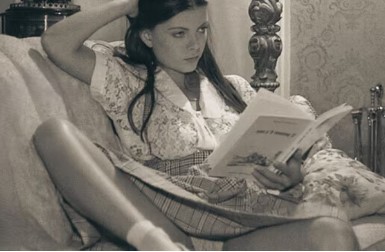
Another photograph might show a child reading a book in England in 1940.
The image is quiet.
There is no battle.
No political speech.
No famous figure.
But that quietness is precisely the point.
While governments fought wars and leaders made decisions, children still read.
People still ate.
Workers still went to work.
Families still tried to maintain ordinary routines.
History did not stop everyday life.
It entered everyday life.
Sometimes it did so gently.
Sometimes it did so violently.
And sometimes nobody could know which direction events were about to take.
The most haunting example remains the photograph of David Johnston.
On May 17, he was monitoring Mount St. Helens from Coldwater II. The next morning, the volcano collapsed and erupted. USGS records show that Johnston radioed observations at 7 a.m. on May 18, and the catastrophic collapse followed about an hour and a half later. (USGS Publications)
The photograph therefore sits on an invisible boundary.
On one side is an ordinary scientific observation.
On the other is disaster.
The camera could capture the first side.
It could not capture the future.
That limitation is what makes historical photography so fascinating.
A photograph never knows what happens next.
The person behind the camera does not always know either.
That is why photographs can sometimes reveal something written history struggles to reproduce: uncertainty.
When we look at a photograph taken shortly before an important event, we know the future.

The people inside the image did not.
We know which building would be destroyed.
Which government would fall.
Which war would begin.
Which person would become famous.
Which child would grow old.
Which city would change beyond recognition.
They knew none of it.
They were simply there.
The early twentieth century is filled with such moments.
A bicycle rider moving down the steps of the U.S. Capitol.
A passenger relaxing in a railway sleeper.
A worker standing beside a factory.
A family posing for a portrait.
A bride wearing traditional clothing in Sweden.
A woman spinning wool in County Galway.
Children gathering in a street.
People enjoying a day at the beach in New Jersey.
These photographs are easy to overlook because nothing appears to be happening.
But something is happening.
Time is passing.
And the world being photographed is disappearing.
The old railway carriage will eventually vanish.
The clothes will change.
The street will be rebuilt.
The factory will close.
The technology will become obsolete.
The children will grow old.
The city will acquire new buildings.
The photograph becomes the only surviving frame of a world that once seemed permanent.
That may be the deepest reason people are drawn to historical photographs.
We are not simply looking at the past.
We are looking at people who did not know they were living in the past.
They thought their clothes were normal.
Their cars were modern.
Their buildings were permanent.
Their jobs were ordinary.
Their technology was advanced.
Just as we think the same things today.
One day, someone may look at photographs of our streets and wonder how people lived without the technology that now seems indispensable.
They may look at our vehicles, offices, homes and clothing with the same curiosity that we feel when looking at a photograph from 1905.
And they may discover something we often forget.
Every present moment eventually becomes historical evidence.
The photograph of David Johnston became a record of the final hours before a volcanic catastrophe.

The photograph of Glenn Dungey became part of the historical record of child labor.
Photographs of wartime factories became records of industrial mobilization.
Images of Gagarin’s achievement became records of the beginning of the human space age.
Photographs of performers and filmmakers became records of a changing culture.
Images of ordinary families became records of everyday life.
None of these photographs can tell the entire story.
But together, they can reveal something that statistics and timelines often cannot.
They show what history looked like before we knew what it meant.
And perhaps that is why the most remarkable historical photograph is not always the one showing the biggest event.
Sometimes it is the photograph taken one day earlier.
One hour earlier.
One ordinary afternoon earlier.
A scientist sitting near a volcano.
A child standing outside a bakery.
A worker beginning another shift.
A passenger settling into a train.
A young girl reading a newspaper.
A family posing for a camera.
None of them could see the historical significance of the moment.
The camera could.
Decades later, we can too.
The question is not only what happened after the photograph was taken.
It is also this:
How many ordinary moments are we living through today that future generations will recognize as the last photographs of a world that no longer exists?
Some content was generated using AI tools (including ChatGPT) and edited by the author for creativity, storytelling, and historical illustration purposes. Historical facts and key details should be verified against reliable historical sources. Any AI-generated or reconstructed visuals are intended for illustrative purposes and should not be interpreted as original historical photographs or archival evidence.