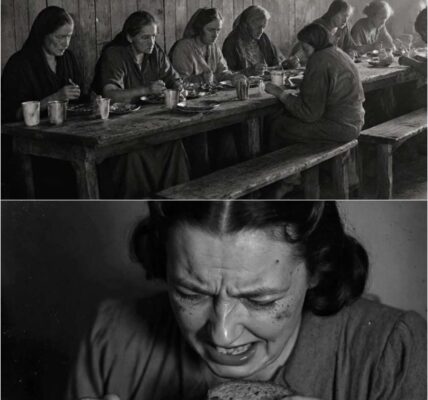
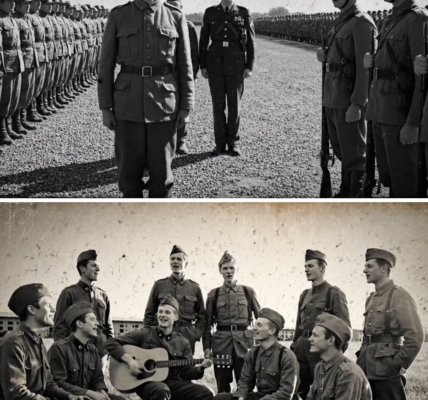
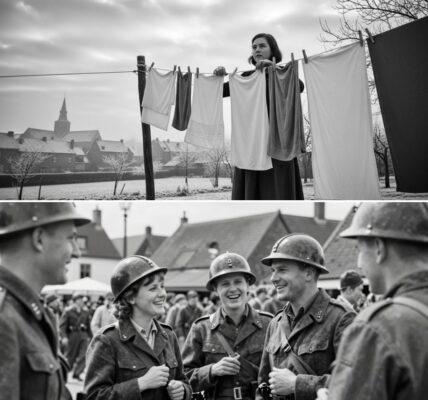
In the spring of 1945, Allied soldiers moved through the ruins of Europe while the last structures of Nazi Germany’s concentration-camp system were being destroyed. In the same months, soldiers landed in Normandy, cities lay shattered, prisoners were liberated, and families waited for men who might finally return. Yet behind these familiar images was another story—one of fear, sacrifice, survival, and choices that could not simply disappear when the guns fell silent. What did these photographs preserve that the official ending of the war could never erase?
One of the most disturbing claims in the source material concerns a supposed “German sleep experiment” in 1942, allegedly involving prisoners deprived of sleep for days. This story should be treated cautiously. There is no reliable historical evidence establishing the specific experiment as described. Versions of the infamous “sleep experiment” story circulating online have repeatedly been identified as fictional or creepypasta, while documented Nazi crimes against prisoners included many forms of torture and medical experimentation. The distinction matters because real history is already horrifying enough; it does not need invented experiments to make it darker.
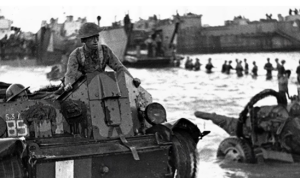
The verified photographs of the war tell a different story.
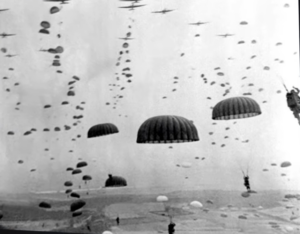
On June 6, 1944, more than 150,000 Allied troops crossed the English Channel and landed along the Normandy coast. The operation, known as D-Day, was not a simple arrival on French beaches. German defenses included bunkers, artillery, mines, barbed wire and machine guns. By the end of the day, roughly 155,000 Allied troops were ashore, but the invasion had already cost thousands of Allied casualties.
Photographs of those landings have become some of the defining images of the twentieth century.
But a photograph can make a complicated operation appear deceptively simple.
Men leave landing craft.
Boats approach the shore.
Aircraft cross the sky.
The image freezes.
The uncertainty remains outside the frame.
For the soldiers moving toward Normandy, victory was not yet guaranteed. General Dwight Eisenhower had even prepared a message accepting responsibility if the invasion failed. That detail is easy to overlook because history remembers what happened next. But at the time, the outcome remained uncertain.
That uncertainty is important.
History is often written backward.
We know the invasion succeeded.
The men on those beaches did not.
They had only the next few minutes.
And beyond Normandy, the war was still spreading across a continent already devastated by years of fighting.
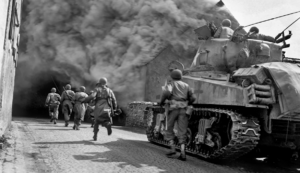
In the autumn of 1942, Soviet soldiers advanced through the ruins of Stalingrad. The battle that had begun in August would continue until February 1943, transforming the city into one of the most brutal symbols of the Eastern Front.
Photographs of soldiers moving through shattered streets can look almost unreal. Buildings are broken open. Rubble fills the roads. The familiar shape of a city has disappeared.
Yet this was not an empty landscape.
People had lived there.
Families had once walked those streets.
The destruction therefore represented more than military damage. It represented the transformation of a civilian environment into a battlefield where survival itself became uncertain.
The same pattern appeared elsewhere.
Rotterdam suffered devastating destruction during the German bombing of May 1940. London firefighters worked through the Blitz amid burning buildings and debris. French towns were damaged during the German advance and later during the Allied campaign. By 1944, entire communities had become landscapes of rubble.
The photographs often show the buildings.
The history requires us to remember the people who once occupied them.
Then came the moments when the tide turned.
On February 23, 1945, U.S. Marines raised the American flag on Mount Suribachi during the Battle of Iwo Jima. The famous photograph became one of the most recognizable images of the war.
It is often remembered as a symbol of determination and victory.
But the photograph cannot tell the whole battle.
Iwo Jima was not finished when the flag went up.
Fighting continued.
The image captured a moment of achievement, but not the full cost surrounding it.
That is one of the recurring problems with famous photographs. They preserve one instant and can accidentally become substitutes for the larger historical event.
The same is true of photographs from Normandy.

A landing photograph is not D-Day.
A flag is not Iwo Jima.
A ruined street is not Stalingrad.
A liberated prisoner is not the entire concentration-camp experience.
Each photograph is a doorway.
Behind it is a much larger story.
By 1945, Allied armies were pushing deeper into Germany. In April, photographs recorded the ruins of Berlin and the collapse of the Nazi regime. On April 28, figures were photographed near the destroyed Reich Chancellery. Days later, Berlin fell.
The physical destruction was immense.
But the political collapse was even more significant.
The regime that had initiated aggressive war across Europe was disappearing.
Yet the consequences were only beginning to be documented.
At the Nuremberg Trials, which opened in November 1945, leading figures of the Nazi regime were placed before an international tribunal. The photographs of defendants seated together can look strangely ordinary.
That is perhaps what makes them unsettling.

A camera does not automatically make a historical criminal look like a monster.
It records a human face.
The responsibility comes from the evidence surrounding that face.
The trials attempted to establish legal accountability for crimes committed during the war, creating a landmark moment in the development of international criminal law.
The photograph therefore represents something different from a battlefield image.
The battlefield asks who survived.
The courtroom asks who was responsible.
And between those two questions lies one of the most difficult tasks of historical memory.
How does a society transform suffering into evidence?
The liberation of concentration camps made that question unavoidable.
At Bergen-Belsen, British forces discovered catastrophic conditions when they liberated the camp in April 1945. In the following weeks, the camp itself was systematically burned because of the typhus epidemic and the appalling sanitary conditions. The final huts were burned in May.
The source describes a rifle salute and the destruction of the final hut as a symbolic ending.
But the real historical significance lies deeper.
The buildings could be destroyed.
The evidence could not.
Photographers had already documented what had been found.
Survivors carried memories.
Allied investigators recorded testimony.
The dead were counted.
The world had to confront evidence of crimes that had been committed behind fences and hidden from ordinary view.
That is why photographs from liberated camps remain so important.
They are not simply images of horror.
They are historical evidence.
And evidence creates responsibility.
The source also describes prisoners being transported by train during the war, sometimes under the belief that they were being moved for work.
Here again, the historical record demands careful language.
Not every wartime transport had the same purpose, and not every person traveling by train knew where they were going. But millions were forcibly displaced, deported, imprisoned or transported by the Nazi regime and its collaborators.
The railway became part of the machinery of war and persecution.
A photograph of a train can therefore look ordinary.
That is exactly the danger.
History sometimes hides inside ordinary objects.

A railway carriage.
A uniform.
A document.
A warehouse.
A road.
A photograph.
The meaning emerges only when we understand what happened around them.
In 1944, Allied forces also faced another problem: deception.
The Normandy invasion depended not only on troops and weapons but on convincing German commanders that the main Allied attack might occur somewhere other than Normandy.
Inflatable tanks and other deceptive equipment formed part of the broader Allied deception effort.
From a distance, a fake tank could look real.
From the air, an entire formation could appear convincing.
It was a strange kind of warfare.
The enemy was not always being attacked.
Sometimes he was being persuaded.

And behind that deception was a simple objective: manipulate what the opposing side believed about where the next attack would come.
The photograph of an inflatable tank therefore represents something larger than an unusual military object.
It shows how much of modern war depends upon information.
What the enemy sees.
What he does not see.
What he believes.
And what he believes incorrectly.
The same principle appeared in intelligence operations.
The source describes a German infiltrator captured behind American lines wearing a U.S. uniform. German forces did use deception and infiltration during the war, including operations involving men dressed in Allied uniforms.
One of the most famous examples occurred during the Battle of the Bulge, when German commandos associated with Operation Greif attempted to pass through Allied lines disguised as American soldiers.
The purpose was not simply combat.
It was confusion.
Road signs could be changed.
Orders could be disrupted.
Suspicion could spread.
Every unfamiliar soldier could become a question.
That atmosphere reveals something difficult about warfare: trust itself can become a weapon.

And when everyone is searching for an enemy, even the ordinary act of asking who someone is can become dangerous.
The Battle of the Bulge produced another series of photographs that showed how desperate the final German counteroffensive had become.
Beginning in December 1944, German forces attempted to split the Allied armies in Belgium and Luxembourg.
At Elsenborn Ridge, Allied troops resisted the German advance.
Snow, forests, tanks, artillery and exhausted infantry turned the landscape into a battlefield.
The offensive failed to achieve its strategic objectives, but the fighting was intense.
Again, the photographs show machines.
The history shows people.
Men inside tanks.
Men carrying ammunition.
Medics moving toward the wounded.
Drivers attempting to keep supplies moving.
And civilians trapped between armies.
The war was becoming a contest of endurance.

Who could continue?
Who could replace losses?
Who could keep roads open?
Who could keep aircraft flying?
Who could keep tanks moving?
Behind every military operation was an enormous logistical system.
That is why photographs of women working in underground munitions factories matter.
They show the other side of the battlefield.
Factories produced ammunition.
Workers assembled weapons.
Transport networks moved supplies.
Women entered jobs that had previously been closed to them.
The war demanded an industrial effort on a scale that transformed entire societies.
The same transformation occurred in Britain.
Children participated in safety drills.
Civilians prepared for air raids.
Tunnels and underground spaces became shelters.
Liverpool’s Queensway Tunnel, originally designed for road traffic, was among the spaces used as an air-raid shelter during the Blitz.

The war had entered civilian life so completely that ordinary infrastructure acquired a second purpose.
A tunnel was no longer simply a tunnel.
A school was no longer simply a school.
A home could become a shelter.
A street could become a battlefield.
A factory could become a military target.
The boundaries between military and civilian existence had become increasingly difficult to maintain.
That reality was especially visible in London.
British firefighters worked among damaged buildings during the Blitz, often returning to the same streets repeatedly.
Their work rarely appears in traditional battle maps.
Yet without firefighters, rescue workers, medics, engineers and civilians, cities could not function under sustained attack.
Photographs preserve some of these people.

Many others remain unnamed.
Perhaps that is another lesson hidden inside old war photographs.
History remembers famous generals because their names were recorded.
But survival often depended on people whose names disappeared.
The mechanic.
The nurse.
The firefighter.
The factory worker.
The driver.
The messenger.
The person who opened a shelter.
The person who carried a wounded stranger.
Their contributions were rarely accompanied by ceremonies.
They simply had to continue.
The Pacific war created another world of extremes.
Photographs show aircraft carriers, machine-gun positions, damaged aircraft and exhausted Marines.
On aircraft carriers such as USS Enterprise, support crews sometimes had only moments to rescue pilots from burning or damaged aircraft.
A carrier deck was simultaneously an airfield, workplace and battlefield.
There was little room for error.
An aircraft landing incorrectly could endanger everyone nearby.
Yet photographs sometimes capture men performing these dangerous tasks with remarkable calm.
The image freezes the movement.
It cannot show the seconds immediately before or after.
Again, the missing space matters.
The most important part of a photograph may be what happened just outside its frame.

That is especially true of photographs showing exhausted soldiers.
A Marine resting after intense combat may look almost peaceful.
But exhaustion itself tells a story.
War is not continuous heroism.
It is fatigue.
Waiting.
Fear.
Cold.
Heat.
Hunger.
Confusion.
And then another order.
The photograph of the resting soldier reminds us that human endurance has limits.
Yet armies repeatedly asked people to cross those limits.
On the other side of the world, Finnish soldiers fought in the Continuation War, while German forces operated across Northern Europe and the Eastern Front.

The war was not one single battlefield.
It was thousands of connected campaigns stretching across Europe, Africa, Asia and the Pacific.
That vastness is difficult to imagine.
A photograph makes it smaller.
One road.
One village.
One tank.
One soldier.
One face.
And suddenly a global war becomes visible at human scale.
The photographs of soldiers returning home after 1945 are therefore among the most important in the entire collection.
The war had ended.
The men were coming back.
Ships carried thousands of troops across oceans.
Crowds waited.
Families gathered.
There were celebrations.
But the return was also a beginning.
Some veterans would struggle with memories.
Some would find it difficult to explain what they had experienced.
Some returned to homes that had changed.
Some returned to countries transformed by war.
The photograph captures arrival.
It cannot capture everything that came afterward.
That may be why the final surrender documents of 1945 carry such symbolic weight.

On September 2, Japanese representatives formally signed the Instrument of Surrender aboard USS Missouri in Tokyo Bay. The ceremony marked the formal end of World War II. The National Archives preserves photographs and film of the event.
A document was signed.
The fighting stopped.
But history did not stop.
The ruined cities remained.
The displaced people remained.
The survivors remained.
The prisoners remained.
The veterans remained.
The memories remained.
And the new nuclear age had already begun.
Perhaps the most haunting photograph is therefore not the one showing the beginning of an invasion.
It is the photograph taken after everything appears to be over.
Nagasaki’s ruins.
Belsen’s empty grounds.
Berlin’s destroyed government buildings.
Abandoned military vehicles.
Returning soldiers.
Each image contains the same contradiction.
The war has ended.
But the consequences are still visible.
The source material also includes Marlene Dietrich performing for Allied troops in Italy in 1945. This was not simply celebrity entertainment. Dietrich made overseas USO tours, including one through North Africa and Italy and another through France and Germany, bringing performances close to troops near the front.
A piano surrounded by soldiers may appear strangely peaceful beside photographs of tanks and ruined towns.
But that contrast is part of the story.
People needed moments when they could stop thinking about the war.
A song could not end the conflict.
A performance could not erase fear.
But for a few minutes, it could create another world.
And perhaps that is why these photographs feel so human.
They contain destruction, but also ordinary life.
They contain fear, but also humor.
They contain military machinery, but also hands reaching out to help.
They contain victory, but also uncertainty.
They contain death, but also the stubborn continuation of life.
That is the history behind the photographs.
Not one simple story.
Not one clean ending.
A collection of moments in which people were forced to make choices inside circumstances they had not created.
Some fought.
Some fled.
Some resisted.
Some endured.
Some rescued others.
Some committed crimes.
Some documented what happened.
And many simply tried to survive another day.
The greatest danger in looking backward is believing that we already know everything because we know how the story ended.
The soldiers approaching Normandy did not know.
The civilians hiding during the Blitz did not know.
The people inside besieged cities did not know.
The prisoners waiting for liberation did not know.
The soldiers crossing Europe in 1945 did not know exactly what the next day would bring.
Only later could historians connect the fragments.
Only later could photographs become evidence of a world that no longer existed.
That is why these images should not be viewed merely as spectacular old photographs.

They are pieces of a human record.
Some show military power.
Some show suffering.
Some show courage.
Some reveal ordinary life continuing beside extraordinary events.
And some force us to confront the uncomfortable truth that the end of a war is rarely the end of its consequences.
My personal view is that the strongest lesson in these photographs is not about military victory. It is about how ordinary human beings were forced to live inside decisions made on a scale far beyond their control. The images of Normandy, ruined cities, liberated camps, exhausted soldiers, returning troops and moments of compassion remind us that history is ultimately experienced one person at a time. That is why accuracy matters so much: when we replace documented history with invented horror, we do not make the past more powerful—we make it less trustworthy.
Perhaps the question these photographs leave us with is the simplest one: when future generations look back at our own era, which human moments will remain visible after everything else has disappeared?
Some content was generated using AI tools (including ChatGPT) and edited by the author for creativity, storytelling, and historical illustration purposes. Historical facts and key details should be verified against reliable historical sources. Any AI-generated or reconstructed visuals are intended for illustrative purposes and should not be interpreted as original historical photographs or archival evidence.