
What German Tank Crews Said About Fighting Sherman Swarms
September 19th, 1944, shortly after dawn, a thick autumn fog blanketed the rolling hills near the village of Arracourt in eastern France. Visibility dropped so low that Lieutenant Leiper of the 704th Tank Destroyer Battalion would later report seeing a German gun muzzle just 30 ft away before he could identify the vehicle behind it.
German Panther tanks from the 113th Panzer Brigade rumbled forward through the mist, their commanders straining to see through the gray soup that swallowed everything beyond arm’s reach. These were factory fresh Panthers, delivered only weeks earlier, painted in fresh dark yellow camouflage. Their 75-mm high-velocity guns could destroy any Allied tank from 2,000 m away, but in this fog, 2,000 m meant nothing.
Somewhere ahead, American Shermans were waiting. The German crews could not see them. They could not use their superior optics. They could not exploit their longer range. And when the first muzzle flashes erupted from the fog at point-blank range, when armor-piercing rounds began slamming into Panther hulls from directions no one expected, the men inside those steel coffins discovered a terrifying truth.
Technical superiority meant nothing when you could not see your enemy, when he appeared from your flank before you could traverse your turret, when for every tank you destroyed, three more materialized from the mist to take its place. By the end of that fog-shrouded morning, the fields around Arracourt would be littered with burning Panthers, and the surviving German tank crews would begin telling stories that contradicted everything the propaganda films had promised them.
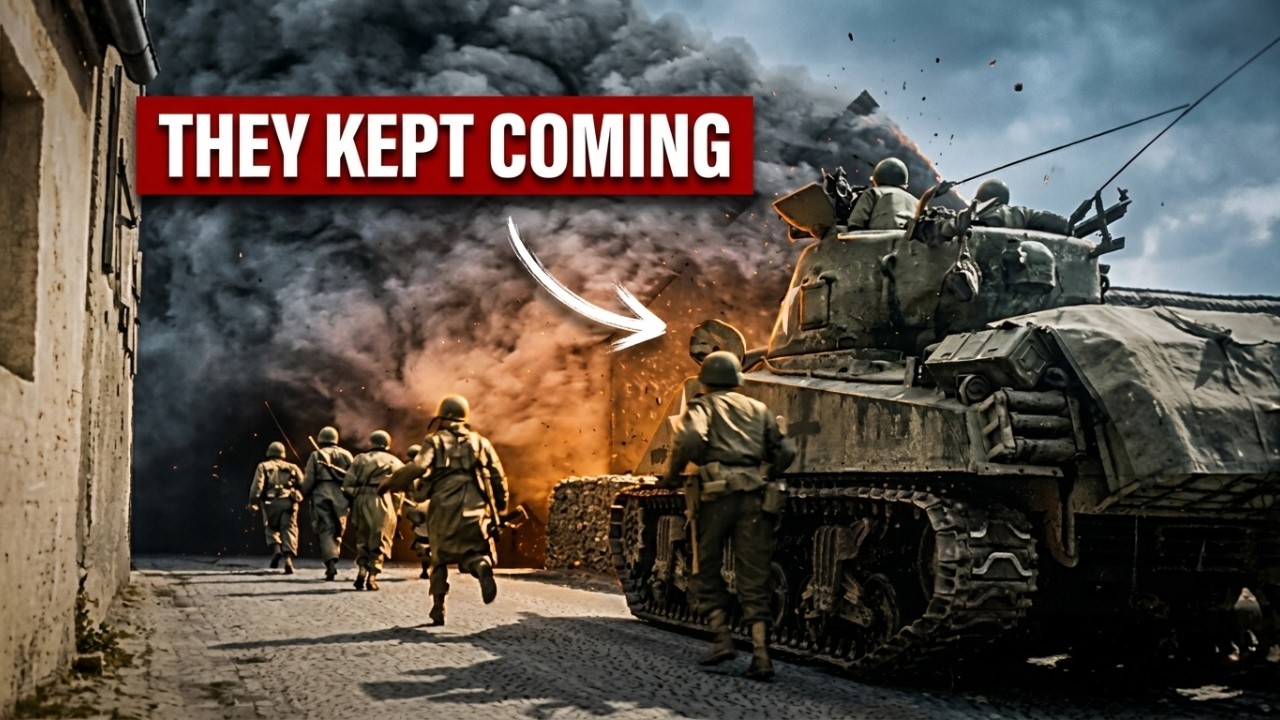
Stories about an enemy tank they had been taught to despise, a tank they had been told was inferior in every way, a tank that kept coming no matter how many they destroyed, the American M4 Sherman. The German Panzer force of 1944 represented some of the most formidable armored fighting vehicles ever built. The Tiger I, which saw its disastrous combat debut near Leningrad in late August 1942, weighed 57 metric tons and mounted the devastating 88-mm gun that had earned a fearsome reputation on every front.
That first engagement near the village of Mga saw three of four Tigers break down before reaching the enemy, a preview of the mechanical troubles that would plague German heavy armor throughout the war. Hitler had insisted on rushing the Tigers into combat against his commanders’ advice, and the Soviets captured one largely intact, studying its secrets.
Despite this inauspicious beginning, the Tiger’s frontal armor measured 100-mm thick, essentially flat rather than sloped, relying on raw thickness to defeat enemy rounds. At range, it was formidable. The Panther, first deployed at Kursk in July 1943 with the 10th Panzer Brigade attached to the Großdeutschland Division, combined a high-velocity 75-mm gun with sloped armor that gave it excellent protection while maintaining a weight of nearly 45 metric tons.
200 Panthers deployed for that offensive. 16 broke down before the attack even began. Within 3 days, fewer than 50 remained operational. These machines embodied German engineering philosophy, an emphasis on firepower and protection that made each individual tank a potential war-winner in single combat, but at a cost in reliability that would prove catastrophic.
The men who crewed these tanks had been trained to believe in their technical superiority. German optics, manufactured by firms like Zeiss and Leitz, were considered the finest in the world. German gunnery training emphasized accuracy at long range, with experienced crews capable of first-round hits at distances exceeding 1,000 m.
The doctrine was straightforward. Find the enemy at maximum range, destroy him before he can close the distance, use superior firepower to compensate for inferior numbers. It had worked spectacularly against the Soviets at Kursk. It had worked in North Africa. It would work against the Americans. But the Sherman represented something the German tactical doctrine had never truly accounted for.
This American tank was not designed to win individual duels. It was designed to be produced in overwhelming numbers, to be mechanically reliable enough to actually reach the battlefield, to be simple enough that replacement crews could learn to operate it quickly, and to work as part of a combined arms team rather than as an individual champion.
The United States would produce over 49,000 Shermans during the war. Germany would produce approximately 7,300 Tigers and Panthers combined. The American approach to armored warfare reflected a fundamentally different philosophy. While German doctrine emphasized the tank as a decisive weapon to be conserved and employed at critical moments, American doctrine treated tanks as expendable tools to be used aggressively and replaced when lost.
The Sherman’s design facilitated this approach. Various models used different power plants, from the Continental radial aircraft engine to the Ford 58, but all proved reliable and produced abundant power for their weight. The vertical volute spring suspension was simple to maintain and repair. The armor, while not as thick as German tanks, was adequate for infantry support operations, which remained the primary mission American planners envisioned for their armored forces.
The Sherman’s 75-mm gun could destroy any German tank from the flank or rear, and the later 76-mm variant improved frontal penetration significantly against the Tiger’s flat 100-mm plate. American crews also had access to high-velocity armor-piercing rounds using tungsten carbide cores. Though these proved effective mainly against Tiger frontal armor and Panther turrets, rather than the Panther’s steeply sloped glacis plate.
What the Sherman lacked in individual capability, it compensated for with numbers, reliability, and the combined arms doctrine that brought artillery, air support, and infantry together in coordinated assaults that no tank, however powerful, could defeat alone. The construction of the German heavy tank force had consumed enormous resources.
Each Tiger required approximately 300,000 man-hours to build, compared to roughly 50,000 for a Sherman, a ratio of 6:1. The precision engineering that made German tanks so formidable also made them difficult to manufacture, difficult to repair, and desperately prone to mechanical failure under the strain of actual combat conditions.
German tank crews took immense pride in their machines, but that pride would be tested in ways none of them anticipated when the American armor began arriving in France. The training these men received was rigorous and thorough, at least in the early years of the war. German tank crews learned their vehicles intimately, understanding every mechanical system, every tactical capability.
They practiced gunnery until accuracy became instinct. They studied terrain analysis and combined arms coordination. The veterans who had fought in Poland, France, and the Soviet Union represented an irreplaceable wealth of combat experience. These were not merely soldiers, they were specialists, craftsmen of armored warfare who had honed their skills across thousands of kilometers of battlefield.
But by 1944, this expertise was hemorrhaging away. The veterans were dying faster than they could train replacements. The Eastern Front consumed experienced tank crews at a horrifying rate. Each engagement against Soviet armor cost Germany men whose knowledge could not be replaced by a few weeks of training school instruction.
The men arriving at Panzer units in 1944 and 45 were often former Luftwaffe ground personnel, navy sailors without ships to crew, or boys barely old enough to shave. They received abbreviated training and were sent forward to operate machinery that demanded years of experience to master. By the summer of 1944, the strategic situation in Europe had shifted dramatically against Germany.
The D-Day landings on June 6th had established an Allied foothold in Normandy that could not be eliminated. American industrial capacity was pouring men and equipment into France at a rate Germany could not match. The Luftwaffe had been swept from the skies over France, meaning German tank movements during daylight invited destruction from fighter-bombers.
Soviet forces were advancing relentlessly in the east, drawing away resources that might otherwise have reinforced the Western Front. The loss of air superiority transformed every aspect of German armored operations. Tank columns that once moved freely across open terrain now had to travel at night or risk annihilation from above.
Thunderbolts and Typhoons prowled the French countryside, hunting anything that moved on roads or in fields. German tank commanders learned to fear the sound of aircraft engines more than enemy tanks. A column spotted from the air would be attacked within minutes, and there was little a tank crew could do against rockets and bombs screaming down from the sky.
The psychological effect was devastating. Crews who had been trained to feel invincible in their Tigers and Panthers discovered they were vulnerable, exposed, hunted. Fuel shortages added another layer of misery. The Allied bombing campaign against German synthetic fuel plants and the loss of Romanian oil fields had crippled the Wehrmacht’s fuel supply.
Tanks that could theoretically drive hundreds of kilometers sat immobilized because there was no fuel to move them. Commanders had to make agonizing choices about which units would receive fuel and which would not. Sometimes tanks were abandoned, not because they were damaged, but simply because there was no fuel to drive them away from the advancing enemy.
In this context, German Panzer units found themselves fighting a fundamentally different kind of war than the one they had been designed for. The decisive armored breakthroughs of 1940 and 1941 were impossible now. There were no exposed flanks to exploit, no isolated enemy formations to encircle. Instead, German tanks fought a grinding defensive battle against an enemy who could afford to lose three tanks for every one he destroyed and still keep advancing.

The mathematics of attrition were merciless. The cruel irony was that German tanks often performed exactly as designed. They destroyed Shermans in large numbers. Individual German tank aces racked up impressive kill tallies, but it did not matter. The destroyed Shermans were replaced within days.
The destroyed Panthers and Tigers were not. A German tank commander might knock out five enemy vehicles in a single engagement and feel like a hero, only to discover that his own tank had developed transmission problems and would require a week to repair, that no replacement parts were available, that the maintenance company had been destroyed by air attack, that his victory meant nothing because tomorrow there would be 10 more Shermans in the same spot and he would be walking back to Germany.
Ludwig Bauer was one of the German tankers who survived to tell this story. Born on February 16th, 1923 in Künzelsau, Bauer served in Panzer Regiment 33 of the 9th Panzer Division, operating Sturmgeschütz assault guns, Panzer IVs, and eventually Panthers. Decades after the war, between June 2015 and January 2016, historian Rob Shafer conducted extensive recorded interviews with Bauer, producing some of the most detailed and candid German tanker testimony ever documented.
Bauer’s assessment of the Sherman was surprisingly balanced for a man who had spent years fighting against them. He acknowledged that the Sherman was a good and capable tank, particularly effective in the close terrain of Normandy and the Ardennes, where engagements typically occurred at ranges of 500 to 600 m. At those distances, he admitted, the Sherman’s 75-mm gun could effectively engage German Panzer IVs and assault guns.
What impressed him most was not the Sherman’s individual capabilities, but its availability. The Americans had an endless supply of them. Where Bauer claimed German superiority was in optics and gunnery. “German guns were more powerful with better range,” he stated. “German optical equipment allowed accurate engagement at 1,000 m without calculating trajectory.
” He also criticized the Sherman’s cast armor, noting that it cracked under powerful hits, even when rounds did not fully penetrate. He had observed this phenomenon repeatedly. Shells that should have bounced instead opening fissures in the Sherman’s hull. But Bauer’s most controversial observations concerned American crew quality.
He described witnessing American tank crews bail out after non-penetrating hits, abandoning fully functional vehicles because they believed they had been knocked out. This behavior would have been unthinkable on the Eastern Front, he claimed. He recounted an incident near Cologne, where a Sherman crew surrendered their intact tank to a single German infantryman armed only with a Panzerfaust anti-tank weapon.
The man had not even fired. These observations require careful context. Bauer was comparing fresh American troops, many in combat for the first time, against battle-hardened German veterans who had survived years of the Eastern Front’s brutality. The comparison was deeply unfair. American crew quality improved dramatically as the campaign progressed, and by the end of the war, veteran American tankers were every bit as capable as their German counterparts.
Bauer himself acknowledged this evolution, noting that the Americans learned quickly and adapted their tactics effectively. In mid-January 1945, near the villages of Foy and Noville during the counteroffensive phase of the Battle of the Bulge, Bauer participated in one of the rare set piece tank battles on the Western Front.
His unit engaged American armor with six Sturmgeschütz assault guns in what he described as a proper tank battle, something that was rare in that theater. According to his account, they destroyed approximately 15 Shermans and several half-tracks without suffering casualties. This account remains unverified against American records, but it illustrates the tactical victories German tank crews could achieve under favorable conditions.
The morning of September 19th, 1944 had begun with German confidence. The 111th and 113th Panzer Brigades were advancing toward the American positions around Arracourt as part of a major counteroffensive. These were not worn out veteran units with battle-damaged equipment. These were freshly formed brigades equipped with brand new Panthers straight from the factory.
On paper, they should have been devastating. The Panthers rolling toward Arracourt represented the pinnacle of German tank design. Their 75-mm high-velocity guns could penetrate any Allied tank at extreme range. Their sloped frontal armor could deflect most American shells. Their sophisticated optics and fire control systems gave them accuracy that American tankers could only envy.
Each Panther cost the German war economy hundreds of thousands of Reichsmarks and countless man-hours of skilled labor. Each one represented the concentrated industrial might of a nation struggling to survive. The crews inside these Panthers should have felt invincible. They had been told they were driving the finest tanks in the world.
They had been promised that German engineering superiority would overcome American numerical advantage. The propaganda films showed Tigers and Panthers destroying enemy tanks with contemptuous ease, their crews confident and professional, and their machines unstoppable. Reality would prove cruelly different. But the Panzer Brigades carried a fatal flaw.
Their crews had received only 2 weeks of training. Many had been transferred from Luftwaffe ground units with no armored warfare experience. They could barely operate their vehicles, let alone fight effectively in them. Some crews could not read maps. Navigation at night proved nearly impossible. When the brigades attempted a coordinated night movement to position themselves for the attack, the 111th Panzer Brigade got lost entirely after being misdirected by a French farmer, leaving the 113th to attack alone.
Combat Command A of the American 4th Armored Division was waiting for them. Lieutenant Colonel Creighton Abrams commanded the 37th Tank Battalion, a unit that would become legendary in American armor history. Abrams himself would later become a four-star general and the M1 Abrams tank would be named in his honor decades later.
But on this foggy morning, he was simply a tank commander facing an enemy advance with inferior numbers and inferior firepower, relying on training, tactics, and the thick autumn fog to equalize the odds. The fog negated everything that made German tanks superior. The Panthers could not see far enough to use their range advantage.
Their sophisticated optics were useless when visibility dropped below 100 m. American tankers, trained to work as teams and use terrain aggressively, exploited the conditions ruthlessly. Company C of the 37th Tank Battalion, commanded by Captain Kenneth Lamason, executed a flanking maneuver that caught the Germans completely off guard, driving through the Panzer formation firing, wheeling around, and driving back through again.
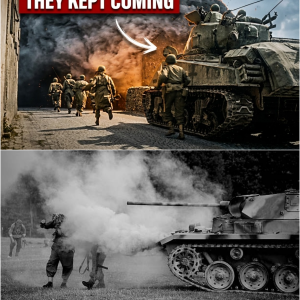
Panthers were hit from the side, where their armor was thinnest, by enemies they never saw coming. The destruction was catastrophic. A platoon of M18 Hellcat tank destroyers from the 704th Tank Destroyer Battalion defending Combat Command A headquarters engaged the Panthers at close range in the fog. Even M7 Priest self-propelled howitzers joined the fight, engaging Panthers with direct fire at point-blank range.
The Germans had expected to use their superior tanks to smash through American defenses. Instead, they drove into a meat grinder. Inside the German tanks, commanders screamed orders that could not be executed. Drivers tried to maneuver vehicles they barely knew how to operate. Gunners traversed turrets, desperately searching for targets in the fog.
Loaders struggled with ammunition in vehicles whose layouts were unfamiliar. Radio discipline collapsed as panicked crews jammed frequencies with contradictory reports. Some Panthers simply stopped, their crews frozen with indecision, presenting stationary targets for American gunners who had practiced this exact scenario. The 113th Panzer Brigade ceased to exist as an effective fighting force by noon.
The 111th, having finally found its way to the battlefield, fared no better in subsequent engagements over the following days. By the end of September, the German counteroffensive had completely failed. Of 262 tanks and assault guns deployed by German units during the week of fighting, 86 were destroyed, 114 were damaged or broken down, and only 62 remained operational.
The 111th Panzer Brigade was reduced to seven tanks and 80 men. Its commander, Colonel Heinrich Bronsart von Schellendorf, was mortally wounded on September 22nd. American Combat Command A had lost 25 tanks and seven tank destroyers, a fraction of German losses. The exchange ratio at Arracourt, far from the mythical five to one in German favor, had been roughly three to one in American favor.
The survivors stumbled back to German lines with stories that contradicted everything they had been told. They had attacked with the best tanks in the world, freshly manufactured, technically superior in every measurable way, and they had been annihilated by Shermans. Not because the Sherman was a better tank. It was not. But because crew quality mattered more than vehicle specifications because tactics mattered more than armor thickness because being able to navigate, communicate, and coordinate mattered more than having the biggest gun.
The American tankers at Arracourt were experienced professionals. The German tankers were barely trained replacements sitting in vehicles they did not understand. Technical superiority meant nothing when the crews could not exploit it. The official investigation into German tank performance against Allied armor revealed uncomfortable truths.
German kill claims were massively inflated across all theaters. At the Battle of Kursk, overall German claims exceeded actual Soviet losses by a factor of two to four depending on methodology. British operational research found that the mean engagement range for Tiger actions in Normandy was only 450 m, not the theoretical maximum ranges of over 2,000 m that German specifications promised.
The famous claim that it took five Shermans to destroy one Tiger has become one of the most persistent myths of the Second World War. Research has traced this claim back decades before Belton Cooper’s 1998 book Death Traps popularized it for modern audiences. In 1965, Henry Giles wrote in his GI journal that four Shermans equaled one Panther.
In 1977, Bruce Culver stated it was an unofficial rule of thumb in the American Army. The myth has been repeated so often that many assume it must be based on documented casualty figures. It is not. The actual explanation is prosaic. The American M4 platoon consisted of five tanks. That was the minimum tactical maneuver element. Five was the smallest number of Shermans that would ever attack anything together under normal doctrine.
If American doctrine called for attacking with overwhelming force and American doctrine absolutely called for attacking with overwhelming force then naturally you would see groups of five or more Shermans engaging single German vehicles. Not because five were needed to win, but because five was the smallest tactical unit.
You do not send fewer soldiers than necessary simply because the enemy appears weak. That is how you get killed. Verified statistics tell a different story entirely. The BRL memorandum report number 798 from Aberdeen Proving Ground published in 1954 and studying engagements involving the 3rd and 4th Armored Divisions from August through December 1944 found that the defender consistently held the advantage regardless of tank type.
When Shermans defended, they achieved favorable kill ratios. When Shermans attacked, ratios reversed. The same pattern held for German tanks. The side that spotted and fired first almost always won. Detailed analysis suggests actual loss ratios in Normandy were approximately 1.
5 to 1 or 2 to 1 in favor of German tanks in direct tank-on-tank combat, far from the mythical 5 to 1. Swedish Defense College researcher Niklas Zetterling studied German tank losses in Normandy and discovered that of 2,336 German tanks and assault guns sent to that theater roughly 1,500 were lost. At least half of those losses came from fuel shortages, mechanical breakdowns, and crew abandonment rather than Allied fire.
German tanks were destroying themselves faster than American tanks were destroying them. The pattern repeated across every theater and every type of German vehicle. The Panther’s final drive, the gearbox that transferred engine power to the tracks, failed catastrophically. Approximately every 150 km according to French Army post-war testing.
At the Battle of Kursk, 16 of 200 newly deployed Panthers broke down during the approach march before the attack began. Within 3 days of combat less than a quarter of the original 200 remained operational with mechanical failure accounting for a large share of the losses. Panzerlehr Division suffered devastating losses simply marching to Normandy hammered by Allied fighter-bombers along what the crews called the Jabo Rennstrecke, the fighter-bomber racecourse.
By late 1944, the 100th 1st SS Heavy Panzer Battalion experienced dramatic fluctuations in operational strength dropping from 37 of 45 Tigers on June 1st to just 15 by mid-June. The battalion that was supposed to be Germany’s armored fist could barely field a fraction of its authorized tanks. Sabotage by the millions of foreign forced laborers in German factories contributed to component failures that only worsened as the war continued.
German tank crews faced an enemy inside their own vehicles as dangerous as the one outside. The most striking official German acknowledgement of Sherman superiority came from Albert Speer himself. In November 1944, after visiting the Italian front, Speer submitted a report that would have seemed like heresy to those raised on propaganda about German technical superiority.
“The Sherman tank climbs mountains that German Panzer crews consider impassable,” he wrote. “This is accomplished by the especially powerful engine in comparison to its weight. The terrain crossing ability on level ground is completely superior to German Panzers. Sherman tanks drive freely cross-country while German Panzers must remain on trails and narrow roads.
” Most remarkably, Speer reported that German tank crews on the front lines wanted tanks more like the Sherman, not less. “All Panzer crews want to receive lighter Panzers which are more maneuverable, possess increased ability to cross terrain, and guarantee the necessary combat power just with a superior gun.
” The men actually fighting the war had reached conclusions that contradicted official doctrine entirely. They did not want heavier armor and bigger guns. They wanted reliability, mobility, and a tank that would actually work when they needed it. German Tiger units in Italy converted captured Shermans into recovery vehicles and according to Christopher Wilbeck’s research loved them because they were so reliable.
The 10th SS Panzer Division Frundsberg maintained a unit of 12 captured Shermans seized near Herlisheim in January 1945 operating them until the war’s end. The enemy’s tank had become more dependable than their own. Otto Carius remains the most famous German tank commander in popular imagination, author of the celebrated memoir Tigers in the Mud.
But what documentary makers must understand is that Carius fought predominantly on the Eastern Front against Soviet T-34s. His direct experience fighting American Shermans was confined to the chaotic final weeks of the war commanding Jagdtigers with the Second Company of schwere Panzerjäger Abteilung 512 in the Ruhr pocket during March and April 1945.
That brief Western Front service was a disaster. Not because of Sherman quality, but because of the complete collapse of the German military. Carius’s company destroyed approximately 10 American tanks while losing 10 Jagdtigers in return achieving a mere 1 to 1 exchange ratio with what was theoretically the most powerful tank destroyer ever built.
The losses included one to combat, one to friendly fire from a Volkssturm militia unit, and the rest to mechanical breakdown or crew self-destruction. His crews were barely trained and he was contemptuous of the Jagdtiger itself finding it extremely slow with poor maneuverability and a weak transmission. The 72-metric-ton vehicle was theoretically devastating.
In practice, it was nearly useless. Carius is considered one of the more credible German memoirists precisely because he revised his kill count downward in post-war interviews from the credited 150 to approximately 100. His book was supported by preserved combat reports. But his limited Sherman-specific experience makes him a poor primary source for German-American tank combat specifically.
The other frequently cited memoirists present more serious reliability problems. Willi Fey of the 102nd SS Heavy Panzer Battalion claimed to have destroyed 15 Shermans in 30 minutes near Chenedolle on August 7th, 1944. But the 23rd Hussars, his alleged victims, had only 11 operational Shermans 2 days before the engagement. British records do not confirm the losses.
Ernst Barkmann’s famous engagement, known as Barkmann’s Corner on July 27th, 1944, is even more problematic. Military historian Steven Zaloga, after analyzing Allied war records, was unable to locate any losses matching Barkmann’s claims. He attributed the narrative to propaganda efforts of the Waffen SS. American records for the area document only a modest action against Troop A of the 4th Cavalry Squadron involving two M5 light tanks, two M8 armored cars, and six Jeeps.
This bears no resemblance to the nine Shermans Barkmann claimed to have destroyed. The most authoritative primary source on German crew psychology comes from an interrogation conducted at the 7th Army Interrogation Center on May 24th, 1945. Senior German prisoners of war were questioned about what their tank crews feared most. The answers surprised the interrogators.
Sepp Dietrich attributed 45% of tank losses to Allied tanks and tank destroyers stating that these were most feared by crews. Paul Hauser concurred. An 8-year veteran tanker named the M36 Jackson tank destroyer and the bazooka as the most feared weapons. These interrogation responses contradicted the prevailing assumption that German crews feared air attack above all else.
While fighter-bombers certainly inflicted psychological damage, experienced German tankers understood the statistical likelihood of being destroyed by an aircraft was lower than popular perception suggested. Ground-based threats, particularly the fast-moving American tank destroyers with their powerful guns and low profiles, posed a more immediate danger in their estimation.
The bazooka’s appearance on this list of most feared weapons speaks to the changing nature of armored warfare. A single infantryman with a cheap disposable rocket launcher could destroy a tank worth hundreds of thousands of dollars and kill a crew that had taken years to train. German tankers learned to fear close terrain where infantry could approach unseen.
The hedgerow country of Normandy was a nightmare for tank crews precisely because every bush could conceal a man with a bazooka. Other prisoners stated that German tankers feared white phosphorus more than airplanes. White phosphorus shells blinded optics and created choking smoke that forced crews to abandon their vehicles.
The terror of fire was universal. The Sherman’s burn rate after penetrating hits ranged from 60% to 80% in early models before wet ammunition stowage was introduced, comparable to the Tiger’s rate in a small British study. Both German and American crews shared the nightmare of incineration, of being trapped in a steel box as flames consumed everything inside.
Fire was the great equalizer of tank warfare. It did not matter how thick your armor was or how powerful your gun if a penetrating hit ignited ammunition or fuel and turned your vehicle into a crematorium. Tank crews on both sides developed an almost superstitious fear of fire. They watched friends burn alive and knew that the same fate awaited them if luck turned against them.
Some crews refused to enter their vehicles after witnessing burning tanks. Others developed rituals and talismans that they believed would protect them. The psychological toll of armored combat was immense and rarely discussed in the heroic narratives that dominated postwar memoirs. The Cologne Cathedral duel on March 6th, 1945, offers one of the few engagements documented from both sides, captured on film by Army Signal Corps cameraman Technical Sergeant Jim Bates of the 165th Photo Signal Company.
This footage remains one of the most remarkable visual records of tank combat from the Second World War, showing the actual moment of destruction with a clarity that written accounts cannot match. The engagement took place literally in the shadow of Cologne Cathedral, one of the few structures left standing in the devastated city.
Leutnant der Reserve Wilhelm Bartelborth’s Panther from Panzer Brigade 106 Feldherrenhalle had already destroyed one F Company Sherman and disabled a second with devastating precision. Two 75 mm rounds striking within inches of each other on the first Sherman’s turret. Second Lieutenant Karl Kellner was mortally wounded in that first Sherman, his driver and gunner killed instantly.
Bartelborth knew his trade. He had positioned his Panther at an intersection where he could engage targets as they appeared around corners, using the urban terrain to negate the Americans’ numerical advantage. The bodies of the Sherman crewmen lay in the street where they had fallen trying to escape their burning vehicle.
Bartelborth had demonstrated exactly why the Panther was feared. Its gun was lethal. Its accuracy in trained hands was superb. Against Shermans approaching without knowing he was there, Bartelborth was death incarnate. When the T26E3 Pershing of Staff Sergeant Robert Early and Gunner Corporal Clarence Smoyer appeared around a corner, Bartelborth made a fatal error.
He did not recognize the Pershing as American. His daughter later confirmed that he told the family the tank that had appeared would have been a German tank. The Pershing was so new that many German soldiers had never seen one. Its long-barreled 90 mm gun and distinctive hull profile resembled no American tank Bartelborth had encountered before.
This moment of hesitation cost Bartelborth everything. Smoyer fired first, hitting under the gun shield, then put two more rounds through the Panther’s side. Three of the five German crew ultimately survived. The gunner was found dead inside the next day and one of the men who escaped died later of his wounds.
The engagement demonstrated both the Panther’s continued lethality against Shermans and the deadly cost of a single moment’s confusion in the chaos of urban combat. Kampfgruppe Peiper’s Ardennes advance in December 1944 provides extensive German accounts of fuel-starved, road-bound armor unable to exploit theoretical superiority.
Peiper himself noted that the roads assigned to him were not for tanks, but for bicycles. The entire German offensive in the Ardennes was predicated on capturing American fuel depots because Germany simply did not have enough fuel to sustain a prolonged offensive otherwise. The plan called for Peiper’s column to reach the Meuse River within 48 hours.
It would take over a week and they would never get there. Peiper’s column represented the best Germany had to offer in late 1944. His unit included Tiger IIs from schwere SS Panzer Abteilung 501, the most heavily armored tanks in the world with 250 mm effective frontal armor, along with Panthers and Panzer IVs.
On paper, his starting strength approached 117 tanks and assault guns. His men were veterans hardened by years of combat on the Eastern Front. If any German unit could demonstrate the superiority of German armor, it was Kampfgruppe Peiper. What they discovered instead was the vulnerability of heavy armor in close terrain without air cover or fuel reserves.
The narrow roads through the Ardennes forests channeled Peiper’s column into predictable routes. Bridges collapsed under the weight of the Tiger IIs. Fuel consumption far exceeded projections as tanks idled waiting for traffic jams to clear. American forces did not need to defeat him in tank duels. They simply needed to delay him, to blow bridges ahead of his advance, to force him to expend fuel navigating detours, to wear down his combat power through a thousand small encounters rather than one decisive battle. At Stoumont on
December 19th, eight of Peiper’s Panthers were engaged by just four Shermans from the 743rd Tank Battalion in a short and fierce firefight that delayed the German advance. Remarkably, no tanks were knocked out by either side, but the Shermans used the terrain effectively, engaging at close range from prepared positions where their numerical inferiority mattered less than their tactical positioning.
This was not the decisive tank battle German doctrine envisioned. It was a skirmish, a delay, a minor action that consumed time and fuel Peiper could not afford to lose. By December 21st and 22nd, Peiper had been reduced to a perimeter of less than 2 square kilometers at La Gleize, surrounded and cut off. His aid station had no anesthetics or drugs and could administer little more than first aid or carry out essential amputations.
On December 24th at 2:00 in the morning, he ordered all vehicles abandoned and escaped on foot with roughly 800 men of his original 4,800. A final roll call showed 770 survivors reached German lines on Christmas Day. The Tiger IIs, the Panthers, the vehicles that were supposed to win the war were left behind, out of fuel, their crews walking back to Germany through the snow.
The Battle of the Bulge consumed Germany’s last strategic Panzer reserves. The offensive that Hitler had promised would split the Allied armies and force a negotiated peace instead bled the Panzerwaffe white. By February 5th, 1945, only 190 tanks remained operational on the entire Western Front with an additional 533 assault guns and 87 tank destroyers.
Against this force, the Allies could deploy thousands of Shermans, Cromwells, and increasingly the new M26 Pershings. The great armored force that had conquered Europe was finished. Wolfgang Schneider, a German Bundeswehr instructor who studied these battles professionally, was scathing in his assessment of famous German tank charge into Villers-Bocage pure folly that breached all the rules.
No intelligence, no concentration of forces, no reconnaissance. The afternoon German counterattack into the town cost approximately five Tigers and eight Panzer IVs destroyed. Schneider concluded that the 101st SS Heavy Panzer Battalion’s overall contribution was everything but awe-inspiring. The families of German tank crews received news of their losses through telegrams that offered no explanation, no context for how their husbands and sons and fathers had died.
A mother in Bavaria learned that her boy had burned to death in a Panther outside Arracourt, killed in a battle that should never have been fought, sent forward by commanders who had given him 2 weeks of training against an enemy that had been preparing for years. A wife in Hamburg learned that her husband had been listed as missing during the retreat from France, his Tiger abandoned when the fuel ran out, his fate unknown.
These men had died because their leadership had sent inadequately trained crews into battle against opponents with superior logistics and doctrine, because their machines had been designed for a type of warfare that no longer existed, because the mathematics of industrial production had rendered individual tank quality irrelevant.
They had been taught to believe in the superiority of German engineering and that belief had killed them. Historians who have studied the actual records have painted a very different picture than the one that dominates popular imagination. Steven Zaloga, who spent decades analyzing tank combat data from World War II, concluded that the Sherman was an excellent tank for its intended purpose.
It was reliable, producible in mass quantities, and effective within the combined arms doctrine that American forces employed. Its weaknesses were real, but manageable. Its strengths were substantial, and often overlooked by those fixated on armor thickness and gun caliber. The German perspective, when examined honestly and without the distortion of propaganda, reveals a grudging respect for the Sherman that contradicts the myth of universal contempt.
German technical evaluations noted the Sherman’s excellent power-to-weight ratio and superior cross-country mobility. German tank crews in Italy converted captured Shermans into recovery vehicles because they were more reliable than German alternatives. German commanders recognized that American combined arms tactics posed a greater threat than any individual tank specifications.
Heinz Guderian, the father of German armored warfare, understood this reality even as it was happening. He attributed 60% to 70% of German tank losses on the Eastern Front to mechanical failures alone. The enemy was destroying German armor, but so were final drive failures, transmission breakdowns, fuel shortages, and the inability to recover damaged vehicles because the recovery vehicles themselves had broken down.
A tiger that cannot move is not a weapon. It is a bunker, and bunkers do not win mobile warfare. The fundamental lesson of the German-Sherman encounter is that tank warfare is not a duel between individual champions. It is a systemic contest where logistics, training, doctrine, and industrial capacity determine outcomes more than vehicle specifications.
The Sherman was good enough, and there were enough of them, and the crews were well trained enough, and the supporting arms were effective enough. And all of those factors together overwhelmed German advantages in individual tank quality. The men who crewed those Tigers and Panthers deserved better than the mythology that has grown up around them.
They deserve to be remembered as what they actually were, skilled professionals caught in a losing war, fighting with failing equipment against an enemy who had figured out that winning required systems, not supermen. Today, the fields around Arracourt are quiet. Farmers work the same soil that drank the blood of German and American tankers 80 years ago.
The fog still rolls in during autumn mornings, reducing visibility to nothing, turning the landscape into the same gray void that swallowed the 113th Panzer Brigade. The Tigers and Panthers are rare artifacts now, precious remnants of a dead military philosophy, admired by enthusiasts who see only the impressive specifications and miss the mechanical unreliability, the impossible logistics, and the fundamental unsustainability of building wonder weapons when your enemy was building adequate weapons by the tens of
thousands. When Ludwig Bauer spoke to his interviewer 70 years after the war, he did not dwell on his kill counts or his victories. He spoke about the endless supply of Shermans, about how it did not matter how many they destroyed because there were always more. He spoke about watching the war slip away despite winning individual battles.
He spoke about the profound exhaustion of fighting an enemy who could afford to lose and lose and lose and still keep coming. Bauer lived until 2020, passing away on May 20th at 97 years old, one of the last German tank veterans to have fought against American armor in the Second World War. He did not claim that German tanks were perfect, or that victory had been stolen by factors beyond his control.
He acknowledged that the war had been lost for reasons that went far beyond individual tank quality. Industrial capacity, strategic positioning, the combined weight of enemies on multiple fronts, these were the factors that determined the outcome, not whether a Panther could defeat a Sherman in single combat.
This is what German tank crews actually said about fighting Sherman swarms, not the sanitized propaganda version that portrayed them as invincible supermen in wonder weapons, not the post-war mythology that blamed defeat on everything except the fundamental flaws in German strategy and equipment.
The truth, as documented in their own words and verified against the historical record, they respected the Sherman for what it was, a reliable, capable tank that showed up when needed and kept running when German machines broke down. They feared its numbers, and they understood, long before the war ended, that those numbers would destroy them no matter how many individual victories they won.