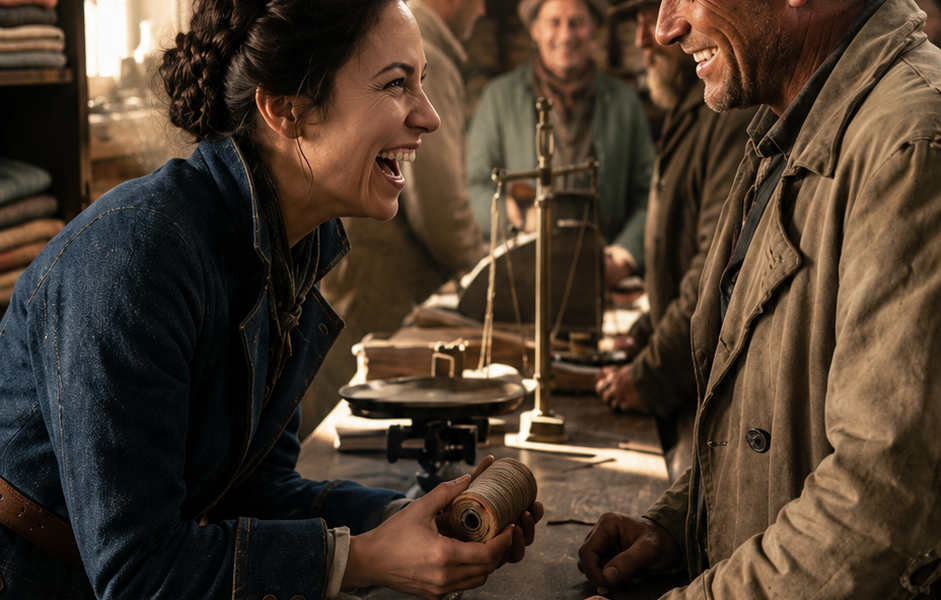

They said the letter arrived after the man was already dead.
Folded in four, sealed in wax that no longer held its shape, it was found beneath the floorboards of a burned-out ranch house west of Red Mesa—where the wind still carried the smell of old ash even fifty years later. The envelope had no stamp, no sender, only a name written in a trembling hand that looked like it had been pressed down by someone writing while the ground itself was shaking: “For the man who stayed when everyone else ran.”
Inside was a confession so heavy the county clerk who first read it refused to speak about it for three days. Not because it was illegal. Not because it named killers or thieves. But because it described something far worse in the Old West than gunfire or gold—trust given to the wrong stranger at exactly the wrong moment, and a love that should never have survived the truth but somehow did.
The ranch it referred to had a name once. People still whispered it in barrooms from Santa Fe to Abilene, but always differently, as if no two men could agree on what had really happened there. Some called it redemption. Some called it fraud. Others swore it was a miracle disguised as betrayal.
And buried in the final line of that letter was a warning that would not make sense until the very last piece of the story was uncovered: “If you are reading this, then the valley already chose who to believe.”
No one knew what valley it meant.
No one knew what truth had been buried under it.
But every account agreed on one thing—before the letter existed, a woman stepped off a train in Dry Creek with a name that might not have been hers, and a man waiting for her who had already decided he had nothing left to lose… until she arrived and proved him wrong in ways neither of them understood yet, and in ways the frontier would never forget.
The train screamed into Dry Creek like it was tearing time itself open, iron wheels grinding sparks out of dry rails as if the land resisted its arrival. Dust rolled across the platform in slow brown waves, and every man standing there—cowhand, merchant, preacher, gambler—stopped talking at once, because something about that train felt like it wasn’t just carrying passengers, it was carrying consequences. Ethan Hale stood near the hitching posts with his hat in one hand and the other clenched so tightly around the telegram in his coat pocket that the paper had begun to soften into sweat. It was the kind of telegram no man reads twice unless he wants it to change him: “Bride arriving noon. Do not disappoint her. —Agency.”
He had not asked for a miracle. He had asked for survival.
His ranch was already dying in slow pieces long before the train arrived—water rights slipping into the hands of men who smiled too easily, cattle disappearing into branded lies that came back months later under different ownership, and neighbors who suddenly forgot how to return greetings. The Hale spread sat at the edge of Red Mesa like something forgotten by both God and government, and Ethan had stopped believing anyone would come help him long before he wrote that letter east. He had written it anyway because loneliness, like thirst, eventually makes even proud men negotiate.
When the train door finally opened, the sound of it was too ordinary for what followed. A woman stepped down without hesitation, her boots touching Dry Creek dust like she had walked across worse things and survived them all without needing witnesses. She wore no dress meant for admiration, only a travel coat darkened by miles and weather, and beneath it a simple pale blouse that did not belong to any city Ethan recognized. Her hair was tied back low, practical, almost severe, yet there was nothing fragile in the way she surveyed the platform as if she had already counted every man watching her.
She did not smile.
She did not hurry.
She simply looked at Ethan Hale, and something in the way her gaze landed on him made him feel briefly as if he were the one arriving somewhere unfamiliar.
“You’re late,” she said, though her voice carried no accusation, only observation, as if time itself was something she measured differently.
Ethan blinked once. “You must be mistaken.”
“I don’t think so,” she replied, stepping closer as though distance was a negotiable thing on the frontier. “You are Ethan Hale. The ranch east of the mesa. The one losing water through someone else’s patience.”
That last line should have made him angry. Instead, it made him still.
He should have asked her name first. He did not.
Instead, he said the only honest thing left in him. “This place will ruin you.”
And she answered with something that would later haunt every man who heard it spoken aloud: “Only if it is already ruined.”
They left Dry Creek without ceremony, as if their meeting had been arranged by something older than letters and railroads. The wagon ride east cut through land that looked increasingly abandoned the farther they traveled, fences sagging like tired men, wind moving through dry grass in long, whispering stretches that sounded almost like warnings. Ethan expected questions. He had prepared answers. But she asked none of the obvious ones. Instead, she studied the land the way a doctor studies a sick patient—quietly, attentively, as if listening for symptoms no one else had learned to hear.
“You don’t trust me,” Ethan said at last, partly to fill the silence, partly to test her reaction.
“I don’t trust easy things,” she replied. “You don’t look easy.”
That was the first moment he noticed the letter in her hand. Not held openly, not hidden, just there, folded with the careful precision of someone who had already decided it mattered more than the journey itself. He wondered if it was from home. He wondered if it was from someone waiting to take her back.
He did not ask.
By the time the ranch came into view, the sky had begun to change color in the way it always did before something broke—too orange, too still, like the horizon was holding its breath. The Hale homestead sat low against the land, barn leaning slightly as if listening for collapse, corrals half-empty, windmill turning only when it felt like remembering its purpose.
“This is it,” Ethan said.
She stepped down from the wagon slowly, looking at the house, the barn, the broken fence line near the creek. Then she said something that made him forget the sound of his own breathing.
“This isn’t failing,” she said. “It’s being taken apart carefully.”
That night, she cooked without asking permission. The stove had not been used properly in weeks, yet she made it work as if she had always known its temperament. The food was simple—beans, bread, salt—but it tasted like something had been restored rather than prepared. Ethan watched her hands while she worked, noticing the steadiness, the absence of hesitation. People who survive hardship, he thought, usually carry it in their movements. Hers carried something else entirely, as if hardship had been studied, not endured.
When she finally sat across from him, she placed the folded letter on the table between them.
“I should tell you something,” she said.
Ethan leaned back slightly, bracing for disappointment, betrayal, confession—he did not know which would hurt more.
“I am not who you expected,” she continued.
He exhaled slowly. “No one ever is.”
A pause. Then she added, “And I did not come here alone.”
That should have been impossible. The wagon had been empty.
Before he could respond, hoofbeats cut through the wind outside—three riders, hard and fast, stopping just beyond the fence line. The lead rider did not dismount. He simply called out into the darkness like he already owned it.
“Ethan Hale,” the voice said, “you’ve been living on borrowed land.”
The woman beside him did not move.
But the letter on the table shifted slightly, as if something inside it had finally decided to wake up.
And in that moment, Ethan understood the truth that would unravel everything he thought he knew about the ranch, the woman, and the name she had given him—none of them had arrived in Dry Creek by accident. They had been summoned.
The next morning began with silence so deep it felt staged. The riders from the night before were gone, leaving only hoof prints near the creek bank and a tension that clung to the air like dust refusing to settle. Ethan found the woman already outside, kneeling near the water line, her fingers pressing into soil that most men would have walked past without thought.
“You didn’t sleep,” he said.
“I did,” she replied. “Just not where you expected.”
She stood, brushing dirt from her hands, and pointed toward the far fence line. “That post is newer than the others.”
“It’s just a post.”
“No,” she said quietly. “It’s a correction.”
She walked the fence slowly, counting steps, pausing where the ground shifted slightly in tone and texture. Ethan followed reluctantly, irritation rising in him like heat before a storm.
“You’re seeing things that aren’t there,” he said.
“No,” she answered again. “I’m seeing what was moved.”
They dug.
The first post came free too easily.
The second revealed older soil beneath newer packing.
By the time they reached the third marker, Ethan stopped speaking altogether.
Because the land was telling a story he had never been taught to read.
And it was not his story.
By midday, the riders returned.
This time there were five.
And the man in the center dismounted slowly, smiling like someone who had already read the ending.
“I heard you’ve been digging,” he said.
The woman stood beside Ethan now, no longer a guest, no longer a stranger.
The man looked at her longer than necessary. “Didn’t think you’d make it this far.”
Ethan felt something cold move through him. “You know her?”
The woman answered first, before anyone else could speak.
“He knows what he buried,” she said.
The man’s smile widened slightly. “Careful. That kind of language gets landowners emotional.”
Ethan stepped forward. “Tell me what this is.”
The rider reached into his coat and pulled out a folded document stamped with county ink. “This,” he said, “is the truth you were always going to lose in court.”
But the woman shook her head once, softly.
“No,” she said. “That’s the first version.”
And then she looked at Ethan in a way that finally broke the last illusion he had been holding onto since the train arrived.
“I didn’t come here to marry a rancher,” she said. “I came here because your father never signed what they said he signed.”
The wind changed direction.
Somewhere in the distance, the windmill creaked like it remembered something it had refused to say for decades.
And Ethan realized the story was no longer about land, or marriage, or even survival.
It was about who had rewritten history while everyone else was too tired to notice.
And the woman standing beside him had not come to save him.
She had come to finish what someone else had started.
The rest of it would take days to uncover, and by the time the valley understood what had been hidden beneath its own soil, nothing about Dry Creek—or Ethan Hale—or the woman with the folded letter—would ever belong to the same version of truth again.
Note: Some content was generated using AI tools (ChatGPT) and edited by the author for creativity and suitability for historical illustration purposes.