
The whistle reached Dry Creek long before the train did.
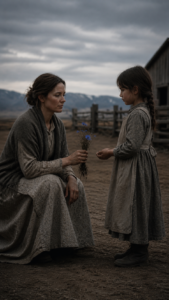
Folks on the platform stopped talking, though none of them could later remember making that choice. The sound drifted across the empty Montana prairie like a warning carried by the wind, slow enough to let dread settle into every heartbeat. By the time the black locomotive crawled into view beneath a ceiling of steel-gray clouds, every pair of eyes in town had turned toward the single passenger who refused to look back through the window.
She remained seated until the wheels surrendered their final groan.
Some said she looked like a widow.
Others swore she carried herself like someone who had buried too many people to waste tears on another grave.
No one noticed the worn leather satchel chained to her wrist.
No one noticed the folded map hidden beneath her coat.
And no one—not the stationmaster, not the ranchers leaning against hitching posts, not the deputy pretending to study freight receipts—recognized the faded silver badge sewn inside the lining of her traveling trunk.
If they had, the story of Dry Creek might have ended before it truly began.
Because the woman stepping onto that lonely platform had not crossed two thousand miles searching for honest work.
She had come looking for a man everyone believed had died twelve years earlier.
The only trouble was…
Someone in Dry Creek already knew he was alive.
And they were willing to kill again before anyone else discovered the truth.
The train sighed like an exhausted animal before pulling away, leaving behind drifting smoke that swallowed the station in shifting curtains of gray. When the haze finally lifted, the woman stood alone beside a weathered trunk scarred by countless journeys. She rested one gloved hand upon its lid, studying the town with patient eyes that missed very little.
Dry Creek looked peaceful enough.
Fresh whitewash covered the church.
Children chased one another between wagons.
A blacksmith hammered iron beneath a canvas awning while laughter floated from the hotel porch.
Yet peace had a peculiar habit in frontier country. Sometimes it was genuine.
More often it was simply fear that had learned how to smile.
She counted details instead of people.
Fresh horse tracks leading behind the mercantile.
A shattered upstairs window recently repaired.
Two identical rifles resting in opposite windows across Main Street.
Someone expected trouble.
Or perhaps someone expected her.
The stationmaster finally approached, removing his cap with practiced politeness.
“You waiting on family, ma’am?”
She offered the smallest smile.
“I expect family stopped waiting for me years ago.”
The answer puzzled him enough to end the conversation.
That suited Eleanor Hayes perfectly.
She had spent the last decade learning that questions often revealed more than answers.
A freight wagon rolled past carrying sacks of grain toward the northern road. Painted across its side were the words McCall Ranch.
Her fingers tightened around the trunk handle.
The name struck like an old bullet finding fresh flesh.
McCall.
According to every official record she’d gathered from county archives, Samuel McCall had died beside the Yellowstone River in the autumn of 1878. His body had supposedly been identified by two witnesses before being buried beneath a simple cedar cross.
Except no doctor had examined him.
No marshal had confirmed his identity.
Only two frightened ranch hands had sworn the corpse belonged to Samuel.
Both men disappeared within six months.
That was when Eleanor stopped believing the grave.
She hired a drifter to carry her trunk toward the boarding house.
Instead of following, she wandered through town without purpose—or so it appeared.
Old investigators understood something ambitious young detectives rarely did.
People revealed themselves when they believed they were being ignored.
A barber paused mid-shave as she passed.
The woman arranging apples outside the general store glanced toward the sheriff’s office before looking away.
Even the dogs remained strangely quiet.
Silence carried memory.
Dry Creek remembered something it wished forgotten.
Near the edge of town stood a neglected cemetery fenced by leaning cedar posts.
Most visitors searched for relatives.
Eleanor searched for lies.
The grave marked Samuel McCall rested beneath a cottonwood whose roots had begun lifting nearby headstones.
The marker looked old.
Too old.
She knelt, brushing away dust with careful fingertips.
The inscription claimed Samuel died on October 9, 1878.
But the sandstone itself showed barely five years of weathering.
Someone had replaced it.
Recently.
She looked closer.
Near the base lay a tiny mason’s mark—a carving no larger than a thumbnail.
She recognized it instantly.
The same stonecutter had crafted her father’s monument in Ohio only three years earlier.
Impossible.
Unless someone had ordered this replacement from hundreds of miles away.
Unless whoever commissioned it desperately needed the grave to appear older than it truly was.
Bootsteps crunched behind her.
“You won’t find many answers talking to the dead.”
The voice belonged to an elderly ranch hand whose beard had turned the color of winter sage.
His clothes were patched beyond counting, but his boots remained meticulously cared for.
A man who respected long roads.
Eleanor rose slowly.
“Maybe,” she answered.
“But graves sometimes tell the truth living people refuse to.”
The old cowboy studied her far longer than politeness allowed.
Then his eyes settled upon the trunk waiting beyond the cemetery gate.
Recognition flickered.
Only for a heartbeat.
But she caught it.
“You’ve traveled far,” he murmured.
“I’ve been traveling longer than the railroad knows.”
His weathered face tightened.
“Then I’d leave before sunset.”
“Why?”
He looked toward the distant ridge where storm clouds gathered over endless prairie.
“Because folks who ask about Samuel McCall usually disappear before breakfast.”
Without another word, he tipped his hat and walked away.
Eleanor watched until he vanished behind the church.
She had heard threats before.
This one sounded different.
Not cruel.
Regretful.
As though the old cowboy wasn’t warning her about dangerous men.
He was warning her about a promise someone had never broken.
That evening she rented the smallest room in the boarding house.
After bolting the door, she unlocked the chain securing her leather satchel.
Inside rested a faded photograph.
Four people stood before a ranch house.
A husband.
A wife.
A little girl smiling at something beyond the camera.
And Samuel McCall.
Across the back someone had written seven words in hurried ink.
If I disappear, never trust the preacher.
Eleanor stared at the sentence until darkness filled the room.
Every record in Montana described Reverend Thomas Whitlock as the kindest man west of the Missouri.
He had buried hundreds.
Fed hungry travelers.
Built Dry Creek’s first schoolhouse.
Entire generations trusted him without question.
Which made him the last man anyone would suspect.
Outside, church bells rang nine slow notes.
A minute later came another sound.
Not bells.
A shovel.
Someone was digging.
In the cemetery.
Eleanor did not waste time wondering whether she had imagined it.
The sound came again.
Steel biting into hard earth.
A measured scrape followed by the dull thud of loosened soil. Whoever worked beneath the moon understood silence as well as any outlaw. There were no hurried movements, no whispered voices, only the patient rhythm of someone who believed the night belonged to them.
She extinguished the oil lamp, allowing darkness to swallow the room before easing the window open.
Cold April air drifted inside carrying the scent of damp sage and fresh-turned dirt.
The cemetery lay no more than three hundred yards beyond the boarding house, its leaning headstones silver beneath a rising moon. Between the cottonwoods she caught the faint swing of a lantern, quickly covered again as though its owner feared even the stars might betray him.
Eleanor slipped her revolver into her coat pocket.
The weapon had belonged to her father.
Its walnut grip had grown smooth beneath decades of determined hands.
She prayed she would not need it.
Experience told her otherwise.
The streets of Dry Creek had emptied. Porch lights glowed behind drawn curtains, but not a soul ventured outside. It was an odd kind of obedience. Frontier towns usually welcomed excitement. Tonight they behaved as though everyone had agreed to ignore whatever happened after dark.
That frightened her more than gunfire ever could.
People only learned such habits after surviving something terrible.
She crossed the churchyard without disturbing the gravel path.
The digging stopped.
Silence settled over the cemetery again.
Too suddenly.
Someone had heard her.
She crouched beside an aging cedar marker and listened.
Nothing.
Then, somewhere behind Samuel McCall’s grave, a crow burst from the branches with a startled cry.
Eleanor spun toward the sound just in time to glimpse a shadow disappearing between the cottonwoods.
Tall.
Broad-shouldered.
Moving with remarkable speed for a man carrying a shovel.
She gave chase.
The shadow never looked back.
Instead it disappeared into a narrow wash cutting through the hills east of town. Eleanor followed until loose stones rolled beneath her boots. By the time she reached the bottom, the stranger had vanished as completely as smoke on prairie wind.
Only the shovel remained.
It lay half buried beside a patch of disturbed earth.
She knelt.
The soil was fresh.
Very fresh.
Not the loose dirt from Samuel’s grave.
Someone had dug here tonight.
Her fingers uncovered the corner of an old wooden box no larger than a saddlebag.
The lid had rotted enough to split beneath gentle pressure.
Inside rested a child’s leather shoe.
Tiny.
Beautifully stitched.
Beside it lay a silver hair ribbon faded almost white with age.
Nothing else.
No bones.
No clothing.
No explanation.
Only two objects carefully wrapped in oilcloth before being hidden underground.
Eleanor turned the little shoe over in her hands.
The sole bore the initials A.M.
Not S.M.
Not Samuel.
A.M.
She repeated the letters until memory answered.
Anna McCall.
Samuel’s daughter.
According to county records, the child had died of scarlet fever the winter before her father’s supposed death.
Yet no grave in Dry Creek carried her name.
Why preserve a dead child’s belongings in secret?
Unless…
Someone expected her to need them again.
The realization sent a chill through her.
Children outgrew shoes.
Dead children did not.
Footsteps echoed behind her.
She drew the revolver before the newcomer could speak.
“Easy.”
The elderly ranch hand slowly lifted both palms.
Moonlight carved deep lines across his weathered face.
“I figured you’d come looking.”
“You’ve been following me.”
“I’ve been trying to keep you alive.”
His answer carried no pride.
Only exhaustion.
Eleanor lowered the revolver slightly.
“You knew someone was digging.”
“I knew someone always digs.”
He glanced toward the open box.
“So they found the hiding place.”
“They?”
He nodded.
“There’ve been others before you.”
“Looking for Samuel?”
“Looking for the truth.”
“What happened to them?”
The old cowboy stared toward town.
“You ever notice how many empty ranches surround Dry Creek?”
She had.
Half a dozen abandoned homesteads stood scattered across the valley, their fences collapsing beneath years of wind.
“I assumed drought.”
“So did everyone else.”
His voice became almost a whisper.
“But drought doesn’t leave dinner plates on tables.”
Eleanor waited.
He continued only after several long seconds.
“First came a schoolteacher from Helena.”
“He disappeared?”
“Without packing.”
“Then?”
“A newspaper man from Billings.”
“And after him?”
“A deputy marshal.”
He looked directly into her eyes.
“They all started by asking about Samuel McCall.”
The breeze shifted, carrying distant church bells across the valley.
Midnight.
The old cowboy removed his hat.
“I should leave.”
“You’re afraid.”
“I learned long ago there’s a difference between courage and foolishness.”
He turned to go.
Eleanor caught his sleeve.
“What aren’t you telling me?”
He hesitated.
For the first time, genuine fear cracked the calm mask he had worn since their meeting.
“Samuel didn’t disappear because someone wanted him dead.”
She frowned.
“Then why?”
“He disappeared because he found something no honest man was supposed to see.”
“What?”
The cowboy swallowed.
“Gold.”
Eleanor blinked.
“There were no gold strikes near Dry Creek.”
“Exactly.”
Silence stretched between them.
Then he added the words that changed everything.
“It wasn’t buried in the mountains.”
He pointed toward the church.
“It was buried beneath the town.”
A rifle cracked through the darkness.
The old cowboy staggered backward.
Blood blossomed across his coat.
Before Eleanor could catch him, a second shot shattered the lantern hanging from a nearby branch, plunging the wash into complete darkness.
Somewhere above them, hidden among the rocks, a calm voice echoed through the night.
“You should have minded the grave.”
Then came the unmistakable sound of a rifle bolt sliding home.
And whoever waited in the darkness was taking careful aim at Eleanor Hayes.
Note: Some content was generated using AI tools (ChatGPT) and edited by the author for creativity and suitability for historical illustration purposes.