
The scream did not come from the woman tied to the post.
It came from a little girl who was just old enough to understand that something evil was happening, yet far too young to know why no one was trying to stop it.
Every conversation in Redemption Gulch died at once.
Dust drifted through the autumn sunlight, wrapping itself around the weathered auction platform standing in the middle of town. On that platform stood a young Chinese woman, her wrists bound above her head with coarse hemp rope. Her coat was torn. Her boots were cracked from months of walking. A bruise darkened one side of her face, but none of those wounds unsettled the crowd as much as her expression.
She refused to bow her head.
She refused to cry.
She refused to look broken.
Instead, her dark eyes searched beyond the saloon, beyond the church, beyond the endless Wyoming prairie, as though she were waiting for someone who had made a promise long ago.
The auctioneer slammed the butt of his cane against the wooden platform.
“Ladies and gentlemen,” he shouted with theatrical delight, “here stands the hardest-working woman west of the Mississippi! She cooks. She sews. She cleans. She speaks little and obeys quickly.”
Laughter exploded through the crowd.
The woman never blinked.
The little girl buried her face against her father’s leg.
“Papa…” she whispered. “Why are they selling her?”
Her father could not answer.
Neither could anyone else.
Because every adult standing there understood a terrible truth they would rather ignore.
When enough people stay silent, cruelty begins calling itself business.
The auctioneer grinned wider.
“Ten dollars!”
He raised both arms dramatically.
“Surely somebody needs another servant.”
The bids never came.
Not because the crowd pitied her.
Because they already knew who intended to buy her.
Near the front stood Jedediah Cain.
A cattle broker.
A labor contractor.
A respected businessman in three counties.
And a trafficker in everything the law refused to see.
He smiled with complete confidence.
The woman belonged to him before the auction had even begun.
This public spectacle was only paperwork disguised as entertainment.
The Chinese woman closed her eyes for one brief moment.
Not in surrender.
In memory.
She remembered waves crashing against the wooden ship that had carried her across the Pacific.
She remembered her mother’s hands wrapping a faded red ribbon around her wrist before she left home.
“You are traveling toward opportunity,” her mother had whispered.
“If the world is kind, write to us.”
If.
Such a small word.
Such a dangerous promise.
Opportunity had lasted exactly four days after she reached San Francisco.
The employment contract had disappeared.
The interpreter had vanished.
The wages had become debts.
The debts had become chains.
One railroad camp led to another.
One owner sold her to the next.
Every signature on every piece of paper carried the same hidden message.
You no longer belong to yourself.
She had forgotten how many names men had called her.
But she had never forgotten her own.
May-Ling Zhao.
The last possession no one had managed to steal.
The auctioneer raised his voice again.
“Ten dollars! Surely she’s worth that.”
Silence answered him.
Then another voice drifted across the street.
“I’ll pay.”
Heads turned instantly.
Standing beside a supply wagon dusted with mountain dirt was a broad-shouldered rancher wearing a faded cavalry coat.
Elias Thorne.
Widower.
Father of two.
A man known more for keeping to himself than involving himself in other people’s affairs.
He hadn’t come looking for trouble.
He had come to buy flour, lamp oil, and winter seed.
Yet now every eye in town rested on him.
The auctioneer laughed.
“Didn’t know you were shopping for a wife today, Elias.”
More laughter followed.
Elias ignored every word.
He stepped forward.
Reached into his coat.
Placed ten silver dollars one by one onto the wooden platform.
Each coin rang like a hammer striking a church bell.
The laughter slowly disappeared.
Something about the rancher’s face warned everyone that this was no joke.
The auctioneer counted the money twice.
Business was business.
He sliced through the rope with a hunting knife.
May-Ling’s arms dropped heavily to her sides.
Blood rushed painfully back into her hands.
For several seconds she simply stared at her own wrists, almost unable to believe they were free.
Elias nodded toward his wagon.
“Come.”
Only one word.
No orders.
No bargain.
No explanation.
She hesitated.
Experience had taught her that kindness often hid the sharpest traps.
Still…
Remaining here guaranteed only one future.
So she climbed quietly into the wagon.
As the horses pulled away from Redemption Gulch, she looked back one final time.
Jedediah Cain had not moved.
He stood exactly where she had left him.
Smiling.
Not the smile of a man who had lost.
The smile of a man who already knew where his property would be found.
That smile followed the wagon for miles across the prairie.
And long after the town disappeared behind distant hills, May-Ling could not shake the terrifying feeling that she had not escaped anything at all.
She had merely wandered into the next chapter of someone else’s plan.
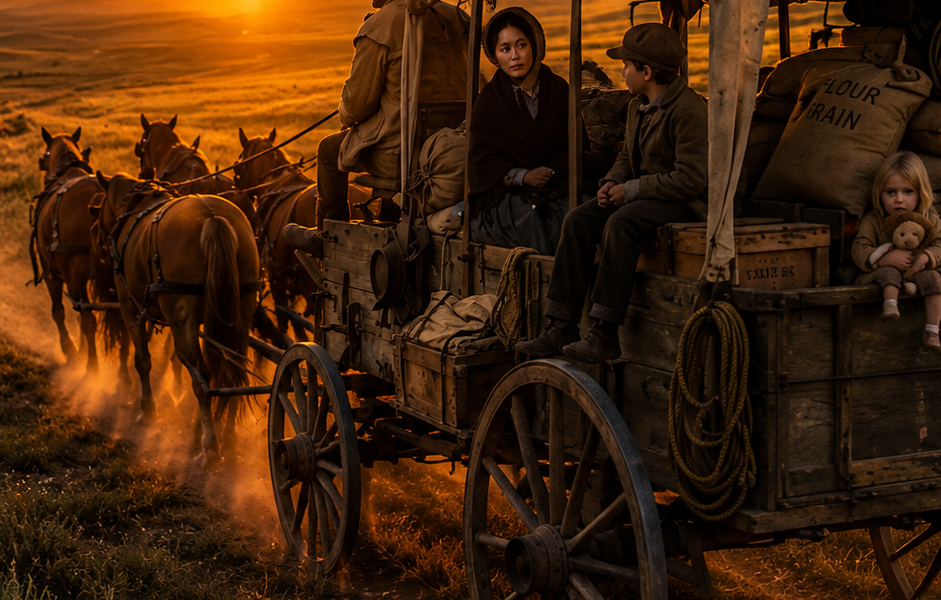
The journey home stretched across nearly forty miles of open country where the wind never seemed to stop speaking.
The wagon creaked over frozen ruts while endless golden grass bent beneath the late autumn breeze. Snow rested on distant mountain peaks, glowing beneath a pale afternoon sun that promised another hard winter. The land was beautiful in the lonely way only the frontier could be—vast enough to make a man believe he could leave his past behind, yet empty enough that every secret eventually found its way back.
May-Ling sat quietly in the rear of the wagon with her hands folded in her lap.
She did not ask where they were going.
She did not ask why Elias had paid for her freedom.
Questions had become dangerous long before she crossed the Pacific.
People who asked questions disappeared.
She had seen it happen too many times.
Across from her sat a little girl clutching a faded rag doll whose stitched smile had nearly worn away.
Every few moments the child peeked over the doll’s shoulder, studying May-Ling with cautious curiosity before quickly looking away again.
Finally, she gathered enough courage to speak.
“Are you hungry?”
May-Ling blinked.
No one had asked her that in months.
Before she could answer, the little girl carefully reached into a cloth sack and offered half of an apple.
It was bruised.
Small.
Probably the only fruit she had.
May-Ling stared at it as though it were something precious.
Then she accepted it with both hands.
“Thank you.”
The little girl smiled.
“My name’s Lily.”
May-Ling returned the smile, though hers carried years of exhaustion.
“I’m May-Ling.”
Lily nodded happily, as if introductions alone had solved some great mystery.
Children had a remarkable gift.
They saw people before they saw differences.
Beside the wagon seat, ten-year-old Samuel remained silent.
Unlike his younger sister, he watched everything carefully.
Not with fear.
With responsibility.
His eyes reminded May-Ling of boys who had grown into men long before childhood was supposed to end.
She recognized that look.
She had worn it herself.
Hours later, the wagon climbed a narrow trail overlooking a quiet valley hidden between towering pines and granite cliffs.
Smoke drifted lazily from the chimney of a single log cabin standing beside a weathered red barn.
Split firewood had been stacked with military precision.
Fences enclosed horses and cattle grazing peacefully along a winding creek.
The place looked forgotten by the rest of the world.
Perhaps that was exactly why Elias had chosen it.
“This is home,” he said quietly.
The words sounded almost unfamiliar coming from his own mouth.
May-Ling stepped down from the wagon and slowly surveyed the valley.
No shouting.
No guards.
No chains.
Only the sound of water flowing over smooth stones.
For a brief, dangerous moment, she allowed herself to imagine what peace might feel like.
Then her eyes found something standing alone on a hill overlooking the cabin.
A single wooden cross.
Old.
Weather-beaten.
Surrounded by wildflowers that had long since faded with autumn.
Someone still visited that grave.
Fresh pine branches rested at its base.
Someone had loved the person buried there enough to remember.
Inside the cabin, warmth wrapped around her like a forgotten memory.
The scent of pine logs, fresh bread, and simmering stew lingered in the air.
Everything was simple.
Everything was clean.
Yet every corner carried traces of someone who was no longer there.
A shawl hung beside the fireplace.
Embroidery rested unfinished in a basket near the window.
A cracked teacup remained carefully placed upon a shelf instead of thrown away.
It was not a house abandoned by love.
It was a house still waiting for it.
Elias carried her small bundle into the spare room.
The space held little more than a narrow bed, a wooden chair, and a tiny window overlooking the creek.
“You can stay here.”
She nodded.
He placed a folded blanket beside the bed.
“If you decide to leave…”
He hesitated.
“…there’s food enough for several days.”
May-Ling looked at him in confusion.
“You aren’t locking the door?”
“No.”
“You aren’t afraid I’ll run?”
A faint sadness crossed his face.
“No one should have to earn the right to walk away.”
Those words lingered long after he quietly left the room.
That night May-Ling slept with one eye open.
Every creak of the cabin made her heart race.
She waited for footsteps outside her door.
For angry voices.
For someone demanding payment.
Nothing came.
Only the soft crackling of the fireplace and the distant howl of wolves somewhere high in the mountains.
She woke before sunrise out of habit.
The cabin remained silent.
No orders waited for her.
No overseer struck a bell.
For nearly an hour she simply stood in the kitchen, uncertain what a free person was supposed to do with an ordinary morning.
Finally she noticed a basket overflowing with clothing that needed mending.
She found a needle.
Then thread.
Without thinking, her hands began working.
Old habits often survived long after suffering ended.
When Elias entered carrying fresh milk from the barn, he stopped in the doorway.
“You don’t have to do that.”
May-Ling looked up.
“I know.”
“Then why?”
She lowered her eyes.
“Because busy hands keep bad memories quiet.”
He said nothing.
There was no answer large enough for a sentence like that.
Over the following days, the rhythm of the homestead slowly changed.
Samuel showed her where extra firewood was stored.
Lily insisted on teaching her the names of every chicken as though they were important members of the family.
May-Ling laughed for the first time in months when Lily introduced an especially stubborn rooster as “the mayor.”
The sound surprised everyone.
Including May-Ling herself.
Elias noticed it from across the yard.
It was soft.
Almost uncertain.
But it transformed the lonely valley more completely than spring sunlight ever could.
Even so, shadows refused to leave completely.
Some nights May-Ling awoke trembling from nightmares.
She dreamed of auction blocks.
Locked wagons.
Voices arguing over prices while pretending she could not understand English.
Once, just before dawn, Elias found her sitting alone on the porch wrapped in a blanket, staring toward the eastern mountains.
“You couldn’t sleep?”
She shook her head.
“They always found us before sunrise.”
He frowned.
“Who?”
She remained silent for so long he assumed she would never answer.
Then she whispered,
“The men who kept the records.”
“The records?”
“They remembered every face.”
“Every debt.”
“Every escape.”
She looked toward the dark horizon.
“They never stopped searching.”
Elias followed her gaze.
Nothing moved beyond the trees.
Yet for reasons he could not explain, he suddenly felt that someone far away was already searching this valley.
Watching.
Waiting.
And somewhere beyond the mountains, a man who had smiled during an auction was preparing to collect something he believed had never truly stopped belonging to him.
Note: Some content was generated using AI tools (ChatGPT) and edited by the author for creativity and suitability for historical illustration purposes.