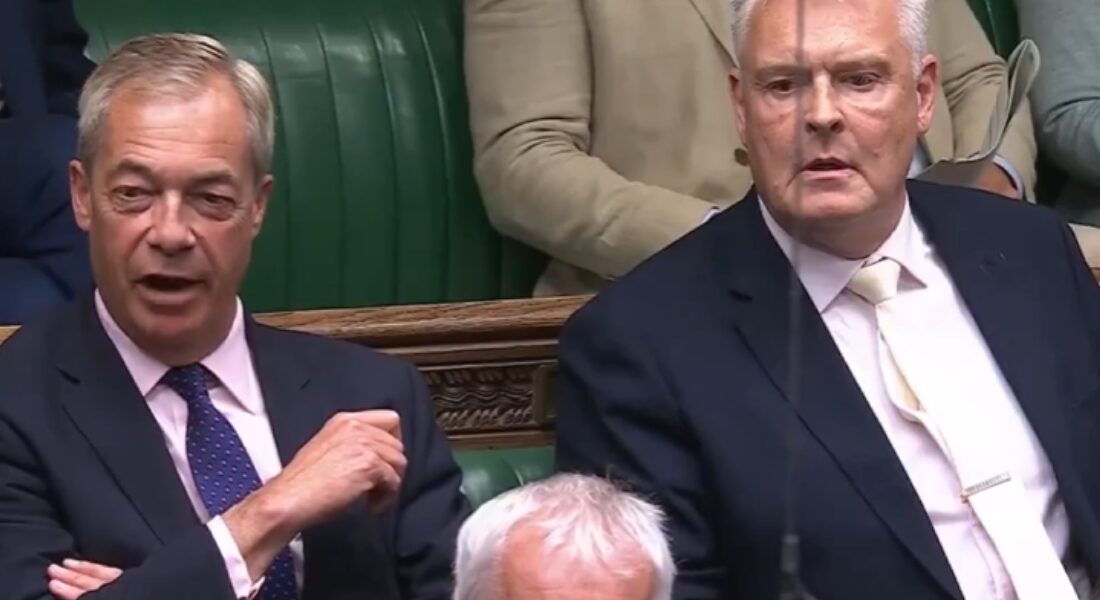
Starmer turns Lee Anderson’s PMQs attack into a brutal question about Farage’s £5m gift. n1

Keir Starmer Turns Lee Anderson’s Immigration Challenge Into Another Attack on Nigel Farage’s Finances
A tense exchange during Prime Minister’s Questions highlighted how questions surrounding Nigel Farage‘s finances have become a recurring feature of political debate in Westminster.
During the weekly Commons session, Reform UK MP Lee Anderson challenged Prime Minister Keir Starmer on immigration, asking whether he agreed that all people in the UK illegally should be deported.
Rather than answering the immigration question directly, Starmer immediately redirected attention toward Reform UK’s leader.
“He should be asking questions of his party leader,” Starmer replied.
He continued:
“Why did he keep his £5m gift secret? And are they happy with him earning £22,000 per hour?”
The response transformed what began as a debate over immigration into another parliamentary confrontation over Farage’s financial disclosures and outside earnings.
The £5 Million Investigation
Starmer’s first remark referred to an ongoing investigation by the Parliamentary Commissioner for Standards into Farage’s declaration of financial support connected with businessman Christopher Harborne.
The matter concerns a reported £5 million personal gift that critics argue should have been disclosed earlier under parliamentary transparency rules.
Farage has consistently denied wrongdoing and maintains that the financial arrangement did not require registration under Parliament’s rules.
Over recent months, he has offered different explanations regarding the purpose of the funds, at various times describing them as relating to personal security, as recognition for his role in campaigning for Brexit, and declining in one television interview to discuss the matter further.
The Parliamentary Commissioner for Standards has not yet published conclusions.
Until that investigation is complete, no finding of wrongdoing has been made.
However, the issue has become a frequent subject of political debate.
Labour has publicly called on Farage to answer numerous questions regarding the financial arrangement, arguing that greater transparency is necessary.
Should the Commissioner ultimately conclude that parliamentary rules were seriously breached, sanctions could potentially include suspension from the House of Commons.
Under parliamentary rules, suspensions exceeding ten sitting days may trigger a recall petition in the MP’s constituency.
Whether that threshold is ever reached depends entirely upon the outcome of the independent investigation.
The £22,000-an-Hour Reference
Starmer’s second criticism focused on Farage’s outside employment.
Recently published parliamentary records showed that Farage registered approximately £270,000 for around twelve hours of promotional work as a brand ambassador for Direct Bullion.
That equates to an hourly rate of roughly £22,500.
The declaration attracted significant political attention because it came amid renewed debate over MPs holding second jobs.
Labour MP Richard Burgon subsequently led a parliamentary debate advocating tighter restrictions—or potentially a ban—on second jobs for Members of Parliament.
Burgon publicly invited Farage to participate in that discussion and explain his outside earnings.
Farage did not attend.
According to parliamentary declarations, Farage’s outside earnings since entering Parliament exceed £1.5 million, placing him among the highest-earning MPs from activities beyond Westminster.
Holding outside employment is not itself prohibited under parliamentary rules, provided relevant interests are properly declared.
The political debate instead concerns whether substantial external income creates potential conflicts with parliamentary responsibilities.
Immigration Question Goes Unanswered
Although Starmer’s response generated headlines, it left Anderson’s original question unanswered.
Anderson had asked whether the government supported deporting everyone residing illegally in the United Kingdom.
The Prime Minister did not address the policy directly.
Instead, he used the opportunity to challenge Reform UK’s credibility by highlighting unresolved questions surrounding its leader.
Such exchanges are hardly unusual during Prime Minister’s Questions.
The weekly session frequently serves as a forum for political point-scoring rather than detailed policy discussion.
Questions are often met with counter-attacks rather than direct answers.
A Familiar Parliamentary Strategy
The latest exchange reflects an increasingly recognizable pattern.
Reform MPs have repeatedly focused their Commons questions on immigration, asylum policy, and border security.
Government ministers have increasingly responded by redirecting attention toward Farage’s financial affairs rather than engaging directly with Reform’s policy arguments.
Labour appears to regard the issue as politically effective because the Standards investigation remains ongoing and continues to attract media attention.
Rather than treating the investigation as a separate controversy, ministers increasingly deploy it as part of broader political exchanges.
The strategy allows Labour to shift difficult debates onto questions of political transparency.
Whether that represents effective political communication or avoidance of substantive policy discussion depends largely on one’s perspective.
Financial Scrutiny Continues
The Parliamentary Standards investigation concerning Christopher Harborne is only one element of broader scrutiny surrounding Farage’s finances.
Recent reporting has also examined separate allegations involving financial support from longtime associate George Swinfen Cottrell, although those allegations remain contested and are separate from the Harborne inquiry.
Farage and Reform UK deny wrongdoing in relation to both matters.
Independent investigations remain ongoing.
No formal findings have yet been published.
My Professional Perspective
Having covered Westminster for decades, I believe this exchange illustrates a broader evolution in British parliamentary politics.
The most significant story is not what was said.
It is what was not answered.
PMQs Is Increasingly About Political Framing
Prime Minister’s Questions has never been a forum primarily designed for detailed policy discussion.
Its purpose is political accountability.
In practice, however, it often functions as a contest over narrative.
Opposition MPs ask questions designed to expose perceived government weaknesses.
Prime ministers respond by highlighting perceived weaknesses within the opposition.
This exchange followed that familiar pattern almost perfectly.
Anderson attempted to frame the day’s agenda around immigration.
Starmer reframed it around transparency and ethics.
Each side pursued the subject they believed offered greater political advantage.
Why Labour Keeps Returning to the Same Story
The persistence of the £5 million issue reflects an important communications principle.
Political attacks become particularly effective when they rely on unresolved questions rather than disputed conclusions.
Labour does not need to prove wrongdoing every week.
Instead, ministers simply remind Parliament that an independent investigation remains underway and that questions continue to be asked.
As long as those questions remain unresolved, they retain political value.
That explains why Starmer can repeatedly reference the investigation without introducing any new information.
Reform Faces a Difficult Strategic Challenge
Reform UK has built much of its political identity around challenging the political establishment on issues such as immigration, government spending, and public accountability.
However, when its own leader becomes the subject of transparency questions, those issues become politically awkward.
Every time Reform attempts to focus attention elsewhere, Labour now has an opportunity to redirect discussion back toward Farage’s financial affairs.
Until the Standards Commissioner reaches a conclusion, that tactical dynamic is unlikely to disappear.
Immigration Still Matters
At the same time, the exchange demonstrates the limitations of parliamentary theatre.
Anderson’s underlying policy question—how the government intends to deal with illegal immigration—remains an issue of considerable public interest.
Many voters watching PMQs may have expected an answer addressing deportation policy.
Instead, they witnessed another argument over political ethics.
That disconnect highlights one of Westminster’s enduring tensions.
The issues politicians choose to debate are not always the same issues voters most want addressed.
The Investigation Will Ultimately Determine the Political Narrative
It is important to distinguish political rhetoric from institutional process.
At present, the Parliamentary Commissioner for Standards has not concluded that Farage breached any rules.
Labour is entitled to raise questions.
Farage is entitled to deny wrongdoing.
Only the independent investigation can determine whether parliamentary disclosure requirements were satisfied.
Until that process concludes, political arguments will continue to outpace definitive findings.
Conclusion
The latest Prime Minister’s Questions exchange demonstrated how Nigel Farage’s financial affairs have become embedded in Westminster’s daily political battles.
Lee Anderson attempted to challenge the government on immigration. Keir Starmer instead shifted attention to unresolved questions surrounding Farage’s financial disclosures and substantial outside earnings.
Neither side achieved a full discussion of the other’s chosen subject. Anderson did not receive a direct answer on deportation policy, while Starmer repeated criticisms that remain subject to ongoing independent investigation.
The episode illustrates how parliamentary debate increasingly revolves around competing political narratives rather than straightforward exchanges on policy.
Ultimately, the durability of Labour’s strategy will depend on the outcome of the Parliamentary Commissioner for Standards’ investigation. If the inquiry clears Farage, repeated attacks may lose force. If it identifies serious breaches, the political consequences could extend far beyond a single Prime Minister’s Questions session.
The broader question for Westminster is whether political accountability is better served by tactical exchanges that dominate headlines—or by substantive answers to the policy questions MPs place before the House each week.