Shocking Historical Photos That Make You Question Everything – Decoding Ancient .V2

In an old photograph, an ordinary moment can survive long after the world around it has disappeared. A soldier holds a puppy near the end of the Second World War. A seven-year-old child liberated from Buchenwald waits to be transported to Switzerland. In London, wounded British servicemen sing beside nurses in a military hospital in 1940, while elsewhere in Europe, the machinery of war continues to reshape entire nations. Yet these photographs tell only part of the story. Beyond the uniforms, famous faces, ruined buildings, and carefully preserved poses lies something harder to capture: the lives people were trying to protect, the societies they were struggling to understand, and the fragile boundary between an ordinary day and a moment that history would never forget. What happens when we look beyond the image itself?
The past rarely announces which moments will become historical. In 1925, Howard Carter examined the innermost coffin of Tutankhamun, continuing the painstaking work associated with one of the most famous archaeological discoveries of the twentieth century. The scene belonged to a world far removed from the battlefields of Europe, yet it reflected another human struggle against time: the attempt to recover the traces of people whose lives had ended thousands of years earlier. The coffin was more than an object of extraordinary historical interest. It was a surviving fragment of a civilization, preserved through centuries and brought into the modern world by the work of archaeologists.
There is a quiet contrast between that examination and the photographs taken during the wars that followed. Carter studied the remains of an ancient ruler, trying to understand a distant past. A generation later, photographers would document the remains of modern cities, the consequences of political decisions, and the faces of people whose lives had been interrupted by events they could not control. In both cases, the camera and the historical record preserved something that time might otherwise have erased. But preservation is never complete. An image can reveal the shape of an object, the expression on a face, or the condition of a building. It cannot automatically tell us everything that happened before the shutter opened or after it closed.
That limitation becomes particularly important when we examine photographs of the Second World War. The conflict produced images of extraordinary destruction, but it also left behind smaller scenes that resist the idea that wartime life consisted entirely of fighting. In April 1945, near Katherineberg in Germany, paratrooper Harry Lorenzo of the 509th Parachute Infantry Battalion was photographed clutching his Thompson submachine gun while holding his puppy, Kaput. The image brings together two realities that seem almost incompatible: a soldier equipped for combat and a small animal associated with companionship and ordinary domestic life.
The photograph does not tell us everything about Lorenzo’s experiences, nor does it establish what happened to him or Kaput afterward. Its significance lies in what it actually shows. Even in a landscape shaped by military operations, a soldier could be photographed holding a puppy. The weapon and the animal occupy the same frame, reminding us that the people who participated in war did not cease to exist as individuals simply because they wore uniforms.
It is tempting to turn such a scene into a symbol of innocence surviving amid destruction. That interpretation can be meaningful, but it must remain an interpretation rather than a claim about what the soldier felt. What the photograph establishes is simpler and, in its own way, more powerful: at a particular moment near the end of the war in Europe, a man carrying a weapon held a small animal close to him. History has preserved that moment without preserving every thought that accompanied it.
The end of the war was approaching, but the human consequences were far from resolved. On May 8, 1945, Field Marshal Wilhelm Keitel signed the act of military surrender in Berlin. The signature marked a decisive moment in European history. Germany’s armed forces were surrendering, and the war in Europe was coming to an end. The document represented the collapse of a military campaign that had devastated the continent, but it could not instantly restore the homes, families, institutions, and communities that had been destroyed.
The importance of that moment becomes clearer when it is placed beside another image from the same year: a seven-year-old prisoner liberated from the Buchenwald concentration camp waiting in a queue before being transported to Switzerland. The child’s identity is not established in the supplied caption, and the photograph alone cannot tell us the full course of his imprisonment. Nevertheless, the central fact is unmistakable. A child who had been held in a concentration camp was among those whose lives required attention after liberation.
For an adult military commander, surrender could be recorded through a signature, a document, and an official date. For a child emerging from imprisonment, the consequences of war were not so easily contained within a single moment. Liberation changed the immediate circumstances, but it did not make the preceding experience disappear. Transporting a child to safety was one step in a much larger process of survival and recovery.
There is a danger in treating the end of a war as though it were a clean dividing line between suffering and peace. The calendar changes. Governments issue announcements. Armies surrender. Yet people must still live with what has happened. Families must discover who has survived. Displaced people must find somewhere to go. Children must be cared for. Those who have lost homes must confront the uncertainty of beginning again.
The photograph of the young Buchenwald survivor waiting for transport captures one small part of that transition. It does not need invented dialogue or reconstructed emotions to convey its historical significance. The child was alive, had been liberated, and was waiting to be moved to Switzerland. The queue itself suggests an organized effort to transport people away from the conditions they had endured. Behind that practical arrangement lay the enormous task of bringing vulnerable survivors into a safer environment.
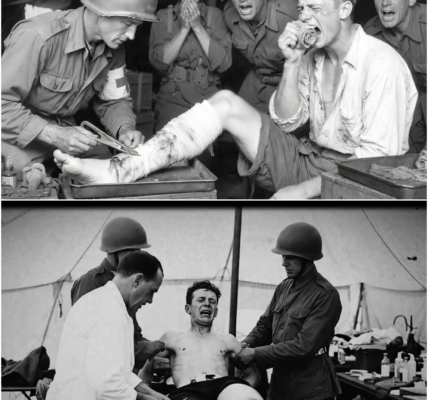
The same distinction between military victory and human recovery appears in a photograph taken in London in 1940. Wounded soldiers of the British Expeditionary Force, having returned from continental Europe, were shown singing with nurses in a ward at a military hospital. The image belongs to the early period of the Second World War, when Britain was already confronting the consequences of military operations on the European mainland.

The men in the photograph were wounded. The nurses were working in a setting where medical care was necessary because war had injured the people entrusted to their care. Yet the recorded moment was not one of a battlefield attack or a military advance. It was a song in a hospital ward.
The photograph offers no reason to assume that the singing erased the soldiers’ pain or that the ward was free from anxiety. Instead, it preserves a moment of collective activity within a place defined by injury and recovery. The soldiers and nurses were brought together by circumstances created by war, but the activity visible in the image belonged to another part of human life: music, shared attention, and the ordinary ways people occupy time while facing difficult circumstances.
That contrast matters because wartime photographs can easily reduce individuals to categories. Soldiers become numbers. Nurses become supporting figures. Wounded men become evidence of military losses. An image of them singing resists that reduction, not by explaining everything about their experiences, but by recording an activity that cannot be understood solely through a list of casualties.
The war also transformed places far beyond hospital wards and military installations. In February 1945, destroyed American vehicles were photographed along the shore of Iwo Jima, Japan. The vehicles stood as material evidence of the fighting on an island that had become a major battlefield in the Pacific campaign. Their damaged forms showed what military operations could leave behind even after the immediate movement of troops had passed.
The wreckage of vehicles offers a different kind of historical evidence from a photograph of a person. It records the physical consequences of conflict rather than an individual’s expression or gesture. But these two forms of evidence belong to the same history. Military equipment was designed to move people and supplies, support operations, and sustain forces in combat. When such equipment was destroyed or abandoned, it became part of the landscape of war.

The shore of Iwo Jima was not merely a backdrop. It was a place where military objectives, human decisions, and physical destruction converged. The photograph cannot by itself reconstruct every action that produced the wreckage, but it preserves the result. The vehicles that once served a practical purpose had become silent objects within a battlefield environment.
When we look at images of destroyed equipment, it is easy to concentrate on the machines themselves: their shapes, their engineering, and the violence implied by their condition. Yet the significance of such photographs extends beyond technology. Vehicles required crews, maintenance, fuel, transportation networks, and a wider system of military organization. Their destruction belonged to a much larger human and logistical process.
In 1945, another extraordinary image was made far from the Pacific battlefield. American officers Lieutenant Colonel Ben Thompson and Virgil Happy were photographed with bundles of money in the vault of the Magdeburger Bank, where reichsmarks reportedly worth $280 million were found. The photograph connected the end of the war in Europe with the material remains of a defeated regime.
Money is often treated as an abstract measure of value. Inside a bank vault, it can be arranged, counted, secured, and recorded. But the political and economic circumstances surrounding a currency can change dramatically. A large quantity of banknotes may remain physically present even as the system that gave them their meaning is transformed.
The photograph’s reported figure is striking, but the deeper historical interest lies in the contrast between the orderly interior of a bank vault and the upheaval surrounding the end of the Third Reich. The war had not been fought only through military movements. It had also depended on institutions, economic resources, administrative systems, and the ability of governments to direct material wealth toward their objectives.
The discovery of reichsmarks in a bank vault did not, by itself, explain the entire financial history of Nazi Germany. Nor can the image establish the subsequent fate of every banknote shown. It does, however, preserve a moment when officers encountered a substantial quantity of currency within the territory of a defeated state. The vault offers a glimpse of the material structures that remained when political authority and military control were being radically reorganized.
A different image, taken during the Nuremberg trials between 1945 and 1946, shows former leaders of the Third Reich laughing at a translation error. The caption draws attention to a brief incident during proceedings intended to address the responsibility of leading figures in Nazi Germany. It is an unsettling reminder that even within a courtroom established to examine immense crimes, moments of ordinary human behavior could occur.
The photograph should not be mistaken for evidence that the proceedings were trivial or that the crimes under examination were somehow diminished by an incidental moment of laughter. Its meaning depends on the wider setting. The trials represented an attempt to establish individual responsibility through legal proceedings, evidence, testimony, and judgment. Translation was essential to that process because participants needed to communicate across languages.

A translation error could produce an unexpected reaction. But the historical significance of the trials did not rest on such an incident. It rested on the effort to document crimes, assess evidence, and determine responsibility under law. The photograph preserves a moment that was human in its immediate form, while the proceedings surrounding it dealt with questions of extraordinary consequence.
This is one of the difficulties of reading historical photographs. A single frame can make an incidental moment appear central because it is unusual or visually striking. The viewer must resist allowing that moment to replace the larger event. The laughter recorded in a courtroom does not define the trial. It simply reminds us that history unfolds through real people, whose gestures and expressions may not always appear consistent with the gravity of their surroundings.
The war’s consequences extended beyond Europe and the Pacific. On March 8, 1919, graves of American soldiers who had died of influenza in Devon, England, were photographed. The image belongs to the aftermath of the First World War, but it also reveals how the human losses of the era cannot be understood through combat alone. The influenza pandemic affected military personnel and civilian populations across national boundaries, adding another layer of suffering to a period already shaped by mass mobilization and conflict.
These graves point toward an important distinction. Not everyone who died during a wartime period was killed in battle. Disease, inadequate living conditions, movement between countries, and other circumstances could also prove fatal. A historical account that concentrates only on military engagements risks overlooking people whose deaths were connected to the wider conditions of the age.
The graves in Devon preserve a record of loss, but they also raise questions about the systems responsible for caring for the dead and remembering them. Military cemeteries organize individual deaths into rows and names, giving them a visible place within a larger collective memory. The arrangement can create a sense of order, even though the lives represented by the graves were distinct and the circumstances of each death were not necessarily the same.

By 1919, the First World War had ended, but its aftermath remained visible in the lives of soldiers, families, and communities. The influenza epidemic complicated that transition. It demonstrated that the conclusion of military hostilities did not mean the immediate disappearance of danger or uncertainty.
Another photograph from the aftermath of the Great War shows crowds in London observing the first two-minute silence for those killed in the conflict. The men in the image have removed their hats as a gesture of respect. The scene records a public act of remembrance in 1919, when the dead were being commemorated not only through individual funerals and military ceremonies but also through a shared moment of silence.
Silence is an unusual historical subject. It contains no speech to transcribe and no explicit argument to preserve. Yet a photograph of people standing quietly can record a collective decision about how the past should be remembered. The removal of hats, the gathered crowd, and the stillness of the moment provide visible evidence of a public ritual.
The two-minute silence was not the same as a complete understanding of the war. No ceremony could account for every loss, every disagreement, or every experience of those who had lived through it. But remembrance created a public space in which the dead could be acknowledged beyond the immediate circle of their families.
The image also reminds us that memory is shaped by actions repeated across generations. Memorial ceremonies, anniversaries, and moments of silence do not bring the dead back. They help societies express that the dead have not simply vanished from public consciousness. The crowd in London was participating in an emerging culture of remembrance, one that sought to give collective meaning to losses too numerous to comprehend individually.
The relationship between memory and political change appears again in a photograph from Poland in 1939 or 1940. Stalin’s portrait hung on the facade of Branicki Palace in Białystok during the Soviet occupation. The image shows a historical building transformed by the display of a political leader’s portrait. Architecture that had existed before the occupation became a surface on which a new authority could make itself visible.

A portrait displayed on a building is not merely decoration. In a context of occupation, it can serve as a public expression of power. It changes the appearance of a place and signals whose political presence is being asserted there. Yet the photograph’s date is given with uncertainty, and the image alone cannot establish every administrative or military decision associated with the occupation.
What it can show is the relationship between public space and political authority. The facade of Branicki Palace became the setting for an image of Stalin, connecting a particular place in Poland with the power of the Soviet state during a period of profound upheaval in Eastern Europe.
War and occupation are often described through borders, treaties, military formations, and political agreements. Those structures are essential to understanding events, but photographs reveal another dimension: the way political change enters the visible environment. Portraits appear on buildings. Uniforms occupy streets. Flags and symbols replace those that came before. The physical setting of everyday life becomes part of the language of power.
In 1943, another photograph captured a different kind of encounter with military authority. During the Zoot Suit Riots in Los Angeles, sailors were photographed armed with bats after clearing a street of pachucos. The event emerged from racial and social tensions that had developed in wartime California. It cannot be understood simply as a clash between two groups in a street, because the broader context included discrimination, public hostility toward Mexican American youth, and the pressures of a society mobilized for war.
The image is particularly important because it records a moment when people associated with the armed forces appeared not on a distant battlefield but within a domestic urban conflict. The United States was engaged in a global war against foreign military powers, yet serious tensions and acts of discrimination existed within its own communities.
The wartime setting did not eliminate these divisions. In some circumstances, the atmosphere of military mobilization and heightened patriotism intersected with existing prejudices and fears. Young Mexican Americans wearing zoot suits became targets of hostility, and the violence associated with the riots exposed tensions over belonging, citizenship, race, and public space.

A photograph of sailors carrying bats cannot tell the entire history of the riots. It does not identify every person involved or explain all the events leading to the scene. But when considered alongside the wider historical record, it reminds us that a country can mobilize enormous resources to fight a war abroad while remaining divided over the rights and treatment of people at home.
That contradiction is not unique to the United States, nor can it be reduced to a single photograph. It is a recurring problem in the history of societies at war: the ideals invoked to justify a national struggle do not automatically govern every action within the nation itself.
The Second World War also left photographs of ordinary encounters that complicate the separation between military life and civilian life. In the 1940s, American soldiers were photographed playing with local children on a cart somewhere in West Germany. The caption does not specify the exact location or the identities of the children, so the image should not be assigned a more detailed narrative than the evidence allows.
Still, the scene records an encounter between soldiers and children in a country that had experienced the collapse of the Nazi regime. The soldiers remained members of an occupying military presence, and the children belonged to the local population. Their relationship existed within a political reality shaped by defeat, occupation, and the reorganization of Germany after the war.
The photograph does not prove that the encounter was representative of all relations between American forces and German civilians. It shows a particular moment. But its everyday quality makes it useful precisely because it differs from the images of surrender, destruction, and military equipment that often dominate popular memories of the war.
A child playing near a soldier does not erase the history that brought them together. Nor does it resolve the complicated questions associated with occupation. It simply records a form of contact between people whose lives had been brought into proximity by events on a much larger scale.
Such images encourage a more careful understanding of historical change. Political systems can collapse quickly compared with the time required for societies to rebuild. Armies can enter and leave territories, but people continue to share streets, public spaces, workplaces, and ordinary moments. The relationships that emerge under these conditions are varied, and no single photograph can represent them all.
In November 1918, a photograph in Belgium showed a girl holding a bucket up to a Canadian artillery horse. The date places the image at the end of the First World War, when the effects of military mobilization were still visible across parts of Europe. The presence of an artillery horse connects the scene to the practical systems that sustained armies before motorized transport fully displaced animal power in many military roles.
The girl and the horse occupy a frame that brings civilian life into contact with military equipment and infrastructure. The photograph does not tell us whether the girl was asking for water, offering something to the animal, or engaged in another activity. It would be misleading to invent a definite explanation. What remains visible is the proximity between a child and a horse associated with artillery, in Belgium at the close of a devastating war.
Military histories often focus on weapons, commanders, and strategic objectives. Animals can appear only as equipment or transport. Yet horses were living creatures that required feeding, care, and handling, and their use connected the practical work of war to the people who managed them. The photograph makes that connection visible without requiring a dramatic event.
It also offers a reminder that the end of hostilities did not instantly remove the traces of war from civilian environments. Military animals, vehicles, supplies, and personnel could remain present as communities attempted to return to everyday life. The transition from war to peace was not simply a matter of signing an agreement; it involved the gradual transformation of spaces that had been shaped by military needs.

Not all historical images of conflict depict destruction directly. Some show the machinery that societies created in anticipation of war, the experiments they conducted, or the technological ambitions that surrounded military power. In July 1918, an American-built tank designed by Professor E. F. Miller of the Massachusetts Institute of Technology was photographed. The caption identifies it as the tank America, a name that connects the vehicle to the national ambitions associated with the development of military technology during the First World War.
A prototype or experimental vehicle is a record of a particular moment in engineering. It embodies ideas about protection, mobility, and the possibilities of mechanized warfare. But a photograph of a tank does not establish how effectively it performed, how extensively it was deployed, or what impact it had on military operations. Those questions require evidence beyond the image itself.
The same caution applies to a photograph of a three-wheeled vehicle from 1926, a hovercraft from 1960, and the many images in this collection that document unusual machines or engineering experiments. A vehicle can be visually striking without having transformed history. To understand its significance, we must distinguish between what the photograph shows and what the technology actually achieved.
The development of military and civilian machinery also reveals how the twentieth century changed the relationship between people and the built environment. Machines became larger, faster, and more specialized. Some were created to move troops or carry weapons; others were designed for transportation, exploration, scientific research, or commercial use. Their histories sometimes intersected, but they should not all be treated as parts of the same technological story.
A similar transformation was taking place in science. In 1960, NASA engineers worked on TIROS, America’s first meteorological satellite. The image belongs to a period when space-based observation was beginning to change the way scientists could study the Earth’s atmosphere. Unlike the battlefield photographs of the world wars, it records a technological effort directed toward observing weather from above the planet.
The satellite represented a new way of gathering information about a system that affects every society. Weather had always influenced agriculture, transportation, construction, and military planning. But observing cloud patterns from space offered capabilities that could not be achieved in the same way from a single location on the ground.
The engineers shown working on TIROS were participating in a scientific project whose importance extended beyond one laboratory or one national program. The satellite belonged to a broader development in which instruments placed in orbit could help researchers observe large-scale atmospheric patterns. Its history demonstrates that the same century that produced unprecedented military destruction also produced new methods of scientific observation.
There is a meaningful contrast between the photograph of engineers working on a meteorological satellite and the photographs of destroyed vehicles at Iwo Jima or ruined streets after an earthquake. One records the development of a tool for observing the planet; the others preserve the consequences of events that damaged human settlements. Together, they reveal the range of challenges that modern societies attempted to confront through technology, organization, and collective effort.

But scientific progress did not make the world predictable. In the twentieth century, people continued to face disasters that overwhelmed the systems designed to protect them. On April 18, 1906, a major earthquake struck San Francisco, followed by widespread fires. Photographs taken afterward showed ruins along Geary Street and the remains of the Fairmont Hotel. These images document the physical destruction that transformed the city.
The earthquake and fire were not military events, but their photographs belong in any broad examination of the history of modern society. A ruined street can resemble a battlefield in appearance even when the causes of destruction are entirely different. Buildings that had once defined a neighborhood become damaged structures. Roads lose their familiar function. Landmarks that seemed permanent are revealed to be vulnerable.
The images of San Francisco record more than damaged architecture. They show the limits of human control over the environments people build. Cities depend on networks of buildings, transportation, utilities, commerce, and public services. When disaster damages those networks, the effects extend beyond individual structures.
The Fairmont Hotel, photographed among the ruins, became part of the visible record of the disaster. Geary Street offered another view of the damage. These locations mattered because they were elements of a living city, not simply objects of architectural interest. Their ruined condition made the scale of the disruption visible.
Photographs taken after a disaster also shape how later generations imagine the event. A person who never visited San Francisco in 1906 may come to know its destruction through the surviving images. The photographs provide a point of contact with a city that no longer exists in exactly the same form. But they also create a challenge: a viewer may become familiar with the ruins without understanding the lives that had once filled the streets.
A similar challenge appears in the photograph of a devastating flood in St. Petersburg in 1924. Water changes the appearance and function of a city in a different way from fire or structural collapse. Streets and public spaces that ordinarily support movement and commerce can become difficult or impossible to use. Buildings remain standing, yet their surroundings become unfamiliar.
The caption identifies the flood as devastating, but the image alone cannot establish the experiences of every resident or the full extent of the damage. It does, however, preserve evidence of a disaster that interrupted ordinary urban life. As with the San Francisco photographs, the significance lies not only in the physical scene but also in the relationship between a city and the forces that can temporarily transform it.
Floods, earthquakes, fires, and war differ in their causes, but photographs of their aftermath share an important characteristic: they show places after something has changed. The viewer sees the result rather than the complete process. The absent moments—the warning, the decision to evacuate, the struggle to protect a home, the first return to a damaged street—must be understood through additional evidence rather than invented to make the photograph more dramatic.

This is why historical photographs require both imagination and restraint. Imagination helps us recognize that a ruined building was once part of a functioning community. Restraint prevents us from assigning specific thoughts, conversations, or actions to people whose experiences are not documented.
Some photographs preserve not destruction but the way societies attempted to organize themselves. In the United States in 1944, a collection point was established for stockings intended to meet the needs of the army. The image reflects the involvement of civilian resources in the wider wartime effort. Even an item of clothing could become part of a system of collection and distribution when military requirements influenced everyday consumption.
Such a scene may seem modest compared with photographs of tanks, bombed buildings, or surrender documents. Yet large military campaigns depended on networks that extended far beyond combat units. Supplies had to be gathered, sorted, transported, and distributed. Civilian participation could take many forms, including the collection of materials that might be redirected toward military needs.
The photograph does not establish how many stockings were collected or precisely how they were used. Its value is more immediate: it records a collection point in the United States during 1944, demonstrating how the war reached into civilian life through the organization of resources.
A photograph can also show how societies managed public health during periods of uncertainty. On March 2, 1920, a man in the United Kingdom was photographed spraying the top of a bus with what the caption describes as an anti-flu gas. The description reflects an approach to public health that should not automatically be treated as evidence of medical effectiveness. The image records an attempt to address fears surrounding influenza through a visible intervention in public transportation.
The early twentieth century was marked by major public-health challenges, including the influenza pandemic that had spread across countries in the preceding years. Such experiences influenced how communities understood infection and attempted to protect themselves. But a photograph of a person spraying a bus cannot, by itself, demonstrate that the substance was effective or that the procedure represented established medical practice.
That distinction matters because historical photographs often preserve practices that later generations may find strange or difficult to understand. The camera records what was done, not necessarily whether it worked. A responsible account must distinguish between a documented action and a scientific conclusion about its effectiveness.
Another image from 1919 shows a physics class at the University of Montana in Missoula being held outdoors during the influenza epidemic. Here, the setting itself reveals an adjustment to unusual circumstances. Instead of gathering in a conventional classroom, students attended a lesson outside.
The contrast between the outdoor physics class and the man spraying a bus is instructive. Both images document attempts to respond to concerns about disease, but they do not establish the same level of medical understanding or effectiveness. One shows an educational activity moved into an open environment; the other records a particular public-health measure whose success cannot be determined from the image alone.

The students in Montana were still studying physics. The epidemic had changed the conditions under which education took place, but it had not removed the need for teaching and learning. The photograph preserves an ordinary institutional activity adapting to an extraordinary public-health situation.
This is one of the most revealing aspects of historical photography. The images that endure are not always records of great leaders or dramatic events. Sometimes they show a classroom, a bus, a collection point, or a hospital ward. Such scenes reveal how historical change enters daily routines, altering the spaces in which people work, learn, travel, and care for one another.
The same principle can be seen in photographs of voting and public participation. In November 1920, women in New York City were photographed casting their first votes for president following the ratification of the Nineteenth Amendment in the United States. The amendment prohibited the denial of voting rights on the basis of sex, although discriminatory laws and practices continued to prevent many women, particularly women of color, from exercising that right equally in practice.
The photograph captures a milestone, but the broader history requires more than a celebratory reading. Voting rights had been the subject of a long struggle, and the legal change did not erase every barrier to political participation. The image of women voting in New York therefore represents both an achievement and a point within an unfinished process.
A ballot is a small object, yet it connects an individual to a larger political system. The act of casting it may appear routine, but access to that act has been contested throughout history. The photograph preserves a moment when women exercised a right that had recently been constitutionally protected in the United States.
Its significance becomes clearer when placed beside the images of political authority elsewhere in this collection: Stalin’s portrait displayed during the Soviet occupation of Białystok, or the meeting between North Korean leader Kim Il-sung and Hungarian communist leader János Kádár in 1964. These photographs represent different political contexts and cannot be reduced to a single narrative. Yet they illustrate the variety of ways power becomes visible, whether through participation in elections, the display of political symbols, or meetings between leaders.
The image of Kim Il-sung meeting Kádár is accompanied by a caption noting a large tumor on Kim’s neck. That detail should be treated cautiously unless supported by reliable medical or archival documentation. A photograph may show a visible swelling, but it cannot independently establish a medical diagnosis or the precise nature of a condition. The meeting itself belongs to the history of relations between communist leaders during the Cold War, a period when political alliances, ideological commitments, and national interests shaped international diplomacy.
The broader lesson is not that every photograph conceals a dramatic secret. It is that images often contain details that invite questions, and those questions must be investigated with care. A visible feature may be genuine while the explanation attached to it remains uncertain. Historical accuracy depends on recognizing the difference.

By the second half of the twentieth century, cameras were recording a world transformed by global conflict, technological change, mass media, and shifting social expectations. Some photographs document major political events; others preserve cultural moments that later generations recognize through music, film, fashion, and popular entertainment.
In 1964, the Beatles were photographed with Muhammad Ali. The meeting brought together figures associated with two different forms of international fame: popular music and boxing. The image reflects a period when television, photography, and mass media were expanding the reach of cultural personalities across national boundaries.
A photograph of famous people can be historically useful without representing a military or political turning point. It can show how public culture operated, how personalities from different fields intersected, and how images circulated as symbols of an era. The photograph of the Beatles and Ali preserves one such encounter, but it should not be burdened with a meaning that the evidence does not support.
The same is true of the photographs of Audrey Hepburn, Marilyn Monroe, Jane Russell, Sophia Loren, and other entertainers included in this collection. Their images document changing styles of publicity, celebrity, and public presentation. They also remind us that the twentieth century was not experienced exclusively through war, crisis, and political struggle. Film, music, fashion, and popular entertainment formed part of everyday life, even as international events continued to shape the world.
Audrey Hepburn was photographed with her award for Best Actress for Roman Holiday at the 26th Academy Awards in 1954. The image connects a particular performance to a public ceremony in New York City. It preserves a moment in the history of cinema, when an actor’s work was recognized through an institution that had become an important part of the film industry’s public identity.
Other photographs show Hepburn at home in Los Angeles around the same period, creating a contrast between the public image of an award-winning performer and the more ordinary setting of domestic life. Neither photograph offers complete access to the person behind the image. Both are shaped by the circumstances in which they were made. Yet together they demonstrate how photography can preserve different aspects of a public figure’s life without necessarily revealing the full individual.
In 1958, Alfred Hitchcock was photographed having dinner with MGM’s Leo the Lion, the studio’s famous symbol. The scene belongs to the history of film production and publicity, where an emblem could become part of the visual identity of a company and its films. A dinner photograph may seem trivial beside images of war and political upheaval, but it captures a different institution through which twentieth-century culture was shaped.
The camera also followed people whose work involved creating images rather than appearing in front of them. A cameraman strapped to the front of a race car for a scene in the 1966 film Grand Prix represents the practical demands of cinematic production. The photograph records an attempt to capture a particular visual perspective by placing a camera operator in an unusual position relative to the vehicle.
The image is evidence of a filmmaking setup, not proof that every scene in the finished film was recorded in the same way. Behind a completed movie lies a process involving equipment, planning, specialized labor, and technical decisions. Photographs taken during production preserve glimpses of that process, revealing the work that remains invisible when audiences watch the finished film.
The same interest in behind-the-scenes labor appears in photographs from the making of Teenage Mutant Ninja Turtles II: The Secret of the Ooze, released on March 22, 1991. The finished film belongs to popular entertainment, but production photographs show another side of its existence: the people and practical arrangements involved in bringing a fictional world to the screen.
Such images demonstrate why archival photography cannot be divided neatly into pictures of important events and pictures of unimportant things. A production photograph may not alter our understanding of a war, but it can illuminate the history of technology, work, and culture. It preserves evidence of how a particular form of entertainment was made at a particular time.
The same breadth is visible in images of fashion, beauty contests, and social rituals. In 1943, a posture contest winner demonstrated her posture to the other girls. In 1938, Parade magazine offered dating advice to women. These photographs and publications belong to a history of social expectations: the ways people were encouraged to present themselves, behave in public, and understand relationships.
The images do not prove that all women followed the same ideals or that every reader accepted the advice. Instead, they show that such expectations were being presented to audiences through magazines, contests, and public events. Fashion and social guidance are part of the historical record because they reveal the values that institutions and popular culture chose to promote.
A similar point applies to the photographs of women in bikinis, models posing for advertisements, and beauty contestants visiting Vietnam veterans with Bob Hope in 1972. The latter image connects entertainment and public appearances with the aftermath of the Vietnam War. The veterans’ presence gives the event a context beyond celebrity and pageantry, while the participation of well-known performers reflects the role of public figures in organized visits and morale-related activities.
The caption identifies Priscilla Barnes, Miss San Diego, Betty Joe Grove, Miss Maryland, and Lynda Carter, Miss World. Their appearance in the photograph should be understood within the specific context provided rather than expanded into claims about what each person thought or felt. The image documents an encounter between public personalities and Vietnam veterans, placing popular culture alongside the continuing human consequences of a major conflict.
Vietnam also appears in a photograph of a United States Marine wearing full equipment in Hue in 1968. The city was a major setting of fighting during the Tet Offensive, and the photograph belongs to a period when the war’s intensity became increasingly visible to international audiences. The Marine’s equipment conveys the practical demands of operating in a combat environment, but the image alone cannot reconstruct the specific circumstances of the moment or establish what happened immediately before or after it.
The contrast between the 1968 photograph and the 1972 visit to veterans is important. One records a serviceman in a wartime setting. The other places veterans within a public event after their military experiences. Together, they point toward different stages in the relationship between conflict and public life: the immediate presence of military operations and the later efforts to acknowledge those who had served.
A photograph cannot encompass the full history of the Vietnam War, including its political origins, military campaigns, civilian suffering, antiwar movement, and long-term consequences. But individual images can reveal how the conflict entered different environments, from streets and battle zones to hospitals, public demonstrations, and visits involving entertainers.
On May 4, 1970, a photograph at Kent State University showed National Guardsmen surrounding the charred remains of the Army ROTC building during a demonstration against the Vietnam War. The image belongs to a pivotal period in American domestic history, when opposition to the war intersected with protests, campus politics, and confrontations between demonstrators and authorities.
The destruction of the ROTC building was part of the visible environment surrounding the protests, but the photograph must be placed within the larger sequence of events at Kent State. The shootings that occurred that day resulted in the deaths of four students and injuries to others. Those deaths became a major turning point in public debate about the war and the government’s response to protest.
The photograph of the charred building does not, on its own, explain who set the fire or reconstruct every moment of the confrontation. Nor should the building’s condition be treated as a substitute for the wider history of the day. It records one element of a deeply consequential event, in which disagreement over war, political authority, and public protest developed into a tragedy.
Images from demonstrations often carry competing meanings. To one viewer, a damaged building may symbolize disorder; to another, it may represent the intensity of opposition to a political system. Historical analysis requires more than selecting the interpretation that produces the strongest immediate reaction. It requires reconstructing the sequence of events, considering reliable evidence, and distinguishing the visible aftermath from the causes that preceded it.
A comparable challenge appears in photographs of the 1989 student protests in Tiananmen Square. The image belongs to a major episode in modern Chinese history, when demonstrations calling for political change were met with a military crackdown. The protests and their suppression became internationally significant, but individual photographs capture only portions of a complex and contested sequence of events.
The visual record can be powerful precisely because it is incomplete. A crowd, a line of soldiers, or a public square may be visible, while the political negotiations, individual decisions, and wider experiences surrounding the event remain outside the frame. Photographs are indispensable evidence, but they are not self-sufficient explanations.
The same caution applies to the images of the Bogside barricades in April 1972, two months after Bloody Sunday in Northern Ireland. The barricades were part of a landscape shaped by political conflict and community division. Their presence showed how ordinary urban spaces could be transformed by tensions over authority, identity, and the future of the region.
A barricade is both a physical object and a practical statement about access. It separates spaces, restricts movement, and marks an area as contested. When such structures appear in a photograph, they reveal that the ordinary functions of streets have been interrupted by political circumstances.
Yet the image does not tell us everything about the people who built, maintained, crossed, or opposed the barricades. Those questions require a broader historical account. The photograph provides a starting point, not a complete explanation.
Across these images, a recurring theme emerges. The camera records moments when ordinary arrangements have been changed by forces larger than the people caught within them. A city is damaged by an earthquake. A hospital ward fills with wounded soldiers. A child waits after liberation. A classroom moves outdoors during an epidemic. A street is blocked by barricades. A group of women casts ballots under a newly protected constitutional right.
These scenes differ enormously in scale, cause, and consequence. They should not be treated as interchangeable. But each one reveals something about the relationship between individuals and the historical conditions surrounding them. People live within institutions, communities, and physical environments that they do not completely control. Their choices matter, but those choices take place within circumstances shaped by political decisions, technology, disasters, and events that can transform a life in a short time.
Some photographs make this relationship visible through famous people. Others do so through anonymous individuals. Anna Swan, the Nova Scotia giantess, was photographed around 1870 in an image that presented her alongside a much smaller performer described as a Lilliputian king. She was billed as the tallest woman in the world. The photograph belongs to the history of public spectacle, entertainment, and the ways unusual physical characteristics were presented to audiences in the nineteenth century.
The description reflects the language of the period’s publicity, but it should not be mistaken for an independently verified measurement or a complete account of Swan’s life. The image shows how she was presented to the public. It also raises questions about the relationship between personal identity and commercial exhibition, especially when a person’s body became a central part of the attraction.
The historical interest lies not only in the unusual contrast within the frame, but in the society that made such photographs and circulated them. Photography was increasingly capable of carrying images of people across distance and time. Publicity could turn an individual into a recognizable figure, while the photograph itself preserved only one carefully selected representation.
Other photographs show Indigenous people, Jewish women in Morocco, Inuit girls in Alaska, and communities whose lives were documented by outsiders. Such images require particular care because historical captions sometimes reflect the assumptions, prejudices, or limited knowledge of the people who made them. A photograph of Inuit girls holding puppies in Alaska around 1904, for example, records a scene involving children and animals. It does not, by itself, explain the girls’ identities, their family circumstances, or the wider social conditions in which they lived.
A photograph captioned as showing a Berber Jewish woman with large earrings in Morocco during the 1930s similarly preserves an aspect of dress and appearance, but it cannot stand in for the full diversity of Jewish and Amazigh communities in North Africa. The clothing and jewelry visible in a photograph may be historically informative, yet the meaning of those objects depends on cultural knowledge that cannot always be recovered from the image alone.
This is especially important when historical photography reflects unequal relationships between photographer and subject. Some people were photographed in circumstances they controlled; others were represented through the expectations of travelers, journalists, commercial publishers, or institutions. The surviving image may tell us as much about the person behind the camera and the intended audience as it does about the individual being photographed.
A caption describing a resident of New Guinea who was reportedly stunned at seeing a white man for the first time, with the image dated before 1930, illustrates the problem. The claim that local mountain communities believed they were the only people on Earth is a sweeping interpretation that cannot be established by a single photograph. Without reliable contextual evidence, such a statement should not be repeated as a fact about an entire population.
The image may document an encounter as understood by the photographer or the original publisher. But it cannot establish the knowledge, beliefs, or experiences of every person involved. A responsible historical account must avoid turning one observer’s description into a universal claim about another community.
That caution does not diminish the value of historical photographs. It allows us to use them more accurately. The image remains a record of a particular encounter, while the assumptions surrounding it become a separate subject for investigation.
Photography can also preserve moments when the ordinary passage of time becomes visible in an unusual way. The oldest photograph of Paris described in this collection was made in 1837 from a laboratory window belonging to an inventor. The caption explains that a long exposure of ten minutes meant that moving people and traffic did not appear clearly, while one man remained visible.
The technical principle behind the scene is central to its historical interest. Early photographic processes often required long exposure times. Objects that remained still could register on the image, while moving subjects might leave little or no recognizable trace. The result was a city view in which the built environment appeared without the density of human activity that would normally have occupied the street.
The familiar city and the apparently empty street therefore belonged to different realities. Paris was not without people. Rather, the process of making the photograph was not yet capable of preserving every movement in the way later cameras would. The image shows the limits of the technology as much as it shows the city itself.
The man who remained visible became an unusual detail within the scene, a reminder that photographic records are shaped by exposure, timing, and the physical behavior of light. The camera does not simply copy the world. It records the world according to the conditions under which the image is made.
That insight applies to the entire history of photography. Every photograph is selective. The frame excludes some things and includes others. The exposure preserves certain movements while losing others. The photographer chooses a position, a moment, and a subject. Even when an image is authentic, it is not a complete representation of everything that happened.
One of the last photographs taken on the Titanic carries a different kind of weight. The ship’s loss in 1912 became one of the most famous maritime disasters in modern history. A photograph described as among the last taken aboard the vessel represents the narrow interval between ordinary activity and catastrophe. But the precise circumstances of the image, and whether it was truly among the final photographs, require reliable provenance before they can be established with certainty.
The power of such a photograph comes partly from what viewers know about the event that followed. An ordinary scene can acquire new meaning after a disaster, because later knowledge changes how the image is understood. People who appear to be going about their lives may unknowingly be approaching a moment that will define their place in history.
That does not mean the photograph contains a hidden warning or that the people shown sensed what was coming. The sense of foreboding belongs to the viewer, who knows the outcome. Distinguishing that retrospective interpretation from the evidence itself allows the image to remain powerful without turning it into a fictional prophecy.
The same principle applies to images of the San Francisco earthquake, the flood in St. Petersburg, and the ruins of war. The viewer sees a moment through knowledge acquired afterward. What once seemed ordinary may become historically significant because of what followed. The camera preserves the earlier moment, while later events change the way generations interpret it.
Some images in the collection carry a more immediate relationship to political memory. A photograph of young Jews celebrating the proclamation of the new state in Tel Aviv on May 14, 1948, records a public moment associated with the establishment of Israel. The declaration was a major turning point in Jewish political history, coming in the aftermath of the Holocaust and amid the end of the British Mandate in Palestine.
The celebration in the photograph represents one perspective on that moment: the public expression of hope and political achievement among those welcoming the new state. Yet the wider history is more complicated than any single image can show. The same events were connected to the displacement and suffering of Palestinians, including the mass flight and expulsion associated with the 1948 war. A historically responsible account must acknowledge that different communities experienced the period in profoundly different ways.
A photograph of celebration does not invalidate the suffering experienced by others, just as an image of displacement does not explain every dimension of state formation. Historical memory often develops through images that preserve particular perspectives. Understanding the wider event requires placing those perspectives in context rather than allowing one photograph to represent the whole.
This is a recurring challenge in the study of the twentieth century. Political events rarely produce a single shared memory. People may remember the same date through victory, loss, displacement, liberation, or fear. Photographs can make one experience visible, but they cannot automatically reconcile competing accounts of what happened.
The same is true of the images of protests, military occupation, and the aftermath of war. The charred building at Kent State, the barricades in the Bogside, and the scenes from Tiananmen Square each belong to distinct historical circumstances. They should not be collapsed into a single story. Yet each shows how public space can become the setting in which political conflict is made visible.
When we move through a collection of photographs spanning the nineteenth and twentieth centuries, we are not simply watching history progress in a straight line. We are moving among different societies, technologies, beliefs, conflicts, and forms of everyday life. The images contain contradictions. Scientific innovation appears beside disaster. Public celebration appears beside displacement. Celebrity publicity appears beside wartime injury. A child with a puppy appears beside the machinery of military power.
The most useful way to read these photographs is not to force them into a single emotional message. It is to ask what each one can genuinely tell us, what remains uncertain, and what wider historical context is necessary to understand it. Some images document events that changed nations. Others preserve practices that reveal how people lived, worked, dressed, learned, entertained themselves, or attempted to respond to uncertainty.
A photograph of wounded soldiers singing in London in 1940 is not the same kind of evidence as a photograph of Keitel signing Germany’s surrender in 1945. One preserves an activity within a hospital; the other documents an official act with major military and political consequences. Both are historically valuable, but they answer different questions.
Likewise, the image of Harry Lorenzo holding Kaput does not explain the military campaign in Germany, and the image of the Buchenwald survivor waiting for transport does not provide a complete history of the concentration camp system. Their value lies in the particular aspects of the past that they preserve. To understand the wider history, they must be read alongside other records, testimony, and scholarship.
The same care should guide our interpretation of photographs whose captions make claims about medical conditions, cultural beliefs, or historical firsts. A visible detail is not always proof of the explanation attached to it. A famous description may have originated in publicity rather than careful documentation. A photograph may be authentic while its date, identity, or accompanying story remains uncertain.
That is not a weakness of historical inquiry. It is one of its essential disciplines. The past deserves more than a compelling story; it deserves a story that respects the difference between what is known and what is merely plausible.
In the end, the photographs gathered here offer something more valuable than a parade of unusual scenes. They reveal how many different forms the past can take. It can appear as a signature on a surrender document, a child’s wait for transport, a group of wounded soldiers singing, a public ceremony of remembrance, a damaged city, a new satellite, a classroom moved outdoors, or an early photograph that failed to capture most of the people moving through a street.
Each image marks a boundary between what has survived and what has been lost. The camera preserved a fragment, but the world that surrounded it continued to change. Buildings were rebuilt. Political systems rose and fell. New technologies altered daily life. People who appeared in photographs grew older, disappeared from public view, or became known to later generations only through a name in an archive.
The Second World War remains central to this collection because its images expose the relationship between military decisions and individual lives with particular force. But the photographs also show that war belongs to a wider human history. People were living before it, during it, and after it. They continued to study, work, vote, create, care for animals, make films, and build communities. They experienced the consequences of political decisions alongside the ordinary changes that make up a lifetime.
Remembering that wider context does not diminish the seriousness of war. It helps us understand what war disrupts. The loss is not limited to buildings, vehicles, territory, or military capability. It reaches into the ordinary activities and relationships through which people construct their lives.
A photograph cannot restore those lives to us in full. It cannot tell us every thought, recover every conversation, or resolve every historical question. But it can give us a reason to look more carefully, to ask better questions, and to resist the temptation to treat the past as a collection of simple symbols.
Perhaps that is the lasting value of these images. They do not offer a complete window into another time. They offer something smaller, but still significant: a surviving fragment through which the complexity of that time becomes visible. The task is to look closely without pretending to know more than the evidence allows, and to remember the people in the frame without turning their lives into stories they never told.
When we look at these photographs today, which matters more to you: the extraordinary historical events they preserve, or the ordinary human moments that reveal what life was like for the people who lived through them?
Some content was generated using AI tools (including ChatGPT) and edited by the author for creativity, storytelling, and historical illustration purposes. Historical facts and key details should be verified against reliable historical sources. Any AI-generated or reconstructed visuals are intended for illustrative purposes and should not be interpreted as original historical photographs or archival evidence.