
The Burnham Effect: Can Labour’s New Leader Win Back the Voters Who Are Ready to Walk Away?
British politics has entered one of its most volatile and unpredictable phases in living memory. In just ten years, the country has seen six prime ministers come and go; now, it stands ready to welcome its seventh: Andy Burnham, who will take over from Sir Keir Starmer later this month following Starmer’s resignation and Burnham’s emphatic return to Parliament in the Makerfield by-election.
For the Labour Party, the transition comes at a critical moment. Having won power in 2024 with a clear majority, the party now faces a new threat: erosion from both the left and the right. On one flank, Zack Polanski’s Green Party is attracting voters disillusioned with what they see as Labour’s cautious, centrist approach. On the other, Nigel Farage’s Reform UK is picking up support from those who believe Labour has drifted too far from working-class concerns and national priorities.
Now, exclusive research conducted for PoliticsHome by leading pollsters Thinks Insight & Strategy suggests that Andy Burnham could be the figure to halt that drift — but only if he acts fast and delivers results that feel real to voters.
Main Events
The research is based on a nationwide survey of 2,079 adults carried out between 24 and 25 June 2026, plus four focus groups made up specifically of people who voted Labour in 2024 but are now considering switching to either the Greens or Reform UK. It was conducted shortly after Burnham secured his Commons seat and Starmer announced his departure, offering a clear snapshot of public expectations as the leadership changes hands.
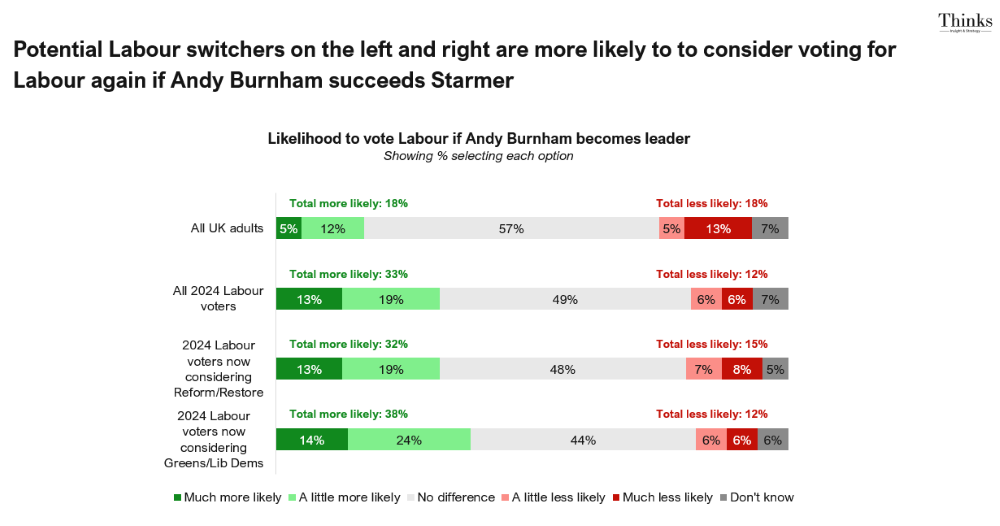
The headline finding is striking: Burnham’s arrival makes the party more appealing to the very voters it risks losing. Overall, 33% of 2024 Labour voters say a Burnham leadership makes them more likely to back Labour again, compared to just 12% who say it makes them less likely.
The shift is even more pronounced among those flirting with other parties:
- 44% of Labour voters now looking at the Greens say they are more likely to return or stay under Burnham — the highest figure among any group.
- 33% of those considering the Conservatives or Liberal Democrats say the same.
- 31% of those looking at Reform UK believe Burnham improves Labour’s appeal.
- 39% of those considering Restore Britain also lean toward staying loyal.
Ben Shimshon, co-founder and CEO of Thinks Insight & Strategy, summed it up: “Burnham definitely opens a window of opportunity for Labour and should give the party real hope.”
But there is a catch — and it is a big one. The polling makes clear that voters have low patience and low definition of what they actually expect. They like Burnham’s reputation as a straight-talking northerner, his track record as Mayor of Greater Manchester, and his perceived independence from the Westminster bubble — but they do not yet know what exactly he will do. As Shimshon puts it: “They like his vibes, his accent and his manner — but they’re not yet convinced he’s truly different.”
The clock is also ticking faster than it was for his predecessor. More than half of respondents — 54% — say they will know within six months whether Burnham is doing a good job; only 19% will give him longer than a year. Reform voters are the least forgiving, while Green supporters are the most patient, but both groups want tangible progress quickly.
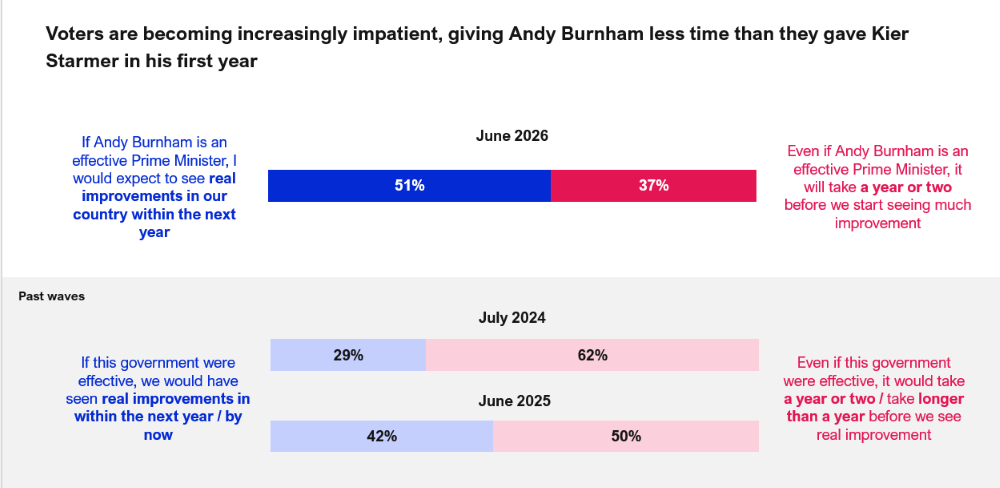
When asked what counts as “success,” 51% say they expect to see real improvements within 12 months of him taking office. This marks a notable shift from the mood when Starmer first arrived, when 62% of voters said it would naturally take a year or two to see results. Burnham, in short, starts with higher hopes — but a shorter runway.
The leadership transition also raises questions of legitimacy and mandate. Reform UK and even some figures within Labour have called for a snap general election, arguing Burnham inherits a mandate won under Starmer, not his own. 34% of voters agree a new PM should call an election quickly, rising to 68% among Reform supporters and 52% among Conservative voters. Labour voters, by contrast, oppose this idea by a wide margin — only 20% back an immediate vote.
There is also a fascinating tension over promises and delivery. 46% say Burnham should stick closely to Labour’s 2024 manifesto, while 35% say he should feel free to change course. But the same proportion — 46% — also say they would accept changes or broken promises if it means real change arrives. As Shimshon notes: “Voters say they value keeping promises, but when push comes to shove, they care more about results.”
Key Facts
- Sample: 2,079 adults nationwide, plus four focus groups of wavering Labour voters.
- Timing: Conducted 24–25 June 2026, after Burnham’s by-election win and Starmer’s resignation.
- Net appeal: +21 points among 2024 Labour voters (33% more likely vs. 12% less likely).
- Best recovery: +44 points among Labour voters now considering the Greens.
- Expectations: 54% will judge his performance within six months; 51% want visible improvements within one year.
- Mandate: Only 34% back a snap election; Labour voters strongly oppose the idea.
- Priorities: Voters will tolerate breaking promises if they believe the change is genuine and effective.
My Professional Perspective
Having covered British elections, leadership changes, and shifting voter behaviour across four decades, I can tell you this: When a leader is liked but not yet known, their honeymoon is brief — and their margin for error is razor-thin.
This research is not just a set of numbers; it is a roadmap to what could make or break Andy Burnham’s time in office — and what most commentators are missing right now.
What People Are Overlooking
Most analysis focuses on the obvious: Burnham is popular; he can stop the Greens and Reform from taking voters. But there are three deeper truths hidden in the data.
First, he is bridging two worlds that do not naturally fit. The voters drifting left to the Greens want faster action on climate change, more investment in public services, and less focus on fiscal caution. Those drifting right to Reform want tighter immigration controls, lower taxes, more support for local communities, and a clearer break from what they see as “Westminster politics.” Burnham is appealing to both groups because of who he is, not yet because of what he stands for. The moment he makes concrete policy choices, that broad appeal will narrow — and one side or the other will feel let down.
Second, voters are tired of “promise fatigue.” Look at the contradiction: they say they want manifesto commitments kept, but also say they will forgive changes if it means results. What this really means is: We don’t believe politicians anymore — so we’ll judge you by what changes, not what you said you’d do. Starmer fell into the trap of being too cautious, too technocratic, and too focused on looking “credible” rather than feeling “effective.” Burnham starts with the chance to break that pattern — but if he looks like just another leader talking about change but delivering more of the same, the disillusionment will hit harder and faster.
Third, the mandate question is a political time bomb. On paper, Burnham has the right to govern until 2029 under the Fixed-Term Parliament Act and the convention that leaders from the same party do not automatically call elections. But in an era when trust in institutions is low, conventions count for less than they used to. If he struggles to deliver or faces difficult decisions, opponents will repeatedly question his right to rule. The research shows most voters don’t demand an election right now, but that could shift if things go wrong.
The Deeper Meaning Behind the Findings
This story reveals a profound shift in how British voters view leadership. We are no longer in an age where ideology or party loyalty is the main driver. We are in the age of authenticity and delivery.
Andy Burnham’s greatest asset is that he does not sound or act like a typical Westminster insider. As Mayor of Greater Manchester, he built a reputation for standing up for his region, for speaking plainly, and for fighting for what he believed in — even against his own party or central government. That record creates the impression that he is “one of us,” not “one of them.”
But here is the paradox: Being seen as different is not enough — you must be different. If Burnham enters Downing Street and simply continues Starmer’s cautious approach, trimming policies to please markets and focus groups rather than addressing public frustrations, his appeal will evaporate. The voters who say “we like his vibe” will soon say “he’s just like the rest.”
The research also confirms a lesson I have seen play out many times: Opportunity equals pressure. The window has opened, but it will close quickly. In politics, six months is not a long time — it is barely enough to settle in. But that is the timescale voters have set for him.
Why This Matters Beyond Polling
For Labour, the stakes could not be higher. The party has spent decades trying to find the right formula: too radical, and it loses the centre; too cautious, and it loses its soul and its base. Under Burnham, it has a chance to reset that balance.
If he succeeds in holding on to the Greens-leaning voters and winning back the working-class voters drifting toward Reform, Labour could build a broad, durable coalition that secures it in power for years. If he fails, the centre of British politics will fragment further — with three or four major parties splitting votes and making stable government almost impossible.
For the country, this matters too. Britain faces major challenges: slow growth, stretched public services, the climate transition, and divisions over identity and sovereignty. It needs leaders who can explain difficult choices and deliver improvements people can feel. Burnham arrives with a unique mandate of expectation — even if it is not a formal election mandate.
What Questions Remain Unanswered
Polls tell us what voters feel today — not how they will react to tomorrow’s decisions. These are the questions that will define his premiership:
- How will he reconcile the different demands of voters wanting more spending and those wanting lower taxes?
- Will he have the authority within his own party to change direction, or will he be constrained by the legacy of Starmer’s team?
- How will he demonstrate progress fast enough to satisfy the short timetable voters have given him?
- If he delivers unpopular policies, will his personal popularity protect him — or will it fade when the tough decisions begin?
Beyond the Headline
At its core, this research tells us one simple but powerful truth: Andy Burnham does not have to be perfect to succeed — but he does have to be clear, consistent, and convincing.
He starts with something no other recent leader had: the potential to speak to both ends of Labour’s broad church. But that potential is fragile. It is built on perception, not performance. As the old political saying goes: The honeymoon is over the moment the first decision is made.
Conclusion
The numbers in this survey are clear: Andy Burnham walks into Downing Street with a rare advantage. He is the leader most likely to stop Labour from splitting in two — losing progressive voters to the Greens and traditional supporters to Reform UK. He brings with him a reputation forged outside Westminster, a direct style, and a track record of standing his ground.
But the polling also sends a warning that cannot be ignored: The margin for error is smaller, and the deadline for results is shorter, than it was for any prime minister in recent memory. Voters are not giving him a free pass; they are giving him a chance to prove he is different.
The choice ahead is straightforward. He can use this opportunity to set a new direction, tackle the issues people care about, and turn hope into reality — or he can play it safe, avoid risk, and watch his support slip away as quickly as it appeared.
As Britain waits for him to take office, one question hangs over both his leadership and the future of the Labour Party: Will Andy Burnham be the leader voters want — or just another leader they tolerate?