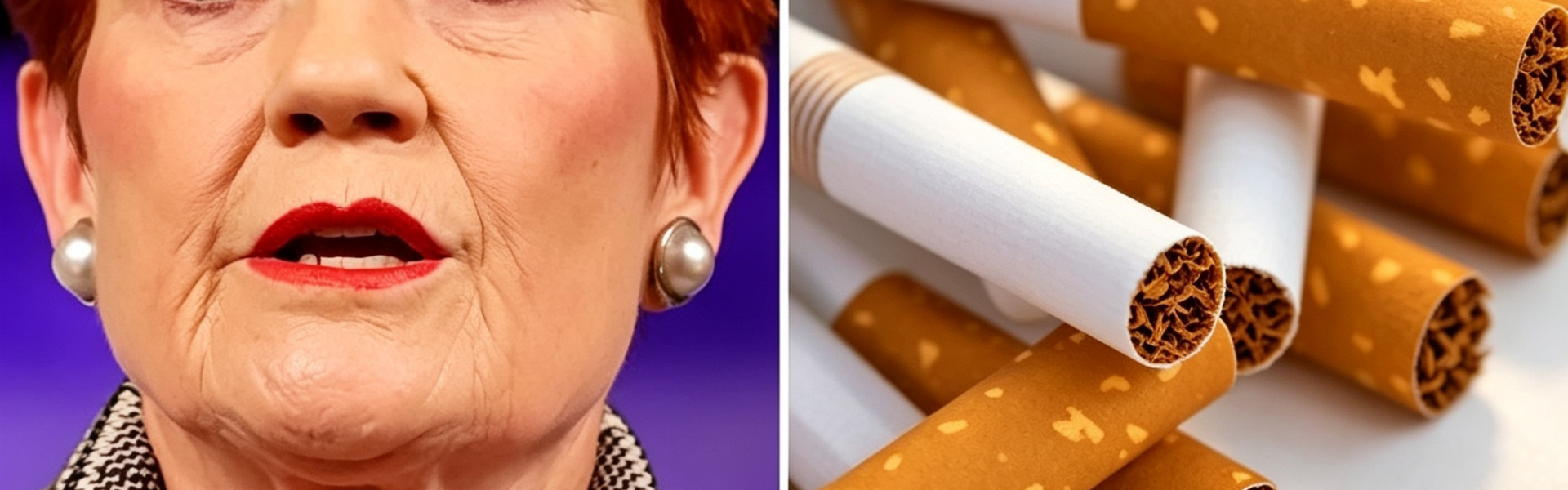

Pauline Hanson’s Plan to Halve Tobacco Tax Ignites National Debate Over Crime, Public Health and Australia’s Black Market
Australia’s long-running battle over tobacco policy has entered a new and highly controversial phase after Pauline Hanson announced that One Nation would cut tobacco excise by 50 percent and freeze any further increases until at least June 2028 if the party formed government.
The proposal immediately reignited one of Australia’s most polarizing policy debates: have decades of ever-rising tobacco taxes protected public health, or have they unintentionally created one of the country’s fastest-growing black markets?
Supporters argue Australia’s record-high cigarette prices have become a gift to organized crime. Critics counter that lowering tobacco taxes would reverse decades of progress in reducing smoking and expose a new generation to cheaper cigarettes.
The announcement arrives as authorities continue to confront an illicit tobacco trade that has expanded rapidly in recent years, accompanied by increasingly sophisticated criminal operations and violent attacks linked to the illegal market.
Rather than simply reopening an argument over cigarette prices, Hanson’s proposal has forced policymakers to confront a much larger question: can Australia’s tobacco strategy still achieve both public health goals and effective criminal enforcement, or has the balance begun to break down?
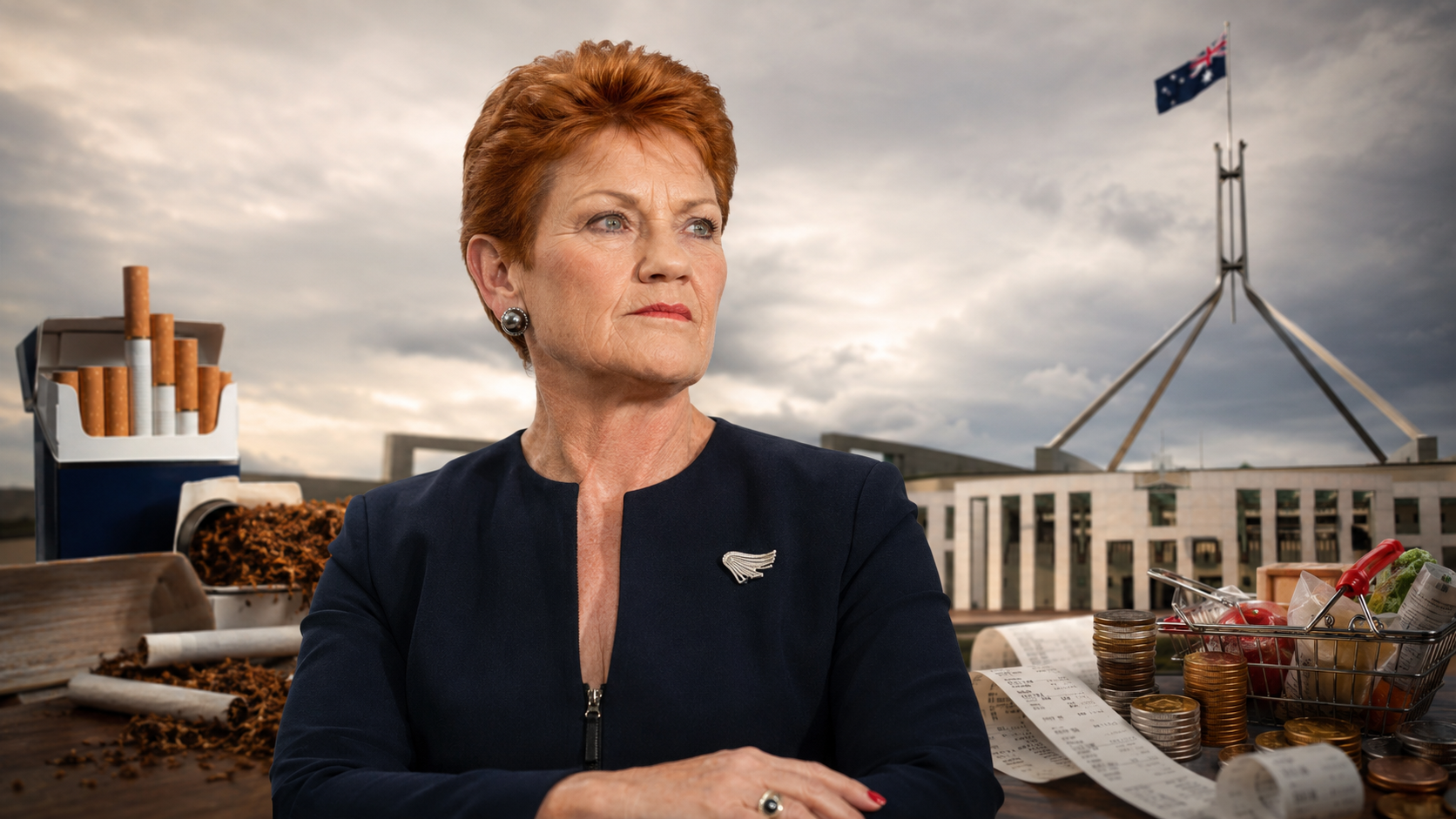
Australia’s Tobacco Tax Strategy
For decades Australia has pursued one of the world’s most aggressive tobacco taxation policies.
Successive governments from both major parties steadily increased excise on cigarettes as part of broader public health campaigns aimed at reducing smoking prevalence.
The economic logic was straightforward.
Higher prices generally discourage consumption, particularly among young people and lower-income smokers who are most sensitive to price increases.
International evidence has consistently shown that increasing tobacco prices is among the most effective tools for reducing smoking rates, alongside advertising restrictions, public education campaigns and plain packaging requirements.
Australia became a global leader in tobacco control, with smoking rates declining substantially over several decades.
For many public health advocates, those achievements remain one of Australia’s greatest preventive health successes.
Hanson Says the Strategy Has Reached Its Limit
Hanson argues that what once worked no longer reflects today’s reality.
According to One Nation, cigarettes have become so expensive through taxation that a growing number of smokers have simply stopped buying legal products.
Instead, many allegedly purchase untaxed tobacco through criminal networks.
“The current system isn’t working,” Hanson argues.
“Instead of reducing smoking, it’s rewarding organised crime.”
Under the proposal:
- tobacco excise would be reduced by 50 percent;
- further increases would be frozen until at least June 2028;
- legal cigarettes would become substantially cheaper than today;
- One Nation believes smokers would migrate back toward licensed retailers.
The party contends this would reduce the enormous profit margins currently enjoyed by illicit tobacco suppliers.
A Black Market That Has Become Increasingly Visible
Unlike previous debates about tobacco taxation, today’s discussion takes place against the backdrop of a rapidly expanding illicit tobacco industry.
Australian law enforcement agencies have reported major seizures of illegal cigarettes and loose tobacco in multiple states.
Authorities have also investigated numerous violent incidents linked to illegal tobacco operations, including arson attacks targeting tobacco stores and suspected organized crime disputes.
These developments have transformed what was once largely viewed as a tax compliance issue into a significant organized crime concern.
Supporters of Hanson’s proposal argue these events demonstrate that extremely high excise rates have unintentionally created enormous financial incentives for criminal syndicates.
The larger the price difference between legal and illegal cigarettes, they argue, the more profitable illicit trafficking becomes.
Could Lower Taxes Actually Increase Revenue?
One Nation’s proposal rests on a counterintuitive economic argument.
Instead of reducing government revenue, Hanson believes lower taxes could ultimately increase collections.
The reasoning is relatively simple.
If smokers currently purchasing untaxed products returned to licensed retailers because legal cigarettes became more affordable, governments would once again collect excise revenue from those sales.
Rather than taxing fewer cigarettes at higher rates, governments could potentially tax more cigarettes at lower rates.
Whether that would occur in practice remains highly contested.
The outcome would depend on how many smokers actually switched from illegal suppliers back to legal retailers.
Economists note that such behavioral responses are difficult to predict precisely.
Public Health Experts Strongly Disagree
Health organizations remain deeply skeptical.
Their concern is not primarily about criminal organizations.
It is about smoking itself.
Public health research consistently concludes that higher tobacco prices reduce cigarette consumption, particularly among teenagers and young adults who often have limited disposable income.
Lower prices generally increase affordability.
Greater affordability can increase consumption.
Even if lower taxes reduced illicit trade, health experts warn that cheaper cigarettes could encourage:
- more young people to begin smoking;
- former smokers to relapse;
- existing smokers to consume more cigarettes;
- slower long-term declines in national smoking rates.
Those outcomes could ultimately produce higher healthcare costs through increased rates of cancer, cardiovascular disease and chronic respiratory illness.
The Law Enforcement Perspective
Police and border agencies face a different challenge.
Even with high-profile seizures and arrests, illicit tobacco remains highly profitable.
Australia’s exceptionally high retail cigarette prices mean smugglers can generate enormous profits while undercutting legitimate retailers.

Some security analysts acknowledge that taxation policy influences criminal markets, although they caution that organized crime often adapts quickly to changing economic conditions.
Lower taxes alone, critics argue, may not dismantle well-established criminal supply chains that have already developed sophisticated distribution networks.
Political Timing
The proposal arrives as Australians continue ranking cost-of-living pressures among their highest political concerns.
Although tobacco affects only smokers directly, the issue has broader political implications.
One Nation is framing the proposal as:
- reducing living costs;
- weakening organized crime;
- supporting small retailers;
- recovering lost government revenue.
Opponents frame exactly the same proposal as:
- weakening tobacco control;
- increasing smoking;
- damaging public health;
- creating larger long-term medical costs.
That contrast reflects two fundamentally different philosophies of government.
My Professional Perspective
This debate is frequently portrayed as a straightforward conflict between smokers and health advocates.
In reality, it exposes something much deeper.
It asks whether a policy can remain successful after changing the incentives it originally sought to influence.
The Hidden Question
The real issue is not whether high tobacco taxes reduce smoking.
The evidence overwhelmingly indicates they do.
The more difficult question is whether there comes a point where taxes become so high that criminal markets begin replacing legal ones.
That possibility deserves serious examination rather than political slogans from either side.
Organized Crime Has Changed the Conversation
Twenty years ago, tobacco taxation was largely a public health discussion.
Today it has also become a policing discussion.
When authorities investigate arson attacks, extortion and sophisticated smuggling operations linked to illicit tobacco, the policy landscape changes.
Governments are no longer weighing only smoking rates.
They are also confronting organized crime.
That makes today’s debate fundamentally different from earlier arguments over tobacco excise.
Both Sides Can Be Correct
An important point often overlooked in political debate is that both competing arguments may contain truth.
Higher prices almost certainly discourage smoking.
Higher prices may also increase incentives for illegal supply.
These are not mutually exclusive propositions.
The real policy challenge lies in determining where the optimal balance exists.
What Evidence Would Settle the Debate?
If One Nation’s proposal were ever implemented, policymakers would need to measure several outcomes simultaneously:
- legal tobacco sales;
- illicit tobacco seizures;
- smoking prevalence;
- youth smoking rates;
- organized crime activity;
- healthcare costs;
- government tax revenue.
Looking at only one of those indicators would produce an incomplete picture.
Why This Matters Beyond Tobacco
This controversy reflects a broader question governments increasingly face.
How should policymakers respond when taxes become so high that they materially alter consumer behavior in unexpected ways?
Similar debates exist regarding alcohol, vaping, fuel, gambling and other highly taxed products.
Australia’s tobacco debate may therefore serve as an important case study for wider taxation policy.
Conclusion
Pauline Hanson’s proposal to halve tobacco excise has reopened one of Australia’s most contentious policy discussions.
Supporters argue decades of escalating tobacco taxes have unintentionally strengthened organized crime and pushed smokers into an expanding illicit market. Critics maintain that high prices remain one of the most effective public health tools ever developed and warn that making cigarettes cheaper risks reversing years of progress in reducing smoking.
Both arguments are grounded in legitimate concerns, but they prioritize different outcomes. One focuses on shrinking the black market and disrupting criminal profits. The other emphasizes preventing disease and discouraging tobacco use.
As the next federal election approaches, this debate is likely to extend far beyond cigarette prices. It will become a broader discussion about how governments should balance public health objectives, tax policy, law enforcement and individual behavior in an increasingly complex economic environment.
The central question remains unresolved:
If a policy successfully reduces smoking but simultaneously creates a lucrative criminal market, should governments preserve the policy as it stands, strengthen enforcement, or redesign the system to pursue both objectives at once?