
Forced to Be a Cook… He Sank 3 German U-Boats in 30 Minutes
The Cook Who Wouldn’t Die Below Decks
By November 1942, the North Atlantic had become something beyond dangerous. It was a graveyard in the most literal sense, a cold black cemetery stretching across thousands of miles of open water, swallowing ships, cargo, and men with such regularity that loss itself had started to feel routine. Since the war began, more than three thousand Allied ships had been sent to the bottom by German U-boats. Not damaged. Not driven off. Gone. Along with them went millions of tons of food, fuel, ammunition, vehicles, medical supplies, and spare parts, the entire bloodstream of the Allied war effort pouring uselessly into the ocean. Every week, more sailors died out there. Some were killed instantly when a torpedo tore open the hull beneath them. Some drifted for hours or days in freezing water or lifeboats, waiting for rescue that never came. Some died in ways even worse than drowning, trapped in burning slicks of oil when tankers exploded and turned the sea itself into fire. The lucky ones died fast. The unlucky ones had time to understand exactly what was happening.
The German submariners who made that nightmare possible had become frighteningly good at what they did. The U-boats, the wolves, hunted in packs and attacked with a kind of cold precision that made the whole thing feel less like chaos than method. A half-dozen submarines could rip apart a convoy of thirty or forty merchant ships in a single night. Their tactics were refined, ruthless, and brutally efficient. Surface after dark, when radar was still unreliable and visual detection was difficult. Slip into the convoy itself, close enough that escorts could not always fire freely without hitting their own ships. Launch torpedoes almost point-blank into freighters and tankers so heavily loaded they barely had a chance once their hulls were breached. Then dive, vanish, reposition, attack again. It was a system designed to weaponize confusion. Winston Churchill later admitted that the Battle of the Atlantic was the one struggle in the war that genuinely frightened him from beginning to end, and he had good reason. Britain was an island. It lived or died by ships. If Germany severed that lifeline, the island would starve, the Soviet Union would weaken without aid, and the Allied war machine would start to choke to death not on the battlefield, but by arithmetic. If the U-boats could sink ships faster than the Allies could build and supply them, Germany won. If the Allies could build, convoy, and deliver faster than the U-boats could destroy, the Allies won. In late 1942, that equation still looked dangerously favorable to Germany.
Into that world sailed the USS Doyle, a destroyer escort with none of the glamour of a battleship and none of the imposing silhouette of a cruiser, but with one very specific purpose: keep merchant ships alive long enough to arrive where they were needed. The Doyle was fitted for convoy work, sonar for hunting submarines below the surface, depth charges for punishing them once found, guns for engaging threats above it. In November 1942, she was assigned to escort a convoy of forty-seven merchant vessels crossing from Norfolk, Virginia, toward North Africa. The ships carried supplies for Operation Torch, the Allied invasion of French North Africa, and their cargo mattered enormously. Tanks, trucks, ammunition, food, fuel, medicine, replacement parts, everything an army needed not just to land, but to survive once it got there. Somewhere down the line, that cargo would support a then-rising American commander named George S. Patton. That alone made the convoy valuable. Valuable cargo meant U-boats were already hunting it.
Among Doyle’s crew of 186 men was a twenty-two-year-old sailor from Baton Rouge, Louisiana, named Leonard Jackson. He had grown up in a segregated neighborhood, attended segregated schools, and learned very early the most corrosive lesson of American life in that era: that skin color decided which doors opened for you and which remained permanently shut. Jackson had enlisted in the Navy before Pearl Harbor, before America was officially at war, for reasons that were at once simple and complicated. Duty mattered. Adventure mattered. So did the possibility that service might lead somewhere better than the future already waiting for him at home. He imagined himself doing something active, maybe manning guns, maybe learning radar, maybe even one day earning enough respect to rise. The Navy had other ideas. In 1942 the U.S. Navy was segregated by design, not merely by habit. Black sailors were almost entirely restricted to the stewards branch. That meant cooking, cleaning, serving officers, washing dishes, handling laundry, performing support labor, and remaining far away from positions the Navy classified as real fighting jobs. Black sailors were barred from combat roles. They were not meant to operate weapons. They were not meant to command men. They were certainly not meant to become officers in the ordinary sense. The rationale behind those restrictions was as ugly as it was common in white America at the time: the belief that Black men lacked the intelligence, discipline, or courage for combat. So Leonard Jackson, who had scored well on entrance exams and specifically expressed interest in gunnery, found himself assigned to Doyle’s galley as Cook Third Class.
He turned out to be very good at it. By all accounts, the crew liked his food, which was no small achievement considering Navy rations were famous for being bland, repetitive, and grim. He worked hard. He arrived on time. He kept the galley moving through endless cycles of chopping, peeling, boiling, scrubbing, serving, and cleaning. He did it for men who often barely noticed him beyond the next meal. But there was something nobody on Doyle really understood about Leonard Jackson, perhaps because nobody bothered to look closely enough. He paid attention. Quietly. Methodically. Intensely. During months at sea, the ship ran battle drills constantly. General quarters would sound, and every man would move to his station. Jackson’s assigned station during combat was below decks, in a sealed compartment where noncombat personnel were expected to wait out attacks in relative safety. To reach it, though, he had to pass through the main deck, right by the gun crews, and every single time he watched.
He watched the men on the 20mm anti-aircraft guns, weapons intended to knock aircraft from the sky but effective against light surface targets as well. He watched how the circular drum magazines were seated and locked into place. He watched how the gunner leaned into recoil instead of fighting it. He watched how they used the simple ring sight, not staring at the target itself but tracking movement and leading where the target was going to be. He watched the safety, the charging handle, the rhythm of loading and firing, the body mechanics of staying balanced when the weapon bucked. No one had trained him. No one had invited him to learn. No one even imagined he was learning. But he had eyes, patience, and a mind that retained what it saw. During breaks he brought coffee and sandwiches to the crews and listened to their casual complaints, their shorthand descriptions, their little curses and corrections. Piece by piece, without a single formal lesson, Leonard Jackson taught himself Doyle’s weapons.
The officers aboard had no idea. Why would they? In their minds, a Black cook learning gunnery was irrelevant at best and improper at worst. Jackson knew that too. He never volunteered what he knew because there seemed no purpose in it. Navy regulations were perfectly clear about what he could and could not become, and no regulation in the world cared whether he had quietly memorized the operating sequence of a 20mm gun. But the ocean does not care about regulations. War does not care about regulations. And on November 14, 1942, three days from the North African coast, both were about to prove that in a way no one on Doyle would ever forget.
Most of the crossing had been miserable, which in a strange way helped. Bad weather was hard on crews and ships, but it also made U-boat work more difficult. Rough seas complicated periscope tracking, obscured targets, and made attacking from the surface more dangerous. The convoy had been scattered by storms more than once, but the escorts kept pulling it back together, the formation battered but intact. Then, as they neared Africa, the weather changed. The ocean flattened. The wind eased. The sea turned almost glassy. It was beautiful in the abstract and terrifying in practice because calm water was ideal hunting water for submarines. On Doyle, sonar operators listened constantly. Lookouts scanned the horizon until their eyes hurt. Officers pored over reports of known U-boat positions. The ship was wound tight with anticipation.
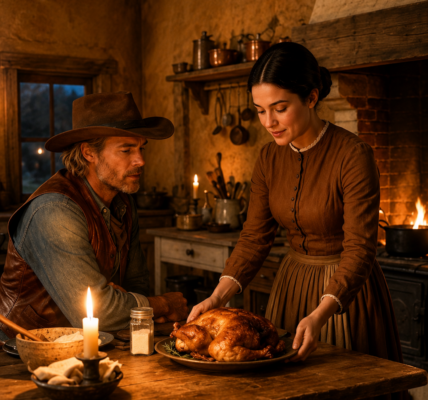
Leonard Jackson kept working. He rose at 4:45 in the morning to start breakfast, served meals in shifts, cleaned the galley, and prepared for the next meal before the last one was fully done. His world was stoves, knives, coffee, steam, and enormous sacks of potatoes. Somewhere around his two-hundredth potato of the day, another cook asked if he was scared. Scared of what, Jackson said. The U-boats, the other man told him. We’re sitting ducks out here. Jackson shrugged and answered with the kind of fatalistic calm sailors often use to keep fear from taking hold: if a torpedo has my name on it, there’s nothing I can do about it. If it doesn’t, why worry? But there was another thought he did not say out loud. If Doyle got hit, he did not want to die below decks in a sealed compartment, waiting in the dark for steel and water to decide his fate. If death came, he wanted to meet it doing something.
At 2:47 in the morning on November 14, the convoy’s luck ended.
Jackson was in the galley making coffee for the predawn watch change when the first impact came. It did not sound like an explosion at first. It felt like one. A blast wave hit Doyle like the fist of something enormous, shuddering the whole destroyer from bow to stern. Jackson slammed into a counter. Scalding coffee splashed across the deck. Pans crashed from hooks. For one strange suspended second there was only shocked silence as every man aboard tried to understand what had happened. Then the alarms began to ring, harsh and metallic. Battle stations. This is not a drill.
Jackson ran to a porthole and looked out. Roughly eight hundred meters away, one of the convoy’s tankers had been hit amidships. The torpedo had ripped open fuel tanks and the ship was dying in real time, broken open and burning. Oil spread across the water and caught fire, turning the sea itself into a lake of flame. Men were already jumping overboard, choosing a burning ocean over the certainty of staying aboard a ship that might explode outright. The glow from the fire was so bright it painted the night orange and threw the entire convoy into a hellish silhouette.
The loudspeaker crackled with orders: all hands to battle stations. Surface and subsurface contacts. Multiple U-boats in the area.
By regulation, Jackson should have gone below decks at once. That was his station. That was the safe place for noncombat personnel. That was the rule. He did not go. Maybe it was instinct. Maybe stubbornness. Maybe the older, deeper refusal of a man who had spent his life being told where he belonged and no longer felt like obeying when steel and fire were coming. Maybe it was as simple as the thought he had carried privately all day: if I die tonight, I will not die hiding below the waterline. Whatever it was, he ran upward instead of down, pushing against the current of men heading to their assigned posts. No one stopped him. No one had time.
He burst onto the main deck just in time for the second torpedo to hit Doyle herself.
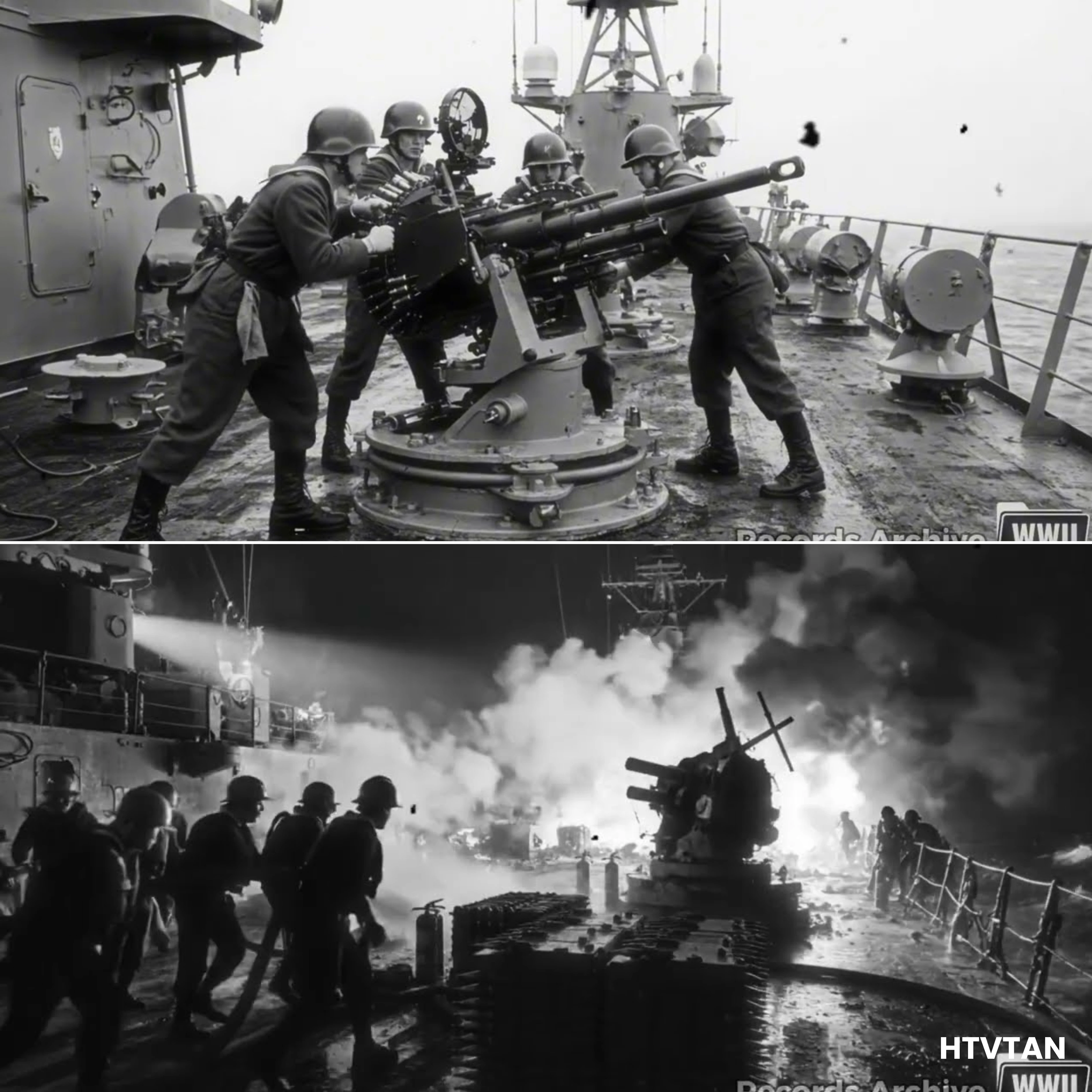
This one struck at the stern, near ammunition storage for the rear guns, and the effect was catastrophic. Flame and debris shot upward in a violent column. The aft section of the ship twisted and buckled. Men were blown overboard. Others died where they stood. Jackson was thrown flat, ears ringing, vision blurred, lungs emptied by the concussion. When he finally dragged in a breath, the air tasted like smoke and hot metal. Doyle was badly hurt. Fires were burning in several places. The rear 20mm position was gone. Damage control parties were running with hoses and extinguishers, trying to keep flames away from fuel and remaining ammunition. The deck was slick with seawater, oil, and blood. A calm disciplined warship had become, in a matter of seconds, a floating nightmare.
And then Jackson saw the gun.
Twenty feet away, one of the midships 20mm positions sat intact and unattended. The gunner assigned to it lay nearby, not moving. The weapon still pointed into the sky, magazine loaded, ready. Jackson looked at the gun, then at the blazing water around the convoy, then at the men trying to keep the ship alive while submarines circled somewhere in the dark. He did not stop to ask permission. He ran to the mount, climbed up, and grabbed the twin handles.
The metal was cold. The smell of oil and burnt propellant clung to the weapon. Through the ring sight he could see the reflected inferno from the dying tanker. He had never officially fired this gun. He had never been authorized to touch one. He had never had a minute of formal instruction. But he had watched. He remembered the safety lever. He remembered how to track through the sight. He remembered how to lean into recoil. His hands went through the sequence as if they had been trained there. Safety off. Drum seated. Gun charged. Target acquisition through the ring. The magazine held 20mm high-explosive incendiary rounds, shells powerful enough to rip through light structures, exposed men, and critical equipment. He was ready.
He did not have to wait long.
Doyle’s searchlights slashed across the water looking for submarines. U-boats often attacked on the surface at night because on the surface they were faster and, under the right conditions, harder to detect than when submerged. They would launch torpedoes and either dive away or run on the surface before escorts could react. But one of the German commanders made a fatal mistake. Perhaps he was emboldened by the chaos. Perhaps he wanted to reload torpedo tubes quickly and fire again before the convoy reorganized. Whatever his reasoning, he surfaced only about three hundred meters from Doyle to begin reloading.
A Type VII C U-boat broke the surface like some dark sea animal breaching out of the night. Water sheeted off its hull as the conning tower rose, then the deck gun, then the long cylindrical body. Hatches opened and sailors scrambled onto the deck to begin the standard reload drill. Under ordinary conditions, it was risky but manageable. Surface briefly, reload, dive, disappear. But these were not ordinary conditions, and Leonard Jackson was not behaving like any gunner the commander expected.
The searchlight fixed the submarine in a cone of blinding white. German sailors shielded their eyes. Jackson opened fire.
The 20mm cannon slammed in his hands, barking rounds at roughly 450 per minute. Every fifth shell was a tracer, streaking a bright glowing line across the water and showing him exactly where the shots were going. The first burst went high. He corrected instantly, walking the fire down the way he had seen trained crews do during drills. The second burst tore across the deck. German sailors dove for hatches, abandoning the reload. The U-boat commander shouted for an immediate dive. Jackson kept adjusting, and then he did something crucial. Instead of concentrating on the armored conning tower, he aimed lower, toward the waterline, where the hull was thinner and where enough penetrating damage could turn a controlled dive into a death sentence. His next burst hit there. The shells punched through and exploded inside. Individually, 20mm rounds do not carry the kind of charge that shatters a submarine apart at once. But they do not need to. They only need to make holes.
The submarine tried to dive. Ballast tanks flooded. The bow pitched downward. But now water was entering where it should never have been able to enter, and the dive that was supposed to be an escape became a sinking. The stern went under, then the midsection, then the conning tower. Men trying to get below were swallowed with it. The boat did not return. Later analysis would conclude that it took on water too rapidly, lost depth control, dropped past its safe limit, and imploded under pressure at roughly three hundred meters. All forty-four crewmen died almost instantly. Jackson did not know any of that in the moment. He only knew the target was gone.
Then a second submarine surfaced.
This one came up on the opposite side of Doyle, farther out, about four hundred meters away. It was larger, a long-range Type IX, carrying more torpedoes and a bigger crew. Its commander had watched what happened to the first boat and made a different calculation. Surface fully, bring the deck gun to bear, destroy the escort before it can kill again. It was a bold decision and, against many damaged escorts in chaos, might have worked.
Jackson was already traversing the gun.
He swung the 20mm around in a smooth arc, moving now without conscious thought, months of observation turned into instinctive mechanics. The Type IX was still rising, water still pouring off its hull, hatches only beginning to open, when Jackson fired. The first burst struck the conning tower. Men emerging from the hatch went down before they understood what was happening. The commander ordered an emergency dive, but the deck gun crew that might have returned fire was already dead or pinned. Jackson swept the weapon’s fire down the submarine’s length, then concentrated on critical systems at the top of the conning tower: the periscope housing and radio antenna. These were lightly protected because they had to extend and retract. The 20mm shells tore them apart, wrecking the boat’s eyes and ears in seconds.
Inside the U-boat, reports would have come in fast and ugly. Periscope destroyed. Radio gone. Hull damage. Deck casualties. The commander had seconds to choose: stay up and try to fight blind, or dive and hope. He chose to dive. The submarine angled down, but the damage was already too serious. Water entered compartments that were never supposed to flood. At fifty meters, the commander tried to level off. The boat would not answer. At one hundred meters the hull started groaning under pressure. At one hundred fifty, metal began to fail. At two hundred meters, the Type IX imploded. All fifty-eight men aboard died in an instant. On Doyle’s deck, Jackson saw only the bubbles and debris rising where it vanished.
Two U-boats were gone in under fifteen minutes.
His magazine was nearly empty. His shoulder hurt from the pounding recoil. His ears were ringing so badly he could barely hear. He should have stopped. He should have gone below. He should have handed the gun off to someone whose presence there regulations would have recognized. Instead he ejected the spent drum, grabbed another from the ready rack, locked it in place, charged the gun, and kept watching the water.
On the bridge, Commander William Harris was trying to keep Doyle together while piecing together a battle that made less sense the more reports came in. His ship had been torpedoed. A tanker in the convoy was burning. Damage control teams were fighting multiple fires. Amid all that, an unmanned midships 20mm position was somehow still firing with deadly accuracy, and submarines were going down in rapid sequence. Harris raised binoculars and looked. Through smoke and spray he could make out a figure in what had once been a white cook’s uniform, now soaked in blood and oil, calmly manning the gun.
Who the hell is that, he asked.
No one knew.
Before he could pursue it, a lookout shouted another warning. Submarine surfacing close. Two hundred meters, bearing zero-nine-zero.
At that range, if the U-boat got its deck gun operating, it could savage Doyle quickly. The third submarine was making a desperate play. Its commander had watched two boats die. He understood that some unexpected gun crew on Doyle had become the center of the battle, and he decided the only chance was to surface close, surface fast, and destroy the escort before it reacted. Against a disorganized enemy, that kind of aggression can work. Against Leonard Jackson, it did not.
The U-boat burst out of the water at speed. The conning tower hatch flew open and German sailors spilled toward the deck gun with real skill and urgency. They were fast. They were trained. They were not fast enough. Jackson had the weapon trained on them before the first man fully cleared the hatch. By now hesitation was gone. There was only a sequence: acquire, fire, correct, destroy.
The German commander emerged, mouth opening to shout orders. Jackson’s first burst caught him squarely in the chest and threw him backward into the hatchway, where his body jammed the opening and blocked the men below from getting out. Jackson kept firing, sweeping the conning tower area and cutting down anyone who tried to push through. Then he shifted to the deck gun. Even unmanned, it represented a threat if anyone reached it. His shells smashed the mount, wrecked the mechanism, and bent the barrel.
Inside the submarine, the executive officer suddenly had no good options. They could not surface safely because the deck was a kill zone. They could not dive comfortably so close to the destroyer without risking ramming or immediate depth-charge attack. They could not fight because the deck gun was gone and the commander was dead. That left surrender. A white cloth—someone’s undershirt—appeared at the hatch, waving frantically. A voice shouted in accented English that they surrendered.
Jackson kept the gun trained on them and did not fire.
One by one, with hands raised, eleven German sailors emerged and climbed onto the deck. A boarding party took them off the submarine and brought them onto Doyle. The U-boat itself, damaged and abandoned, began to sink slowly. Jackson watched it go under while his body finally started to shake with the adrenaline leaving him. Three submarines in thirty minutes. One man at a gun he had never been trained to use.
That is where Commander Harris found him.
He was slumped against the gun mount, legs finally giving out, empty shell casings spread everywhere around him and the barrel still smoking faintly in the orange glow from the burning tanker. Harris stood there for a long moment trying to reconcile Navy doctrine with the physical fact in front of him. Jackson struggled to his feet and tried to come to attention. Harris looked at the sailor, the gun, and then at the oily grave-marks on the water where three U-boats had gone down.
Jackson, sir. Cook Third Class.
Harris repeated the word slowly, as if it had stopped meaning what it was supposed to mean. Cook. Then he asked the only question that really mattered. Where did you learn to operate this weapon?
Jackson hesitated because the truth, in another context, might have been enough to get him punished. He had been somewhere he was not supposed to be, learning things he was not supposed to learn. But lying to the commanding officer of the ship felt worse. So he told the truth. He watched. During drills. Every time. He never touched the guns, but he memorized what the gunners did. He did not expect ever to need it.
Harris stared at him and then gave a short, disbelieving laugh. You watched, memorized it, and then went out there and killed three submarines. Jackson answered the only way he knew how. Yes, sir. I think so, sir.
Harris made his report immediately, and it shot through the Navy chain of command because the facts were too large to bury quickly. A Black cook, segregated into the stewards branch, had apparently destroyed three U-boats in half an hour and saved a vital convoy. The report was extraordinary. It was also embarrassing to a military institution built on the official assumption that Black servicemen were unfit for combat responsibility. Within days the account reached higher commands in North Africa. Within a week it reached the orbit of George S. Patton.
Patton was in North Africa preparing for the next phase of operations when a Navy liaison mentioned the incident, almost as an oddity at dinner. A Black cook sank three U-boats. Patton stopped him. One man? Three submarines? Yes, General. Leonard Jackson. There are, the liaison added carefully, complications.
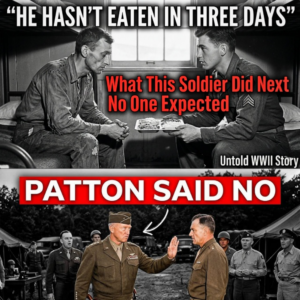
Patton knew exactly what those complications were. He had spent years arguing, often to little effect, that courage and military ability were not racial traits and that combat effectiveness had nothing to do with skin color. He had not won those arguments institutionally, but he had not abandoned them either. When he heard that the sailor was still aboard Doyle in Casablanca while the ship underwent repairs, he stood up from the table and ordered his jeep made ready. If a man saved a convoy and achieved a tactical victory, Patton said in essence, then a general could go meet him.
The next morning, Patton came aboard Doyle. The torpedo damage was still visible. Repair crews were welding and pumping out compartments. Word that a three-star general had arrived spread fast. Commander Harris met him at the gangway. Patton dispensed with formalities almost immediately. Where’s Jackson? Harris, slightly wrong-footed, said the sailor was in the galley working and offered to have him brought up. Patton said no. Take me to the galley.
So they went down into the cramped heat and smell of the ship’s kitchen, where Leonard Jackson was standing at a counter peeling potatoes into a bucket, hands moving with practiced speed. He looked up, saw the stars on Patton’s helmet, and nearly dropped the knife. Patton waved off the attempt at rigid formality and told him to keep working. He wanted to hear what happened in Jackson’s own words.
Jackson told the story quietly at first, then more steadily as Patton listened without interruption. The torpedoes. The chaos. The gun. The submarines. The way he had learned simply by watching. When he finished, Patton did not immediately ask about the battle. Instead he looked at Jackson’s hands and asked how many potatoes he peeled in a day. Jackson, caught off guard, said maybe two hundred, depending on the menu. Nobody taught you how to peel potatoes, Patton said. They gave you a knife and a bucket and expected you to figure it out. Yes, sir. And that’s how you learned the gun, isn’t it? Watch. Learn. Repeat it in your head until your body knows what to do.
Then Patton turned to the officers gathering in the galley entrance and said something close to the heart of the whole matter. This, gentlemen, is what a soldier looks like. Not a man trained for the moment. Not a man authorized for it. A man who saw what had to be done and did it. A man who improvised, attacked, and won.
He then told Jackson something harsher and more honest than ceremony usually allows. The Navy, he said, would probably pin a medal on him and then send him right back to peeling potatoes, because institutions hate being forced to admit their assumptions are wrong. Then Patton unbuckled one of his pistols—the famous ivory-gripped Colt .45 he carried—and offered it to Jackson. You earned this, he said in effect. Not because of rank. Not because of permission. Because you are a warrior. One of the finest I have ever encountered.
Jackson took the pistol with trembling hands. Patton started to leave, paused once more, and told him not to forget who he was. Not merely a cook. Not a Black man confined to a white man’s Navy. A warrior. Then, with the strange abruptness that made him Patton, he added that the potatoes were not going to peel themselves and left the galley.
The Navy did eventually award Leonard Jackson the Navy Cross, second only to the Medal of Honor. But the recognition was quiet, almost hidden. No publicity. No celebrated transformation from steward to gunner. No broader institutional reckoning. The citation honored valor without dwelling too much on the uncomfortable reality that an untrained Black cook had done what supposedly trained white combat personnel were presumed uniquely qualified to do. After the ceremony, Jackson was returned to the galley. He was not retrained as a gunner. He was not commissioned. He spent the rest of the war cooking, peeling potatoes, serving food, and carrying with him the private knowledge of what he had done.
When the war ended, he returned to Baton Rouge and opened a restaurant. It was not fancy. It did not need to be. It served good Southern food in a clean room where, according to the story, everyone was welcome regardless of race. The place did well enough. He built a life there with his high-school sweetheart. He did not talk much about the war. When people noticed the Colt .45 with ivory grips in a glass case on the wall and asked about it, he smiled and said a general gave it to him because he cooked real good. Most people laughed and left it there. A few looked more closely, recognized the kind of pistol it was, and suspected the joke carried something larger inside it. Jackson would only smile wider.
At night, after the restaurant closed, he sometimes took the pistol down and held it. He felt its weight. He remembered the deck under his feet, the ring sight glowing in the dark, the tracer arc over black water, the moment when the rules had stopped mattering and only ability remained. He remembered being seen clearly, perhaps for the first time in his military life, not as a category or a restriction but as what he had actually proven himself to be.
Official Navy histories reduced the engagement to almost nothing. Three U-boats destroyed by USS Doyle during convoy operations. Allied losses minimal. No mention of Leonard Jackson. No mention that one man did the killing. No mention that the man was a cook with no formal gunnery training. Yet in captured German naval records and later interrogations, the incident lingered differently. U-boat commanders described a wolfpack shredded in minutes by terrifyingly accurate fire from a single weapon on a damaged escort. They did not understand how the Americans had reacted so quickly or fired so precisely. Allied interrogators knew. They had read the reports. But they never clarified it for the Germans. Better to let the fear remain unshaped.
Leonard Jackson died peacefully in 1987 at the age of sixty-seven. Hundreds attended his funeral in Baton Rouge: family, friends, and customers who knew him as a restaurateur, a good man, a steady presence. During the service, his eldest son told the story his father had finally shared more fully in later life. My father sank three German submarines in thirty minutes with a gun he had never been trained to use. When a general asked how he did it, he said he learned the same way he learned everything else: by watching, by practicing, by refusing to accept that something was impossible just because someone else said it was.
The Navy Cross mattered. Patton’s pistol mattered. But perhaps the truest thing that mattered was what Patton told him in the galley: you are not a cook, you are a warrior. In a world that had spent most of Leonard Jackson’s life trying to limit what he could be, one powerful man had looked at the evidence and named him correctly.
The ivory-gripped Colt was buried with him, placed in the casket by his family. It had hung on the wall for decades as a private relic, proof that on one night in 1942 the regulations did not matter, the assumptions did not matter, the color line did not matter. What mattered was what a man could do when everything was on the line.
Three submarines. Thirty minutes. Two hundred potatoes. And one absolute refusal to die hiding below decks. Some stories do not need embellishment. They are already impossible enough exactly as they happened.