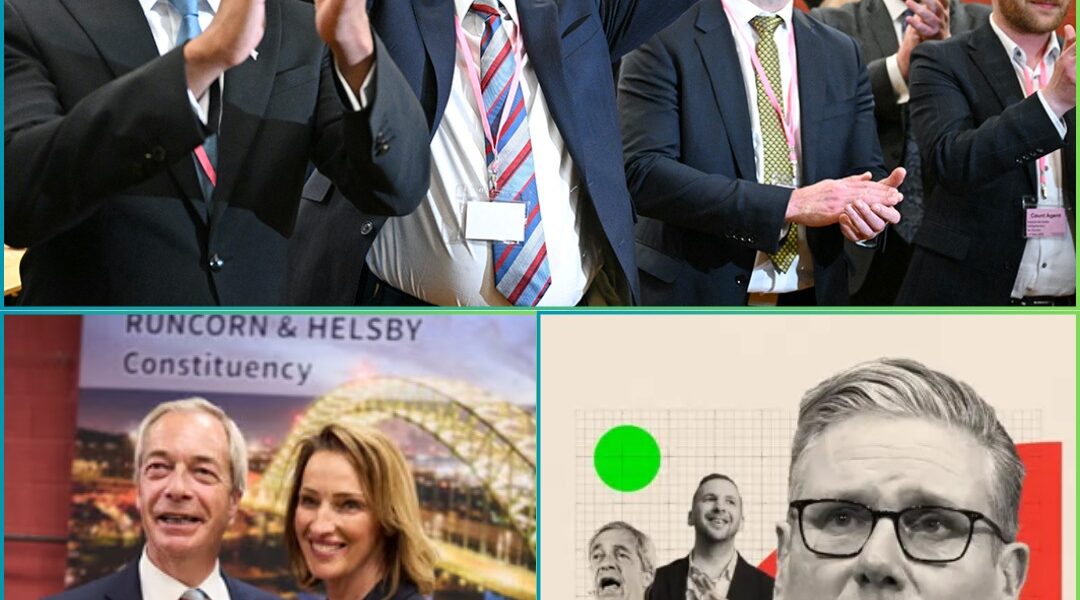
Farage Predicts Starmer’s Downfall as Reform Targets Labour Heartlands Ahead of May Elections! n1

Farage Predicts Starmer’s Downfall as Reform Targets Labour Heartlands Ahead of May Elections!
Nigel Farage has claimed that a strong Reform UK performance in next week’s local and devolved elections could trigger the downfall of Prime Minister Keir Starmer within months, as the party intensifies its campaign against Labour and attacks government policy on energy, spending, and Net Zero.
Speaking from Westminster in an interview conducted less than a week before voters head to the polls, the Reform UK leader argued that the elections on May 7—covering councils, six English mayors, and parliamentary contests in Wales and Scotland—could serve as a political turning point.
Farage suggested that while Parliament itself is unlikely to remove Starmer, a dramatic electoral defeat in Labour’s traditional strongholds could destabilise the Prime Minister’s leadership and force a resignation by midsummer.
“A crushing defeat in Labour’s heartlands on May the 7th will see the end of the Prime Minister by midsummer,” Farage said.
His comments underline Reform UK’s strategy of turning local elections into a referendum on Starmer’s leadership, even though the contests are formally focused on regional governance and council responsibilities.
Reform campaign frames local vote as national protest
Farage’s remarks came after the interviewer questioned whether Reform UK’s messaging risks misleading voters, given that the May elections are not a general election and will not directly determine the government at Westminster.
The interviewer argued that local contests are traditionally centred on council services such as bin collections, roads, planning decisions, and local taxes.
Farage responded by saying that national issues are dominating voter concerns, claiming that two-thirds of voters will cast their ballots based on national politics rather than local issues.
While insisting Reform is not ignoring council responsibilities, he acknowledged that removing Starmer has become one of the party’s central campaign themes.
Farage described the Prime Minister in unusually harsh terms, calling him “the most unpatriotic, un-British, dissembling Prime Minister that the country’s ever had.”
Reform UK has positioned itself as the leading opposition voice against Labour’s economic and immigration policies, and Farage has increasingly framed local elections as the only realistic route to politically damage Starmer in the near term.
Reform highlights opposition to council reorganisation and solar developments
Despite the national focus, Farage said Reform UK is also campaigning on specific local issues.
He criticised proposals for local government reorganisation, arguing that plans to restructure county governance would divide England’s historic counties and weaken traditional local identities.
He also pledged that Reform councils would pursue judicial reviews to challenge major renewable energy developments, particularly large-scale solar farms planned for agricultural land.
Farage described such developments as “monstrous solar farms” and argued that farmland should prioritise food production rather than energy generation.
He claimed Reform has a record of fiscal restraint in the councils it controls, saying the party has cut unnecessary expenditure, reduced waste, and kept council tax increases lower than other parties in comparable areas.
Farage pointed to the ten councils where Reform currently holds majority control as evidence that the party can deliver on its promises in government.
Worcestershire dispute exposes internal tensions
However, Farage faced immediate pushback when the interviewer raised Worcestershire, where council tax reportedly rose by 9% despite Reform involvement.
Farage rejected responsibility for the increase, arguing that Reform does not hold majority control in Worcestershire and is instead part of a minority administration.
He described the council as “bankrupt” and suggested that the party had faced difficult decisions in the area.
Farage also admitted that there had been internal disagreement over whether Reform should become involved in the council’s leadership.
He said he had previously expressed the view that the party should have avoided taking part, but noted that local Reform figures had chosen to “step up” and attempt to manage the situation.
The exchange highlighted the growing pains facing Reform as it expands rapidly and takes on more governing responsibility at the local level.
Reform defends candidate vetting after wave of resignations and suspensions
Farage was also challenged on the party’s internal discipline and candidate selection, following reports that 74 Reform councillors elected last year have resigned, defected, been expelled, or been suspended.
The interviewer suggested that the scale of departures raised serious concerns about vetting and recruitment.
Farage acknowledged that some candidates had caused problems, but argued that similar issues exist across all parties, particularly during large-scale election campaigns.
He claimed Labour had lost 300 councillors and the Conservatives had lost 200, arguing that churn is common in local government.
Farage said Reform had fielded candidates in 99.9% of elections taking place next week, with nearly 5,000 candidates standing nationwide.
He argued that only a “handful” had created controversy and suggested that many issues arose because candidates allegedly lied about past associations or undisclosed social media accounts.
Farage also pointed to suspensions in other parties, including the Conservatives, the Greens, and Plaid Cymru, arguing that no party is immune from problematic individuals.
When pressed on whether Reform attracts extremist or racist candidates, Farage rejected the suggestion, stating that the party’s candidate list includes individuals “from all backgrounds” and that isolated cases do not represent Reform’s wider membership.
He also claimed that in the last general election, Reform received more votes from black and ethnic minority communities than the Liberal Democrats, using this as evidence that the party is not defined by the controversial statements of a minority of candidates.
Energy policy becomes central to Reform’s cost-of-living message
Farage used the interview to pivot toward energy policy, describing it as one of the most important drivers of the UK cost-of-living crisis.
The interviewer noted that energy prices are expected to rise significantly by the end of the year and linked the global energy shock to international tensions involving the United States, Iran, and Russia.
Farage was asked directly who he believed posed the greatest threat to global stability: US President Donald Trump or Russian President Vladimir Putin.
Farage responded by arguing that he had no influence over international military decisions, including Russia’s invasion of Ukraine or Western strikes on Iran. Instead, he said his focus was on domestic energy independence.
Farage claimed the UK could significantly reduce household heating costs, industrial energy prices, and fuel prices if it expanded domestic production of oil and gas, reopened refining capacity, and reversed what he described as self-destructive energy policy.
He argued that the best way to cut living costs was to become self-sufficient in energy and reduce dependence on imported resources.
According to Farage, Britain’s failure to maintain domestic production has contributed to industrial decline, weakened national security, and increased consumer costs.
He warned that shortages of key resources, including helium and other industrial inputs, could have knock-on effects across sectors, including healthcare supply chains.
Clash over oil markets and UK refining capacity
The interviewer challenged Farage’s argument, noting that reopening North Sea oil fields would not necessarily make energy cheaper for UK consumers, since a large proportion of oil is sold on international markets at global prices.
Farage conceded the point on oil to some extent but insisted that gas was a different case, due to the high costs of transporting liquefied natural gas.
He claimed much of the UK’s gas is now imported from the United States, involving extraction, liquefaction, shipment across the Atlantic, and regasification—processes that add significant cost to household bills.
Farage argued that producing gas domestically would lower prices and allow Britain to re-industrialise.
He also criticised the expansion of renewable infrastructure in rural areas, arguing that Britain is “industrialising the countryside” through solar farms and large-scale energy projects while towns and ports decline.
Farage further blamed the UK’s declining refining capacity for the fact that much domestically extracted oil is exported.
He pointed to the threatened closure of the Grangemouth refinery in Scotland and said that the UK’s industrial energy prices are making it impossible to sustain domestic refining.
He claimed Britain’s energy costs are double those of France, four to five times those of the United States, and eight times those of the Middle East, arguing that this makes British industry uncompetitive.
Farage also warned that reliance on imported manufactured goods simply exports carbon emissions overseas while raising costs for British households.
Farage attacks Net Zero and targets Labour’s energy strategy
A central theme of the interview was Farage’s rejection of Net Zero policies, which he described as economically damaging and strategically dangerous.
He said Net Zero was introduced by Conservative governments with “the best of motives” but claimed it is now being pursued by Labour with “almost religious fervour,” singling out Energy Secretary Ed Miliband.
Farage argued that Net Zero policies have driven up energy prices, increased household bills, and threatened the UK’s national security by weakening domestic production.
He presented Reform’s approach as a “radical, sensible” alternative that would prioritise energy security, industrial renewal, and lower costs.
The issue is likely to remain central in the May elections, particularly as voters continue to struggle with inflation pressures, energy bills, and declining economic confidence.
Farage leaves door open to future Conservative cooperation
As the interview neared its end, Farage was asked whether he could imagine working with the Conservative Party in a coalition arrangement if the UK political landscape shifted further toward the right.
Farage said he did not see such an outcome as “highly desirable,” stating he does not trust the Conservatives after what he described as their failures over the past five years in government.
However, he did not rule out cooperation entirely, suggesting future arrangements would depend on election outcomes.
His comments reflect Reform UK’s complex relationship with the Conservatives. Reform competes directly for right-leaning voters but also faces repeated questions about whether it could eventually merge with or support a Conservative-led political bloc.
Farage instead framed next week’s elections as the most important test before the next general election, predicting Reform would deliver results in northern England, the Midlands, and South Wales that would “surprise everybody.”
He again claimed that such an outcome could end Starmer’s political career.
Debate challenge with Zack Polanski raised
Farage was also asked about Zack Polanski, a rising political figure often associated with a more progressive platform.
The interviewer suggested that Farage and Polanski represent two major personalities drawing attention in British politics and asked whether Farage would agree to debate him directly.
Farage dismissed the idea initially, saying Polanski would likely seek a public confrontation rather than a constructive discussion.
However, he left the possibility open, stating that after the election results he would “think about it hard.”
High-stakes election seen as test of Reform’s national momentum
With Reform UK fielding thousands of candidates and campaigning aggressively across England, Wales, and Scotland, the May elections will serve as a critical measure of whether Farage’s party can translate polling momentum into real political power.
For Farage, the stakes are not limited to local council seats. He is attempting to position Reform UK as the primary force capable of weakening Labour, destabilising Starmer, and reshaping the right-wing political landscape.
Whether that strategy succeeds remains uncertain.
But Farage’s message is clear: next week’s vote is not simply about local councils. In his view, it could mark the beginning of a national political collapse for Labour’s leadership.