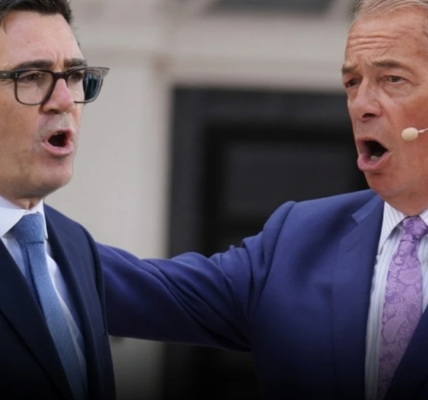

Britain’s Refugee Debate Reaches a New Turning Point: Reform UK Council Moves to Exit Resettlement Scheme
A major political battle is unfolding in Britain after a Reform UK-controlled council announced plans to withdraw from the government’s refugee resettlement programme, a move that supporters describe as putting local residents first and critics view as a troubling shift in Britain’s approach to humanitarian responsibilities.
The decision, if formally approved, would make Lancashire County Council the first local authority in the United Kingdom to leave the national refugee resettlement framework.
The proposal comes at a time when immigration, public services, housing pressures, and local government spending have become some of the most contentious issues in British politics.
For Reform UK, the move represents a flagship example of the party’s broader political message: prioritizing the needs of British citizens before extending resources to newly arrived migrants.
For opponents, it raises difficult questions about Britain’s international commitments, moral responsibilities, and the practical realities of refugee integration.
At the center of the controversy is Nigel Farage and his rapidly expanding political movement.
Following significant local election gains, Reform UK secured control of Lancashire County Council, winning 53 of the authority’s 84 seats and establishing one of the party’s strongest local government footholds.
Now, that electoral victory is beginning to translate into policy changes.
Under proposals expected to be considered by the council’s Cabinet, Lancashire would withdraw from both the UK Resettlement Scheme and the Afghan Resettlement Programme.
Support for Ukrainian refugees, however, would continue.
The distinction is politically significant.
It reflects the increasingly complex landscape of refugee policy in Britain, where public attitudes often vary depending on the specific circumstances surrounding different refugee groups.
The current resettlement schemes were introduced to provide safe and legal pathways for vulnerable refugees to rebuild their lives in Britain.
Councils participating in the programmes typically receive funding to help refugees settle into local communities.
Support can include assistance with housing, registration for healthcare services, introductions to schools, employment guidance, language support, and access to welfare systems.
Advocates argue these measures are essential for successful integration and help refugees become self-sufficient members of society more quickly.
Reform UK, however, argues that the system creates an unfair imbalance.
Party officials contend that local authorities are being encouraged to provide substantial assistance to newly arrived refugees while many long-term residents continue struggling with housing shortages, homelessness, financial hardship, and overstretched public services.
The party’s Home Affairs spokesman, Zia Yusuf, framed the issue in stark terms.
According to Reform UK, local resources should first be directed toward British citizens facing hardship before being allocated to individuals arriving through refugee programmes.
The argument is politically potent because it taps into a wider sense of frustration that has emerged in many communities across Britain.
Years of economic pressure, rising housing costs, strained healthcare services, and concerns about local infrastructure have fueled a growing debate over how limited public resources should be distributed.
Lancashire County Council cabinet member Joshua Roberts echoed those concerns, arguing that vulnerable residents and military veterans have not received sufficient attention from successive governments.

Supporters of the proposed withdrawal see the decision as a corrective measure.
They argue that local authorities should prioritize those already living within their communities.
Critics reject that framing.
Humanitarian organizations and refugee advocates frequently point out that resettlement programmes involve relatively small numbers of people compared with overall population figures.
They also note that refugees arrive through legal channels specifically established by government policy.
In their view, the issue is not a choice between helping local residents and helping refugees.
Rather, they argue that governments should ensure sufficient resources exist to support both.
The debate has become even more politically charged because of Reform UK’s broader immigration platform.
The Lancashire proposal arrives alongside other controversial ideas promoted by the party, including expanded deportation policies and the creation of migrant detention facilities.
One particularly contentious proposal involves locating detention centres in areas represented by political opponents.
Reform UK figures have suggested that if the party enters government, detention facilities should be prioritized in constituencies represented by politicians who support more liberal immigration policies.
Supporters describe the proposal as a matter of democratic accountability.
Critics view it as an attempt to politicize immigration enforcement infrastructure.
The controversy also highlights the increasingly intense rivalry between Reform UK and the Green Party.
While Labour and the Conservatives have traditionally dominated British politics, recent elections have revealed growing voter support for alternative parties.
The Greens and Reform UK represent dramatically different visions of Britain’s future, particularly regarding immigration, environmental policy, social issues, and the role of government.
As a result, local government decisions are increasingly becoming symbolic battlegrounds in a much larger national struggle over identity, sovereignty, public spending, and social priorities.
The Lancashire decision may therefore represent more than a local policy change.
It could become a test case for how Reform-controlled authorities approach immigration and public service allocation across Britain.
If the proposal is approved, pressure will likely grow on other Reform-led councils to consider similar measures.
That possibility explains why political observers across the country are watching closely.
The outcome could provide an early indication of how Reform UK would seek to govern if it gains greater influence nationally.
My Professional Perspective
After covering British politics, immigration policy, local government, and social change for more than three decades, I believe many observers are focusing on the wrong question.
The immediate debate is whether Lancashire should remain part of the refugee resettlement programme.
The deeper question is why this issue resonates so strongly with voters in the first place.
The answer lies in trust.
Across much of Britain, a growing number of voters feel that political institutions have become disconnected from their everyday experiences.
Housing shortages, rising living costs, pressure on public services, and economic insecurity have created an environment where questions about resource allocation carry enormous political weight.
When citizens believe resources are scarce, debates about who receives assistance become particularly emotional.
This is not unique to Britain.
Similar arguments are unfolding across Europe, North America, and Australia.
Immigration policy often becomes a proxy for broader anxieties about economic change, cultural identity, and public confidence in government.
One of the most overlooked aspects of the Lancashire controversy is that both sides are responding to legitimate concerns.
Supporters of refugee resettlement emphasize humanitarian obligations and Britain’s longstanding tradition of providing sanctuary to people fleeing conflict and persecution.
Supporters of Reform UK’s position emphasize fairness for struggling residents who believe their own needs have been overlooked.
These perspectives are not necessarily mutually exclusive.
Yet modern politics increasingly presents them as opposing choices.
That dynamic fuels polarization.
Another overlooked reality is that public perception often matters more politically than statistics.
Even if refugee programmes account for a relatively small portion of public spending, many voters judge policy through personal experience.
If a family cannot access affordable housing, struggles to obtain medical appointments, or feels public services are deteriorating, broader budget figures may do little to change their outlook.
Political movements succeed when they connect with those perceptions.
Reform UK has demonstrated a growing ability to do exactly that.
The party’s language consistently focuses on fairness, priority, and national obligation.
Whether voters agree with the proposed solutions is a separate question.
But there is little doubt that the underlying concerns resonate with significant sections of the electorate.
The most important unanswered question is whether withdrawing from refugee resettlement programmes would meaningfully improve conditions for local residents.
That issue deserves careful examination.
Would housing availability improve?
Would public services become less strained?
Would financial resources be redirected in ways that produce measurable benefits?
Or would the move function primarily as a symbolic political statement?
Those questions remain largely unanswered.
History shows that symbolic policies can be politically effective even when their practical impact is limited.
The challenge for all political parties is that voters increasingly demand tangible results rather than symbolic victories.
The Lancashire proposal therefore represents more than an immigration debate.
It is a test of whether populist political promises can translate into outcomes that voters can actually see and measure.
That may ultimately determine its significance.
Conclusion
Lancashire County Council’s proposed withdrawal from Britain’s refugee resettlement programme marks a potentially significant moment in the country’s immigration debate.
Supporters see it as a long-overdue effort to prioritize local residents and restore fairness in the allocation of public resources.
Critics view it as a retreat from humanitarian responsibilities and an oversimplification of complex social challenges.
The controversy reflects a broader transformation taking place in British politics.
Questions about immigration are increasingly intertwined with concerns about housing, healthcare, public spending, national identity, and trust in government.
As Reform UK expands its influence, local authorities are becoming testing grounds for policies that could eventually shape national debates.
Whether Lancashire’s decision becomes an isolated case or the beginning of a wider trend remains uncertain.
But one thing is already clear.
The argument is no longer simply about refugee policy.
It is about competing visions of what government should prioritize, whom public institutions should serve first, and how Britain defines its responsibilities in an era of growing political division.
And that raises a question that extends far beyond Lancashire:
When resources feel limited and public trust is fragile, how should a modern democracy balance its obligations to vulnerable newcomers with its responsibilities to the citizens who already call the country home?
The answer may shape British politics for years to come.