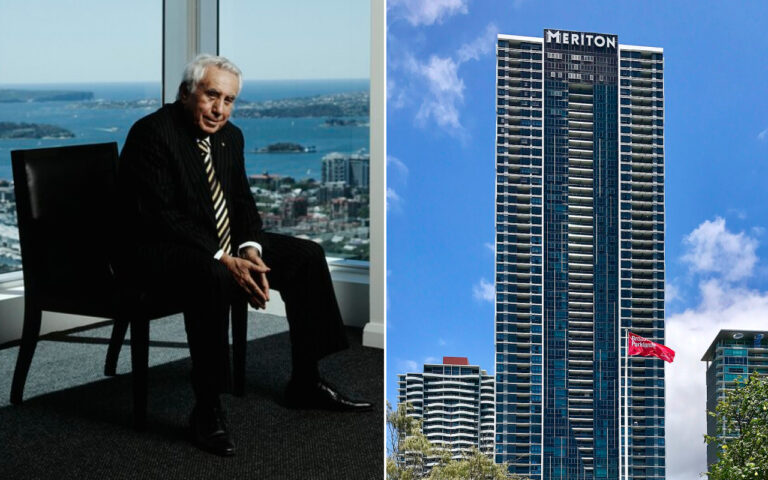

The Master Builder’s Gambit: Inside Harry Triguboff’s War for the Australian Dream
In the quiet, wood-paneled upper offices of Meriton Tower in Sydney, the numbers always tell the real story. For more than six decades, these offices have been the command center for Harry Triguboff—affectionately and sometimes warily known across the continent as “High-Rise Harry”. At 93 years old, the billionaire property tycoon remains as sharp, combative, and unapologetically direct as the concrete towers he has planted across Australia’s east coast.
When Triguboff speaks, the nation’s political and financial elite are forced to listen, not merely because he sits on a personal fortune of $32.29 billion—eclipsed on the national Rich List only by mining magnate Gina Rinehart—but because he controls the very roof over the heads of tens of thousands of Australians. His company, Meriton, has built more than 80,000 apartments, fundamentally shaping the skylines of Sydney, Brisbane, and the Gold Coast.
On a quiet Monday, Triguboff used his company’s media channel to drop a rhetorical bomb into the center of Australia’s most toxic and highly charged public debate: the housing crisis.
(Note: While the political landscape features populist resistance to rapid growth, developers like Triguboff push relentlessly in the opposite direction.)
Triguboff’s manifesto was simple, provocative, and entirely self-serving: Australia must bring in more immigrants, slash lending restrictions, and loosen foreign investment rules to deliberately drive housing prices back up.

In a nation where a generation of young Australians has been effectively locked out of homeownership by skyrocketing costs, Triguboff’s demand to make housing more expensive felt, to many, like an act of economic heresy. Yet, beneath the shock value of his words lies a complex, deeply calculated worldview of a man who viewed the entire continent not as a delicate social ecosystem, but as an unfinished canvas waiting to be paved.
The Manifesto: “This Country is Too Big to Be Left as It Is”
The article published on Meriton’s official website was less of a corporate press release and more of a philosophical challenge to the federal government. Triguboff did not mince words. He warned of an impending “catastrophe in real estate” that was stifling the national work ethic.
At the heart of his argument is a belief that a stagnant or falling property market destroys the very incentive of capitalism. With Australian housing prices experiencing a minor national dip of 0.7% from their absolute peak following a grueling sequence of interest rate rises, Triguboff declared that the country was in a “terrible mess.”
"It’s no good writing that prices are dropping. We must also say what must be done for prices to rise. If prices keep dropping, buyers will disappear... What is the point of working hard if prices drop?"
- Harry Triguboff, Founder of Meriton Properties
For Triguboff, the psychological impact of falling prices is devastating to the economy. He argues that when Australians see property values decline, they adopt a “wait and see” attitude, choosing to sit on their cash rather than build wealth. This indecision, he claims, has paralyzed buyers who visit Meriton display centers but refuse to sign on the dotted line.
The Attack on Banks and the Foreign Capital Flight
Triguboff laid the blame for this paralysis squarely at the feet of two institutions: the major commercial banks and the federal government’s regulatory bodies. He accused banks of making it “impossible” for everyday citizens to secure a home loan.
But his frustration extended far beyond domestic buyers. Triguboff took aim at the strict rules governing foreign investment, pointing out that international investors—particularly from China and Japan—had been burned by the Australian market in recent years.
“Investors must make a reasonable profit,” Triguboff insisted. “The Chinese came and lost money, the Japanese came and lost money. They don’t come to lose money.”
                       [Triguboff's Growth Engine]
                                  │
         ┌────────────────────────┴────────────────────────┐
         ▼                                                 ▼
[Mass Immigration]                               [Foreign Capital]
  • Drives rental demand                           • Funds high-rise construction
  • Fills labor shortages                          • Absorbs luxury inventory
         │                                                 │
         └────────────────────────┬────────────────────────┘
                                  ▼
                     [Rising Property Values]
To counteract this, the Meriton founder called for a massive influx of overseas buyers, brushing aside persistent public concerns regarding cultural assimilation and infrastructure strain. “This country must grow,” he declared. “It’s too big to be left in its present state. To develop we need more people… When they do come here, they mix very well with the local people.”
The Clash with Canberra’s Reality
Triguboff’s demand for even higher migration levels comes at a time of extreme political sensitivity. Prime Minister Anthony Albanese has presided over a historic surge in net overseas migration, with more than 1.6 million people entering the country since mid-2022.
Despite these record-breaking numbers, Triguboff claimed the government “actually wants migrants but does nothing about it,” arguing that bureaucratic red tape, slow council approvals, and high development taxes are preventing developers from building the very homes these migrants need.

This is not a new battleground for Triguboff. For years, the billionaire has been a major political donor to both the Liberal and Labor parties, using his immense wealth to lobby for high-growth, high-density policies. When Chinese buyer interest dried up in recent years, Triguboff adapted by holding onto his stock, renting out thousands of apartments himself, and using Meriton’s in-house finance arm to bypass traditional bank lending. But his ultimate goal remains unchanged: an Australia of unceasing growth, fueled by international capital and a continuous stream of new arrivals.
Having spent thirty years dissecting the intersection of money, politics, and power, I have learned that when a billionaire complains about the state of the nation, you must always look at his balance sheet to find his true motivation.
Harry Triguboff is not a public policy theorist; he is a master builder whose entire empire is structurally dependent on two raw materials: cheap credit and rapid population growth. When either of those taps is turned off, the massive machinery of Meriton begins to grind.
To look at Triguboff’s latest remarks through a purely journalistic lens is to reveal a much deeper, far more complex narrative about the state of the Australian dream—one that many everyday citizens feel is being slowly dismantled.
The Unspoken Math: The Rental Cushion
The casual observer might wonder how a developer can survive when apartment sales drop and foreign buyers dry up. The answer lies in a highly strategic pivot that Triguboff executed years ago.
| Meriton’s Dual-Engine Business Model | |
| The Sales Engine | Building and selling luxury and medium-density apartments to owner-occupiers and investors. (Currently slowed by high interest rates and tight bank lending). |
| The Rental Cushion | Holding a massive portfolio of built apartments (including over 5,000 in Sydney alone) to operate as build-to-rent and serviced apartments. |
When the sales market cools, Triguboff simply takes his apartments off the market and rents them out. By renting out thousands of units, Meriton enjoys a massive, recession-proof cash flow.
When Triguboff demands more immigration, he knows that even if these new arrivals cannot buy an apartment immediately, they must rent. High migration directly drives down rental vacancy rates and pushes rent prices to record highs—a reality that directly inflates Meriton’s bottom line while placing immense pressure on everyday Australian families struggling with the cost of living.
The Psychological Illusion of “Working Hard”
One of the most fascinating aspects of Triguboff’s argument is his assertion that falling housing prices cause people to stop working hard. He asks, “What is the point of working hard if prices drop?”
This is a revealing look into the psyche of the property elite. For Triguboff, the ultimate measure of national health and individual achievement is the size of one’s property portfolio. But for the average Australian, this logic is completely inverted.
To a school teacher, a nurse, or a young tradesman in Sydney or Melbourne, the fact that housing prices continue to hover at ten to twelve times the average annual salary is the very thing that makes them want to give up. The “wait and see” approach he criticizes is not laziness; it is financial survival. When the median house price in Sydney sits well over $1.6 million, the motivation to work harder evaporates because the goalpost has been moved entirely out of reach.
[Triguboff's View]  : Falling Prices ──► People Stop Working Hard (No Asset Growth)
[Average Citizen's View]: Skyrocketing Prices ──► People Stop Trying (Homeownership is Impossible)
By framing rising property prices as a moral imperative for national productivity, Triguboff is attempting to align his personal commercial interests with the spiritual well-being of the working class. It is a brilliant, if deeply cynical, piece of rhetorical engineering.
The Foreign Investment Trap
Triguboff’s lament that “the Chinese and Japanese came and lost money” exposes the fragile nature of the high-density apartment market. For years, the rapid construction of high-rise towers in Sydney and Brisbane was funded by pre-sales to foreign investors.
But many of these international buyers purchased off-the-plan apartments that failed to appreciate in value, burdened by high taxes, building defect scandals, and a shifting global economy. When Triguboff demands that the government “change the rules so foreign investors can make more money,” he is asking for the socialization of risk and the privatization of profit.
He wants the Australian government to lower the barriers to entry for foreign wealth, even if that wealth drives up the cost of land and makes entry-level apartments more expensive for local first-home buyers.
The Unanswered Questions
If Australia were to follow Triguboff’s blueprint for growth, it would trigger a series of profound structural consequences. As an analytical journalist, these are the critical questions that remain unaddressed in his vision:
-
Where is the infrastructure? Triguboff dismisses concerns about assimilation and growth by saying “they mix very well.” But mixing well does not build hospitals, expand schools, or lay down rail lines. If Australia continues to absorb historic levels of migration without a corresponding, massive investment in public infrastructure, does the quality of life for all Australians degrade?
-
What happens to systemic risk? If banks loosen their lending rules to the extent Triguboff desires, do we risk creating a subprime debt bubble? Forcing banks to lend more money in a high-inflation, high-interest-rate environment might boost short-term sales for Meriton, but it leaves the entire financial system deeply vulnerable to a systemic crash.
-
Is there a limit to growth? Triguboff argues that Australia is “too big to be left in its present state”. But does a nation’s greatness lie solely in its population density and the height of its concrete towers? Or is there value in preserving the space, the environment, and the livability that made Australia a desirable destination in the first place?
Harry Triguboff’s bold intervention into the housing debate is the ultimate expression of unbridled, high-growth capitalism. At 93, the billionaire developer has no time for political correctness or diplomatic hedging. He wants more people, cheaper money, and higher property prices—and he wants them now.
To understand Triguboff is to understand the engine that has driven the Australian economy for the past thirty years. It is an engine fueled by brick, mortar, concrete, and human capital. But as the gap between the wealthy elite and the average citizen continues to widen, the master builder’s blueprint is facing unprecedented resistance from a population tired of renting a dream they can no longer afford to buy.
A Final, Thought-Provoking Question
As we look at our crowded cities and our increasingly unaffordable suburbs, we must ask ourselves: Should the success of Australia be measured by the rising value of our real estate and the height of our skylines, or by our ability to provide a secure, affordable home for every citizen who works hard to build this country?