100 Historical Photos So Rare Most People Will Never See Them – Decoding Ancient .V2

A photograph can preserve a second that the world was never meant to forget: soldiers marching through a burning city, children growing up beneath the shadow of war, a crowd standing against injustice, or an ordinary person caught in a moment that would later become part of history. Yet the past is never made of famous images alone. It also lives in forgotten faces, unfamiliar streets, strange inventions, changing fashions, and the small gestures of people whose names have disappeared from the record. From the battlefields of Europe to the streets of Jerusalem, from the ruins of San Francisco to the final days of the Vietnam War, these photographs offer more than a window into another time. They reveal how human lives continue amid destruction, uncertainty, ambition, and change—and how even the most extraordinary historical moment is experienced by ordinary people one day at a time.
The year 1945 appears again and again in the photographs of the twentieth century, but rarely does it look the same twice. In one image, Soviet troops march through the outskirts of Vienna in April, trampling a Nazi flag as a house burns nearby. The scene belongs to the final, violent months of the war in Europe, when German defenses were collapsing and cities that had endured years of conflict were becoming battlefields once more. A flag that had once represented the power of a regime now lies beneath marching boots. Yet the burning building is a reminder that the defeat of an army does not immediately end the suffering of the people living among its ruins. Even as victory approaches, destruction remains painfully present.
Berlin in 1945 offered another portrait of a world coming apart. Streets that had once carried commuters, shoppers, and children on their way to school were transformed by rubble, shattered buildings, and military occupation. Photographs of German prisoners moving through the city reveal a defeated population that included soldiers of different ages and backgrounds. Among them were boys who had served in the Hitler Youth or the Volkssturm, the last-ditch formations that drew increasingly young and old men into the defense of Germany. Their presence reflected the desperate circumstances of the final stage of the war. Some had been raised under Nazi rule, surrounded by its slogans and expectations; others had been pulled into military service as the regime struggled to survive.
Their youth does not erase the crimes of the regime they served, nor does it make all their individual circumstances identical. But the sight of such young prisoners raises a difficult question about the cost of political fanaticism: what happens when a government turns childhood itself into a resource for war? By 1945, Germany’s defeat was no longer in doubt. The human consequences of the ideology that had carried the country into catastrophe, however, would continue long after the last battles ended.
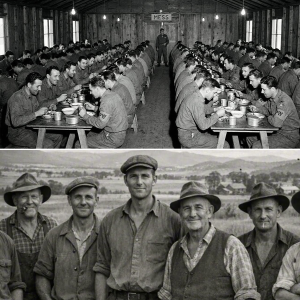
The war had begun years earlier, and its prisoners came from far beyond Germany. A photograph described as showing captured soldiers from eight nations in a German prisoner-of-war camp during the First World War offers a reminder of the conflict’s international scale. The men in such camps could have come from societies with different languages, traditions, and political loyalties, yet captivity imposed a shared condition upon them. Their lives were shaped by guards, regulations, food supplies, illness, uncertainty, and the distance separating them from home. A photograph can identify a camp or a group of prisoners, but it cannot reveal every man’s story. It cannot tell us how many expected to return to their families, how many had already lost someone, or what each man remembered when the camp fell silent at night.
The First World War helped establish a century in which mass mobilization, industrial weapons, and state power would repeatedly transform ordinary people into participants in conflicts far larger than themselves. The Second World War intensified that pattern on an even greater scale. In the besieged city of Leningrad, a column of men carried vessels used to transport hydrogen for balloons along what is now Nevsky Prospekt. The image belongs to a city where survival required immense improvisation and endurance. The siege lasted from 1941 until 1944, and starvation, bombardment, and extreme cold killed vast numbers of civilians. Even activities that might seem unremarkable in peacetime—moving equipment along a main avenue, keeping transport functioning, maintaining essential services—became part of a struggle to keep the city alive.
Another photograph from Leningrad shows children and a teacher in a school damaged by shelling during the siege. The classroom is not simply a symbol of destruction. It also represents an attempt to preserve some form of ordinary life under extraordinary conditions. Education, routine, and the presence of a trusted adult could not protect children from the dangers surrounding them, but they remained meaningful. When war invades a city, it does not merely damage buildings. It attacks the structures through which people understand the world: the school, the home, the marketplace, the street where neighbors meet. A damaged classroom shows what has been lost, but the decision to continue teaching also reveals what people refused to surrender.
In another part of the war, American Marines crawled across a beach on Saipan in June 1944 under enemy fire. Their low bodies and forward movement convey the physical vulnerability of soldiers during an amphibious assault. There was little room for grand gestures. The immediate concerns were the ground ahead, the position of the enemy, and the desperate need to reach cover. Across the Pacific, American forces fought from island to island, facing Japanese defenses designed to make every landing costly. Saipan’s capture was strategically important, bringing the United States closer to the Japanese home islands, but the campaign also brought catastrophic losses to military personnel and civilians.
The battle for Iwo Jima, fought in February and March 1945, produced some of the most recognizable images of the Pacific War. North American P-51 Mustang fighters later flew over the island, including over a crashed B-29 bomber. Such photographs document the machinery of a war conducted across enormous distances: bombers, fighter aircraft, airfields, ships, and the ground crews who kept them operating. Yet the wreckage beneath the aircraft offers another perspective. Machines built to cross oceans and deliver tremendous force could still be destroyed in moments. Every damaged aircraft represented not only a loss of equipment but also a disruption to the people who depended on it and the missions for which it had been prepared.
The image of a curved-barrel Sturmgewehr 44, fitted with a Krummlauf attachment that allowed a soldier to fire around a corner, reveals another aspect of modern warfare: the effort to solve lethal problems through engineering. The device was an attempt to give infantrymen the ability to engage enemies without fully exposing themselves. Its unusual shape looks almost unreal today, like a prop from a science-fiction film. But it belonged to a real military environment in which designers were searching for every possible advantage. The same technological ingenuity that produced tools for exploration, communication, and transportation could also be redirected toward killing.
War did not always look like a battlefield. Sometimes it appeared in the lives of people forced to flee. In 1943, Polish women and children waited in an American Red Cross evacuation camp in Tehran, hoping to be moved to new homes. Their presence reflected the enormous population displacements created by the war, particularly in Eastern Europe. Families had been uprooted by occupation, deportation, forced labor, and military campaigns. A camp might provide temporary shelter, but it could not restore the home that had been lost or guarantee where the family would go next. The people in the photograph were not simply waiting for transport. They were waiting for the possibility of beginning again.

A different photograph records a Dutch woman who refused to leave her German soldier husband and accompanied him into Allied captivity in Walcheren in 1944. The image suggests the painful collision between personal loyalty and the political divisions created by war. Relationships did not always fit neatly into the categories imposed by military authorities or public opinion. A spouse might be regarded as an enemy because of the uniform worn by the person she loved, while the soldier himself might have been feared, hated, or regarded with suspicion by the community around him. Without knowing the couple’s full circumstances, it would be wrong to assume what either person believed or had experienced. What the photograph does preserve is a visible choice to remain together at a moment when separation may have seemed easier.
Another image, taken in July 1946, shows a Dutch soldier with an Indonesian guerrilla he had captured during a patrol in East Java. Indonesia’s struggle for independence from Dutch rule continued after the Japanese surrender in 1945. The end of the Second World War had not automatically restored peace across Asia. In many places, the collapse of Japanese occupation opened the way for new struggles over sovereignty, national identity, and the future of colonial empires. The two men in the photograph occupied opposing positions within that conflict. One had captured the other, but their shared presence in a single frame also reminds us that history’s political divisions are lived through individual bodies and individual encounters.
The final days of American involvement in South Vietnam produced another set of unforgettable scenes. On April 30, 1975, North Vietnamese tanks entered Saigon and moved toward the presidential palace, bringing the war to its decisive end in the city. In a separate image associated with the evacuation, an employee identified by the alias T. D. Lass helps people climb a ladder toward the final American helicopter leaving South Vietnam. The hurried movement captures the urgency of an evacuation in which time, space, and safe passage were limited. For those leaving, the helicopter could mean escape from immediate danger, but it also meant abandoning familiar streets, possessions, workplaces, and sometimes relatives who could not get out.
For those who remained, the fall of Saigon brought a new political order and an uncertain future. The war had already cost immense numbers of lives and left families divided across borders. A single image of a helicopter cannot convey the full range of experiences that followed: the fear of reprisals, the difficulties of adapting to a changed society, the journeys of refugees, or the memories carried by veterans. But the photograph makes one truth difficult to ignore. The end of a war is often announced in military terms, while the people who live through it must continue to deal with consequences that have no clear ending date.
Not every photograph from the twentieth century records combat. Some reveal the quieter struggles over dignity, rights, and belonging that continued alongside war. In 1920, Margaret Sanger protested in Boston against restrictions on discussing birth control, covering her mouth to make the point visible. Her activism formed part of a larger controversy over contraception, reproductive autonomy, public morality, and the limits placed on speech. The image is striking because its message is carried through an act of physical silence: a person who wants to speak about a subject is shown with her own mouth covered. It captures the tension between a public demand for discussion and the social or legal barriers that attempt to suppress it.

In the United States, Martin Luther King Jr.’s arrest in Montgomery, Alabama, in 1958 belongs to the wider history of the civil rights movement. Photographs of King in police custody remind us that the struggle against racial segregation was not conducted only through speeches and marches. It also involved arrests, court proceedings, intimidation, and the daily risks faced by those who challenged the established order. The civil rights movement sought to dismantle a system that restricted Black Americans’ access to public facilities, voting, education, and equal treatment under the law. An arrest photograph may show only a brief encounter with authority, but it sits within a much longer struggle over who could claim the full protection of citizenship.
A different photograph from Montgomery in 1956 shows a Black woman looking toward members of the Ku Klux Klan. The precise circumstances of the encounter matter, and a caption alone cannot tell us everything about what happened before or after the image was taken. Still, the contrast between the woman and the hooded figures evokes the racial intimidation that shaped life in the American South. The Klan’s robes and symbols were designed to project power through anonymity and fear. The woman, whose name may not have been preserved in the caption, stands as a visible individual facing a group whose public identity was built around threatening others.
The history of racial inequality also extends into the labor system that followed slavery. Around 1903, prisoners were leased to harvest timber in Florida. After emancipation, several Southern states used criminal laws, discriminatory enforcement, and convict-leasing arrangements to force many Black Americans into labor under brutal conditions. Convicts could be leased to private businesses, where they often worked in dangerous environments with little meaningful protection. The system was not identical to slavery in legal form, but it allowed coercive labor and racial exploitation to persist long after the Thirteenth Amendment abolished slavery, except as punishment for a crime. A photograph of workers cutting timber can appear at first glance to show only an industrial task. Its larger historical significance emerges when we ask who controlled the workers, how they came to be there, and whether they had any real freedom to leave.
The Vietnam War also provoked protests far from the battlefield. In May 1968, Paris experienced major demonstrations and clashes that grew from student protests into a broader crisis involving workers and the French government. On Gay-Lussac Street, the confrontation formed part of a wave of unrest that challenged established authority and exposed deep generational and political tensions. Two years later, protests against the Vietnam War at Kent State University in Ohio ended in tragedy when members of the Ohio National Guard fired on students on May 4, 1970, killing four and wounding nine. Howard Ruffner’s photographs of the shootings and their aftermath became part of the visual record of a national crisis. The deaths intensified opposition to the war and raised lasting questions about the use of force against demonstrators.

A photograph of a demonstration against the Vietnam War in Italy in 1970 places the conflict in an international context. Opposition to the war was not limited to American campuses. People across Europe and elsewhere debated the intervention, the suffering of Vietnamese civilians, the legitimacy of military power, and the responsibilities of governments. Demonstrations were often made up of people with different political aims, but they shared a willingness to take public space and make disagreement visible. In photographs, a protest can appear as a dense mass of signs and faces. The individuals within that crowd, however, may have arrived for very different reasons: some out of moral conviction, some from political commitment, and others because they feared what the war represented for the future.
Another photograph from June 4, 1989, depicts student protests in Tiananmen Square as helicopters dropped government leaflets admonishing the demonstrators. The student-led movement had drawn people into one of the most consequential political confrontations in modern Chinese history. The demonstrations became a broader expression of demands and frustrations concerning political reform, corruption, and the direction of the country. The subsequent military crackdown resulted in deaths and injuries, though the exact number of casualties remains disputed. The image of leaflets descending from helicopters reveals an attempt to communicate with or influence the crowd from above, even as the confrontation between demonstrators and the authorities continued to intensify. A photograph freezes a moment of that confrontation, but it cannot capture every hope that brought people to the square or every consequence that followed.
The 1930s offered a different but equally disturbing example of political extremism. On July 18, 1937, nearly a thousand uniformed American Nazis reportedly marched in New Jersey, displaying swastika armbands and banners. The image is a reminder that fascist ideology did not exist only in Germany. Movements inspired by Nazism sought attention and support in other countries, including the United States, during the years before the Second World War. Their existence did not mean that American society as a whole embraced their beliefs, but it demonstrated that antisemitism, authoritarian nationalism, and admiration for foreign dictators could find organized expression beyond the borders of the Nazi state. The march is unsettling precisely because it took place in an ordinary American setting, where the symbols of a regime that would soon unleash a devastating war were displayed in public.
The suffering of civilians during the Second World War is also reflected in the story of the SS St. Louis, a German passenger ship that sailed in May 1939 carrying 937 passengers, almost all of them Jewish refugees fleeing Nazi persecution. The passengers hoped to reach Cuba, but most were denied permission to disembark. The ship later sailed near the Florida coast, yet the United States also refused to admit those who lacked the required visas. The passengers were eventually returned to Europe, where Britain, France, Belgium, and the Netherlands agreed to receive them. Many found temporary refuge, but 254 passengers who returned to continental Europe were later killed in the Holocaust.
A photograph of the St. Louis passengers is difficult to look at because it records a moment when safety seemed close enough to imagine but remained beyond reach. These people had already taken the frightening step of leaving their homes. They had boarded a ship in the hope that distance might protect them from persecution. Yet a border, a visa rule, or a government’s refusal could determine whether they would be allowed to begin again. Their story demonstrates that the catastrophe of the Holocaust cannot be understood only through the machinery of Nazi persecution. It must also be examined through the decisions of countries that had opportunities to provide refuge but chose not to admit many of those seeking it.
Other images show the world attempting to recover from destruction. On April 18, 1906, a powerful earthquake struck San Francisco, triggering fires that burned for days and destroyed large parts of the city. Thousands of people died, and much of the population was left homeless. The photographs of the ruined City Hall and surrounding streets reveal a city whose familiar landmarks had been reduced to damaged walls and heaps of debris. Yet the aftermath also produced extraordinary efforts to provide food, shelter, medical care, and rebuilding assistance. Survivors slept in tents and waited in lines for necessities while officials and residents worked to restore basic services. The disaster was not over when the ground stopped shaking; for many people, the struggle to live through its consequences was only beginning.
Nearly three decades later, the Great Ohio River flood of 1937 covered communities across the river valley. At Churchill Downs in Louisville, the famous racetrack was flooded, with water covering the track and infield. A place normally associated with horses, crowds, and competition became a landscape shaped by water. The contrast is a reminder that disasters do not respect the boundaries between important places and ordinary ones. Floodwater can enter homes, businesses, roads, and sporting grounds alike, disrupting both livelihoods and the routines through which communities recognize themselves. Photographs of the flood show the scale of the event, but the most enduring consequences were often measured in damaged property, lost income, displacement, and the long work of rebuilding.

The Messina earthquake of 1908 produced similar scenes of devastation in southern Italy. A photograph of sailors from the battleship Slava among the ruins records the international dimension of disaster response. When a catastrophe overwhelms a community, the need for assistance can cross national borders, bringing people who might otherwise never meet into a shared effort. The image of sailors standing amid shattered masonry also reveals the limits of military power: warships and trained crews can provide help, but they cannot prevent every natural disaster or immediately undo its effects.
Some historical photographs preserve the very different catastrophe of industrial and technological failure. On May 6, 1937, the German airship Hindenburg caught fire while attempting to land at Lakehurst, New Jersey. Sam Shere’s famous image of the disaster captured the airship burning as it fell, turning a technological spectacle into a scene of sudden destruction. The disaster killed 36 people aboard and on the ground, and it became a defining event in the public memory of airship travel. The Hindenburg had represented an ambitious vision of long-distance transportation, combining size, luxury, and the promise of speed. Its destruction showed how quickly confidence in a new technology could be shaken by a single catastrophic event.
The oil tanker Torrey Canyon met another kind of technological disaster in March 1967, when it ran aground on Seven Stones Reef off the southwestern coast of Britain and broke apart. The resulting oil spill polluted long stretches of coastline and harmed wildlife. Images of the damaged vessel made visible the environmental risks of an increasingly industrialized world. Ships and tankers moved goods that modern economies depended upon, but accidents could transfer the costs of commerce to coastal communities, fishing grounds, and ecosystems. The wreck was a warning that technological progress brings responsibilities as well as benefits, particularly when the consequences of failure extend far beyond the machine itself.
Not all the photographs in this collection carry such weight. Some are reminders that human beings have always been inventive, playful, and a little eccentric. A so-called literal selfie stick from 1934 may look surprisingly familiar to modern viewers, accustomed to photographing themselves with phones held at arm’s length. The resemblance is amusing, but it also reveals a recurring human desire: to include ourselves in the record of an experience. The technology changes; the impulse does not. Long before digital cameras and social media, people experimented with ways to capture their own likenesses and share a moment with others.
An unusual helicopter unit in the Indian Air Force decorated its aircraft with elephant-shaped designs during the 1970s. The image turns military machinery into something playful and ceremonial, showing how aviation can also be used for display, spectacle, and public engagement. In another photograph, a man attempts to ride a zebra in German East Africa around 1910. The scene may appear comic, but it also belongs to a colonial world in which Europeans often treated unfamiliar environments and animals as stages for adventure or display. Without more context, the photograph cannot tell us the man’s intentions, but it does preserve a curious encounter between human ambition and an animal not suited to ordinary riding.
A photograph of an early car with a toy-like design reveals how differently people once imagined the future of transportation. The automobile was still transforming roads, cities, work, and leisure during the early twentieth century. Designers experimented with shapes and mechanisms, while buyers learned to regard the motorcar as both a practical tool and a symbol of status. The Golden Gate Bridge, photographed during construction in 1934, represents a more monumental version of that ambition. Its cables, towers, and incomplete spans show a structure in the process of becoming one of the world’s most recognizable bridges. Behind the finished landmark lay difficult engineering, dangerous work, and the coordinated labor of many people whose individual contributions are less visible than the structure they helped create.
A photograph of the first chief engineer of the RMS Mauretania, John Curry, at Canada Dock in Liverpool in 1909 offers a more personal view of engineering history. Great passenger liners were achievements of design, manufacturing, navigation, and labor. They connected continents and carried migrants, business travelers, tourists, and crews across oceans. Their public image often emphasized luxury and speed, but their operation depended on workers whose skills were essential to the vessel’s success. A portrait of an engineer beside such a ship reminds us that large technological achievements are never the work of machines alone. They are also the products of human knowledge, discipline, and cooperation.

The past also survives in the clothes people wore and the identities they chose to present. A photograph of African-American teenagers in zoot suits in 1943 captures a style that had grown out of Black musical and urban culture before spreading to other communities, including Mexican-American youth. The exaggerated jackets, high-waisted trousers, and distinctive silhouettes made the outfit immediately recognizable. Clothing could signal creativity, group belonging, and pride, but it could also provoke hostility in a society marked by racial prejudice. During the Second World War, zoot-suit wearers became associated with wider tensions around race, patriotism, and public behavior. A photograph of young people in fashionable clothes therefore records more than a passing trend. It shows how style can become a statement about who has the right to be visible in public.
A different image shows women in the 1920s wearing rolled stockings, part of a fashion trend that encouraged the playful practice of painting designs on the knees. Photographs of such details can seem trivial beside images of war and political upheaval, but everyday fashions are valuable records of social change. They reveal how people negotiated expectations about respectability, gender, beauty, and modernity. What seemed daring in one decade might become ordinary in the next. The same is true of hairstyles, bathing costumes, Halloween masks, and the clothing worn by schoolchildren. Each image preserves a small piece of the social world in which people lived.
The 1920s also appear in photographs of women dressed for Halloween, children wearing masks, and girls dancing in Harlem. The masks can be amusing or unsettling to modern eyes, but they show that the desire to disguise oneself and temporarily become someone else is not new. The Harlem photograph, meanwhile, offers a glimpse of dance as a form of shared social life. The neighborhood became a major center of African-American cultural creativity during the Harlem Renaissance, with music, literature, performance, and visual art helping reshape American culture. A group of girls dancing is not necessarily a formal record of that movement, but it belongs to a broader history in which Black communities created spaces for expression and pleasure despite widespread discrimination.
Images of performers and actors offer another route into the past. Ernest Hemingway, photographed as a teenager in 1915, appears long before the fame that would make his name synonymous with twentieth-century literature. A young portrait cannot predict the work or controversies that will define a person’s later life. It simply captures a stage of existence before the world has attached its larger meanings. The same is true of Audrey Hepburn in the early years of her career, Jane Fonda at the Actors Studio in 1958, and Paul McCartney beside a swimming pool in 1974. Famous people are often remembered through their achievements, but photographs return them to ordinary time: young, learning, resting, working, or sharing a moment away from the public stage.

The contrast between a public image and a private person is especially clear in photographs of Michael Jackson as a teenager in 1979, or of musicians and actors before their later careers were fully established. Such images can tempt viewers to interpret every gesture through knowledge of what happened afterward. Yet that hindsight can distort the moment itself. The young person in a photograph does not know the future that viewers will attach to the image. Their expression may be no more than a reaction to the camera, the company they are keeping, or the events of an ordinary afternoon.
Photographs of political leaders can be equally misleading when separated from their context. A young Joseph Stalin in Bailov prison in Baku in March 1910 belongs to a period when he was still a revolutionary activist under the Russian Empire, years before he became the leader of the Soviet Union. A portrait of President Ulysses S. Grant reading a newspaper shortly before his death offers a much quieter scene. Grant’s final illness was painful, and he worked to complete his memoirs while facing throat cancer. Such images remind us that leaders are not born into the historical roles for which they later become known. They move through time, shaped by decisions, opportunities, conflicts, and circumstances that may not be visible in a single photograph.
Other photographs preserve the lives of people who never became household names. An Indian chief identified as Yellow Robe stands with his daughter in 1927. A Blackfoot group appears in Glacier National Park in 1913. A Rwandan man wears the traditional Amasunzu hairstyle in a photograph from around the 1920s. These images can provide valuable glimpses of cultural traditions and personal presentation, but they must be approached with care. Indigenous and African communities have often been photographed by outsiders who recorded only what interested them, sometimes reducing complex societies to costumes or stereotypes. A respectful viewer should recognize that the people in these photographs had lives extending far beyond the frame: families, languages, beliefs, responsibilities, humor, and histories of their own.
The same caution applies to historical images of women from Tripoli, Yemen, Salzburg, and French Indochina. Clothing and appearance may be the most immediately visible features, but they do not tell us everything about the person pictured. A photograph labeled with a place and date offers a starting point, not a complete biography. Even when the photographer’s name is known, the subject may remain unidentified. Felice Beato’s 1877 portrait of a man wearing a kanmuri, a crown-like hat associated with Japanese nobles and court officials, preserves an aspect of formal dress and social status. But the sitter’s individual thoughts and experiences remain outside the image unless other evidence survives.
Some photographs invite us to consider how knowledge itself is preserved. A Maya monument at Copán, identified as Stela B and dedicated in 731 CE, bears an inscription that includes a date in the Maya Long Count calendar and imagery associated with Maya deities. The carved stone represents a sophisticated historical tradition in which rulers, ceremonies, and important dates could be recorded through writing and monumental art. Modern viewers may approach such an image as archaeology, but for the people who created and understood it, the monument belonged to a living political and religious world. Its survival across centuries reminds us that the past is not preserved only through photographs. It also endures in inscriptions, buildings, artifacts, oral traditions, and the work of communities that continue to interpret their heritage.
A Swedish runestone from the eleventh century carries another kind of memory. Its inscription states that Vibiorn raised the stone in memory of Solvi, his brother. The words are brief, but their purpose is deeply familiar. Someone wanted a loved one’s name to remain visible after death. The stone was a public marker, a way to make remembrance endure beyond the lifespan of those who had known the deceased personally. The same impulse appears in photographs of family gatherings, portraits of children, wedding dresses, and images of parents watching their children grow. Different societies have developed different ways to preserve memory, but the underlying desire is often the same: to prevent a person from disappearing completely.
A photograph of President Franklin D. Roosevelt and Prime Minister Winston Churchill at the Casablanca Conference in January 1943 documents a meeting at which Allied strategy was discussed during the Second World War. Such conferences shaped decisions that affected armies, occupied territories, and civilian populations across several continents. The leaders’ meeting was a political event, but the consequences extended far beyond the room in which they sat. Strategy determined where forces would be deployed, how resources would be allocated, and what risks soldiers and civilians would face. A photograph can record the presence of powerful decision-makers, while the historical record must explain the policies and choices made around them.

In another photograph, a young Princess Elizabeth drives an ambulance during her wartime service in the Auxiliary Territorial Service in April 1945. Her service occurred during the final months of the war in Europe and placed her among the many women who undertook military support roles. Women served as drivers, mechanics, nurses, communications specialists, and workers in industries essential to the war effort. Their contributions did not erase the unequal expectations that continued to shape their lives, but wartime service helped make visible skills and responsibilities that were often overlooked. The photograph shows a future monarch engaged in a practical task at a moment when Britain was still living through the consequences of a global conflict.
A different royal photograph shows Princess Elizabeth and Princess Margaret performing in a pantomime at Windsor Castle before Christmas in 1941. The image belongs to a period when the war had altered nearly every aspect of British public life. Even a royal household could not entirely escape the pressures of wartime uncertainty. A theatrical performance offered a temporary space for humor and familiar traditions, although it did not remove the dangers facing the country. The juxtaposition of a young princess in costume and the wider war around her captures one of the recurring contradictions of historical life: people continue to celebrate, perform, and maintain rituals even when the future remains uncertain.
There are also photographs of a 14-year-old Princess Elizabeth and her younger sister Margaret, children living through a war that was reshaping the world. Childhood photographs are often treated as charming glimpses of innocence, but their historical significance depends on the circumstances surrounding them. For children growing up during wartime, birthdays, schoolwork, family portraits, and performances took place against a background of evacuation, rationing, military service, and loss. The camera could preserve an apparently ordinary moment, even when the larger world was anything but ordinary.
One of the most painful images in this collection concerns the explosion of the Space Shuttle Challenger in January 1986, as members of teacher Christa McAuliffe’s family watched from Kennedy Space Center. The disaster killed all seven crew members and shocked a nation that had come to regard spaceflight as a symbol of technological achievement. McAuliffe, selected to become the first teacher in space, represented the hope that space exploration could be shared with the public in a new way. The launch was meant to inspire students and demonstrate the possibilities of scientific discovery. Instead, the catastrophe exposed the risks that remained even after years of technical progress and experience.
The image of relatives watching the explosion carries a different kind of historical weight from a photograph of the shuttle itself. A spacecraft can be examined as a machine, and an accident can be analyzed through engineering reports and technical evidence. But the people watching from the ground remind us that disasters unfold within families and communities. They are experienced through shock, disbelief, and the sudden transformation of an anticipated celebration into grief. Photographs cannot fully convey the lives of those who were lost, but they can preserve the moment when the world changed for those who loved them.
From a war-torn street in Vienna to a flooded racetrack in Louisville, from a civil rights arrest to a spacecraft disaster, these photographs show how many different forces shape history. Political decisions can turn cities into battlefields. Racism can determine who is free and who is exploited. Natural disasters can destroy familiar landscapes in minutes. Technology can connect distant places or create new dangers. Fashion, art, music, and family life reveal how people respond to the world around them, sometimes through resistance, sometimes through invention, and sometimes simply by carrying on.
The people in these images did not know they were becoming part of a historical record. A soldier crossed a street, a child posed for a portrait, a worker completed a task, a family waited for news, and a crowd gathered to protest. The camera preserved a fragment of their lives, but the meaning of that fragment often became clearer only later. Some photographs are famous because they document a turning point. Others matter because they bring attention to people whose experiences might otherwise be forgotten. Still others remind us that history is not always dramatic in the moment it is lived. Sometimes its significance lies in a small detail that a photographer happened to notice.
The past is not a single story moving neatly from disaster to recovery, or from injustice to progress. It is a collection of overlapping experiences, many of them contradictory. The same century that produced extraordinary engineering achievements also produced devastating wars. The same societies that celebrated freedom often denied it to entire groups of people. The same people who endured hardship found reasons to dance, dress up, build, invent, and celebrate. Looking at these photographs together does not make history simpler. It makes its complexity harder to ignore.

Perhaps that is why old photographs continue to hold our attention. They allow us to meet the past without pretending that we can fully understand it. We can study the uniforms, buildings, tools, and public events, but we must also remember the unknown thoughts and private lives beyond the frame. Every photograph leaves something out. Yet even the fragment it preserves can challenge what we thought we knew, reveal a forgotten story, or remind us that the people who came before us were not merely names in a textbook. They were human beings living through a world they could not entirely control.
When you look at these photographs, which stays with you longer: the extraordinary events that changed history, or the ordinary people whose lives were caught in the middle of them?
Some content was generated using AI tools (including ChatGPT) and edited by the author for creativity, storytelling, and historical illustration purposes. Historical facts and key details should be verified against reliable historical sources. Any AI-generated or reconstructed visuals are intended for illustrative purposes and should not be interpreted as original historical photographs or archival evidence.