▶ 100+ Unsettling Old Images That Capture a Lost World – Historical Photos – Ethereal Relics. VD

In July 1945, a strange object was being prepared in the New Mexico desert. It was not yet the weapon that would define the final weeks of the Second World War, but the device later known as “the Gadget” was already surrounded by a sense of enormous consequence. Somewhere between laboratories, military installations, factories, ships, hospitals, ruined cities, and distant islands, the war had been transformed into something larger than any battlefield could contain.
Yet photographs of the Second World War rarely tell the whole story by showing only weapons.
Sometimes they show a woman painting a propaganda poster in New York. Sometimes they show soldiers stepping from a ship in 1944. Sometimes they show a child on an island where the fighting had passed, or an American serviceman sharing food with Japanese children in Okinawa. Sometimes they show people who were simply trying to continue living while the world around them was changing beyond recognition.
That is what makes these photographs so difficult to look away from. They do not show one war. They show millions of different experiences of the same war.
And behind every apparently ordinary photograph is a question that history cannot easily answer: what did the people inside these frames understand about the world they were living through?
The answer was rarely simple.

Before the Second World War had fully begun, the world had already been shaped by the memory of the First. One photograph in the collection shows the 369th Infantry Regiment, the famous Harlem Hell Fighters, returning to New York in 1919 after service in the First World War. Their return is important not because it belongs to the Second World War, but because it reveals the world into which the next generation of soldiers would eventually be born.
The men of the 369th had served in a segregated American military. They returned home to a country that had asked them to fight overseas while racial inequality remained deeply rooted at home. Their story would become part of the complicated history of African Americans in uniform—a history that continued into the Second World War.
The war that followed would again demand enormous sacrifices from people whose lives were already shaped by inequalities of race, class, gender, and citizenship.
Then came September 1939.
Germany invaded Poland on September 1. Britain and France declared war on Germany two days later. A conflict that had been building through years of political crisis became a world war.
For many people, the beginning of war was not experienced through a single dramatic moment. It entered daily life gradually.
A poster appeared.

A uniform replaced civilian clothing.
A factory changed its production.
A family began saving materials.
A son, husband, brother, or father received orders.
A woman who had never imagined herself working in industry found herself being asked to contribute.
The transformation of civilian life became one of the defining features of the conflict.
The supplied photographs include women painting wartime propaganda posters in Port Washington, New York, in July 1942. At first glance, it is an ordinary image of people working with brushes and paper. But wartime propaganda was never merely decoration. Governments understood that modern war required participation far beyond the battlefield.
The United States government actively encouraged women to enter wartime employment. The Library of Congress preserves wartime posters calling women into factories, military service, conservation work, and other forms of national service. One 1942 poster carried the message that the country could not win without women.

The famous “We Can Do It!” poster emerged from this broader campaign. It was produced by Westinghouse during the war to encourage women to participate in the workforce at a moment when wartime labor shortages were becoming increasingly important.
But the real story was larger than a poster.
Millions of women entered industries that had previously been dominated by men. Aircraft factories, shipyards, ammunition plants, offices, transportation systems, and other workplaces depended increasingly on female labor.
The National WWII Museum estimates that more than six million additional American women entered the workforce during the war. By the end of the conflict, more than 19 million American women were working, while hundreds of thousands had also served in the armed forces.
The photographs therefore preserve something easy to overlook.
The war was not being fought only by the men who carried rifles.

It was also being fought, indirectly and collectively, by people standing behind workbenches, operating machinery, painting posters, assembling equipment, growing food, transporting supplies, and keeping communities functioning.
The Home Front was part of the battlefield of industrial war.
And yet even that phrase can hide something important.
These women were not simply symbols.
They were individuals whose lives had been interrupted and redirected by circumstances they did not create.
Some would return to domestic life after the war. Others would continue working. The social changes created by wartime employment did not erase older expectations, but they demonstrated possibilities that could not easily be forgotten. The National WWII Museum notes that wartime labor demands changed ideas about gender and work, even though many traditional expectations survived the conflict.
The camera could capture a woman at work.

It could not capture everything that work meant.
Far away from the American factories, the war was becoming something much darker.
The photographs from the Pacific reveal another side of the conflict.
In 1944, American forces were fighting across islands that had become strategically important to the war against Japan. The source material includes an account of a United States Marine discovering a severely weakened baby in a cave on Saipan.
The image, or the memory behind it, carries almost none of the visual grandeur normally associated with military history.
There is no famous general.
No enormous formation of aircraft.
No map showing arrows moving across the Pacific.
There is simply a child.
And that is precisely why such images matter.

Military campaigns are usually described through objectives: islands captured, positions taken, forces advanced, ships sunk. But civilians experienced those campaigns differently. They lived inside the geography that armies turned into strategic objectives.
A cave could be a hiding place.
An island could be a battlefield.
And a child could become a reminder that beneath every military calculation were people whose lives had nothing to do with the decisions that brought armies there.
The same human dimension appears in the source material from Okinawa in 1945.
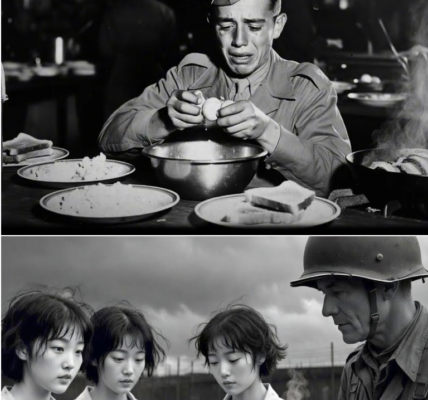
One photograph is described as an American serviceman sharing his rations with two Japanese children.
It is a small gesture.
Historically, it does not change the outcome of the Battle of Okinawa. It does not erase the destruction of the campaign. It does not represent the relationship between all American soldiers and all Japanese civilians.

But a photograph does not have to represent everything to be meaningful.
Sometimes its value lies precisely in its smallness.
The war reduced people to categories with terrifying efficiency: American, Japanese, soldier, civilian, enemy, ally.
A photograph of children receiving food temporarily returns them to what they were before the categories became important.
Children.
Hungry children.
Human beings standing in front of another human being.
That does not make the war simple. It makes it more difficult to understand.
Because history is full of contradictions.
People can fight one another and still recognize suffering.
Governments can describe enemies in political language while individual soldiers encounter individuals rather than abstractions.
And after years of propaganda, fear, and violence, ordinary acts of compassion could survive even inside a conflict defined by division.
The source material also contains photographs connected with another and far darker dimension of the war: the Holocaust.

One caption describes Jewish prisoners forced to work for a Sonderkommando unit and refers to photographs connected with the Yanovska concentration camp after its liberation by the Red Army in 1944.
Here, caution matters.
The Holocaust cannot be reduced to a collection of photographs, and individual captions attached to old images can sometimes contain errors or incomplete identifications. But the historical reality itself is beyond doubt: Nazi Germany and its collaborators systematically persecuted and murdered European Jews, along with millions of other victims of Nazi persecution.
The Sonderkommando prisoners occupied a particularly terrible position within the Nazi camp system. Jewish prisoners were forced by the SS to participate in aspects of the machinery of mass murder. Their existence illustrates one of the most disturbing features of the concentration and extermination camp system: the perpetrators attempted not only to murder victims, but also to force some prisoners into assisting with the process.
Photographs taken after liberation therefore possess a special weight.
The camera is no longer recording the world as it existed under Nazi control.
It is recording what remained.

A camp after the perpetrators had lost control.
A place where the machinery of persecution could finally be seen from outside.
The people who entered such places in 1944 and 1945 encountered evidence that was difficult to comprehend even when standing directly in front of it.
This is one reason historical photographs should not be treated as simple entertainment.
They are fragments.
They are incomplete.
Sometimes they are misidentified.
But when carefully authenticated, they can become witnesses to events that would otherwise exist only in documents and testimony.
The Second World War was therefore a war of enormous technological power and enormous human vulnerability.
The source material contains another photograph that captures this contradiction from a different angle: soldiers wearing protective equipment, experiments with military technology, aircraft, ships, vehicles, and increasingly sophisticated weapons.

The war accelerated technological development at an extraordinary pace.
Aircraft became faster.
Radar transformed detection.
Submarines evolved.
Rocket technology advanced.
Medical techniques developed under pressure.
And by 1945, scientific research had produced a weapon unlike anything previously used in war.
The first atomic bomb test was approaching.
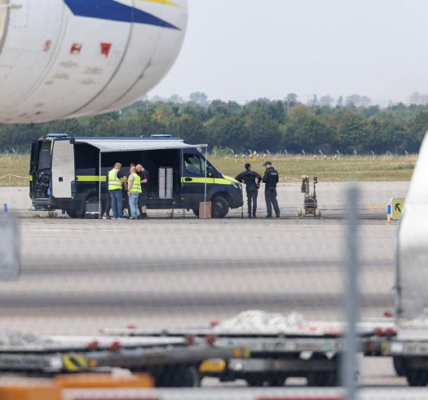
In July 1945, the device known as the Gadget was prepared for the Trinity test in New Mexico. The photograph described in the source as showing the first atomic bomb being unloaded belongs to that final stage of preparation.
At this point, the war in Europe had already ended.
Germany had surrendered in May.

But the war against Japan continued.
The people preparing the bomb were therefore working inside a very specific historical moment. The war was nearing its end, yet no one could know exactly how the final chapter would unfold.
Then came the Trinity test.
The world entered the atomic age.
The significance of that event would only become clearer afterward.
The bomb was not simply another weapon added to an existing arsenal. It represented a change in the scale of destructive power available to states.
The war had begun with armies crossing borders.
It was ending with scientists and engineers demonstrating that humanity had learned to release energy on a radically different scale.
And yet even here, the photographs can mislead us if we focus only on machinery.
Behind every technical achievement stood people.
Scientists.
Engineers.
Soldiers.
Workers.
Families.
Civilians.
The history of the atomic bomb is often told through equations, laboratories, military decisions, and dates. But its ultimate significance lies in what happened when technology entered the lives of ordinary people.
The Second World War had already demonstrated what modern industrial warfare could do.
The atomic bomb showed what might come next.
That is why the final photographs of the war should not be viewed only as images of victory.
Victory itself had a complicated face.
Soldiers came home.
Families waited at railway stations.
Children celebrated liberation.
Cities began rebuilding.

And survivors attempted to reconstruct lives after experiences that could not simply be left behind when the fighting stopped.
The source material includes another photograph from the postwar period: soldiers returning, civilians gathering, and communities attempting to return to ordinary routines.
But “ordinary” had changed.
A generation had lived through rationing, mobilization, occupation, bombing, displacement, imprisonment, military service, and loss.
The photographs could preserve a smile.
They could not preserve the world that had existed before the war.
That is one reason images from 1945 can feel strangely quiet.
The war may be over in the photograph.
But history is not.
Consider again the American serviceman and the Japanese children in Okinawa.
Consider the Marine and the abandoned baby on Saipan.
Consider the women working for the war effort in New York.
Consider the prisoners photographed after liberation.
Consider the soldiers returning home.
None of these images alone explains the Second World War.
Together, however, they reveal something that statistics cannot.
The war was experienced at different distances.
For some, it was measured in miles advanced.
For others, it was measured in letters received.
For some, it was a shift in factory hours.
For others, it was hiding in a cave.
For some, it was the moment a ship arrived.
For others, it was the moment a ship never returned.
For some, it was liberation.
For others, it was displacement.
And for millions, it was simply survival.
That is perhaps the most important distinction between remembering a war and studying a war.
Studying the war tells us what happened.
Remembering the people tells us what those events meant.
There is another photograph in the source material that belongs to an earlier generation: the Harlem Hell Fighters returning home in 1919.
Placed beside the photographs of the Second World War, it creates an unexpected historical bridge.
The men who returned from the First World War entered a society that still struggled with racial inequality. A generation later, African Americans again served in a segregated military during the Second World War while demanding a more equal society at home.
The war against fascism therefore contained a contradiction that could not remain hidden forever.
How could a nation fight for freedom abroad while freedom remained incomplete at home?
The question would become increasingly important during the postwar civil rights movement.
That is why photographs of the Second World War cannot be isolated completely from the decades that followed.
History does not end when the camera shutter closes.
It continues through consequences.
A woman who entered a factory during wartime carried that experience into postwar society.
A soldier who returned from Europe or the Pacific carried memories into civilian life.
A survivor carried the knowledge of what had happened.
A child who received food from an enemy soldier carried a different kind of memory.
And a society that had witnessed industrialized destruction entered a new era dominated by the possibility of nuclear war.
The photographs therefore form something like an accidental archive of transformation.
A world of horse-drawn vehicles gives way to automobiles.
Women enter new professions.
Aircraft become more sophisticated.
Military technology accelerates.
Factories expand.
Cities change.
And eventually, the atomic age arrives.
The photographs are not all about battles.
That is precisely why they are valuable.
A photograph of women painting posters may appear insignificant beside a photograph of a battlefield.
It is not.
A photograph of children receiving food may seem small beside an image of a military operation.
It is not.
A photograph of a survivor after liberation may contain no dramatic action.
It does not need to.
History is not made only at moments when generals sign documents or armies cross frontiers.
History is also made in the moments when ordinary people endure circumstances they did not choose.
That is the quiet truth hidden behind many of these old images.
The people in them did not know that someone decades later would examine their faces.
They did not know which photograph would survive.
They did not know which moment would become part of a historical archive.
They were simply living.
Working.
Waiting.
Traveling.
Fighting.
Surviving.
Helping.
Sometimes suffering.
And sometimes, even in the darkest circumstances, finding a small reason to continue.
By 1945, the old world had been transformed.
Germany had been defeated.
Japan was approaching defeat.
Millions were dead.
Cities lay damaged.
Europe was displaced and exhausted.
The Holocaust had revealed a scale of organized persecution and murder that would permanently change humanity’s understanding of genocide.
The Pacific war had demonstrated the enormous cost of fighting across islands and cities.
And the atomic bomb had opened a new chapter whose consequences would extend far beyond the Second World War.
Yet the final lesson of these photographs is not about weapons.
It is about scale.
History books often speak in millions.
Photographs return us to one person.
One face.
One child.
One worker.
One soldier.
One survivor.
One moment.
That is why old photographs can feel strangely powerful. They compress an enormous historical event into a single human frame.
And perhaps that is also why we should be careful with them.
Not every caption is accurate.
Not every photograph tells the story we initially think it does.
Some images have been misidentified, simplified, or stripped of their original context over the decades.
The responsible task is therefore not merely to admire them.
It is to investigate them.
To compare captions with archives.
To distinguish documented history from later interpretation.
To resist the temptation to turn an uncertain photograph into a dramatic legend.
Because the real history is already powerful enough.
The Second World War does not need invented dialogue.
It does not need fictional heroes.
It does not need exaggerated mysteries.
The truth is more than enough.
A woman painting a wartime poster.
A Marine discovering a child.
A soldier sharing food with children.
Prisoners emerging from a concentration camp.
Workers preparing a weapon unlike anything the world had ever seen.
Soldiers returning home.
These moments belong to different places and different people, but together they form a portrait of a world passing through catastrophe and transformation.
The most haunting thing about them is perhaps their ordinariness.
The people inside the photographs could not see the future.
Neither can we.
They did not know which decisions would shape the decades ahead.
They did not know which technologies would change humanity.
They did not know how their own actions would be remembered.
They simply stood inside history while it was happening.
And that may be the most human way to understand the Second World War.
Not as a collection of dates.
Not as a sequence of battles.
Not only as a contest between nations.
But as millions of individual lives moving through an extraordinary period, each person seeing only a small portion of a much larger story.
The photographs allow us to look back.
But they also ask something of us.
They ask us to remember that behind every statistic was a person who once had an ordinary morning, an ordinary family, an ordinary hope for the future.
War transformed those lives.
Some were lost.
Some survived.
Some returned home.
Some never found the world they had left.
And some photographs became the only surviving doorway through which later generations could glimpse what had happened.
Perhaps that is why these images remain with us.
Not because they make the past seem distant.
But because, for a moment, they make it feel human again.
When we look at these photographs today, what should matter most—the extraordinary technology and battles that changed the course of history, or the ordinary human lives that were caught inside them?
“Some content was generated using AI tools (including ChatGPT) and edited by the author for creativity, storytelling, and historical illustration purposes. Historical facts and key details should be verified against reliable historical sources. Any AI-generated or reconstructed visuals are intended for illustrative purposes and should not be interpreted as original historical photographs or archival evidence.”