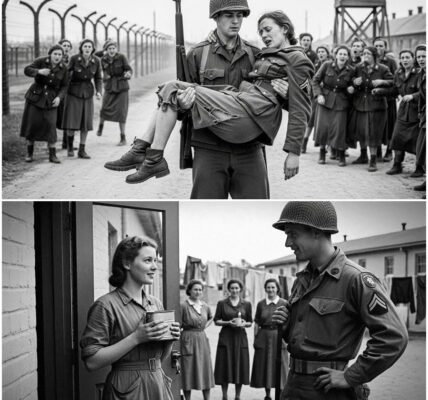
In July 1944, as Soviet forces approached Lublin, the German authorities abandoned the Majdanek concentration camp with extraordinary haste. They had tried to destroy evidence of what had happened there, but they did not have enough time. Much of the camp remained intact.
Among the evidence later discovered were containers and traces of Zyklon B, the poisonous gas the Nazis had used in gas chambers at Majdanek and other killing centers. The photographs taken after liberation would become part of the historical record of a crime that had been deliberately hidden from the outside world.
There is something unsettling about photographs like these.
They do not show a battlefield in the conventional sense. There is no advancing army in the frame. No aircraft crossing the sky. No tank column moving toward an enemy position.
Instead, they show the remains of a system.

A system that had been built by people, administered by institutions, justified through ideology, and eventually exposed by the armies that defeated it.
And when these images are placed beside other photographs from the same era—families waiting for evacuation buses, German soldiers captured after surrender, resistance fighters standing before a defaced portrait of Hitler, children growing up under wartime conditions—a larger story begins to appear.
World War II was not only fought on battlefields.
It entered classrooms.
It entered homes.
It entered train stations and factories.
It entered the language people used to describe one another.
It entered the lives of families who suddenly had to leave everything behind.

And, in the darkest places, it entered the machinery of persecution and murder.
The photographs remain because someone was there to record them.
But what they cannot show us directly is the question that matters most:
How does an ordinary society become capable of extraordinary cruelty?
The answer does not begin with the gas chamber.
It begins much earlier.
In Berlin in 1933, photographer Roman Vishniac photographed a young girl named Mara standing in front of a shop associated with the measurement of human skulls.
The photograph is disturbing not because the shop itself looks extraordinary.

It does not.
That is precisely the problem.
Behind an ordinary storefront was an extraordinary idea: that human beings could supposedly be divided into biological racial categories, measured, ranked, and assigned different value according to physical characteristics.
The Nazis attempted to give their racial ideology a scientific appearance. They measured skulls, noses, eyes, hair, and other physical features in an effort to categorize people into supposed racial groups. But those attempts did not establish the racial theories they claimed to prove. Modern historical scholarship is clear that Nazi racial categories were based on false and prejudiced assumptions, not legitimate science.
The photograph therefore captures more than a storefront.
It captures a moment when pseudoscience was being recruited into politics.

That distinction matters.
Racism had existed long before the Nazi regime.
But the Nazi dictatorship transformed racial prejudice into state policy.
Once that happened, discrimination no longer depended only on individual hatred.
It could be written into regulations.
It could be taught in schools.
It could be printed in newspapers.
It could be recorded on forms.
It could be enforced by police.
And eventually, it could be carried out through an enormous bureaucratic system.

This is one of the most important things that photographs from the Nazi period reveal.
The machinery of persecution did not always look frightening.
Sometimes it looked administrative.
A desk.
A document.
A measuring instrument.
A uniform.
A classroom.
A government office.
A train.
The horror was often hidden inside ordinary-looking institutions.
That was part of the danger.

When a government tells its citizens repeatedly that one group is inferior, dangerous, or unwanted, the language may initially appear abstract.
Words.
Categories.
Statistics.
Definitions.
But words can become policy.
Policy can become exclusion.
Exclusion can become persecution.
And persecution can become something far worse.
The Holocaust did not happen in a single moment.
It developed through a process of radicalization and escalating persecution.
Jewish people were stripped of rights.

They were excluded from public life.
Their businesses and property were targeted.
They were isolated from the societies in which they had lived.
Eventually, millions were deported and murdered.
The progression is important because it shows why the early photographs matter.
The picture of a racial measuring device may seem insignificant compared with the later photographs from concentration camps.
Historically, however, it belongs to the same story.
It shows an idea before the consequences had reached their most devastating stage.
By the time World War II was fully underway, the machinery of Nazi persecution had become vastly more destructive.
The camps were not simply places where prisoners were held.
Some became centers of forced labor, starvation, torture, deportation, and mass murder.
Majdanek, also known as the Lublin concentration camp, was one of them.

The camp operated near Lublin in occupied Poland.
In the later stages of the war, as Soviet forces advanced from the east, German authorities began evacuating prisoners and attempting to destroy evidence.
But history moved faster than they did.
In late July 1944, Soviet forces reached the area.
The Germans had not managed to erase everything.
Majdanek was captured largely intact, making it one of the first major Nazi concentration camps to be liberated. Fewer than 500 prisoners remained when Soviet forces arrived, while much of the physical evidence of the camp remained behind.
The photographs that followed were different from ordinary wartime photographs.
They were evidence.
Barracks.

Warehouses.
Crematorium facilities.
A gas chamber.
Personal possessions.
And remnants of the killing process.
Among them were Zyklon B pellets discovered after liberation.
Zyklon B had originally been developed as a pesticide and disinfectant.
The Nazis repurposed it for murder.
At Majdanek, Zyklon B was used in gas chambers to kill prisoners.
The transformation of an ordinary chemical product into an instrument of mass murder is difficult to comprehend.
But perhaps that difficulty is exactly why it must be remembered.
The Holocaust was not carried out by some supernatural force.
It was carried out through human institutions.

People manufactured materials.
Others transported them.
Others guarded camps.
Others maintained records.
Others processed prisoners.
Others administered the system.
The photographs cannot tell us what every individual believed.
Nor should we invent their private thoughts.
But the historical record tells us enough to understand the larger structure.
A modern state had used its administrative, industrial, military, and police capabilities to persecute and murder human beings on an enormous scale.
And then there were the people who survived.
When Majdanek was liberated, the surviving prisoners were among the first witnesses to what had happened there.

But the evidence left behind spoke as well.
The Germans had attempted to destroy the camp.
They had evacuated prisoners.
They had tried to conceal their crimes.
Yet the buildings remained.
The gas chambers remained.
Objects belonging to victims remained.
The physical landscape itself became a witness.
This is one reason the liberation of Majdanek was historically significant.
The world did not have to rely solely on rumors or secondhand accounts.
Photographs could be taken.
Journalists could inspect the camp.
Evidence could be documented.
The crime had left traces.
And those traces would become part of the historical record.
The photographs therefore carry a responsibility.

They are not entertainment.
They are not simply shocking images.
They are evidence of what happened when a government transformed prejudice into persecution and persecution into organized murder.
Yet World War II was not only a story of Nazi Germany.
It was also a story of millions of civilians caught between governments, armies, and policies over which they had little control.
One of the most revealing photographs from the United States was taken not in Europe, but in California.
On May 8, 1942, members of the Mochida family waited for an evacuation bus.
Their luggage had been gathered.
Identification tags had been issued.
The tags were intended to help keep family units together throughout the forced removal process.
The photograph was taken by Dorothea Lange. The National Archives identifies the people as members of the Mochida family awaiting evacuation in Hayward, California.
Look closely at the image and the contrast becomes difficult to ignore.
There are no soldiers charging toward the family.
No battlefield.
No explosion.
The family is simply waiting.
A father.
Children.
Baggage.
A bus.
And tags.
Yet this quiet scene was part of one of the most controversial chapters of America’s wartime history.
After the attack on Pearl Harbor, the United States government ordered the removal and incarceration of Japanese Americans from much of the West Coast.
Executive Order 9066 was issued in February 1942.
Approximately 112,000 people of Japanese ancestry were eventually sent to assembly and relocation centers, and nearly 70,000 of those affected were American citizens. The National Archives records that many people lost homes, businesses, farms, and personal property as a result.
The photograph of the Mochida family makes those statistics human.
Numbers are necessary for understanding history.
But numbers cannot show the expression on a child’s face.
They cannot show the baggage a family was able to carry.
They cannot show what had to be abandoned.
They cannot show what it felt like to leave a home without knowing exactly what would happen to it.
The photograph can.
Not because we can read the family’s minds.
We cannot.
But because the physical circumstances are visible.
They are waiting.
They have identification tags.
They are being moved.
And they are doing so because of a government policy enacted during wartime.
This is one of the great contradictions of World War II.
The United States fought Nazi Germany and Imperial Japan in the name of defeating aggressive dictatorships and defending a different international order.
At the same time, the American government carried out the mass removal and incarceration of Japanese Americans.
Recognizing that contradiction does not erase the sacrifices made by American soldiers.
It makes the history more complete.
History becomes weaker when it is reduced to heroes and villains without examining what governments actually did.
The war was fought against fascism and militarism.
But wartime fear also produced injustice within democratic societies.
That lesson is uncomfortable.
It is also important.
The photographs from 1942 show how quickly ordinary life could change.
A family that had operated a nursery and greenhouses could suddenly find itself preparing for removal.
Children who had attended school could find themselves living behind fences.
Businesses could be abandoned.
Property could be lost.
A person’s citizenship did not necessarily protect them from wartime suspicion.
The National Archives records that there were no charges of disloyalty against the American citizens among those incarcerated, and that they had no ordinary means of appealing the loss of their liberty and property.
That fact is more powerful than any invented dramatic dialogue could be.
No speech is necessary.
The photograph already asks the question.
What happens when fear becomes policy?
Across the Atlantic, another photograph captures a different response to dictatorship.
On February 20, 1939, the German American Bund held a major rally at Madison Square Garden in New York City.
The event was organized by an American Nazi organization sympathetic to Hitler’s Germany.
Outside and around such gatherings, opponents of fascism protested.
One photograph shows a police officer struggling with an anti-fascist protester as a flag is pulled away.
Again, there is no battlefield.
But there is conflict.
The photograph reveals that the ideological struggle of the 1930s was not confined to Germany.
It reached American cities.
It appeared in public spaces.
It created confrontation between supporters and opponents of fascism.
And it demonstrated that even before the United States entered World War II, the meaning of Hitler’s movement was already being contested on American soil.
The world was moving toward war.
Not everyone yet knew how close it was.
But the signs were there.
Then came the war.
And eventually, the photographs of captured soldiers.
One image from the material supplied shows young German Wehrmacht soldiers after being captured by the British Army’s 11th Armoured Division.
There is an important distinction here.
The uniform tells us something about the institution they served.
It does not, by itself, tell us what each individual believed or what each had done.
That distinction matters when looking at historical photographs.
A prisoner is not a complete biography.
A uniform is not a complete biography.
A photograph is not a complete biography.
The temptation to fill those gaps with invented stories should be resisted.
We can say what the evidence supports.
These were German soldiers.
They had been captured.
The war was moving toward its final stages.
The German military was collapsing under the pressure of Allied advances.
And the men in the photograph were now prisoners rather than combatants.
That alone is enough to tell a story.
There is something deeply human in the photographs of defeated soldiers.
The propaganda of wartime often reduces enemies to symbols.
But a photograph puts faces back onto them.
Young men.
Tired men.
Men who may have been frightened.
Men who had families somewhere.
Men who had made choices.
Men who had also been part of a military machine responsible for aggression and occupation.
These realities can exist simultaneously.
Humanizing an individual does not mean excusing a regime.
Remembering the humanity of people caught inside history does not require forgetting the crimes committed by the institutions they served.
In fact, understanding both is necessary.
By 1944, the direction of the war was becoming increasingly clear.
The Allied landings in Normandy had opened a major western front against Nazi Germany.
Soviet forces were advancing from the east.
Germany was being pushed back.
Cities were being liberated.
And in France, resistance fighters who had spent years living under occupation could finally stand openly against the symbols of the regime that had controlled their country.
One photograph in the source material shows members of the French Resistance posing in front of a defaced portrait of Adolf Hitler in Paris after the German garrison surrendered.
The image is almost symbolic.
For years, Hitler’s image had represented power.
Now it had been damaged.
The German garrison had surrendered.
The occupation was ending.
The photograph does not need exaggerated narration.
The contrast speaks for itself.
A portrait of a dictator.
Defaced.
Behind it, people who had survived occupation.
And in front of it, a city beginning to reclaim its public space.
The war was not over yet.
But something had changed.
Power had shifted.
The liberation of Paris was one of those moments when history could be felt physically.
The occupation that had seemed permanent was suddenly temporary.
The symbols that had dominated public life were being removed.
People could move through streets without the same presence of German military authority.
Resistance fighters could appear openly.
The psychological transformation mattered almost as much as the military one.
Occupation had been a condition of everyday life.
Liberation changed that condition.
But liberation also revealed the damage left behind.
War does not end simply because soldiers stop fighting in one city.
There are prisoners.
Displaced people.
Families separated.
Destroyed homes.
Political divisions.
Trauma.
And questions of responsibility.
The end of Nazi rule also meant the exposure of crimes that had previously been hidden.
Majdanek became one of the earliest major concentration camps liberated by Allied forces.
The evidence found there helped demonstrate the scale and organization of Nazi crimes.
The Soviet advance had been so rapid that the Germans had not been able to destroy the camp completely.
That accident of military timing mattered enormously.
The world could see.
The photographs could be taken.
Journalists could enter.
Evidence could be preserved.
The victims could no longer be reduced to rumors.
Their suffering had left physical traces.
And those traces became part of the historical record.
There is a strange connection between the photograph of the young girl in Berlin in 1933 and the photograph of Majdanek in 1944.
Eleven years separate them.
One shows a child standing beside an instrument associated with racial measurement.
The other shows the remains of a concentration camp where Nazi racial ideology had reached its murderous extreme.
The photographs are not the same kind of evidence.
They should not be treated as if one photograph directly caused the other.
History is more complicated than that.
But together they reveal a progression.
First, people are classified.
Then they are separated.
Then rights are removed.
Then persecution intensifies.
Then violence becomes institutionalized.
And eventually, in the Holocaust, mass murder is organized on an unprecedented scale.
This is not a fictional plot.
It is the historical process documented by archives, survivor testimony, photographs, official records, and decades of scholarship.
The warning is therefore not hidden in the dramatic final image.
It is visible much earlier.
And perhaps that is why the quiet photographs are so important.
The Mochida family waiting for a bus.
The child standing outside a Berlin shop.
The protesters confronting fascists in New York.
The young German soldiers after capture.
The French Resistance posing after liberation.
The evidence left behind at Majdanek.
Each image shows a different stage of a world at war.
Fear.
Ideology.
Discrimination.
Mobilization.
Occupation.
Resistance.
Defeat.
Liberation.
Memory.
The war can be studied through battles and generals.
But it can also be studied through waiting families and ordinary streets.
Sometimes the second approach tells us more about what war actually means.
Because for most people, war does not begin when they fire a weapon.
It begins when something familiar changes.
A letter arrives.
A ration is reduced.
A school closes.
A neighbor disappears.
A government order is posted.
A family is given identification tags.
A soldier does not return.
A newspaper carries another list of names.
A foreign uniform appears in the street.
A familiar flag is replaced.
A shop closes.
A train arrives.
A bus takes a family away.
These are the small movements through which enormous historical events enter private lives.
The most disturbing lesson of these photographs is therefore not simply that World War II was violent.
Everyone already knows that.
The deeper lesson is how much of the road toward catastrophe can look ordinary while it is happening.
A government form can look ordinary.
A school lesson can look ordinary.
A measurement can look ordinary.
A uniform can look ordinary.
A bus can look ordinary.
A chemical container can look ordinary.
But what matters is what these things are being used to accomplish.
That is why historical context is essential.
Without context, a photograph is only an image.
With context, it becomes evidence.
And yet, there is another truth worth remembering.
People are not only victims of history.
They are also capable of resisting it.
The French Resistance did.
People protested fascism in New York.
Prisoners survived concentration camps.
Families tried to protect one another.
Photographers documented what they saw.
Journalists reported what they could.
Soldiers fought and liberated occupied territories.
And after the war, historians, archivists, survivors, and institutions worked to preserve evidence.
Memory itself became a form of resistance against denial.
That is why photographs matter decades later.
They keep the past from becoming too abstract.
Today, it is easy to look at an old photograph and feel that the people inside it belonged to another world.
They did not.
They had ordinary lives.
They had families.
They worked.
They studied.
They went to shops.
They traveled.
They argued.
They celebrated.
They worried about money.
They made plans.
And then history interrupted them.
That is perhaps the most human element of all.
People rarely know when they are living through a moment that future generations will consider historic.
The family waiting beside a bus in California probably could not know that the photograph would survive for decades.
The people standing in Berlin in 1933 could not know where Nazi racial policy would eventually lead.
The soldiers captured at the end of the war could not know how historians would later interpret their generation.
The people standing in Paris after liberation could not know how many years later the photograph would still symbolize the collapse of Nazi power.
History is only obvious in retrospect.
For the people living through it, it is uncertainty.
And that is where the photographs leave us.
Not with a simple story.
Not with the comforting belief that history is divided neatly between good people and bad people.
But with a more difficult understanding.
Governments make decisions.
Institutions enforce them.
Individuals respond to them.
Some obey.
Some resist.
Some suffer.
Some survive.
Some remain silent.
Some speak.
And the consequences can last for generations.
The photographs of World War II remind us that the distance between an ordinary day and a historic catastrophe is not always as large as it appears.
Sometimes it is measured in a government order.
Sometimes in a law.
Sometimes in a classroom lesson.
Sometimes in a train.
Sometimes in a bus.
Sometimes in a photograph.
The most important thing is not simply to look at these images.
It is to understand what they reveal.
The false racial theories.
The persecution that followed.
The concentration camps.
The machinery of murder.
The forced incarceration of Japanese Americans.
The resistance to fascism.
The defeat of Nazi Germany.
The liberation of places where terrible crimes had taken place.
And finally, the memory left behind.
Because the past cannot be changed.
But the way we understand it can determine what lessons we carry into the future.
A photograph cannot tell us everything.
But sometimes it can tell us enough to make us stop.
To look again.
And to ask a question that history never allows us to escape:
How do ordinary people and ordinary institutions respond when fear, ideology, and political power begin to redefine who is considered worthy of rights, dignity, and protection?
Some content was generated using AI tools (including ChatGPT) and edited by the author for creativity, storytelling, and historical illustration purposes. Historical facts and key details should be verified against reliable historical sources. Any AI-generated or reconstructed visuals are intended for illustrative purposes and should not be interpreted as original historical photographs or archival evidence.