The Photographs That Captured a World Changing Before Our Eyes
Some historical photographs seem almost impossible when viewed today. A patient lies inside an iron lung, surrounded by the machinery that keeps breathing possible. Soldiers pose in unfamiliar uniforms on the battlefields of another continent. Workers stand beside machines that once represented the absolute limits of technology. Crowds gather beneath enormous monuments, while others watch history unfold from behind barricades, trenches, or hospital doors.
What makes these images remarkable is not simply that they are old.
It is that they capture moments when the world was changing.
In one photograph, technology appears enormous because a machine that once seemed revolutionary now looks primitive. In another, a human face reveals fear, determination, exhaustion, or curiosity in a way that no written description can completely reproduce. Elsewhere, a strange public spectacle, a famous actor, a soldier, a scientist, or an ordinary worker becomes an unexpected witness to a larger transformation.
These photographs were not necessarily created to become history.
Most were simply records of a moment.
But decades later, they allow us to see how different the world once looked—and how quickly it changed.
In the 1950s, one of the most important medical technologies could occupy an entire room.
The iron lung, or negative-pressure ventilator, had become an essential tool during outbreaks of poliomyelitis. For patients whose respiratory muscles had been paralyzed by polio, the machine could create changes in air pressure around the body, helping the lungs expand and contract.
The image of a person lying inside the large metal cylinder is difficult for modern viewers to imagine. Today, respiratory support is often associated with compact equipment, intensive-care units, and highly specialized monitoring systems. The iron lung looked completely different.
Yet at the time, it represented technology being used against a frightening disease.

During major polio epidemics, hospitals could fill with patients who were unable to breathe without mechanical assistance. Families faced the terrifying possibility that a healthy child could suddenly become seriously disabled.
The iron lung therefore became more than a machine.
It became a symbol of a medical era in which engineering was being used to keep human beings alive while researchers searched for a way to prevent the disease itself.
The development of effective polio vaccines in the 1950s would eventually transform that story.
The photograph of an iron lung is therefore also a photograph of a turning point.
It shows medicine before the victory had been achieved.
Another photograph from the middle of the twentieth century presents a very different kind of machine.
In the early years of the space age, engineers were forced to confront a problem that seemed almost impossible: how could a human being survive in an environment where there was no breathable atmosphere?
The answer was the pressure suit.
The technology did not begin with the Apollo astronauts. NASA’s spacesuit history grew from earlier high-altitude pressure suits developed for pilots who faced dangerous conditions at extreme altitudes. By the 1950s, engineers were experimenting with increasingly sophisticated systems for protecting pilots from loss of atmospheric pressure.
Photographs of these early suits can look strangely futuristic even today.
They show engineers and test pilots wearing garments that seem halfway between military equipment and science fiction.
But these were not costumes.
Every component had a purpose.
The suit had to protect the wearer from dangerous pressure changes while allowing enough mobility to control an aircraft. Later, as human spaceflight became reality, similar principles would be adapted for astronauts.
NASA’s Mercury program eventually required a suit capable of functioning as a personal life-support environment inside the spacecraft. NASA awarded the contract for the Mercury spacesuit in 1959, and the design went through repeated modifications before being approved in 1960.
The photograph of an early spacesuit therefore represents more than an unusual piece of clothing.
It captures the moment when human beings began designing equipment for an environment they had never personally experienced.
At almost the same time, another technological revolution was taking place on the ground.
Computers were becoming more capable, but they were enormous compared with the devices that would eventually fit into people’s pockets.
Magnetic tape was one of the important technologies used by early computers to store programs and data. The Smithsonian’s collections contain magnetic tapes associated with UNIVAC systems and other early computers. These reels were part of a computing world in which data could be physically represented by long strips of magnetic material rather than invisible files on a modern solid-state device.
A photograph showing a person standing beside stacks of computer storage can therefore be misleading to modern eyes.
It is tempting to laugh at how large everything appears.
But that enormous equipment was once advanced technology.
The UNIVAC I, introduced in the early 1950s, became the first commercial electronic computer in the United States. Early systems used magnetic tape to store information and instructions.
By 1960, a magnetic tape reel could even carry a COBOL compiler, demonstrating how software itself was beginning to become portable between machines.
The future was being built from equipment that now looks almost prehistoric.
The same spirit of technological optimism appeared in architecture.
In Seattle, the Space Needle rose above the city as preparations were made for the 1962 World’s Fair.
The structure was designed to represent a vision of the future.

Its shape seemed unlike traditional architecture. It looked less like a conventional tower than an object from another world.
Construction photographs show workers building the structure piece by piece, turning drawings and engineering calculations into one of the most recognizable landmarks in the Pacific Northwest.
The World’s Fair itself was designed around ideas of progress, science, transportation, and the future.
Visitors could see exhibitions presenting space exploration, new technologies, automobiles, communications, and industrial design.
NASA’s own historical records show the enormous public interest in the agency’s space exhibit during the 1962 Seattle World’s Fair.
For people living through the early 1960s, the future seemed unusually close.
Humans had entered space.
Computers were becoming increasingly sophisticated.
Cities were filling with new structures.
Jet aircraft were transforming travel.
And engineers were beginning to imagine technologies that had previously existed only in fiction.
But history was not moving in a straight line toward a perfect future.
The same century that produced spectacular technological achievements also produced extraordinary violence.
One photograph from the Spanish Civil War era shows the strange and disturbing intersection of architecture, psychology, and political repression.
During the Spanish Civil War, Alfonso Laurencic became associated with so-called “checas” in Barcelona—detention spaces in which prisoners were subjected to psychological intimidation and harsh conditions. Some rooms were reportedly designed using deliberately disorienting shapes, colors, and patterns.
The story is a reminder that architecture can be used for purposes very different from comfort or beauty.
Buildings can shelter people.
They can inspire people.
They can also intimidate and control them.
The visit of Heinrich Himmler to Spain in October 1940 belongs to another chapter of the complicated relationship between Nazi Germany and Francoist Spain. Himmler traveled to Spain during a period when Nazi Germany was attempting to strengthen relationships with the Franco regime.
Photographs from such encounters can appear ceremonial.
Uniforms are clean.
Officials stand together.
The surroundings look controlled.
Yet behind these official images existed a continent already transformed by war, dictatorship, persecution, and mass violence.
That contrast appears repeatedly in twentieth-century photography.
Public ceremonies often looked orderly.
History itself was anything but orderly.
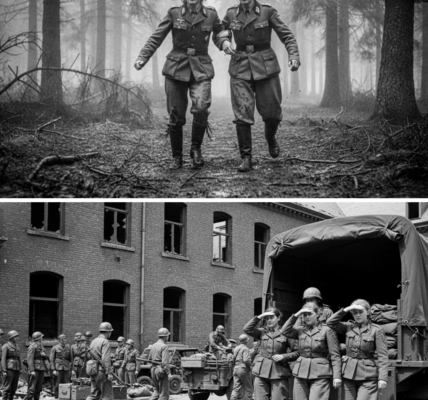
A few years later, Europe would become the center of the largest military conflict the world had yet experienced.
On June 6, 1944, Allied forces landed in Normandy.
D-Day was not a single photograph but an enormous collection of images made on beaches, landing craft, roads, villages, medical stations, and battlefields.
The photographs show soldiers climbing from landing craft, carrying equipment through water, moving past obstacles, and advancing inland.
Some images show the scale of the operation.
Others show almost nothing except individual faces.
That contrast is important.
Military history often describes D-Day through numbers, divisions, objectives, and maps.
Photography brings the story back to individuals.
A soldier carrying a rifle was also a young man who had left someone at home.
A medic working among the wounded was also someone attempting to keep another human being alive.

A photograph of a destroyed village represented not merely a tactical consequence but a community whose ordinary life had been interrupted.
The war would continue for almost another year.
On May 8, 1945, Germany surrendered.
American personnel stationed around the world received the news with celebrations and relief, even though the war against Japan continued in the Pacific.
One photograph described in the source places American military personnel in Okinawa at the moment they learned of Germany’s surrender.
The image represents an unusual emotional contradiction.
The war in Europe was over.
But their own war was not.
The same global conflict had produced another set of extraordinary photographs beneath the surface of the Atlantic.
German U-boat crews spent months operating under the sea or moving through dangerous waters. Yet photographs occasionally captured sailors swimming in the ocean during rare moments away from their normal routine.
Such images are striking because they make wartime sailors look almost like ordinary vacationers.
The submarine disappears from the center of the story.
For a moment, there is only water, sunlight, and men trying to enjoy a brief break.
But the context changes everything.
These sailors were part of a campaign intended to attack Allied shipping and disrupt maritime supply routes.
The photograph therefore contains both ordinary human behavior and the extraordinary circumstances surrounding it.
The First World War had produced similar contradictions.
In 1914 and 1915, Indian soldiers serving in the British Indian Army were sent to France to fight on the Western Front.
Photographs preserved by the Library of Congress show Indian soldiers in France during the First World War, wearing uniforms and distinctive headgear associated with different units and communities.
Their presence challenges the simplified image of the Western Front as a conflict fought exclusively by Europeans.
The British Empire mobilized troops from across the world.
Indian soldiers fought in Europe, endured trench warfare, and became part of a conflict that reshaped international politics.
The photograph captures them standing far from home.
For many of these soldiers, France represented a world radically different from the landscapes in which they had grown up.
They were not merely observers of history.
They were participants in it.

Elsewhere, another photograph from Russia captures the revolutionary transformation of an entire political system.
In November 1917, the Bolsheviks seized power in Petrograd.
Images of revolutionary soldiers and crowds became visual symbols of the Russian Revolution.
The revolution would eventually produce the Soviet Union and reshape twentieth-century politics.
Yet photographs taken during moments of celebration could not show everything that would follow.
Revolutions rarely end with the moment of victory.
They create new political struggles.
New institutions emerge.
Old enemies become new targets.
Leaders who once stood together can become rivals.
A photograph from the funeral of Felix Dzerzhinsky in 1926 provides a striking example.
Dzerzhinsky, founder of the Soviet secret police, died in July 1926. Soviet leaders attended his funeral, including Joseph Stalin and Leon Trotsky.
At that moment, the photograph could still show them within the same political world.
But the future would separate them dramatically.
Stalin would eventually consolidate power.
Trotsky would be forced into exile and later assassinated in Mexico.
Kamenev and Zinoviev would also become victims of Stalin’s political purges.
The photograph therefore possesses a quality that no person in the frame could fully see.
It contains a future that had not yet happened.
This is one of photography’s strangest powers.
The camera records the present.
History supplies the meaning later.
The same principle can be seen in photographs of famous personalities.
Bunny Yeager became one of the best-known photographers associated with American pin-up culture during the postwar era. Her photographs contributed to the development of a visual style that combined fashion, glamour, and commercial photography.
Jayne Mansfield appeared on television during the 1960s, including an appearance associated with The Alfred Hitchcock Hour.
Greta Garbo represented an earlier generation of Hollywood celebrity, becoming one of the defining stars of the studio era.
Sophia Loren became an international symbol of European cinema.
Julie Newmar appeared as Lola in Damn Yankees, while later generations would encounter actresses and models such as Caroline Munro through film, television, and popular photography.
These images are often treated as entertainment history.
But they also document changing ideas about celebrity.
In earlier decades, a star’s public image was shaped largely by studios, newspapers, magazines, and theatrical publicity.
Later, television and mass advertising accelerated the process.
Eventually, celebrities would be able to communicate directly with enormous audiences.
The photographs preserve the beginning of that transformation.
They also show how fashion changed.
Swimwear photographs from California in the 1940s and 1950s reveal styles that can appear conservative by modern standards while simultaneously showing how rapidly ideas about public appearance were changing.
The bikini became increasingly visible in postwar popular culture.
Photographers such as Bunny Yeager helped establish a commercial visual language around swimwear and glamour.
Again, the photograph is not merely about clothing.
It is about a society changing its ideas of modernity, celebrity, and personal expression.
The same transformation could be seen in popular music.
By the 1990s, artists such as Kylie Minogue represented a new generation of global pop culture.
The distance between the entertainment industries of the 1930s and the music culture of the 1990s is enormous.
Yet both eras left behind photographs.
The camera became one of the most consistent witnesses to that cultural transformation.
Other images reveal a different side of modern society: the fascination with risk.
At Niagara Falls, daredevils repeatedly attempted spectacular feats designed to attract attention.
Samuel Dixon crossed the Niagara Gorge on a tightrope in the nineteenth century.

Bobby Leach became famous for surviving a descent over Niagara Falls in a barrel in 1911.
His later death was remarkably unrelated to Niagara Falls. He reportedly died after slipping on an orange peel while traveling in New Zealand.
The story sounds almost too strange to be true.
But that is precisely why it survived.
The age of newspapers and photography had created a growing market for extraordinary stories.
People wanted to see the unusual.
They wanted to see people challenge nature.
They wanted photographs that could make readers stop turning the page.
The same impulse appeared in early twentieth-century urban photography.
As New York grew vertically, photographers captured workers and daredevils standing on rooftops, beams, and elevated structures.
Some images were carefully staged.
Others recorded genuine construction work.
Together they reveal the psychological impact of rapid urbanization.
Buildings were becoming taller.
Cities were becoming denser.
Technology was changing the relationship between humans and height.
The modern metropolis was itself becoming a spectacle.
Another photograph from the early twentieth century shows a very different kind of spectacle: a giant human chess game in St. Petersburg.
People dressed as chess pieces occupied a large outdoor board while horses and participants represented the movements of the game.
Such events transformed an intellectual pastime into public theater.
The image is strange because it combines ordinary chess with military-style ceremony, performance, and spectacle.
History is filled with moments like this.
They are not necessarily major political events.
But they reveal what people found entertaining, impressive, or fashionable at the time.
The same is true of the giant Uniroyal Tire displayed at the 1964 New York World’s Fair.
The enormous tire was not merely an advertisement.
It was an attraction.
Visitors could ride inside it on a Ferris-wheel-style mechanism.
It embodied the optimism of postwar industrial America: enormous machines, bright exhibitions, automobiles, plastics, space exploration, and consumer technology.
At the same World’s Fair, the future was being presented as something that could be entered, photographed, and experienced.
The optimism of the period can also be seen in architecture.
The construction of Christ the Redeemer in Rio de Janeiro between 1926 and 1931 produced photographs showing workers assembling one of the world’s most recognizable monuments.
The statue’s completed form would eventually become an international symbol of Rio de Janeiro.
In Barcelona, construction of the Sagrada Família continued into the twentieth century after Antoni Gaudí took over the project in 1883.
Photographs of its towers and scaffolding show a building that seemed permanently unfinished.
That unfinished quality became part of its identity.
Unlike ordinary buildings that are completed and then gradually altered, the Sagrada Família remained a visible construction project for generations.
In Panama, another enormous engineering project transformed global transportation.
The Panama Canal opened in 1914, creating a new maritime connection between the Atlantic and Pacific Oceans.
The photographs of its construction reveal an engineering challenge of extraordinary scale.
Workers had to excavate enormous quantities of earth, construct locks, manage water, and confront difficult tropical conditions.
The completed canal shortened maritime routes dramatically and became one of the most important pieces of infrastructure in global trade.
These projects share something with the early computer and the first spacesuit.
They were physical expressions of an era that believed engineering could reshape the world.

But the same industrial age could also be brutally demanding.
Photographs of coal miners reveal men working in environments where physical strength and endurance were essential.
A German mining worker photographed in the postwar period represents an economy still heavily dependent on industrial labor.
Coal powered factories, trains, electricity generation, and steel production.
The prosperity of industrial societies was therefore built partly on work that was physically exhausting and dangerous.
Another photograph shows pasta drying in the streets of Naples during the nineteenth century.
Long strands of pasta hang outdoors while workers and residents move through the surrounding streets.
To a modern viewer, the scene may look almost theatrical.
But it was simply part of everyday food production.
Such photographs are valuable precisely because they record activities that people at the time probably considered ordinary.
History tends to preserve kings, presidents, generals, disasters, and wars.
Photography can preserve the ordinary.
A worker.
A shop.
A meal.
A street.
A machine.
A family.
That is why images of the past can sometimes tell us more than famous monuments.
The Klondike Gold Rush offers another example.
Between 1896 and 1899, prospectors traveled toward the Yukon after gold discoveries attracted people from across North America and beyond.
Photographs of the journey reveal an unforgiving landscape.
Men and women carried equipment through difficult terrain.
Animals hauled supplies.
Temporary settlements appeared.
Dreams of wealth collided with cold, distance, exhaustion, and uncertainty.
The same pattern of hope and hardship appeared throughout the American West.
Covered wagons carried settlers and supplies across difficult terrain.
Indigenous communities were simultaneously adapting to a rapidly changing political and economic environment shaped by U.S. expansion and forced displacement.
A photograph of a Potawatomi man standing near a farmhouse in Kansas therefore represents more than rural life.
It also reflects the complicated history of Native communities attempting to maintain cultural identity and continuity after displacement.
Photographs of Albert Einstein at Lincoln University belong to another chapter of that story.
Einstein visited the historically Black university in Pennsylvania in 1946, only a year after the end of World War II.
The visit reflected his support for racial equality and education.
The photograph is particularly meaningful because Einstein had himself become a refugee from Nazi Germany and had witnessed the consequences of racial ideology in Europe.
By the middle of the twentieth century, photographs were increasingly documenting not only scientific achievements but also the moral debates surrounding society.
The century that produced nuclear weapons also produced enormous arguments about how those weapons should be controlled.
Los Alamos was central to the Manhattan Project and remained an important U.S. nuclear research center during the Cold War.
Photographs of laboratories and scientists at Los Alamos often look surprisingly ordinary.
Scientists stand beside instruments.
Researchers work at desks.
Technicians examine equipment.
But the consequences of the work were anything but ordinary.

The nuclear age had transformed humanity’s understanding of warfare.
The same scientific culture that could produce medical advances and space technology could also create weapons capable of destroying cities.
That contradiction runs throughout modern history.
Technology can save lives.
Technology can improve communication.
Technology can explore space.
Technology can also increase the destructive power of war.
This is why historical photographs should not be viewed simply as collections of strange or beautiful images.
They are evidence of choices.
A photograph of an iron lung shows a society fighting disease.
A photograph of a spacesuit shows a society reaching beyond Earth.
A photograph of a nuclear laboratory shows a society developing unprecedented destructive power.
A photograph of a worker in a mine shows the human labor required to sustain industrial civilization.
A photograph of a celebrity shows changing ideas about fame.
A photograph of a protest reveals changing ideas about political participation.
And a photograph of an ordinary street can reveal how completely daily life has changed.
Even photographs of entertainment can preserve unexpected history.
Pac-Man, released in 1980, became one of the defining arcade games of its era.
Its simple visual design and recognizable characters helped establish video games as a major form of popular entertainment.
The arcade photograph is therefore not just about a game.
It belongs to the beginning of a cultural transformation.
Young people who once gathered around arcade cabinets would eventually grow up in a world dominated by home consoles, personal computers, mobile phones, and online games.
The technology changed.
The basic human desire to play did not.
The same idea can be applied to photographs of athletes.
Images of basketball camps featuring players such as Michael Jordan and Len Bias capture a moment before their careers and reputations had fully developed.
Jordan would become one of the most influential athletes in modern sports.
Bias, meanwhile, would die tragically in 1986 before beginning his NBA career.
The photograph therefore contains something the people inside it could not know.
One person would become a global sports icon.
Another would become remembered for a career that never had the opportunity to begin.
That is another reason old photographs can feel haunting.
The people inside them do not know what comes next.
They are frozen before the future arrives.
James Dean standing beside Elizabeth Taylor in 1955 is another example.
At the time, both were already prominent Hollywood figures.
But James Dean’s life would end only months later in a car crash.
Photographs taken before his death would acquire a different meaning afterward.
The camera had recorded an ordinary moment.
History turned it into something else.
That transformation happens constantly.
A photograph cannot predict the future.
But the future changes how we interpret the photograph.
Perhaps that is why photographs from the past remain so compelling.
They are fragments of time that refuse to move.
The people in them do not age.
The buildings do not change.
The machines remain frozen at the level of technology available when the shutter opened.
A child remains a child.
A soldier remains young.
A worker remains beside the machine.
A celebrity remains at the moment the camera captured them.
And yet we know what happened afterward.
We know which cities were destroyed.
Which governments disappeared.
Which technologies transformed society.
Which diseases were defeated.
Which wars ended.
Which people became famous.
Which people were forgotten.
The photograph itself does not tell us all of this.
We bring that knowledge to it.
That is what turns an old image into historical evidence.
A photograph from the 1950s showing an iron lung is not simply an unusual medical picture.
It is evidence of a world before widespread vaccination transformed polio prevention.

A photograph of an early pressure suit is not simply an unusual costume.
It represents the engineering problems that had to be solved before humans could safely enter space.
A photograph of magnetic tape is not simply an old computer image.
It shows how physically demanding data storage once was.
A photograph of D-Day is not simply an image of soldiers on a beach.
It represents a massive military operation that changed the course of the European war.
A photograph of Indian soldiers in France is not simply a portrait of men in unfamiliar uniforms.
It is evidence of the global nature of the First World War.
A photograph of workers constructing a monument is not simply an architectural record.
It shows what societies were willing and able to build.
And a photograph of an ordinary street can sometimes be just as important as one showing a famous leader.
Because history is not only made by the people whose names appear in textbooks.
It is also made by workers, patients, soldiers, engineers, photographers, performers, immigrants, protesters, children, families, and countless people whose names were never recorded.
The twentieth century changed so rapidly that many of the photographs now considered historical were originally taken as simple records of contemporary life.
A machine was simply a machine.
A building was simply a building.
A celebrity was simply a celebrity.
A soldier was simply a soldier.
A crowded street was simply a crowded street.
Only later did these images become windows into another world.
And perhaps that is the most remarkable thing about them.
They remind us that our own present will eventually become someone else’s past.
The technologies surrounding us will one day look primitive.
The buildings we consider modern will eventually appear old.
The fashions we consider normal will become strange.
The people we see every day will become historical figures in someone else’s story.
The camera captures the moment.
History gives it meaning.
And when we look closely at these photographs today, we are not merely seeing what the past looked like.
We are seeing how people lived, what they feared, what they created, what they believed, and what they imagined the future might become.
The real mystery is not why these photographs survived.
The mystery is what future generations will see when they look back at ours.
Some content was generated using AI tools (including ChatGPT) and edited by the author for creativity, storytelling, and historical illustration purposes. Historical facts and key details should be verified against reliable historical sources. Any AI-generated or reconstructed visuals are intended for illustrative purposes and should not be interpreted as original historical photographs or archival evidence.