Sur certaines photos, la guerre est omniprésente. Un avion en flammes plane au-dessus d’un champ de bataille. Des soldats se cachent derrière leurs armes. Des navires manœuvrent sous les avions d’attaque. Une ville brûle. Sur d’autres, la guerre semble presque invisible. Deux soldats partagent un repas au bord d’une rivière. Un enfant libéré se tient près d’un soldat américain. Une famille attend de pouvoir quitter la ville. Des gens font signe par-dessus un mur de béton qui a brisé leurs vies.
Ces photographies appartiennent à des guerres différentes, à des pays différents et à des générations différentes. Pourtant, ensemble, elles révèlent une réalité que les récits militaires peinent souvent à saisir : la guerre ne se limite pas aux champs de bataille. Elle s’insinue dans les foyers, les rues, les hôpitaux, les navires, les écoles et les mémoires. Parfois, elle détruit des bâtiments. Parfois, elle sépare des familles. Parfois, elle redessine les frontières des pays. Et parfois, longtemps après la fin des combats, ses conséquences restent visibles sur les visages des survivants.
L’une des plus anciennes images de cette collection date de la Première Guerre mondiale.
En 1917, une photographie immortalisa un sauvetage de dernière minute d’un navire torpillé par un sous-marin allemand. L’image fige un instant où les certitudes de la vie civile s’évanouissent. Un navire transportant des passagers à travers la mer peut soudain se transformer en théâtre d’une lutte pour la survie.
Ce fut l’une des caractéristiques déterminantes de la guerre moderne.
L’océan lui-même était devenu dangereux.
L’industrialisation de la guerre a permis à une personne de se trouver à des centaines de kilomètres d’un champ de bataille et de se retrouver malgré tout impliquée dans le conflit. Les sous-marins pouvaient frapper des navires sans avertissement. Les avions pouvaient attaquer depuis les airs. Les mines pouvaient rester dangereuses longtemps après le départ des armées.
La Première Guerre mondiale a modifié le rapport entre distance et danger.
Cela a également modifié le rapport entre technologie et destruction.

Dans les années 1920, les avions n’étaient plus de simples machines expérimentales. L’aviation militaire se développait rapidement et les gouvernements réfléchissaient déjà à ce que la puissance aérienne pourrait signifier dans une guerre future.
Les photographies de l’époque montrent des avions en phase de test, des soldats à l’entraînement et de nouvelles machines présentées avec un mélange de fascination et de confiance.
Il y avait une ironie gênante.
La même époque qui célébrait le progrès technologique créait aussi des armes capables d’accélérer la destruction.
Les gens pourraient voler plus loin.
Les navires pourraient voyager plus vite.
Les moteurs sont devenus plus puissants.
Et finalement, ces progrès serviraient à détruire des villes.
La Seconde Guerre mondiale en a démontré les conséquences.
L’une des images les plus extraordinaires de la collection provient de la bataille de la mer des Philippines en juin 1944.
Sur la photographie, des navires japonais, dont le porte-avions Zuikaku, manœuvrent tandis que des avions américains les attaquent depuis les airs.
Vues de loin, les navires ressemblent presque à des maquettes.
Mais l’élégance apparente de cette formation masque la réalité qui se cache derrière.
Des milliers d’hommes ont participé à la bataille, et les avions qui passaient au-dessus de leurs têtes représentaient un énorme système industriel impliquant des pilotes, des mécaniciens, des équipages de pont, des officiers de renseignement, des constructeurs navals et des usines.
La guerre navale moderne était devenue un affrontement entre des sociétés entières.
Un porte-avions n’était pas simplement un navire.
C’était un aérodrome mobile, capable de traverser l’océan.
Et en détruire un seul pourrait entraîner la perte de centaines, voire de milliers de vies.

The photograph of Zuikaku also captures something else: the shrinking distance between technology and catastrophe.
A pilot could identify a ship from thousands of feet above.
A bomb could reach it within seconds.
A torpedo could transform a massive warship into a burning wreck.
On June 6, 1942, the Japanese heavy cruiser Mikuma suffered exactly that fate during the Battle of Midway. After being hit by bombs and suffering catastrophic damage, the ship burned and eventually sank.
Images of burning warships have a strange quality.
They show something enormous becoming vulnerable.
A vessel designed to project power suddenly becomes a survivor’s landscape of smoke, fire and twisted metal.
But the war at sea was only one part of a much larger conflict.
Across Europe, armies were advancing through cities and villages.
In June 1944, Allied forces were fighting their way through France after the Normandy landings.
One photograph from the collection shows Pfc. Fred Linden of the 165th Signal Photographic Company with a liberated child in France.
The image is quiet.
That is precisely why it matters.
There is no visible battlefield in the frame. No aircraft. No tank. No explosion.
Instead, there is a child standing beside a soldier.

The word “liberated” carries enormous historical weight in this context. For civilians living under occupation, the arrival of Allied troops could mean that a political and military system that had controlled their lives was finally disappearing.
But liberation did not mean that everything was suddenly repaired.
Roads were damaged.
Homes had been destroyed.
Families had been separated.
Food remained scarce.
And the psychological consequences of occupation did not vanish on the day soldiers entered a town.
The war had changed the landscape and the people living inside it.
The photographs of 1944 therefore contain two stories at once.
One is the story of military victory.
The other is the story of civilians attempting to return to ordinary life.
The collection also includes photographs connected to the meeting of American and Soviet troops at the Elbe in April 1945.
That encounter has become one of the most famous symbols of the final phase of the European war.
American and Soviet soldiers met near Torgau as Allied forces advanced from opposite directions.
The photograph described as American soldiers treating Red Army soldiers to field rations captures something almost surreal.
Only a short time earlier, these armies had been fighting their way through one of the most destructive wars in human history.
Now soldiers from two Allied powers could stand together, exchange food and celebrate the approaching end.
The photograph is a reminder that alliances are often created by circumstances.
The United States and Soviet Union would soon become ideological rivals.
But in the spring of 1945, they were still partners against Nazi Germany.
History can change remarkably quickly.
So can the meaning of a photograph.
A few months later, Europe would be entering an entirely different political age.
The war ended, but the divisions that emerged from it did not.
Before that future arrived, however, there was still the final violence of the Pacific War.
The collection includes an image of the American aircraft carrier Ommaney Bay burning after being struck by a Japanese kamikaze aircraft in 1944.
Kamikaze attacks represented one of the most extreme manifestations of the war in the Pacific.
The aircraft was not intended to return.
For the sailors aboard the targeted vessel, that meant confronting an attack in which the pilot himself had become part of the weapon.
The photograph of a burning carrier therefore contains several layers of tragedy.
There is the destruction of the ship.
There are the sailors attempting to survive.
And there is the larger political and military system that had produced a form of warfare in which death was deliberately built into the mission.
By 1945, the Pacific conflict had become extraordinarily destructive.
The photograph of a B-29 burning on Iwo Jima captures only one instant of that struggle.
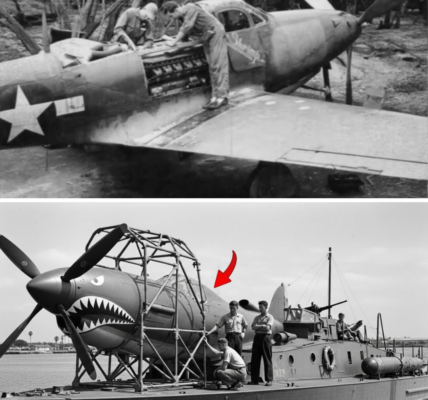
Another image recalls American bombing practice from the interwar period, showing how quickly aviation had evolved from experimentation into a central instrument of military power.
Within a few decades, aircraft had progressed from fragile machines to weapons capable of carrying enormous destructive power across oceans.
The transformation was astonishing.
And terrifying.
Yet photographs from the final months of the war also show something else: cooperation between former enemies and the beginning of reconstruction.
One image shows American and Soviet soldiers meeting near the Elbe.
Another shows an American soldier providing field rations.
Another captures a liberated child.
Together, they suggest that the end of a war is not a single moment.
It is a process.
First comes the silence after fighting.
Then the discovery of what has been destroyed.
Then the return of prisoners.
Then the search for missing relatives.
Then food.
Then rebuilding.
Then questions.

Who was responsible?
Who was innocent?
Who would be punished?
Who would be forgotten?
And who would tell the story?
The photographs of postwar Europe are therefore filled with contradiction.
People smiled because the war was over.
They cried because people they loved were missing.
They celebrated in the streets.
They returned to buildings that no longer existed.
They tried to rebuild lives around ruins.
The same contradiction appears in photographs of American Red Cross workers in Europe in 1945.
Their presence was part of the enormous humanitarian effort required after years of conflict.
War had created needs that armies alone could not solve.
People needed food, medical care, transportation, shelter and information.
The battlefield was disappearing.
The humanitarian crisis was not.
And then came another problem.
Memory.
How would societies remember what had happened?
That question became especially important as evidence of Nazi crimes emerged.
The world now had to confront not merely the destruction of war but the systematic persecution and murder carried out under the Nazi regime.
Photography became part of that evidence.
Cameras recorded liberated camps.
They recorded displaced people.

They recorded prisoners.
They recorded destroyed communities.
And they preserved faces that might otherwise have disappeared from the historical record.
The image of German soldiers confronting evidence of crimes committed by the SS is therefore more than a wartime photograph.
It belongs to the history of memory.
A photograph can force a viewer to look.
And sometimes looking is the first step toward acknowledging what happened.
The postwar period also produced another kind of division.
Germany was defeated, but Europe was not politically reunited.
Instead, the continent gradually became divided between competing spheres of influence.
That division eventually became visible in Berlin.
In August 1961, East German authorities began closing the border between East and West Berlin. Barbed wire appeared before the more permanent concrete structures of the Berlin Wall.
One photograph shows West Berliners watching as the boundary was established.
Another shows West Berliners waving to relatives over the wall at Christmas in 1961.
The images are devastating in their simplicity.
People could see one another.
They could wave.
They could sometimes communicate.
But they could not simply cross.
The wall transformed a political disagreement into a physical reality.
Families that had once lived within the same city could now find themselves on opposite sides of a fortified frontier.
The Berlin Wall would remain for decades.
Its eventual fall in 1989 became one of the defining images of the end of the Cold War.
But photographs from 1961 remind us that the wall did not begin as a famous symbol.
It began as a line of barriers and soldiers.
For the people watching it being built, the future was uncertain.
The same uncertainty appears in photographs from other political crises.
The collection includes images from Northern Ireland in 1969, when serious unrest and violence erupted in Derry and elsewhere.
British soldiers stand near burning buildings.
Police face crowds.
A rioter appears in the Bogside.
These photographs belong to a different conflict from the Second World War, but the visual language is strangely familiar.
Barricades.
Uniforms.
Smoke.
Crowds.
Fear.
The photographs show what happens when political disagreements become physical divisions between communities.
And once violence enters daily life, ordinary places can become symbols.
A street can become a boundary.
A neighborhood can become a front line.
A wall can become a political statement.
A photograph can become evidence.
That pattern would appear again in other parts of the world.
The collection includes photographs from Vietnam, including an AC-47 gunship operating at night in 1966 and American Marines being sent toward the conflict in 1968.
These images represent another stage in modern warfare.
By then, television and photography could bring distant conflicts into living rooms.
War was no longer something most civilians encountered only through newspapers days later.
Images could circulate rapidly.
People could see soldiers leaving for Vietnam.

They could see wounded civilians.
They could see destruction.
And they could question the conflict while it was still happening.
The relationship between war and public opinion was changing.
So was the relationship between government and citizens.
The photographs of the Watts uprising in Los Angeles in 1965 show another kind of confrontation.
Police.
Crowds.
Looting.
Burning buildings.
Anger.
The images are not interchangeable with battlefield photographs, because the circumstances were different. But visually, they reveal a similar truth: once trust between authorities and communities breaks down, ordinary streets can become places of confrontation.
History is full of such moments.
And the camera is often there.
Sometimes the photographer records the powerful.
Sometimes the powerless.
Sometimes both.
The collection also includes an image connected to the internment of Japanese Canadians during the Second World War.
That history demonstrates another way in which wartime fear can affect people who are not combatants.
Japanese Canadians were forcibly removed from their homes and sent to internment camps during the war.
The photograph of a person receiving notice is therefore not simply a bureaucratic scene.
It represents the moment when government policy enters an individual’s private life.

A piece of paper can determine where someone lives.
A uniform can determine who is considered a threat.
A border can determine who is allowed to remain.
And a political crisis can transform neighbors into suspects.
These are difficult lessons, but historical photographs make them difficult to ignore.
Still, the century was not defined only by suffering.
There were moments of extraordinary kindness.
The photograph of a young boy visiting a sick friend in 1950s America seems almost insignificant beside images of battleships and burning aircraft.
Yet it may be just as important.
Because history is not only about the events that make headlines.
It is also about the millions of small actions that allowed people to continue living.
A child visiting another child.
A family sitting together.
A worker doing a difficult job.
A soldier sharing food.
A stranger helping someone survive.
The war years contained such moments too.
Human beings did not stop being human simply because the world was at war.
That may be why some photographs remain powerful long after their political context has faded.
The photograph of a liberated child in France.
The soldiers meeting at the Elbe.
The civilians celebrating victory.
The people waving across the Berlin Wall.
The boy visiting a sick friend.
Different decades.
Different circumstances.
The same human need for connection.
And then there are the photographs that remind us how quickly the world can change.
The final Shah of Iran appears in one image surrounded by supporters as he prepares to leave the country in 1979.
The photograph belongs to another historical turning point.
The political order that had dominated Iran for decades was collapsing, and the Shah was entering exile.
A photograph can capture a political system in its final hours without being able to explain what will replace it.
That uncertainty is common in historical images.
People rarely know that they are standing inside a turning point.
In 1945, the soldiers meeting at the Elbe could not know how quickly their alliance would become a rivalry.
In 1961, Berliners watching the border being closed could not know exactly when the wall would disappear.
In 1979, supporters of the Shah could not know the full consequences of the revolution that was transforming their country.
History becomes clearer afterward.
For the people living through it, it is usually confusing.
That is perhaps the most important thing these photographs reveal.
We look backward with knowledge that the people inside the images did not possess.
We know which wars ended.
We know which governments collapsed.

We know which walls fell.
We know which celebrities became famous.
We know which children became historical figures.
But the people in the photographs did not.
The boy standing beside a sick friend did not know the image would survive.
The soldier meeting a Soviet counterpart did not know that the alliance would soon become a geopolitical confrontation.
The civilians watching the Berlin Wall being constructed did not know that their photographs would someday become symbols of a vanished world.
The child liberated in France did not know that the uniform beside him would become part of a historical archive.
They were simply living.
That is why old photographs can sometimes feel more powerful than historical summaries.
A textbook tells us that a war occurred.
A photograph shows us that someone was there.
A textbook tells us that borders changed.
A photograph shows us people standing on opposite sides.
A textbook tells us that cities were destroyed.
A photograph shows us the street where it happened.
A textbook tells us that soldiers fought.
A photograph shows us the person carrying another human being.
The camera cannot tell us everything.
It cannot reveal every motive.
It cannot prove every story attached to a caption.
It cannot explain what every person in the frame believed.
But when properly identified and preserved, it can give history something extraordinarily valuable.
Presence.
The feeling that someone was there.
Someone saw it.
Someone recorded it.
Someone survived long enough for the image to reach us.
And that is why these photographs should not be treated merely as collections of strange, shocking or nostalgic pictures from another age.
Ce sont des fragments de la mémoire humaine.
Certains font preuve de courage.
Certains montrent des signes de souffrance.
Certains font preuve de pouvoir politique.
Certains font preuve d’amitié ordinaire.
Certaines montrent des signes de destruction.
Certains montrent des signes de rétablissement.
Ensemble, ils révèlent un siècle où la technologie a rendu le monde de plus en plus connecté, tandis que les guerres tentaient sans cesse de briser cette connexion.
Les navires traversaient les océans plus rapidement.
L’avion a franchi les frontières.
Les photographies ont traversé les continents.
Les idées se répandent.
Les armes aussi.
Les murs s’élevèrent.
Les murs se sont effondrés.
Les empires ont disparu.
De nouveaux États ont vu le jour.
Les gens ont migré.
Les familles ont été séparées.
Les familles réunies.
Et pendant tout ce temps, les photographes ont continué à appuyer sur le déclencheur.
C’est peut-être la véritable raison pour laquelle ces images ont encore de l’importance.
Non pas parce que chaque photographie représente une personne célèbre ou un événement spectaculaire.
Mais parce que chacune d’elles préserve un moment qui appartenait autrefois uniquement aux personnes qui se trouvaient à l’intérieur.
Ils ignoraient qu’ils étaient en train d’écrire l’histoire.
Ils essayaient simplement de survivre.
Et des décennies plus tard, c’est nous qui regardons en arrière.
La question est de savoir ce que nous choisissons de voir.
Ne voyons-nous que les batailles ?
Ou bien voyons-nous aussi ces personnes qui transportent de la nourriture, rendent visite à des amis, secourent des inconnus, reconstruisent des maisons et attendent le retour de leurs proches ?
Car derrière chaque photographie de guerre se cache une histoire humaine.
Et parfois, la partie la plus importante de cette histoire n’est pas ce qui s’est passé sur le champ de bataille.
Voici ce qui s’est passé ensuite.
Ce qui a survécu.
Ce dont on se souvenait.
Et ce que ceux qui l’ont vécu ont refusé de laisser le monde oublier.
Certaines légendes du corpus fourni contiennent des identifications incertaines ou potentiellement inexactes ; j’ai donc délibérément évité de présenter ces détails comme des faits avérés. La note de transparence finale doit rester jointe lors de la publication de l’article.