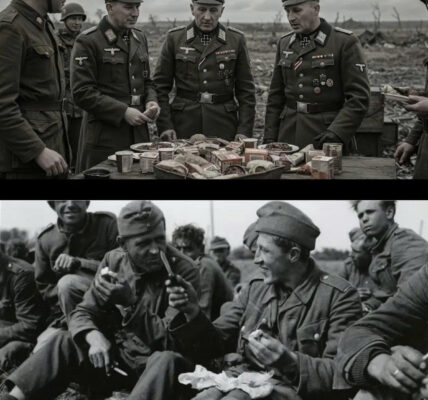
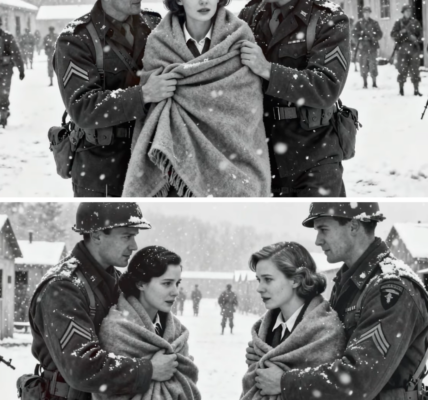
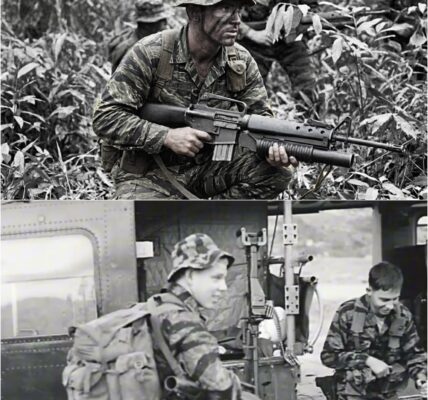
Les photographies de la Seconde Guerre mondiale qui étaient autrefois tenues à l’écart du public — et les histoires qu’elles racontent
Il y a des moments de la Seconde Guerre mondiale qui n’ont duré qu’une fraction de seconde.
Une caméra a été installée.
Un objectif pointé vers la scène.
Un parachute s’est ouvert dans le ciel. Des soldats ont avancé. Un convoi a traversé une ville en ruines. Des civils se tenaient le long d’une route. Quelqu’un regardait droit dans l’objectif.
Puis le volet s’est fermé.
Le moment était terminé.
Mais la photographie est restée.
Elle aurait pu être placée dans une boîte de pellicule, conservée dans des archives militaires, dans une collection privée, ou enfouie dans un dossier que le public ne verrait pas pendant des décennies.
Et lorsque cette photographie serait enfin revue, elle pourrait soulever une question simple mais difficile :
Quelle part de la guerre les gens ont-ils réellement vue pendant qu’elle se déroulait ?
La Seconde Guerre mondiale n’a pas seulement été relatée dans les journaux, les journaux intimes, les rapports officiels et les livres écrits après la guerre. Elle l’a également été à travers des millions de photographies.
Les photographes militaires et les agences gouvernementales ont documenté les champs de bataille, les bases militaires, les usines, les navires, les avions, les camps d’entraînement et la vie civile à l’arrière. Les Archives nationales américaines conservent encore une immense collection de documents photographiques de la guerre.
Mais il y a une autre partie à l’histoire.
Toutes les photographies prises n’ont pas été immédiatement diffusées au public.
Et toutes les photographies qui ont disparu des journaux n’étaient pas forcément des images « interdites ».

Cette distinction est importante.
En temps de guerre, un appareil photo n’était jamais simplement un appareil photo.
Une photographie peut révéler l’emplacement d’une base militaire, la taille d’une unité, l’existence d’une nouvelle arme ou technologie, ou encore les préparatifs d’une opération. Même une photographie en apparence banale peut fournir des informations qu’un ennemi n’est pas censé connaître.
Les archives nationales américaines montrent que certaines photographies de guerre ont été soumises à des restrictions pour des raisons de sécurité militaire, notamment les images révélant des installations militaires, des activités secrètes, de nouvelles technologies ou des informations sur la localisation et l’effectif des forces militaires.
Cela signifie qu’il y avait une autre histoire derrière de nombreuses photographies de guerre.
Un récit de ce que le public a été autorisé à voir.
Et ce qui devait attendre.
Durant les premières années de la guerre, les populations des pays impliqués dans le conflit ont souvent vécu la guerre à travers un flux d’informations soigneusement contrôlé.
Les journaux avaient besoin d’informations.
Les gouvernements avaient besoin de sécurité.
Les commandants militaires devaient protéger les plans opérationnels.
Et les organismes de propagande avaient besoin d’images capables de renforcer le moral du public.
La guerre ne s’est donc pas déroulée uniquement sur les champs de bataille.
La guerre s’est également jouée à travers la manière dont elle a été présentée au public.
Une photographie d’un soldat posant fièrement à côté d’un avion pourrait créer une image de force.
Une photographie d’ouvriers d’usine pourrait devenir un symbole de mobilisation nationale.
Une photographie de troupes se préparant à partir pourrait communiquer l’unité et la détermination.
Mais il y avait d’autres images.
Maisons détruites.
Civils déplacés.
Soldats épuisés.
Hôpitaux.
Prisonniers de guerre.
Des villes transformées par les bombardements et les combats.
Et des visages ordinaires pris au piège d’un événement qui les dépassait largement.
Beaucoup de ces images ont été prises.
Ils n’étaient tout simplement pas toujours rendus publics immédiatement.
Some categories of photographs were restricted more clearly than others. U.S. archival records indicate that identifiable photographs of American servicemen who had been killed, as well as certain images showing death or serious injuries, could be restricted out of consideration for privacy and the families involved. Medical photographs were also often handled differently from ordinary public images.
That is an important detail.
Because if every photograph that was restricted or unpublished is described simply as “banned,” a complicated history can quickly become a much simpler story about governments hiding the truth.
Reality was more complicated.
Some photographs were restricted because of military secrets.
Some because of humanitarian concerns.
Some because of privacy.
Some because authorities believed they could damage public morale.
And some were simply overlooked.
Decades later, however, those forgotten photographs could become extremely valuable.
History is often remembered through famous moments.
An invasion.
A victory.
A speech.
A flag.
A political leader.
A liberated city.
But history was also created through millions of moments that never became famous.
A soldier adjusting his equipment.
People waiting at a railway station.

A woman standing outside a workplace.
A child watching a military convoy pass.
A factory worker returning to a production line.
A family standing in front of its home.
None of these moments, by themselves, seemed large enough to change history.
Yet together, they reveal something that military histories sometimes struggle to communicate:
War is not only about battles. War can become a condition that reaches into almost every part of ordinary human life.
The Library of Congress preserves numerous World War II photographic collections showing military operations, training, civilian life, industrial production, and the experiences of Japanese Americans confined in wartime camps.
That is one reason historical photography can be so powerful.
A book can tell us that a society changed.
A statistic can tell us how many people were affected.
But a photograph can sometimes make us stop.
Not necessarily because it is shocking.
But because it gives us a human face.
During World War II, military photographers often worked in places ordinary civilians could never reach. Their work did not only document combat. They photographed training, logistics, transportation, soldiers’ daily lives, ships, aircraft, bases, and changing conditions on the battlefield.
The Library of Congress describes military photographers as something close to the eyes of the armed forces because their photographs could serve many purposes, from historical documentation to mapping, intelligence, and military records.
But a camera also has limitations.
It records only one angle.
It cannot explain the entire context.
It cannot tell us what a person in the photograph was thinking.
And if the original caption has been lost or changed, the image itself may not be enough to establish exactly what happened.
Sometimes even the caption becomes part of the problem.
In material preserved by the Veterans History Project, military photographer William Robinson Wilson recalled that one of his photographs was later published in an Army photographic history with an incorrect caption.
That small detail carries a much larger lesson:
Even a genuine photograph can be misunderstood if the information attached to it is wrong.
This is why seeing an old photograph does not automatically mean that we understand the history behind it.
We still need to ask:

When was it taken?
Where?
Who took it?
Who owned it?
Why was it taken?
Who wrote the caption?
Was it ever published?
And if not, why?
Most importantly:
What does the photograph show — and what remains outside the frame?
Among the enormous World War II collections now being digitized, many photographs spent decades inside archives.
The National Archives notes that millions of photographs from the two world wars were created by military photographers, foreign forces, private sources, and other organizations. Many collections still require research, cataloging, and digitization.
That creates a fascinating paradox.
We now live in an age when a photograph taken more than eighty years ago can appear on a screen within seconds.
But the easier it becomes to see historical images, the more carefully we need to think about what they mean.
A real photograph can be placed inside a false story.
A genuine image from one event can be incorrectly presented as another.
A photograph from one country can be used to illustrate an event that happened somewhere else.
A propaganda image can be shared as though it were a neutral historical record.
And a photograph described as “forbidden” may actually have been restricted, unpublished, overlooked, or simply forgotten.
That is why historical photographic collections deserve both curiosity and healthy skepticism.
Not skepticism toward everything.
But a willingness to verify before believing.
One of the most revealing examples can be found in the American wartime photographic system itself.
The Office of War Information, established in 1942, used photography as an important way to document and communicate the American mobilization effort.
Photographs showed women entering industrial workplaces, aircraft and ships being produced, workers contributing to the war effort, and civilian life changing under wartime conditions.
Looking back today, we can see two realities existing side by side.

One was the war presented through carefully selected images.
The other was the enormous body of photographs that remained inside archives.
Between those two realities lies a question about memory.
What is remembered?
What is forgotten?
What reaches the front page?
And what remains inside a box in an archive?
Some photographs do not need to be shocking to become haunting.
A soldier looking toward the camera.
A mother standing outside a home that has been left behind.
A group of people sitting silently on a train.
An empty street after troops have passed.
A city before the war.
And that same city afterward.
The difference between those two frames can sometimes say more than hundreds of sentences.
But sometimes the most powerful photographs are the most ordinary.
In a war remembered through the names of generals and the battles they commanded, such images remind us that most people had no power to decide when the war would begin or end.
They simply had to live through it.
The photographers themselves were part of that reality.
They carried cameras rather than rifles, but their work could still take them into dangerous places.
Library of Congress records document military photographers serving across different theaters of World War II, including North Africa, Sicily, the Pacific islands, and major campaigns in Europe.
The film they brought home later became part of the memory of an entire generation.
Some photographs were published.
Some were restricted.
Some remained in archives.
Some became evidence.
Some were not widely seen until decades later.
The National Archives even holds photographs from the collection of Heinrich Hoffmann, Adolf Hitler’s official photographer. After the war, American forces seized many of Hoffmann’s photographs. Some were later used as evidence in war-crimes proceedings before eventually becoming part of the National Archives.
That detail reveals something very different about the power of photography.
A photograph originally created for propaganda could, years later, become part of the historical record used to study and document the actions of the regime that produced it.
The meaning of a photograph can change with time.
The photographer may have had an intention.
A government may have had an intention.
A newspaper may have had an intention.
But later generations can look at the same image in an entirely different way.
Perhaps that is why forgotten wartime photographs still make people stop.
Not because every one of them contains a secret.

But because they give us an opportunity to see history from another angle.
World War II ended in 1945.
But its photographs continue to be discovered, digitized, cataloged, and studied.
Some remain in military archives.
Some are preserved in libraries.
Some belong to private collections.
Some were held by government agencies.
And some were found inside old files that later generations finally had the opportunity to examine.
The National Archives continues to preserve enormous collections of wartime photography, including military images, aerial photography, prisoner-of-war photographs, home-front material, and many other forms of visual documentation.
The story of photographs that were “not meant to be seen,” therefore, should not end with the claim that history was completely hidden.
It should end with a more difficult question:
How have we learned to look at history?
Because history is not contained only in what was written.
It is also contained in what was photographed.
And sometimes, it exists in the space between the two.
A photograph can show us a soldier.
But it cannot tell us everything that soldier thought.
A photograph can show us a destroyed city.
But it cannot contain the entire story of the people who once lived there.
A photograph can show victory.
But it cannot, by itself, tell us the full human cost of that victory.
And a photograph kept from public view for decades does not necessarily contain a forbidden truth.
Sometimes it is simply a missing piece that had not yet been placed into the larger picture.
That may be the real value of historical photography.
Not the feeling that we have discovered a secret.
But the opportunity to question what we thought we already knew.
During the age of social media, an image can travel around the world in a matter of hours.
But speed does not make an image more reliable.
An old photograph needs an accurate caption.
A historical claim needs a source.
A story needs context.
And a memory needs evidence.
The people who lived through World War II did not have the luxury of looking back from the distance of more than eighty years.
They did not know when the war would end.
They did not know whether their city would survive.
They did not know whether a loved one would return.
And they certainly did not know that ordinary moments from their lives might one day become historical records.
A person standing in front of a camera could never have known that decades later, someone living in another country would look at that face and wonder:
What happened to them?
That is the quiet power of photography.
It crosses time.
It does not need to speak.
It only needs to survive.
And when we open an old file, examine a film preserved from the war, or encounter an image that had been forgotten for decades, we are not simply looking at the past.
We are looking at the way people once tried to record that past.
Sometimes that is what makes a photograph valuable.
Not because it was “forbidden.”
Not because it was “shocking.”
But because it survived.
A moment that has passed.
A person who has disappeared from our time.
A city that has changed.
A war that has ended.
Yet the image remains.
Perhaps the most important lesson is not that we should believe every rare historical photograph.
It is that we should learn how to look at them more carefully.
Because history does not become reliable simply because it is presented in a photograph.
History becomes more reliable when photographs, documents, dates, locations, and other evidence can be examined together without contradiction.
In the end, the photographs of World War II do not tell us only about war.
They tell us about memory.
About what people wanted to preserve.
About what was hidden from view.
About what was forgotten.
And about the responsibility of later generations when those old records are opened again.
Personnellement, je crois que la plus grande valeur des photographies historiques ne réside pas dans leur pouvoir de choc, mais dans leur capacité à nous inciter à la réflexion. Une photographie ne peut pas raconter toute l’histoire, mais elle peut nous encourager à poser de meilleures questions, à vérifier plus attentivement les informations et à percevoir plus clairement les êtres humains derrière les statistiques de la guerre.
Si une photographie peut survivre à la personne qui l’a prise, à la personne qui y figure et à l’époque qui l’a créée, devons-nous la regarder simplement pour y chercher un « secret », ou devons-nous la regarder pour mieux comprendre la vérité qu’elle a véhiculée à travers le temps ?
Certains contenus ont été générés à l’aide d’outils d’IA (dont ChatGPT) et modifiés par l’auteur à des fins créatives, narratives et d’illustration historique. Les faits historiques et les détails importants doivent être vérifiés auprès de sources historiques fiables. Les visuels générés ou reconstitués par IA sont fournis à titre illustratif et ne doivent pas être interprétés comme des photographies historiques originales ou des documents d’archives.