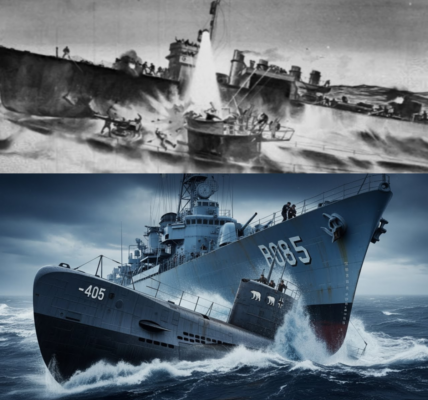
▶ These Shocking Historical Photos Were Hidden From Us | Rare & Vintage Old Photos .NH

Some photographs seem to capture a moment. Others seem to capture the instant when an entire world is changing. A government official’s car rises above a Madrid building. German soldiers walk toward Soviet positions with their arms raised. A mother sits beneath a segregation sign with her baby. Elsewhere, a cat receives an official military identification card, while a giant camera requires fifteen men simply to take one photograph. These images appear unrelated, scattered across wars, revolutions, inventions, cities, and ordinary lives. Yet each contains something more unsettling: a detail that makes the past feel unexpectedly close. And once you notice it, another question begins to appear—what else is hiding behind the frame?
On December 20, 1973, Madrid witnessed an attack whose physical image was almost unbelievable. A vehicle belonging to a Spanish government official was hurled violently upward, rising above the roofline of a nearby building. The trajectory itself became so extraordinary that it later entered popular culture through satirical expressions about how high the car had traveled. But the photograph and the jokes surrounding it could never fully explain the larger significance of the event. The attack affected the political succession of Spain, meaning that what appeared in a single instant on a Madrid street also had consequences far beyond the wreckage itself. A photograph can freeze the movement of a car in midair, but it cannot freeze the political uncertainty that follows. Behind that astonishing image was a country approaching a major transition, and the meaning of the photograph becomes clearer only when the moment is placed inside that larger history.
Other images lead somewhere much darker. Irma Greece and Joseph Kramer appear in custody before facing trial for crimes committed during the Second World War. She had served as a concentration-camp guard, while he had held the position of commander. Both were convicted and executed between 1945 and 1946. The photographs preserve their faces at a moment when the machinery of the war had ended but the consequences had not. Their appearance in custody is therefore more than a record of two defendants waiting for judgment. It belongs to the difficult transition between war and accountability, when Europe was beginning to confront crimes committed under a regime that had collapsed only months earlier. The question behind such images is not simply what happened to the people in the frame. It is how societies decide what must be remembered after the uniforms, flags, and institutions responsible for the violence have disappeared.
The physical remains of that collapse could be found in Berlin. After the end of the war, abandoned strategic facilities revealed the condition of a defeated regime in unusually tangible ways. On the floor of a flooded underground shelter in 1945, a military cap lay covered with mold. There is nothing spectacular about the object itself. It is only a piece of clothing. Yet its condition tells a larger story. The cap had once belonged to a system that demanded discipline, movement, obedience, and military purpose. Now it rested in water, deteriorating in a forgotten underground space. The decay was not merely symbolic; it was physical evidence that the structures which had appeared so powerful only a short time before could be reduced to abandoned rooms and deteriorating objects.
Nearby, another image records the human side of the same collapse. German soldiers, facing intense cold and an empty horizon, move toward Soviet positions with their arms raised. The gesture requires no dramatic explanation. Raised hands were enough. After years of fighting on the Eastern Front, resistance had reached one of its unavoidable conclusions. The soldiers were no longer advancing with weapons ready. They were surrendering. Behind that simple gesture were enormous losses of people and material, exhaustion accumulated over years, and the destruction of a military campaign that had once seemed capable of reshaping Europe. The photograph becomes haunting precisely because nothing needs to be added to it. The silence of surrender says enough.
Yet history did not become peaceful simply because the war had ended. In Paris in 1947, women attacked a model and tore apart her Christian Dior dress on a city street. The incident occurred shortly after the war, when France was still experiencing scarcity and hardship. The heavy luxury associated with the emerging New Look could therefore appear profoundly disconnected from the lives of people who had endured years of deprivation. The torn dress became an unexpected collision between fashion and memory. Clothing normally communicates elegance, status, and aspiration. Here, it became the focus of anger. Beneath the confrontation was a difficult question about recovery: when is it acceptable for a society emerging from hardship to begin displaying abundance again?
The aftermath of conflict could be even more complicated in places where political, cultural, and religious identities became entangled. During the 1971 conflict in what was then East Pakistan, identification methods tied to cultural and religious practices were used to distinguish people in Bangladesh. The record illustrates how physical criteria could become tools for mapping local populations during civil war. What appears at first to be an administrative or military method therefore carries a much heavier implication. In periods of extreme conflict, something as ordinary as appearance can become a means of categorizing human beings. The image leaves behind an uncomfortable question: how quickly can ordinary differences become dangerous when a society is divided by war?
The Eastern Front had already demonstrated the enormous scale of such divisions. During the German invasion of the Soviet Union in July 1941, the advance of German forces led to the capture of thousands of Soviet fighters in the region identified in the record. Among those held were Soviet women involved in the war effort, confronting the uncertainty of imprisonment. Their presence reminds us that the war was not experienced only by the armies that appeared in official military photographs. Women were drawn into the conflict in many different roles, and captivity could erase the distinctions between combatant, participant, and civilian. Behind every numerical description of prisoners were individual lives whose futures had suddenly become uncertain.

The same transformation of ordinary people into participants in survival can be seen during the Nigeria conflict in 1968. A civilian carried ammunition on his head amid the fighting and tensions of the Biafra region. There is something strikingly practical about the image. In a conventional military picture, supplies arrive through organized logistics, vehicles, warehouses, and established chains of command. Civil war can destroy those systems. When that happens, the burden of keeping people supplied may fall directly on civilians. The photograph therefore captures more than one person carrying ammunition. It shows what happens when the machinery of war and the machinery of everyday life become inseparable.
In Washington, a different kind of collective experience was being recorded. During funeral ceremonies on November 25, 1963, young John F. Kennedy Jr. paid a final tribute to his father in front of St. Matthew’s Cathedral. The gesture became part of the collective memory of the United States. Unlike images of battles or military surrender, this photograph does not require weapons to communicate historical weight. A child standing before the funeral of his father became an image of national mourning. The private tragedy of one family and the public grief of a country occupied the same frame. Decades later, the photograph remains powerful because it reminds us that political history is also made of personal losses.
Another photograph brings the viewer into the daily reality of American segregation during the 1950s. A mother holds her baby at the edge of the section reserved for Black passengers on a bus. A segregation sign is visible on the seatback. Nothing about the scene is theatrical. That is precisely what makes it important. Discrimination was not only expressed through major political speeches or famous court decisions. It existed in ordinary places—in buses, schools, counters, neighborhoods, and countless rules governing where people could sit and how they could move. The mother and child therefore stand within a system larger than themselves. The sign in the photograph is small, but the legal and social structure behind it was enormous.
War also encouraged inventions that now seem almost surreal. During the Second World War, Germany developed the Krummlauf, a curved-barrel attachment designed for assault rifles. Its purpose was to allow soldiers to fire around corners or over obstacles without exposing their bodies directly to enemy fire. It is an extraordinary example of engineering responding to the particular conditions of urban combat. The device looks strange because modern weapons are usually imagined as mechanically straightforward. Yet war repeatedly produces inventions that seem bizarre until their intended problem becomes clear. In this case, the shape of the barrel itself reveals the danger soldiers faced in environments where a few inches of exposure could matter.

A much larger weapon appears in an image from 1918, when a heavy artillery piece illuminated the darkness during a night firing in France. The photograph captures the destructive power of industrial warfare at the end of the First World War. By then, the battlefield had become a place where enormous quantities of machinery, ammunition, steel, and explosives could be brought together on a scale earlier generations had never experienced. The bright flash against the darkness is visually dramatic, but its deeper meaning lies in what it represents: technology had expanded the reach of destruction while making the battlefield increasingly industrial.
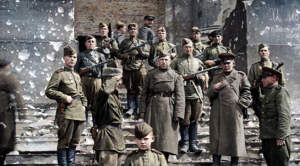
In Berlin in 1945, Soviet soldiers posed on the steps of the Reichstag after the final battles of the war in Europe. Among the veterans, the presence of a very young Red Army soldier stands out. The image can easily be read as a symbol of generations involved in the Soviet victory. But the photograph also invites another thought. The end of a war is often represented through flags, buildings, and victorious soldiers, while the ages of the people who fought can disappear from the story. Seeing a young face among the veterans restores some sense of the human scale behind the historical event.
Liberation in France brought its own difficult images. Women accused of intimate collaboration with the German occupation faced public humiliation after liberation in 1944. In some cases, their heads were shaved by civilians, turning appearance into a punishment and a public mark of disgrace. These scenes reflected the anger, suspicion, and desire for national cleansing that accompanied the end of occupation. Yet photographs of humiliation also force later generations to confront an uncomfortable distinction: liberation from occupation did not automatically produce justice without cruelty. The war had ended, but society still had to decide how anger would be expressed and who would be blamed.

Political alliances could also appear almost unbelievable when viewed without their historical context. A satirical Western press cartoon from 1939 mocked the unlikely relationship between Joseph Stalin and the German leader by portraying their agreement as a political marriage. The joke referred to the Molotov-Ribbentrop Pact, the non-aggression agreement between the Soviet Union and Nazi Germany, which included secret arrangements concerning the division of territories in Eastern Europe. Cartoonists translated an extraordinary diplomatic reversal into an image that ordinary readers could immediately understand: two ideological rivals suddenly appearing as partners. The humor was satirical, but the reality behind it would have consequences measured not in jokes, but in borders and lives.
Another forbidden image came from a very different setting. In 1932, photographer Eric Salomon secretly photographed the United States Supreme Court during a formal session. He reportedly concealed a camera in a fake cast, circumventing the official prohibition on courtroom photography. The result is valuable precisely because the photograph was difficult to obtain. It shows how photographic technology could challenge institutional control over what the public was allowed to see. Before cameras became nearly universal, gaining access to an important room could require extraordinary ingenuity. The image therefore belongs to a history of photography in which the camera was sometimes not merely an observer, but a tool for overcoming secrecy.
In Boston in 1908, another crowd gathered for a very different reason. Magician Harry Houdini prepared for one of his daring public feats, reportedly involving a jump from a bridge while fully chained. The spectacle depended on a question every spectator could understand immediately: could a human being escape the restraints before disaster? Houdini’s performances were built around that uncertainty. The audience saw chains, height, and danger, but the method remained hidden. His photographs survive because they captured not only the performer, but the culture of public spectacle that made such feats so compelling.

By 1934, an entirely different kind of experiment was taking place outside an apartment building. A nanny watched a child placed inside a wire cage suspended beyond the building. The device was intended to give babies living in tall buildings access to fresh air and sunlight. Today the image looks startling because the solution appears so exposed and precarious. Yet the idea reflects an earlier period’s belief that sunlight and outdoor air were essential to health, combined with the practical problem of raising children in increasingly vertical cities. The photograph is strange, but its strangeness comes from a genuine attempt to solve an everyday problem with the technology available at the time.
Maritime history produced its own impossible-looking image on August 5, 1910. The steamship Princess May ran aground on a reef near Sentinel Island in Alaska. At low tide, the vessel was left dramatically perched on the rocks, producing one of the most memorable maritime photographs of the early twentieth century. A ship is supposed to float. Seeing one balanced above exposed rock seems to violate that basic expectation. But the photograph is also a reminder of how navigation depended on geography, tide, weather, and human judgment long before modern systems reduced some of those uncertainties.
World War II produced stranger solutions inside factories as well. Women’s industrial safety became a concern as large numbers of workers entered war production. One unusual response was a rigid plastic bra intended to protect workers from serious accidents involving machinery, impacts, and debris. The object seems almost humorous when viewed without context, but its purpose was practical. Industrial production had become essential to the war effort, and protecting workers became part of sustaining that production. The photograph therefore reveals an aspect of wartime history often hidden behind images of tanks and aircraft: factories themselves had become dangerous fronts.
Nineteenth-century medical experimentation could look equally unconventional. A diagonal suspension machine was designed for physical therapy and body stretching, using a hand-operated wooden mechanism. Such equipment reflects an era when physicians and engineers were still exploring mechanical approaches to orthopedic treatment. What appears primitive beside modern exercise equipment nevertheless belongs to the long process of discovering how controlled movement could be used therapeutically. The strange apparatus is therefore not simply a curiosity. It is an early chapter in the history of rehabilitation.
In 1941, a supposed telepath attempted to hypnotize a chimpanzee dressed in human clothing. The bizarre scene reflected the period’s fascination with parapsychology and public experiments involving animals. Today the image may provoke amusement, but it also shows how seriously some audiences were willing to consider ideas that stood outside established science. Photography has a habit of flattening the distinction between serious research, entertainment, and spectacle. One frame can preserve them all without explaining which interpretation contemporary viewers accepted.
Before radar transformed air defense, armies relied on sound. At Bowling Field in Washington in 1921, a two-horn acoustic locator was used to detect aircraft by listening for distant engines. These giant devices look almost fantastical today, but they represented a genuine technological response to a new problem: aircraft could approach from far beyond the range of ordinary visual observation. The machine attempted to hear the sky before it could see it. Once radar emerged, such equipment became obsolete, but the photograph remains a reminder that technological progress is rarely a straight line. Before the successful solution arrives, there are many strange-looking attempts.
In 1966, Bobby Gibb broke another barrier when she became the first woman to finish the Boston Marathon. Because of restrictions on women participating officially in the race at the time, she ran without an official bib number. Her participation nevertheless became an important landmark in women’s sports. The significance of the photograph lies not simply in the distance she covered, but in the rules that had tried to define who was allowed to cover it. Sometimes historical barriers become visible only when someone crosses them.

Four years later, another social boundary was represented in a wedding photograph. Roger Mills and Berta Linson cut their wedding cake on August 2, 1970, in Mississippi, in what the record identifies as the state’s first interracial marriage. Their wedding occurred only three years after the Supreme Court had struck down laws restricting interracial marriage. The cake, the ceremony, and the smiles of the couple might seem ordinary, but the legal history surrounding the photograph was anything but ordinary. A wedding could become evidence that a law once treated as legitimate had finally been removed.
The passage of generations is visible in another extraordinary family image from 1980. Tame Ruse Vanacha and his son Ivan met while wearing decorations representing very different periods of twentieth-century military history. The father, aged 112 according to the record, wore medals associated with the First World War and the Russian Civil War, while the son displayed decorations from the Second World War. In one frame, several eras appear to overlap. The image compresses decades of upheaval into a single family encounter and quietly demonstrates something history books often struggle to convey: wars do not necessarily remain separate chapters in people’s lives. Their memories can exist within the same family.
The Spanish Civil War of 1936 created another visual language of identity. Volunteers from many countries joined popular militias in defense of political ideals, while fighters sometimes used metal helmets decorated with hand-painted symbols. In an environment where uniforms could vary and identification could become difficult, visual markings had practical importance as well as ideological meaning. The helmet was not merely protective equipment. It could also tell others who the wearer was supposed to be.

The colonial world produced photographs that now demand a different kind of attention. In the Belgian Congo in 1930, Italian explorer Ailioatti posed beside two hired pygmy men and a captured gorilla. The scene reflects the assumptions of the era’s anthropological and hunting expeditions, shaped by a colonial mindset that treated both African populations and wildlife as objects within an expeditioner’s world. The photograph has historical value, but it should not be mistaken for a neutral representation of the people in it. It also preserves the unequal power relationships of the period. Sometimes the most important thing in an old photograph is not what its creators intended to celebrate, but what their assumptions unintentionally reveal.
A Russian photograph from the early twentieth century carries a quieter form of hardship. Peasants crossed a river in the Yenisei region carrying a killed moose on an improvised raft. In the isolated forests of Siberia, hunting could be essential to subsistence. The raft was not a curiosity for its own sake. It represented practical adaptation to a difficult environment where distance, weather, and limited infrastructure shaped daily survival. The photograph therefore captures a world in which obtaining food could require ingenuity as much as physical effort.
In Glasgow on August 18, 1868, a narrow alley revealed the difficult conditions of Scottish tenement life. The photograph, attributed in the record to Thomas Annan, preserved worn architecture and blurred residents created by the long exposure. Those ghostlike figures are one of the accidental visual signatures of early photography. People moved while the camera remained fixed, leaving traces rather than sharply defined bodies. The technical limitation has become part of the historical meaning. The photograph records a neighborhood while simultaneously making its inhabitants seem to drift through time.
More than a century later, New York’s subway system produced another unforgettable visual identity. During the 1980s, graffiti-covered subway cars were photographed alongside the Guardian Angels, reflecting the city’s struggle with crime, public safety, and urban neglect. The graffiti was not merely decoration. It became part of the visual language of a city undergoing profound social and economic change. The subway car itself became a moving canvas on which the tensions of the metropolis were displayed every day.

Aircraft crews also used visual design to shape morale during World War II. A Stuka bomber appeared with a smiling face painted on its front fuselage. The image transforms a machine built for combat into something almost cartoonish. That contrast is significant. Crews spent long periods surrounded by danger and mechanical routines, and personalizing aircraft could provide a sense of identity or morale. Yet the friendly expression remained attached to a weapon of war. The photograph therefore contains an unsettling contradiction between appearance and purpose.
At Camp Tyson in Tennessee, military training used an even stranger object: a giant octopus-shaped barrage balloon. The balloon was part of aerial-defense training and was used to test buoyancy and structural strength. Its unusual form makes the image immediately memorable, but the underlying problem was serious. Before modern defensive systems became standard, militaries experimented with large balloons and other obstacles to complicate attacks from the air. The octopus shape looks almost playful, but it belonged to a world increasingly preparing for aerial warfare.
Daily urban life could be just as inventive without any connection to war. In 1871, workers in many cities still carried heavy containers to maintain public hygiene before modern sewer systems were widespread. Their labor was physically demanding and largely invisible to the people who benefited from it. Infrastructure is often remembered through bridges, towers, and monumental buildings, but cities also depend on countless workers performing repetitive tasks that rarely appear in grand histories.

The automobile age brought its own fantasies. In 1961, translucent synthetic rubber tires with lights installed inside were proposed as a futuristic automotive innovation. The glowing wheels promised a vehicle that looked as though it had arrived from another era. Such inventions reveal the optimism of the period, when designers frequently imagined that technology could transform even the most familiar objects. Some ideas became standard. Others disappeared. The photograph preserves the moment when the future still seemed wide open.
Los Angeles offered another unusual experiment in 1929: a winding road structure designed by Harry Rocks that resembled a roller coaster. With dips and curves, it challenged conventional expectations of what a road should look like. The road was both infrastructure and experience, suggesting that driving could be transformed into entertainment. It belonged to an era when automobile culture was still discovering how much the shape of a road could influence the experience of travel.
The scale of engineering became even more dramatic in Wallsend in the United Kingdom in 1970, where the massive Esso Hibernia oil tanker towered over the surrounding landscape during construction. Small houses and streetcars appear almost insignificant beside the enormous vessel. The contrast communicates something words alone struggle to express: industrial Britain had developed the capacity to build structures whose dimensions dwarfed the communities around them. The tanker represented the extraordinary scale of shipbuilding at the height of that technological era.

And then there was the Eiffel Tower. In Paris in 1888, construction had advanced far enough for the complex iron framework to reveal the ambition of Gustave Eiffel’s project for the World’s Fair. At the time, its height and structure challenged assumptions about engineering and architecture. Today the Eiffel Tower is so familiar that its original audacity can be difficult to imagine. The photograph restores some of that uncertainty. Before it became an icon, it was an enormous experiment rising above Paris.
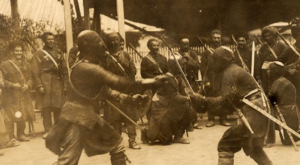
In the Caucasus, Georgian warriors from the Khevsur ethnic group demonstrated traditional combat skills using armor and swords. Their fencing practice preserved ancestral techniques and cultural identity in the early twentieth century. Unlike photographs of modern armies, this image captures a form of martial heritage that existed partly outside industrial warfare. The armor and weapons were not simply relics. They were expressions of a living cultural tradition.
Political power appears again in a photograph of Emil Hácha leaving Berlin in March 1939 after Czechoslovakia was forced to surrender its independence to the German regime. The record describes him as visibly devastated inside his vehicle as he returned to Prague. The image belongs to one of the most consequential moments in the destruction of Czechoslovak independence. A vehicle moving through a city can look like an ordinary travel photograph, but here the journey carried the weight of a country’s political defeat.

In Nepal, King Mahendra’s coronation in Kathmandu in 1955 marked the beginning of a decisive political era. His rule, which lasted until 1972, consolidated the Panchayat system, restricting political parties and centralizing power around the monarchy. A coronation photograph naturally emphasizes ceremony and continuity, but the political history surrounding the throne was more complicated. Images of rulers often show stability. The policies enacted under their rule reveal how that stability was maintained.
In London during the late 1960s, King Faisal of Saudi Arabia attended a diplomatic dinner at the Royal Palace, surrounded by members of British high society. The photograph represents the strategic relationship developing between Britain and Saudi Arabia and the broader political importance of the Middle East. Behind formal clothing and ceremonial surroundings was a world in which diplomacy, energy, security, and international influence were becoming increasingly interconnected.
In 1991, a Soviet family watched television as Mikhail Gorbachev delivered his historic resignation address. The photograph is remarkably ordinary: people at home, watching a screen. Yet the event they were watching marked the end of the Soviet Union and one of the defining geopolitical transformations of the twentieth century. Millions experienced the collapse of a superpower not from a battlefield, but through television broadcasts inside their homes. The photograph captures that strange transition between private life and world history.
Military history returns in June 1944, when Lieutenant Alex Bratzu celebrated shooting down six Japanese aircraft during the Battle of the Philippine Sea, an engagement remembered in American military terminology as the Great Marianas Turkey Shoot. Smiling and holding up six fingers, he marked the number of victories attributed to him. The photograph captures the culture of aerial combat through a personal gesture, but it also sits within a much larger battle in which air power dramatically altered the balance in the Pacific.

In Lviv, then part of Soviet Ukraine, a girl holding colorful balloons during the May 4, 1968 parade appears almost detached from the political world surrounding her. Labor Day celebrations were central to the Soviet calendar and served as public displays of worker unity and state power. The balloons belong to childhood; the parade belonged to ideology. Their coexistence in one photograph illustrates how political systems entered ordinary life through ceremonies, public spaces, and family participation.
A mother and daughter walking through a New York park with Afro hairstyles provide another image of cultural transformation. Their appearance reflected the growing expression of Black pride and identity in American cities during the 1970s. Fashion, hair, music, and public style could become forms of cultural affirmation. What might look like a simple family walk therefore belongs to a much larger movement in which identity became increasingly visible in everyday life.
On June 7, 1965, Mary Kenneth Keller represented another transformation. She became the first woman to earn a doctorate in computer science in the United States. Her work at the University of Wisconsin contributed to programming and to broader access to technical education. The historical significance of the photograph is not simply that it shows a woman working with technology. It records a moment when computing was still developing into a field that would eventually reshape almost every aspect of modern society.

In December 1899, Nikola Tesla conducted dramatic electrical experiments at his Colorado Springs laboratory. The famous image of the experiment uses double exposure to create the appearance of immense electrical discharges cutting through the air. The result looks almost supernatural, but the photograph was created through photographic technique and Tesla’s experimental environment. It stands at the intersection of science, spectacle, and visual imagination—the kind of image that helped make technological experimentation appear like a glimpse of the future.
In 1967, Frank Zappa and the Mothers of Invention posed beside Jimi Hendrix during a photo session connected with the visual concept of the album We’re Only in It for the Money. The scene deliberately parodied the psychedelic aesthetic of the era. Here, photography was not merely documenting musicians. It was participating in the joke. The photograph itself became part of the artistic message.
Beatlemania provided a completely different kind of spectacle. In Sydney during the 1960s, a desperate fan attempted to attract Paul McCartney’s attention. The moment reflected the extraordinary cultural frenzy surrounding the Beatles, whose popularity had moved beyond music into fashion, youth identity, media, and mass culture. The photograph captures one person reaching toward an international phenomenon, illustrating how distant celebrities could suddenly become central figures in ordinary people’s lives.

Anita Ekberg’s 1950 photograph similarly captures the construction of celebrity image. The Swedish actress represented the glamour associated with international cinema and the golden age of screen celebrity. Behind the polished photograph was a rapidly expanding entertainment culture in which appearance could become an enduring public identity.
Rosalind Russell offered a lighter behind-the-scenes image in 1966 while working on The Trouble with Angels. Dressed in the habit of her character, the mother superior, she rode a bicycle with her legs raised. The moment reveals the difference between a film’s serious appearance and the playful reality of a production set. Once the camera stopped recording the fictional world, actors could return to ordinary humor.
Sporting events also depended on technology that rarely appears in the final broadcast. An improvised radio station inside the Hotel St. Moritz used analog equipment and cables to transmit coverage of winter games in Switzerland. The operators worked in a room adapted for broadcasting, showing the technical effort required to deliver sports news before digital communication transformed the process. Every live broadcast has a hidden infrastructure, and photographs like this make that infrastructure visible.

Universal Orlando Resort opened officially in 1990 with employees and recognizable characters gathered beneath its entrance arch. The photograph belongs to the beginning of an entertainment complex that would become part of Florida’s tourism landscape. Unlike war photographs, it records a moment when history is being made through commerce, entertainment, and popular culture rather than conflict.
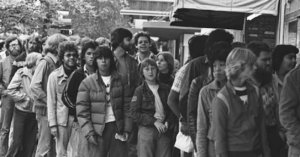
A long line of moviegoers waiting on a sidewalk provides another glimpse of cultural history. The poster announced screenings beginning June 24, 1977, marking the arrival of the science-fiction phenomenon created by George Lucas. The significance of the crowd was not merely that people wanted to see a movie. The film would become a global cultural force, demonstrating how cinema could create shared experiences on a scale previously difficult to imagine.
The earliest Carl’s Jr. stand in California looked much more modest. In 1941, signs advertised hot dogs for twenty cents and hamburgers for twenty-five cents beneath a simple cover. There was no appearance of a global fast-food empire. It was simply a small operation serving inexpensive food. Photographs of beginnings are often valuable for precisely this reason: they show how ordinary the future can look before anyone knows what it will become.

French customers trying Coca-Cola for the first time in the early 1950s provide another small glimpse of globalization. At the counter, people watched the unfamiliar drink being poured, their reactions suggesting curiosity toward a taste that had not yet become an everyday part of European life. Cultural change often begins this quietly—not with a treaty or a speech, but with someone tasting something for the first time.
In the New York subway in 1953, passengers could buy chocolate from a vending machine for one cent. The machine represents several developments at once: mechanized consumption, mass transportation, inexpensive goods, and the changing rhythm of urban life. The price is striking from a modern perspective, but perhaps the more interesting detail is how normal the machine appears. Technology becomes truly transformative when it stops looking extraordinary.
A color photograph of the Taj Mahal in Agra, originally captured in 1914 and published by National Geographic, offers another kind of time capsule. The white marble monument stands among cypress trees and reflecting pools, preserved through one of the early uses of color photography in widely circulated visual culture. The image is not simply a picture of a famous monument. It records how the world itself was being photographed and presented to distant audiences during the early twentieth century.

In Manchester in 1943, children played on an improvised swing attached to a streetlight pole. Britain was still at war, yet the children found a way to create a moment of ordinary life among brick buildings and cobblestone streets. The photograph does not erase wartime hardship. Instead, it shows that even during enormous historical crises, children still played.
New York in the 1960s revealed another dimension of everyday change. Customized bicycles carrying American and Puerto Rican flags reflected the growing cultural influence of Caribbean immigration in city neighborhoods. The street became a place where national identities could overlap rather than remain separate. The flags on the bicycles were small symbols of a much larger transformation in urban America.
Commercial aviation also changed in 1930 when Boeing Air Transport introduced the first flight attendants. The women wore standardized green uniforms and capes, helping establish a profession intended to make air travel more personal and secure. What now seems like a normal part of flying was once a new experiment in how passengers and transportation could interact.

Samsung’s beginnings were similarly modest. Founded on March 1, 1938, as a small trading company focused on exporting local goods, its early storefront in South Korea looked nothing like the global technology corporation it would later become. The photograph is a reminder that technological giants often begin as ordinary businesses whose eventual scale could not have been predicted from their earliest days.
The first Tiffany & Company store in New York also looked different from the global luxury brand it would become. Established on September 18, 1837, the business began as an upscale stationery shop before expanding into the world of fine jewelry. Inside the early store, silverware, decorative china, and luxury goods reflected the tastes of New York’s elite. The photograph captures a company at a stage when its future identity had not yet been fixed.
The Pulsar wrist device introduced around the middle of the 1970s reflected another era’s fascination with combining multiple technologies into one object. A wristwatch, calculator, and computer-like functions were brought together in a compact accessory, operated with a small stylus and tiny controls. Today, the concept feels surprisingly familiar. What looked futuristic then foreshadowed a world in which computing would increasingly move onto the body.
Victorian ingenuity could be far more eccentric. In 1876, Virgil A. Gates patented a mustache protector designed to prevent facial hair from touching food or drink while preserving its shape. The device attached around the ears and represented a very specific concern of the era: maintaining a carefully styled mustache under everyday conditions. It seems absurd only because modern standards of grooming have changed. The invention reminds us that every period has its own definition of an obvious problem.

The AutoPad of 1916 belonged to the changing world of urban mobility. Considered one of the early motorized scooters, it was used by different groups, including women seeking greater independence in city transportation. The machine was not simply a novelty. It belonged to a broader transformation in which motorized personal mobility began changing how people experienced cities.
Home convenience produced equally inventive solutions in the 1940s. A monitoring viewer with angled mirrors allowed a person to see difficult-to-reach areas while bathing. The device was designed to make personal hygiene more independent. Its strange appearance reflects a recurring pattern in technological history: once people identify a small inconvenience, someone will eventually try to build a machine to eliminate it.
Even soldiers sought small moments of normality. A German soldier photographed with his dog during the 1940s appears alongside an animal wearing a helmet and goggles. The image is unusual and almost playful, but its emotional weight comes from the contrast. War is usually remembered through destruction and military operations. Photographs like this preserve another side: companionship, routine, and the brief human attempts to find relief amid hardship.
At the 20th International Exhibition of Inventions in Brussels on March 13, 1971, a model tested a spiral electric bra. The object reflected an era fascinated by applying electronics to ordinary clothing. Whether such inventions became practical or disappeared into the history of novelty, they reveal a period when the boundary between fashion and technology seemed open to experimentation.

During World War II, even a cat received an official role. The United States Coast Guard issued an identification document for Herman, a cat employed as a rodent hunter at the Port of Baltimore. On January 12, 1943, he was recognized as an experienced mouser, helping protect naval supplies. The document sounds almost comic beside the enormous machinery of the war, yet it reveals something very real: protecting military resources required attention to mundane problems as well as strategic ones.
In 1913, a student rested on an innovative desk that could transform into a hammock. The invention represented early twentieth-century attempts to combine education with physical comfort. It seems unusual now, but the underlying question is familiar: how should schools design spaces around the people who use them?
In 1938, a New York radio station transmitted what was described as the world’s first wireless newspaper. Children watched as a continuous printout produced a children’s page from a Missouri newspaper. The scene appears primitive compared with today’s instant digital news, but the principle was revolutionary: information could travel without the physical newspaper itself. The children watching the machine were, in a sense, watching the future of communication being assembled in front of them.

Prague’s National Museum dominated the skyline behind Wenceslas Square as yellow and red streetcars moved through the capital. The photograph preserves a city in motion, where classical architecture existed alongside modern transportation and the political transformation of the twentieth century. Soviet homes reveal another side of the same transformation. Women posed proudly beside their first televisions, treating the new device as a symbol of technological progress and status. The television did more than provide entertainment. It changed how information entered the home.
Al Capone appears in a rare family photograph in Florida with his wife Mae during Christmas 1946. By then, the former Chicago organized-crime boss had been weakened by serious health problems and was living in seclusion. The image is striking because it contrasts sharply with the public mythology surrounding him. The notorious figure of earlier decades had become an aging man in a private family setting. History often preserves reputations longer than it preserves people.
Veterans of the third French siege of Tarragona in 1809 gathered for a photograph in 1869. Some of the last survivors of a brutal Napoleonic conflict were still alive six decades later. The photograph therefore stretches across generations. Men who had fought in the early nineteenth century stood before a camera invented during their own lifetimes, proving how rapidly technology and society had changed while human memory continued to carry the earlier world.

Photography itself became an engineering challenge in 1900. Engineers and photographers operated what was described as the world’s largest camera to capture a full image of a luxury train belonging to the Chicago and Alton Railway. The colossal camera required fifteen men and enormous glass plates. Today, a high-resolution image can be made with equipment small enough to hold in one hand. The photograph of the giant camera reminds us that producing a single large, sharp image once required an entire team and a machine that looked more like industrial equipment than a camera.
Early twentieth-century wedding portraits preserved another kind of technological and social transition. Couples posed formally in traditional clothing, with elaborate veils, bouquets, and strict groom’s attire. The stillness of the image reflected the seriousness attached to marriage and family customs. Such photographs were carefully staged because they were often among the few formal records a family might preserve for generations.
In Moscow during the 1930s, Theater Square showed the grandeur of the Bolshoi Theatre amid streetcars and pedestrians. The architectural scene captured a capital undergoing intense modernization and political transformation. The theater represented cultural grandeur, while the streets revealed the changing rhythm of Soviet urban life. Architecture and politics were not separate in such a city; public spaces themselves became expressions of the society being constructed around them.
French knife sharpeners developed an unusual working position in the early twentieth century, lying on wooden boards to reduce chronic back problems while using sharpening stones. Their dogs helped turn the grinding wheels. The photograph captures an entire working system in a single frame—craftsmanship, physical adaptation, animal labor, and urban economics. What looks eccentric was, for the workers involved, a practical response to the demands of their trade.

The Temple of the Sun at Palenque rises from the vegetation of Mexico, preserving the sophistication of classic Maya architecture. Its roof combs and reliefs reveal the technical skill and social complexity of the civilization that built it. Ancient monuments often seem silent, but their construction represents organized labor, engineering knowledge, religious systems, political authority, and generations of accumulated expertise.
Brussels offered a more ordinary image of nineteenth-century urban life. Milk sellers used draft dogs to haul goods along paved streets. Before motorized delivery, animals were integrated into the local economy in ways that later generations might find difficult to imagine. The photograph is therefore a record of a transportation system that has largely disappeared.
Traditional Dutch clothing provided another practical adaptation. Extremely wide trousers known as klepbroek were worn by fishermen and rural workers in places such as Volendam. Their design provided freedom of movement and practicality in damp coastal environments. What modern viewers might interpret as an unusual fashion choice was closely connected to work, climate, and local identity.

Theodore Roosevelt stood at the center of American political life in 1904, when he was president and promoted his progressive agenda, the Square Deal, a stronger Navy, and environmental conservation. His image belongs to a period when the United States was rapidly expanding its industrial and international influence. Political photographs can make leadership appear static, but the policies associated with the people in them continued to shape institutions long after the camera was put away.
In 1905, the Mississippi River near St. Louis froze completely, according to the record, creating conditions in which pedestrians could walk across the ice. The scene seems almost impossible when viewed from the present. A river normally represents movement; frozen solid, it became a temporary road. Behind the unusual photograph was the unpredictability of climate and the vulnerability of communities to conditions that modern infrastructure cannot completely control.
A 1908 portrait of Awe Au, also known as Pretty Flower, photographed by J. L. Blessing, preserves the dignity of a Seneca woman. Her clothing reflects the cultural heritage of the Haudenosaunee Confederacy and the persistence of Indigenous identity in North America. The photograph deserves attention not simply as an old portrait, but as a record of a person whose identity existed within a much longer cultural history.

In Hamburg, a centuries-old residence built in 1504 represented an earlier form of urban architecture. With wooden details and commercial use, it was described as the city’s oldest home until its demolition in 1910. Its disappearance illustrates another quiet reality of historical photographs: sometimes the camera records a building only shortly before it vanishes. What survives in the photograph may no longer exist in the physical world.
Finally, Gorg Muchanani appears wearing traditional clothing and period weapons. He led the first Albanian band within the Internal Macedonian Revolutionary Organization, with his activities taking place between 1903 and 1907. His photograph belongs to the complicated history of resistance movements in the Balkans, where national, regional, and political identities intersected under imperial and revolutionary pressures.
Taken together, these photographs do not form a single story in the conventional sense. They are fragments. A surrendered soldier. A flooded shelter. A child at a funeral. A mother beneath a segregation sign. A woman crossing a marathon finish line without an official number. A Soviet family watching the end of their country on television. A giant camera. A frozen river. A cat with military papers. A ship stranded on a reef. A strange machine designed to protect a mustache.
But perhaps that is exactly why they matter.

History is often taught as a sequence of dates, wars, leaders, treaties, inventions, and political movements. Photographs complicate that sequence. They return us to moments when the people inside history did not yet know what those moments would become. The soldier raising his hands did not know how future generations would remember the end of the war. The children watching the wireless newspaper could not know how completely communication would change. The small trading company in South Korea could not reveal from its storefront the global technology giant it would eventually become. The couple cutting a wedding cake in Mississippi could not erase the history that had made their marriage politically significant.
And that may be the most haunting thing these images leave behind.
They show us a past that was once simply the present.
People walked through streets without knowing which buildings would disappear. They invented machines without knowing which ideas would survive. They celebrated weddings, watched television, went to cinemas, raised children, crossed rivers, worked in factories, cared for animals, and stood in crowds while enormous political changes unfolded around them. Even the most famous historical moments were experienced one ordinary day at a time.
The photograph stops that day.
The history does not.
Some content was generated using AI tools (including ChatGPT) and edited by the author for creativity, storytelling, and historical illustration purposes. Historical facts and key details should be verified against reliable historical sources. Any AI-generated or reconstructed visuals are intended for illustrative purposes and should not be interpreted as original historical photographs or archival evidence.