The Old West exists in our imagination as a place of gunfighters, dusty streets, Native camps, gold mines, cowboys, stagecoaches, and saloons—but the photographs tell a more complicated story.
Billy the Kid, Annie Oakley, Geronimo, Buffalo Bill, miners, railroad workers, women, children, soldiers, and settlers appear frozen in time. Some became legends. Others disappeared almost completely from memory. And behind nearly every famous image lies an uncomfortable question: was the West really the dangerous frontier of popular stories, or did later generations turn a complicated history into a simpler myth?
Few photographs carry the weight of legend like those associated with Billy the Kid. Born Henry McCarty in 1859, he became one of the most recognizable names of the American frontier. His short life became surrounded by stories of cattle theft, violence, escape, and gunfights, many of which were later embellished. The famous photograph of the young outlaw is itself extraordinarily rare, and that rarity helped transform an ordinary portrait into one of the most recognizable images of the Old West.
His final chapter was connected to another legendary figure, Sheriff Pat Garrett. Garrett pursued Billy for weeks before killing him at Fort Sumner, New Mexico, on July 14, 1881. The event ended Billy’s life but not his legend. Garrett’s account helped shape the story, while later books, films, and popular culture turned the dead outlaw into something larger than the historical person.
That may be the first secret hidden inside these photographs: sometimes the camera captures a person, but history creates a character.
Annie Oakley offers a very different version of the frontier. Born Phoebe Ann Mosey in 1860, she became internationally famous for extraordinary marksmanship. Photographs of her shooting over her shoulder using a mirror look almost impossible, yet they belonged to a real performance tradition in which precision shooting became entertainment.
Her career also reveals how the West was increasingly becoming a show.
Buffalo Bill Cody’s Wild West began in 1883 and transformed frontier memories into traveling entertainment. The Smithsonian describes the production as a hugely successful variety show combining frontier scenes, sharpshooting, riding, and performers from different backgrounds. Annie Oakley joined the show in 1885.
The irony was enormous.
While the American frontier was disappearing, audiences were paying to see it recreated.
Cowboys rode before crowds. Buffalo hunts were reenacted. Battles were dramatized. Native performers appeared in traditional clothing. Riders demonstrated astonishing physical skills. What had been a violent and complicated process of conquest and settlement was being transformed into a theatrical spectacle.
The Smithsonian notes that Buffalo Bill’s shows helped construct and perpetuate simplified images of Native Americans, often presenting an enormous diversity of peoples through a narrow visual stereotype. At the same time, Native performers who joined the shows could earn money, travel internationally, and experience opportunities unavailable to many people living under reservation restrictions.
That contradiction is impossible to ignore.
The Wild West show could distort Indigenous history while simultaneously providing Indigenous performers with opportunities to see the world.
The photographs cannot resolve that contradiction for us.
They can only preserve it.
Geronimo appears in another photograph from the collection. The Apache leader became one of the most famous symbols of Native resistance in the Southwest. Yet his image is frequently separated from the larger history of forced displacement, military campaigns, reservation policy, and the struggle of Apache communities to maintain their autonomy.

The same complicated history surrounds Quanah Parker, the Comanche leader whose life connected two radically different worlds. His mother, Cynthia Ann Parker, had been taken captive as a child and later became part of Comanche society. Quanah eventually became a major Comanche leader during a period when the military defeat and confinement of Native peoples were transforming the Great Plains.
Popular images often reduce such lives to battles.
The reality was much larger.
There were negotiations, displacement, cultural adaptation, resistance, survival, and attempts to preserve community identity.
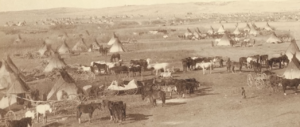
A photograph of a Lakota camp with tepees arranged across the landscape can therefore be beautiful while still carrying a difficult historical question. What did the people inside those structures experience as settlers, railroads, soldiers, hunters, and government officials increasingly entered their territories?
The answer cannot be found simply by looking at the tents.

The buffalo were central to Plains life, providing food, clothing, tools, and other resources. But the commercial slaughter of buffalo during the nineteenth century devastated the herds. A photograph showing enormous stacks of buffalo hides in Dodge City around 1878 is therefore more than an image of trade. It records an economic system that was helping transform the Plains themselves.
The photograph seems almost impossible in scale.
Tens of thousands of hides represented an enormous number of animals.
And behind those hides was a landscape changing permanently.
The destruction of buffalo herds was closely connected to the wider transformation of Indigenous societies. As the animals disappeared, a fundamental source of food and material culture was lost. Meanwhile, railroads carried settlers and commercial goods deeper into territories that had previously been much harder to reach.
The railroad photograph from Promontory, Utah, in 1869 captures the turning point.
On May 10, the Central Pacific and Union Pacific railroads met at Promontory Summit, completing the first transcontinental railroad. The National Park Service describes the event as one of the great technological achievements of nineteenth-century America, connecting the country by rail and dramatically reducing the time required to cross the continent.
The famous photograph by Andrew J. Russell shows workers and officials gathered around the ceremony. It is often remembered as a celebration of national unity.
But there was another story in the same frame.

The railroad had been built by thousands of workers from different backgrounds, including large numbers of Chinese laborers on the Central Pacific. The tracks also crossed lands occupied by Indigenous peoples whose lives were being transformed by the arrival of settlers and commercial transportation.
The railroad did not simply connect two coasts.
It accelerated the transformation of the West.
Mining towns provide another glimpse into that transformation.
Virginia City, Nevada, grew rapidly after the discovery of the Comstock Lode in 1859. The National Park Service describes the Comstock as the first major silver strike in the United States and one of the richest mineral discoveries in the country’s history. Between 1860 and 1880, enormous quantities of ore were extracted, and Virginia City became one of the most important urban centers in the American West.
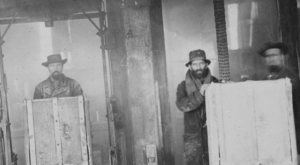
Photographs of miners emerging from shafts in Virginia City therefore represent more than hard labor.
They represent an entire economic revolution.
People arrived believing that fortune might be waiting beneath the ground. Some became wealthy. Many did not. Towns appeared rapidly, businesses followed, and railroads became essential for moving machinery, ore, food, and people.
The West was not simply being conquered.
It was being commercialized.

A miner’s cabin in Colorado looks almost painfully simple by modern standards. Yet such buildings represented a difficult reality. Men arrived with dreams of wealth but often lived in rough structures with limited supplies, harsh winters, uncertain employment, and dangerous working conditions.
Gold could make a town famous.
It could not guarantee that an individual miner would become rich.
That uncertainty helps explain the restless atmosphere visible in so many photographs.
The saloon became one of the defining spaces of this world. Images of poker players, card games, drinking establishments, and crowded bars show places where strangers met, information circulated, money changed hands, and entertainment filled the evening.
Poker and faro were not merely games.
They were part of the social economy of frontier towns.
A person could arrive as a miner and leave as a gambler. A traveler could meet a lawman. A cattleman could encounter a merchant. A criminal could disappear into the crowd.
Yet the famous saloon of Western movies was only one part of frontier society.
Women were there too.
Photographs of women in saloons, brothels, businesses, and traveling shows reveal a society that could be brutally unequal but was also more complicated than the male-centered mythology suggests.
Pearl Hart became famous after robbing a stagecoach in Arizona in 1899. Her story attracted enormous public attention partly because women were not expected to occupy the same outlaw roles as men. Her image therefore became part of a larger fascination with women who challenged conventional expectations.
Belle Starr similarly became known as the “Bandit Queen,” although the legend surrounding her grew considerably larger than the surviving historical record.
Calamity Jane became another famous name associated with the frontier. Her image riding in Buffalo Bill’s Wild West show demonstrates an important distinction: by the time many famous Western characters appeared in photographs, the frontier was already becoming entertainment.
The West was being remembered while it was still alive.
The same process affected cowboys.

Long cattle drives could last months and required men to move herds across enormous distances toward railheads and markets. Photographs of cowboys bathing in rivers after long journeys capture a simple reality that popular Western films rarely emphasize: frontier life involved exhaustion, routine, weather, animals, and long stretches of boredom.
The cowboy was not always riding into a gunfight.
Often he was simply working.
The photograph of a cowboy wearing leather chaps reflects this practical side of frontier clothing. Chaps protected riders’ legs from thorny vegetation, brush, weather, and rough terrain. They became part of the visual identity of the cowboy partly because they were useful.
Practical objects later became symbols.
The same transformation occurred with the cowboy hat, boots, saddle, rifle, and revolver.
Eventually, the costume became more famous than the people who originally wore it.

The Texas Rangers represented another side of the frontier. Photographs of Rangers from the nineteenth century show armed men associated with law enforcement in a region where formal institutions were still developing. Their history is complicated by the different roles they played at different times, including confrontations with criminals, armed groups, and Native peoples.
Law and violence often existed very close together.
That is also visible in photographs of armed men inside saloons. A scene sometimes described as the “bullet dance,” in which gunfire was used to frighten or force another person to jump, may have been staged or performed rather than a straightforward documentary record. Such images remind us that not every dramatic Old West photograph is evidence of an everyday event.
Some were performances.
Others were portraits designed to create an image.
Still others were later given stories that may not have been part of the original photograph.
This is especially important when looking at famous outlaws.

Jesse James was a real Confederate guerrilla and later outlaw whose gang robbed banks, trains, and other targets. His reputation became increasingly romanticized after his death, transforming a violent criminal career into a folk legend.
The same happened with figures such as “Black Jack” Ketchum and Bill Doolin.
Their photographs became objects of fascination because the American public wanted faces to attach to stories.
The photograph of George Parrott, for example, is connected with the grim afterlife of frontier outlaw mythology. Photographs, masks, and personal effects associated with criminals could become trophies, curiosities, or evidence.
The dead were turned into objects.
The living were turned into legends.
And the frontier itself became a stage.
Buffalo Bill understood that transformation better than almost anyone.
His show traveled internationally, including Europe. Smithsonian records show that Native performers traveled with the production and appeared before enormous audiences far beyond the American West.
This meant that people who had never seen the American frontier could purchase an experience of it.

They could watch horsemen.
They could watch sharpshooters.
They could see teepees.
They could watch staged battles.
And they could leave believing they understood the West.
But the real West was disappearing beneath the performance.
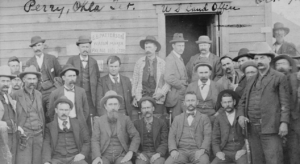
The Oklahoma Land Rush of April 22, 1889, captures that transition in another extraordinary way. Approximately 50,000 participants rushed into the newly opened Unassigned Lands to stake claims. The Library of Congress records that several towns appeared almost overnight as people raced to establish new settlements.

Imagine the landscape before the signal.
Then imagine thousands of people waiting.
Horses.
Wagons.
People on foot.
Land stretching toward the horizon.
And suddenly, movement.
The race was not merely an adventure. It was a massive process of settlement and dispossession whose consequences would continue long after the dramatic opening moment.
Photographs of land offices, marshals, surveyors, and new water towers therefore become part of the same story.
The frontier was becoming bureaucratic.
The gunfighter was being replaced by paperwork.
The stagecoach was giving way to the railroad.
The open range was becoming fenced property.
The saloon was competing with stores, banks, schools, churches, and government offices.
The Old West was becoming something else.
Yet the myth was only beginning.
Even people who had never experienced the frontier would soon know its characters.

Billy the Kid.
Wyatt Earp.
Annie Oakley.
Buffalo Bill.
Calamity Jane.
Geronimo.
Jesse James.
Their names moved from newspapers into dime novels, from dime novels into stage performances, and eventually into films and television.
Wyatt Earp’s reputation, for example, became inseparable from the gunfight at the O.K. Corral in Tombstone in 1881. Yet the event itself lasted only moments compared with the enormous cultural life it acquired afterward.
The photograph outlived the event.
The story outlived the photograph.
And the legend outlived the people.
Some images in this collection show something even more important: people who never became legends.
A father with children and hunting dogs in Arizona.
Workers leaving a mine.
A group of soldiers.
Women posing in a frontier town.
Children traveling through rural landscapes.
People sitting in saloons.
A railroad worker standing beside tracks.
These anonymous faces may tell us more about everyday Western life than the famous gunfighters do.

They remind us that the frontier was mostly populated by ordinary people trying to make a living.
There were farmers.
Shopkeepers.
Laborers.
Miners.
Railroad workers.
Teachers.
Performers.
Mothers.
Children.
Immigrants.
Freed African Americans.
Mexican Americans.
Chinese laborers.
Native communities.
And countless people whose names were never recorded.

Mary Fields is one example of a person who deserves to be remembered beyond the myths of the frontier. Born into slavery in Tennessee, she later moved west and became known in Montana for her work, independence, and remarkable toughness. She eventually became a mail carrier and was remembered locally as a formidable and determined figure.
Her life challenges the simplistic image of the West as a place belonging only to white male cowboys.
The frontier was diverse.
Its opportunities were unequal.
Its violence was real.
Its mythology was selective.
And its photographs preserve all four realities at once.
Kit Carson provides another complicated example. He became famous as a trapper, guide, scout, and military figure. His later reputation as a heroic frontier guide was reinforced by popular literature, while his involvement in campaigns against Native peoples—including the Navajo Long Walk—has made his legacy deeply contested.
The photograph cannot tell us whether someone was hero or villain.

Those judgments require historical evidence, context, and competing perspectives.
The same principle applies to Custer.
Photographs of George Armstrong Custer show the young officer during the Civil War and later during his career in the American West. His death at the Battle of the Little Bighorn in 1876 transformed him into one of the most recognizable figures of the frontier era.
But the mythology surrounding “Custer’s Last Stand” often simplified a much larger conflict.
Behind the famous battle were U.S. expansion, treaty disputes, Native resistance, military campaigns, and the struggle over land and sovereignty.
The photograph is only the beginning of the question.
Perhaps that is what makes the Old West so enduring.
It was never one thing.
It was a place of opportunity and dispossession.
Freedom and coercion.
Innovation and violence.
Hard work and exploitation.
Real people and manufactured legends.

The railroad brought economic growth while accelerating the loss of Native control over land. Mining created towns while leaving behind dangerous working conditions and environmental damage. Buffalo hunting generated wealth while destroying the ecological foundation of Plains societies. Wild West shows created careers for performers while simultaneously turning complex Indigenous cultures into simplified entertainment.
Every photograph seems to contain both sides.
That is why the image of workers celebrating the completion of the transcontinental railroad deserves a second look. The ceremony at Promontory Summit on May 10, 1869, was a genuine technological achievement. The National Park Service records that roughly 1,000 people attended the celebration, including railroad workers, officials, soldiers, members of the public, and a Chinese contingent from the Central Pacific.
The famous photograph captures triumph.
But history asks us to look beyond the celebration.
Who built the railroad?
Who benefited?
Whose land did it cross?
What changed afterward?
The answers make the photograph richer rather than less meaningful.
The Old West did not disappear on a single day.
It was gradually replaced.
Rails crossed the plains.
Telegraph wires followed.
Settlements expanded.
Territories became states.
Businesses became institutions.
And the people who had lived through the frontier became characters in a story told by later generations.

Some photographs were taken deliberately to preserve that story.
Others were simply family portraits.
Some were advertisements.
Some were theatrical.
Some were evidence.
And some have captions that have changed so many times that separating fact from legend is now difficult.
That uncertainty should not make the photographs less fascinating.
It should make us look harder.
A photograph of a masked outlaw may be authentic, but the story attached to it may not be. A staged Wild West scene may not document a real frontier event, yet it tells us something important about how Americans wanted the frontier to be remembered. A portrait of a Native performer in traditional clothing may have been created for a show, but the person inside the costume was still a human being living through a complicated historical reality.
The camera captured the image.
Society supplied the meaning.
And later generations supplied the legend.
My personal reflection is that the most fascinating thing about the Old West is not whether every famous story is true. It is the gap between the historical West and the imagined West. The real frontier was harder, more diverse, more complicated, and often more painful than the version created by movies and popular stories.

These photographs allow us to see that difference.
Behind the gunfighters were families.
Behind the saloons were workers.
Behind the railroads were thousands of laborers.
Behind the Native stereotypes were distinct nations and communities.
Behind the legends were real human beings whose lives could not be reduced to a single photograph.
And perhaps the greatest mystery is not what the Old West looked like.
It is how much of what we think we know about it was created afterward.
Which photograph in this collection do you think reveals the biggest gap between the legendary Old West and the real one?
Some content was generated using AI tools (including ChatGPT) and edited by the author for creativity, storytelling, and historical illustration purposes. Historical facts and key details should be verified against
reliable historical sources. Any AI-generated or reconstructed visuals are intended for illustrative purposes and should not be interpreted as original historical photographs or archival evidence.