100+ SHOCKING Vintage Photos Banned from History Books | Rare Historical Photos .NH

In the middle of the twentieth century, a Marine advanced across Iwo Jima beneath covering fire, while thousands of miles away people continued living ordinary lives that seemed untouched by the war. Elsewhere, soldiers wrote letters home, civilians endured occupation, and children wore gas masks designed for a nightmare they could barely understand. These photographs do not tell one story. Together, they reveal something harder to see: how war, politics, technology and everyday life collided—and what remained after the cameras stopped recording.

The photograph of Marilyn Monroe singing for President John F. Kennedy at Madison Square Garden in May 1962 is usually remembered for its glamour. Yet behind the dazzling performance was a very particular Cold War America, where celebrity and political power could occupy the same stage. The image became famous precisely because it seemed to capture two worlds that were never supposed to overlap so completely. Hollywood belonged to entertainment. The presidency belonged to politics. But in that moment, the boundary nearly disappeared. What happened afterward became part of the mythology surrounding both figures, although the photograph itself cannot reveal everything that happened beyond the spotlight.
Another photograph takes us somewhere far less glamorous: Brooklyn, 1928. Maria Yale stood beside the memory of her husband, Frankie Yale, a prominent figure in organized crime who had been murdered that year. Prohibition had created an environment in which illicit alcohol trafficking generated enormous profits and violent competition. Behind the headlines about gangsters were families forced to live with consequences they had never chosen. The funeral photograph therefore tells a quieter story than the newspapers did. It is not really about the legend of a gangster. It is about what violence leaves behind.
Then comes an image almost impossible to believe without seeing it.
A gigantic horse stands before the camera in 1928, presented as an extraordinary example of equine size. Photographs like this belonged to an age fascinated by unusual bodies, enormous machines and spectacles that could attract crowds. The image feels almost unreal today, but that was part of its appeal. People wanted to see something that challenged their understanding of what nature could produce. Yet even here, caution matters: historical claims about the “largest ever” depend heavily on how height, weight and individual animals were measured.
The First World War offers a much darker transition.

Annamese colonial troops disembarked at Camp San Rafael during a conflict that drew men from across the French colonial empire. Nearly 100,000 Indochinese were involved in the French war effort, with many serving as laborers rather than frontline combat troops. Others did fight. Their presence complicates the familiar European image of the First World War. The trenches were not populated only by Europeans. Colonial subjects were drawn into an imperial war whose consequences would later influence how they understood citizenship, sacrifice and colonial rule.
And yet, alongside these enormous historical forces, photographs repeatedly return to ordinary inventions.
In 1921, an American baby stroller was fitted with a radio, antenna and loudspeaker. It looks almost comical now, but the idea reveals something important about the era: people were already fascinated by the possibility of surrounding everyday life with new technology. The same impulse would eventually produce radios in cars, televisions in homes and computers in pockets. What looks strange today may once have seemed wonderfully modern.
Technology could also be terrifying.

Before radar became practical, enormous acoustic mirrors and listening devices were constructed to detect approaching aircraft by amplifying the distant sound of engines. Their curved concrete surfaces look primitive beside modern electronic systems, but the principle was remarkably direct: listen before you can see. During the interwar years, nations were searching desperately for ways to detect aircraft earlier, because the arrival of the bomber threatened to transform warfare. These strange structures were evidence of a technological race whose consequences were only beginning to emerge.
On Iwo Jima, that race had already become brutally real.
In March 1945, wrecked American vehicles lay scattered across the island’s dark volcanic terrain. The photographs of destroyed equipment communicate something statistics cannot: the battlefield was not an abstract map. It was a physical landscape of broken machines, difficult ground and exhausted men.
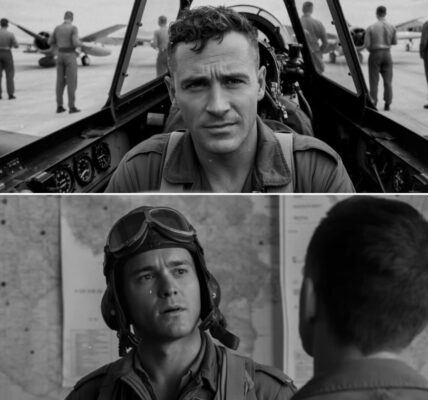
In February, Marine flamethrower operators had advanced toward Japanese defensive positions, sometimes under covering rifle fire. The supplied captions identify one operator near Airfield No. 2 and describe an attack against a Japanese pillbox. Such scenes should not be romanticized. Iwo Jima was one of the Pacific War’s fiercest battles, and the photographs preserve only fragments of a much larger struggle.
The island became a symbol because of what happened there, but the photographs also remind us of what the symbol can hide.
Behind every military objective were individuals.

Some were attacking.
Some were defending.
Some were simply trying to survive another day.
That human scale becomes even clearer in photographs of soldiers resting. During the First World War, men exhausted by trench conditions could be photographed sitting quietly in mud between periods of fighting. There was no grand gesture. No dramatic charge. Just fatigue.
The same quiet appears in the photograph of French soldiers wounded during the First World War, gathered at a banquet in Paris in 1925. Years after the fighting ended, their faces remained marked by what they had experienced. The war was over, but its consequences had not disappeared. This is one of the recurring truths of historical photography: the official end of a conflict rarely means the end of its effects on human beings.
On the Western Front, even animals became part of survival.

A French soldier holds a Jack Russell terrier reportedly used for rat hunting in a trench. The image is almost unexpectedly warm. Amid mud, danger and exhaustion, a small dog creates a moment that feels strangely familiar. The photograph does not erase the war. It shows how people could preserve fragments of ordinary life inside it.
Elsewhere, the war depended on animals in a different way. On India’s Northwest Frontier in 1917, camels transported wounded soldiers through difficult terrain. Such photographs reveal the logistical reality behind military operations. Before helicopters and modern evacuation systems, survival could depend upon roads, pack animals and human endurance.
Thousands of miles away, Australian troops trained in Egypt before being committed to campaigns including Gallipoli. Their photographs show soldiers preparing for a war whose geography was already stretching far beyond Europe.
The First World War was becoming global.
So was the system that supported it.

More than half a million Indian troops served with Commonwealth forces during the Mesopotamian campaign. Their contribution is sometimes overshadowed in popular narratives dominated by the Western Front. Yet the Middle Eastern theater involved enormous numbers of troops, complicated logistics and devastating conditions. The photograph becomes important precisely because it challenges the idea that the war can be understood from Europe alone.
Then the twentieth century moved toward another catastrophe.
On June 5, 1940, German soldiers stood beneath the Eiffel Tower after the occupation of Paris. The image became one of the defining visual symbols of France’s defeat. The tower remained exactly where it had always been, but the people standing beneath it represented a transformed political reality.
The photograph is powerful because the monument itself seems indifferent.
Steel remained.
Paris remained.
But sovereignty had changed.
Five years later, everything would look different.

In October 1944, British soldiers Sergeant R. Gregory and Driver A. Hardman visited the Acropolis during the liberation of Athens. The contrast is extraordinary: modern soldiers walking among ruins created thousands of years earlier. The war was temporary. The stones had survived empires, invasions and political revolutions.
The photograph therefore places human conflict against a much longer timeline.
Nations rise.
Nations fall.
The ruins remain.
In May 1945, Prague was emerging from German occupation amid violence, upheaval and revenge. Photographs of ethnic Germans being forced to repair damaged streets are uncomfortable precisely because they show the complicated aftermath of liberation. Ending Nazi occupation did not instantly produce peace or reconciliation. Across Europe, civilians and prisoners faced displacement, retaliation and uncertain futures.
The same year, the Nuremberg trials placed senior Nazi leaders such as Hermann Göring, Rudolf Hess, Joachim von Ribbentrop and Wilhelm Keitel before an international tribunal. The proceedings became a landmark in the development of international criminal law and the principle that political and military leaders could be held personally accountable for certain crimes. But the photograph of defendants in the dock cannot convey the full scale of the evidence presented against them, nor the enormous debate surrounding justice after mass atrocity.
That is why Nuremberg matters beyond the courtroom.
It represented an attempt to turn the end of war into a process of legal judgment.
Yet another image from 1945 offers a completely different mood.
Soviet soldiers watched acrobats performing on a tank near Berlin.
The scene is almost surreal.

The war had devastated Europe, yet people were still capable of laughter, entertainment and curiosity. Such moments are not evidence that the suffering had disappeared. They are evidence that human beings continued to search for normality even when normality seemed impossible.
Earlier, in February 1945, American sailors aboard USS Hansford conducted a burial at sea for Marines killed at Iwo Jima. There was no spectacle. The Pacific stretched beyond the ceremony. The sea absorbed the remains of men whose families would eventually receive news of their deaths.
This is another reason photographs matter.
They preserve ceremonies that history books often reduce to a sentence.
The burial at sea was not the war.
But for those present, it was their immediate reality.
A few months later, the world was approaching the end.
The photographs of aircraft and ships surrounding the surrender of Japan on September 2, 1945 show the machinery of war at the moment it was finally being brought to a close. The ceremony aboard USS Missouri formally ended Japan’s participation in the Second World War. After years of fighting, the conflict entered history as something finished.
But photographs taken after the fighting ended tell us that history does not simply stop.
The scars remained.
In Welsen, the damage left by fighting in April 1945 eventually gave way to reconstruction. Streets that had been shattered were rebuilt. Towns that had been battlefields became places where people once again lived ordinary lives.
Rebuilding may be one of the least photographed aspects of war.
Destruction produces dramatic images.
Reconstruction happens slowly.
It requires years.
Sometimes generations.
And while nations rebuilt, other forms of history continued unfolding.
In 1943, British sailor Poon Lim was discovered after surviving 133 days adrift at sea on a raft. His survival became one of the remarkable endurance stories of the war era. Yet the photograph of a survivor cannot fully convey the isolation of being alone on an ocean for months. The number—133 days—is almost impossible to imagine until one considers what each individual day would have required.
War produced heroes.
But survival did not always look heroic.
Sometimes it looked like endurance.
Sometimes it looked like waiting.
Sometimes it looked like simply refusing to give up.
That same determination appears in less dramatic photographs from civilian life.

A father in Louisiana posed with his wife and thirteen children in 1938. The Great Depression had created enormous hardship, but the photograph preserves something beyond poverty: a family presenting itself together before the camera. Their circumstances were difficult, yet the image does not reduce them to hardship.
Likewise, photographs of women working, families gathering and children sleeping reveal a society continually adapting to economic and political change.
Even fashion carried historical meaning.
Around 1900, women posed in elaborate clothing and hats. Their carefully constructed appearance reflected changing expectations about women’s visibility in public life. Clothing could communicate social class, respectability and identity. The photograph may look decorative, but it is also evidence of social transformation.
A very different transformation occurred in Germany during the 1920s.
Hyperinflation destroyed the value of the currency. Banknotes that had once represented economic security became almost worthless. Photographs and contemporary accounts of people handling enormous quantities of currency illustrate how quickly monetary collapse could alter everyday life.
Money normally represents confidence.
When confidence disappears, paper remains—but value does not.
The lesson would become relevant again decades later in different forms, as governments around the world learned how closely economic stability is connected to political stability.
Other photographs reveal how societies confronted danger in more practical ways.

The 1924 Paris pedestrian-catching automobile was an attempt to address the growing problem of road accidents. The machine was unusual, but the underlying question was serious: when technology changes faster than regulation, how does society protect the people caught in between?
That question would become increasingly important as cars filled city streets.
It was also visible in aviation.
Before takeoff, B-25 bomber crews inspected their aircraft, preparing for missions during the Second World War. Every mechanical component mattered. The aircraft had to function because the consequences of failure were enormous.
In the Pacific, American aircraft became part of a campaign shaped by Pearl Harbor and the subsequent expansion of the war. Photographs of these bombers are often interpreted as symbols of American determination. But they can also be viewed more simply: machines maintained by crews, carrying people into an uncertain sky.
On December 7, 1941, the forward superstructure of USS Arizona burned at Pearl Harbor. The attack brought the United States directly into the Second World War. The image remains one of the most recognizable visual records of that day.
Yet even here, the photograph cannot tell the whole story.
It cannot show every family receiving the news.
It cannot show every sailor who never returned.
It cannot show the political decisions that followed.
A camera captures smoke.
History must reconstruct everything around it.

That principle becomes especially important when looking at photographs from the Cold War.
On January 18, 1951, U.S. Far East Air Forces aircraft conducted a bombing operation against a target in North Korea. Such images belong to a conflict that was already revealing how the post-1945 world had changed. The Second World War had ended, but military confrontation had not disappeared. Instead, power was reorganized around new ideological and geopolitical divisions.
The world had entered another dangerous era.
Meanwhile, civilians tried to build ordinary lives.
In 1953 Ireland, a father shared a drink with his son. In post-war America, a Huffy bicycle could even be equipped with a radio. In the 1950s, children rested during structured kindergarten nap periods. These photographs are almost deliberately unremarkable.
And that is their strength.
They show what people were trying to recover.
Normal life.
Routine.
Leisure.
Family.
The ability to grow older without war defining every moment.
Then there are images of individuals who would later become cultural symbols.

In 1966, Julie Newmar posed as Catwoman for the television series Batman. Her portrayal became one of the memorable interpretations of the character, demonstrating how popular culture itself becomes part of historical memory.
In 1967, a young Sigourney Weaver wrote a provocative line in her school yearbook expressing a desire not to be ordinary. The quotation later acquired a different significance because of the career she eventually built. Yet hindsight can be misleading. At the time, she was simply a young person writing in a yearbook.
That is another hidden danger of historical photographs.
We know what happened next.
They did not.
Ernest Hemingway’s 1923 passport photograph presents a young writer before he became one of the defining literary figures associated with the Lost Generation. Again, the image is powerful because the future is invisible.
The same can be said of Princess Grace of Monaco visiting President Kennedy at the White House in 1961. The photograph captures glamour, diplomacy and celebrity in one frame. But it also belongs to a world that would soon be shaken by events neither figure could control.
History constantly turns ordinary photographs into symbols after the fact.
The people themselves rarely know they are standing at the beginning of a legend.
That may be the deepest reason these old images remain fascinating.
They show the past before it became history.
A Nazi rally before the regime’s eventual collapse.

A soldier before the battle ends.
A family before anyone knows how their lives will unfold.
A young writer before fame.
A new machine before society understands its consequences.
A city before destruction.
A ruined city before reconstruction.
A child before adulthood.
A photograph is therefore never merely an image.
It is a boundary between what was known and what had not yet happened.
And perhaps the most important lesson hidden in these forgotten frames is that history is not made only by famous leaders or decisive battles. It is also made by workers, soldiers, parents, children, inventors, prisoners, migrants, nurses, engineers, entertainers and countless people whose names were never preserved.
Their lives intersected with events far larger than themselves.
Some survived.
Some did not.
Some became symbols.
Many disappeared from memory.

But the camera occasionally kept one second.
A soldier with a dog.
A father with his children.
A sailor at a burial.
A worker beside a machine.
A crowd beneath a banner.
A Marine advancing across volcanic ground.
A survivor returning from the ocean.
A young person dreaming about the future.
Those seconds are why these photographs still matter.
They do not give us the whole truth.
They give us an opening through which to search for it.

My personal view is that the most valuable historical photographs are not necessarily the most shocking ones. They are the photographs that force us to ask what existed outside the frame. Who was standing nearby? What happened before the shutter clicked? What happened afterward? And how did the people pictured understand their own moment before later generations gave it a meaning they could never have known?
Looking at these images, I am reminded that history is ultimately about people living through uncertainty. The past was not inevitable to those who experienced it. They made choices without knowing their consequences, endured events they could not control, and sometimes simply tried to protect the small pieces of ordinary life that remained.
And that leaves one question worth carrying beyond the final photograph:
Which of these forgotten moments changes the way you see the history of the twentieth century—and what do you think we still fail to see beyond the frame?
Some content was generated using AI tools (including ChatGPT) and edited by the author for creativity, storytelling, and historical illustration purposes. Historical facts and key details should be verified against reliable historical sources. Any AI-generated or reconstructed visuals are intended for illustrative purposes and should not be interpreted as original historical photographs or archival evidence.