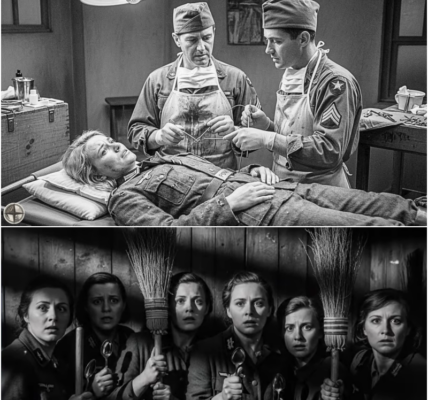
▶ These classic images have terrified the world! Rare historical photographs – Mysterious artifacts .P2

There are photographs that show history as we expect it to look.
Soldiers in uniform. Crowds in the streets. Famous leaders. Aircraft. Battles. Monuments.
And then there are photographs that seem almost too ordinary to matter.
Football supporters lifting a young boy above their heads so he can see the match. A family gathered around a television. A child dressed as a policeman. A woman having her hair arranged before a beauty contest. Workers standing on steel high above a growing city.
At first, these images appear disconnected.
But look a little longer and something begins to emerge.
They show how people actually lived between the great events recorded in history books.
On March 1, 1930, a crowd of football supporters in West Ham, London, created one of those unexpectedly human moments. A young boy was passed above the heads of the spectators so he could see the game.
There is no famous speech in the photograph.
No political leader.
No historic building.
Just strangers helping a child see over the crowd.
That small gesture may be more revealing than it first appears.
Football was already deeply embedded in British working-class culture. A match could bring thousands of people together, and inside those crowds there were rules of behavior that did not need to be written down.
If a child could not see, people made room.
The photograph captures that instinct.

History is often remembered through institutions.
But much of everyday life was shaped by small acts between strangers.
The same feeling appears in photographs of celebrations.
In Brooklyn in 1935, a watermelon-eating competition was held as part of a Fourth of July celebration. The scene looks almost comic today.
But these competitions belonged to a much larger tradition of public entertainment.
Before television became dominant, communities created spectacles themselves.
Parades.
Contests.
Sports.
Dances.
Outdoor performances.
People gathered because there was nowhere else they would rather be.
And sometimes the strangest event became the most memorable.
Elsewhere, another photograph captures a very different form of spectacle.
On September 3, 1935, British racing driver Malcolm Campbell set a new land-speed record at Bonneville Salt Flats in his Blue Bird. His measured speed was approximately 301.13 mph, or 484.6 km/h.
For Campbell, this was not simply another fast drive.
It represented the culmination of years of attempts to push the automobile beyond what seemed possible.
The machine looked less like an ordinary car and more like an aircraft without wings.
The landscape was almost empty.
The road was straight.
The objective was brutally simple.
Go faster.
The photograph freezes the moment before the numbers become history.
But behind that image was an era fascinated by speed.
Cars were becoming faster.
Aircraft were crossing oceans.
Trains were shrinking distances.
Radio was connecting homes.
Cinema was becoming mass entertainment.

Modern life seemed to be accelerating.
And people wanted to see just how far that acceleration could go.
Even the cinema was beginning to escape the traditional theater.
Photographs from the 1920s show passengers watching films aboard aircraft.
Today, an in-flight entertainment system is completely ordinary.
A century ago, the idea itself seemed futuristic.
A darkened cabin.
Passengers seated close together.
A screen showing moving images while the aircraft traveled above the ground.
The novelty was not merely watching a film.
It was the realization that entertainment no longer had to remain in one place.
The machine carrying you could also become the theater.
That idea would eventually lead to television, portable music, laptops, smartphones, and streaming services.
But none of those developments were inevitable when the first experiments were being made.
The future always looks obvious after it arrives.
It rarely looks obvious beforehand.
Another photograph from the 1920s shows Miss America having her hair styled.
It is easy to laugh at old hairstyles.
The curls.
The elaborate arrangements.
The amount of time apparently required to prepare for a photograph.
But beauty standards are historical evidence too.
People have always used clothing, hairstyles, cosmetics, posture, and photography to communicate something about themselves.
The difference is that every generation eventually becomes strange to the next.

A hairstyle that once represented elegance becomes a curiosity.
A swimsuit becomes conservative.
A suit becomes old-fashioned.
A car becomes an antique.
A telephone becomes a museum object.
The photograph remains.
That is why old pictures can feel almost like messages from another civilization.
The people inside them were not trying to look historical.
They were simply dressing normally.
And that is exactly what makes the images valuable.
One of the photographs in this collection shows Bruce Lee apparently performing a one-handed push-up using two fingers.
The image has circulated widely, sometimes with uncertain dates and descriptions. Regardless of the precise caption, photographs of Lee reveal something important about the way physical culture changed during the twentieth century.
Strength was increasingly presented not merely as size.
It could also mean speed.
Control.
Balance.
Technique.
Discipline.
The same fascination appears in photographs of athletes from earlier generations.
There were competitions for unusual physical feats, endurance contests, unusual sports, and public demonstrations.
People wanted to know what the human body could do.
Sometimes the answer was impressive.
Sometimes it was simply strange.
And occasionally, the photograph preserves an experiment that would be difficult to repeat today.
A five-wheeled delivery vehicle.
A vending machine selling light bulbs.
A device for holding a doughnut while dipping it into coffee.
An unusual automobile.
An early aircraft.
A rocket scooter.
A strange safety device.
Each invention reflects the same basic human instinct:
There must be a better way to do this.
The inventor of the shopping cart faced exactly that problem.
Sylvan Goldman introduced the modern shopping cart in 1937 after developing a design that allowed customers to carry more groceries more easily. His invention was initially met with resistance from shoppers, and Goldman reportedly used demonstrations and paid “helpers” to show customers how to use the carts.
Today, nobody thinks twice about pushing one through a supermarket.
But that is the strange thing about successful inventions.
Once they become normal, we forget that someone had to imagine them first.
The same is true of the airplane.
The television.

The moving picture.
The telephone.
Even the modern supermarket.
The photographs in these collections repeatedly show things during that brief stage when they still looked unusual.
That is perhaps why they are so fascinating.
They allow us to see the future before it became ordinary.
But some photographs reveal something much heavier.
In 1953, people in Nevada watched nuclear weapons testing from a distance.
The mushroom cloud became one of the defining visual symbols of the atomic age.
At first, nuclear testing was often presented through the language of science, military preparedness, and national security.
But photographs of ordinary observers standing beneath enormous clouds tell another story.
The atomic age had entered everyday life.
People could look toward the horizon and see a weapon capable of changing civilization.
The mushroom cloud was beautiful from a distance.
That was part of its disturbing power.
A photograph could make destruction look almost abstract.
But the reality behind the image was not abstract.
Nuclear weapons had changed the scale of war.
The same century that produced spectacular advances in transportation and communication had also created unprecedented destructive power.
And people had to learn how to live with both.
That contradiction appears again in photographs of the Second World War.
A British soldier pulls a child from rubble.
A Russian soldier sleeps beside a puppy in Prague.

American and Soviet soldiers embrace after meeting near the Elbe in 1945.
Aircraft fill factories.
Workers stand beneath enormous bomber assemblies.
Children shelter during air raids.
Life continues in the middle of catastrophe.
One photograph described as showing a young girl being rescued from the rubble of her home in London during an air raid captures that reality with painful simplicity.
The image is not only about bombing.
It is about the person who stopped to help.
War creates statistics.
Photographs restore individuals to those statistics.
One child.
One soldier.
One family.
One street.
One home.
That is why wartime photographs can remain powerful decades later.
They give a face to events that otherwise become numbers.
The same thing happened during the civil rights struggle in the United States.
On March 7, 1965, John Lewis and other voting-rights marchers crossed the Edmund Pettus Bridge in Selma, Alabama. State and local law enforcement confronted the marchers and attacked them. Lewis was among those injured. Television and newspaper cameras captured the event, which became known as Bloody Sunday.
One photograph shows Lewis with his hands near his head during the confrontation.
There is something important about photographs like this.
They remove distance.
A textbook can say that protesters were attacked.
A photograph shows a human being standing there when it happened.
The image does not need to explain every political argument surrounding the movement.
It shows the physical reality of the moment.
The event quickly became national news, and the images helped bring widespread attention to the confrontation. The Selma campaign continued, and the march from Selma to Montgomery later grew to tens of thousands of participants before the Voting Rights Act was signed in August 1965.
Two years earlier, another photograph from the civil rights era would have been difficult to imagine.
Nine African American teenagers entering Little Rock Central High School under the protection of federal troops.
On September 25, 1957, the Little Rock Nine entered the school for their first full day of classes with soldiers from the 101st Airborne Division escorting them. President Dwight Eisenhower had federalized the Arkansas National Guard and sent federal troops after resistance and mob violence surrounding the attempt to integrate the school.
The photograph is powerful because the students look young.

They were young.
They were teenagers walking into school.
Yet the political conflict surrounding them had become a national crisis.
Behind the students stood soldiers.
Behind the soldiers stood the federal government.
Behind the confrontation stood a much larger struggle over segregation and constitutional rights.
The image makes the scale of the conflict visible.
Nine students.
Hundreds of soldiers.
Thousands of spectators.
One school.
The camera captures the imbalance.
But it also captures something else.
The students are walking forward.
That is the detail that remains.
Photography often works this way.
A complicated event becomes one physical movement.
Forward.
Backward.
Toward.
Away.
A door opening.
A bridge being crossed.
A wall coming down.
A soldier reaching into rubble.
A family looking at a television.
A worker standing on a beam.
A child being lifted above a crowd.
The past becomes movement.
One of the oldest photographs in the collection offers a very different kind of story.
Marie and Pierre Curie were photographed around the time of their marriage in 1895. The Musée Curie identifies the photograph specifically as an image of Pierre and Marie Curie at their wedding, dated 1895.
Looking at it today, it is easy to focus on what they would eventually become.
Two Nobel Prize-winning scientists.
Names attached to radioactivity.
Figures in the history of modern physics and chemistry.
But the photograph was taken before most of that future had happened.
They were young.
They were newly married.
Their greatest discoveries were still ahead.
That is another reason photographs of famous people are so fascinating.
We see them after history has already assigned them importance.
The camera saw them before that happened.
The same is true of photographs of Albert Einstein, John F. Kennedy, Charlie Chaplin, Muhammad Ali, the Beatles, Jack Dempsey, Harry Houdini, and countless others.
Fame changes how we look at an ordinary photograph.
A photograph of an unknown person asks:
Who was this?
A photograph of a famous person asks:
How did this person become famous?
But both questions begin with the same uncertainty.
The photograph alone cannot tell us everything.
Sometimes it cannot even tell us the person’s name.
And that is where historical research becomes essential.
Consider Fanny Cochrane Smith.
A photograph of her singing in 1903 might look like an ordinary portrait of an elderly woman performing for a camera.
It is much more significant than that.
Smith made sound recordings in 1899 and 1903 on wax cylinders. The recordings are held by the Tasmanian Museum and Art Gallery and are described by the Australian Dictionary of Biography as the only surviving sound record of original Palawa Tasmanian song and speech.
Suddenly, the photograph is connected to something extraordinary.
Not merely an image.
A voice.
A culture.
A language.
A memory.
The camera preserved her appearance.
The recording preserved something of her sound.
Together, they form a rare connection to a world that had already been profoundly transformed by colonization.
That is the deeper meaning of historical archives.
They do not simply preserve famous people.
They preserve traces of lives that might otherwise disappear.
The same feeling comes from photographs of the Tasmanian tiger.
The thylacine was declared extinct internationally in 1986, but the last known captive animal died at Hobart Zoo on September 7, 1936. The species had already become rare, and hunting, habitat destruction, and other pressures contributed to its decline.
Photographs of the animal therefore have a strange quality.
The creature is alive inside the frame.
It moves.
It looks toward the camera.
It occupies physical space.
But we know that its kind would soon disappear.
The photograph becomes a boundary between two worlds.
Before.
After.
A living animal.
Then a memory.
This is one of the reasons the phrase “last photograph” carries such emotional weight.
We know something that the people inside the photograph did not.
The end is coming.
They cannot see it.
The animal cannot see it.
The photographer cannot see the future.
Only we can.
That same feeling appears in photographs taken before major political changes.
A Berlin street before the Wall.
A city before a war.
A family before a disaster.
A factory before its industry disappears.
A neighborhood before redevelopment.
A famous person before fame.
A species before extinction.
The photograph creates an accidental farewell.
The people did not know they were saying goodbye.
That may be the most haunting quality of old photographs.
They are filled with endings that nobody could recognize at the time.
Even photographs of ordinary entertainment can carry this feeling.
A cyclist racing around Wembley Stadium in 1936.
A child watching a puppet or cartoon.
A family gathered around television.
People attending a public swimming pool.
Workers constructing aircraft.
Passengers watching a film aboard a plane.
A woman sitting in Times Square with her cat.
A policeman guiding traffic.

Children crossing a village road.
These scenes were not created for historians.
They were created by life itself.
That is why they are so valuable.
They show what people considered normal before normal changed.
One image shows a zebra-drawn carriage moving through London.
Another shows a railway signalman at work.
Another shows workers assembling aircraft.
Another shows a steelworker high above a city.
Another shows a public toilet in nineteenth-century Paris.
These photographs are almost like pieces of a gigantic puzzle.
No single picture explains the past.
But thousands of pictures begin to reveal its shape.
They show how cities were built.
How people traveled.
How they worked.
How they ate.
How they dressed.
How they entertained themselves.
How they reacted to disasters.
How they protested.
How they celebrated.
How they mourned.
And how quickly the world could change.
There is a photograph of soldiers embracing on the Elbe in 1945.
For millions of people, the Second World War was still far from over when that photograph was taken.
But the meeting between American and Soviet forces represented a dramatic moment in the defeat of Nazi Germany.
Two armies that had fought the same enemy from different directions suddenly met.
The photograph makes the alliance visible.
It also reminds us how temporary wartime alliances can be.
Within a few years, the political relationship between the United States and Soviet Union would become increasingly hostile.
The photograph therefore sits at the edge of another historical transformation.
The war was ending.
The Cold War was beginning.
Again, the people inside the frame could not know exactly what would come next.
History is full of such moments.
A photograph catches the present.
The future remains invisible.
That is why we should be careful with captions.
Some descriptions attached to viral historical photographs are accurate.
Others contain wrong dates, incorrect names, exaggerated stories, or details borrowed from completely different images.
A photograph can be authentic while its caption is false.
That distinction is especially important online, where an interesting story can spread much faster than its correction.
The solution is not to distrust every old photograph.
It is to ask better questions.
Who took it?
When?
Where?
Who is actually visible?
What archive holds the original?
What did the photographer record?
What did later people claim happened?
And what can actually be demonstrated?
The truth is usually less theatrical than the internet caption.
But it is often more interesting.
A young child really was escorted into Little Rock Central High School by federal troops.
John Lewis really was attacked on the Edmund Pettus Bridge.
Fanny Cochrane Smith really did leave recordings of Palawa song and speech.
Marie and Pierre Curie really were photographed together in 1895.
The last captive thylacine really did die in 1936.
These facts do not need fictional dialogue.
They do not need invented mysteries.
They already contain enough meaning.
And perhaps that is what these photographs ultimately teach us.
The past was not a collection of black-and-white pictures.
It was a living world.
People woke up.
They went to work.

They went to football matches.
They fell in love.
They married.
They invented things.
They built factories.
They watched movies.
They raised children.
They protested.
They went to war.
They survived disasters.
They lost homes.
They celebrated victories.
They watched new technology arrive.
They watched old technology disappear.
And sometimes, without knowing it, they stood in front of a camera at the exact moment before everything changed.
We look at them now with the advantage of hindsight.
We know what came next.
They did not.
That difference is what makes historical photography so powerful.
A photograph does not simply show us the past.
It shows us a present that once felt like the future.
And perhaps the strangest realization comes at the very end.
The people in these photographs thought they were living ordinary lives.
The football fans did not know they were preserving a moment of social history.
The workers did not know their factory would one day become an archive.
The children did not know their school would become famous.
The family watching television did not know someone would eventually study their living room as evidence of technological change.
Marie and Pierre Curie did not know how much their names would matter.
Fanny Cochrane Smith could not know that her recorded voice would become an irreplaceable cultural record.
The people watching a nuclear test could not know how differently future generations would see those clouds.
The young people crossing a bridge could not know that photographs of their struggle would become part of the nation’s memory.
And the photographer standing behind the camera could not know which fraction of a second would survive for a hundred years.
That is the quiet mystery hidden inside almost every historical photograph.
Not what happened before the shutter.
Not only what happened afterward.
But the fact that, for one brief moment, nobody knew what was coming.
Some content was generated using AI tools (including ChatGPT) and edited by the author for creativity, storytelling, and historical illustration purposes. Historical facts and key details should be verified against reliable historical sources. Any AI-generated or reconstructed visuals are intended for illustrative purposes and should not be interpreted as original historical photographs or archival evidence.