
Welcome to the Mystery and History Channel. Be sure to subscribe and like so you don’t miss out on more videos like this one. A motorcycle polo match excites the crowd in California in 1919, showing the search for new forms of extreme entertainment after the war.
The sport adapted traditional horse polo to a more mechanized society, using the agility of machines for daring moves on the field. Emotional goodbyes mark the departure of soldiers at a railroad station during the period of World War II. Women lean in to hug and kiss the fighters through the train windows, showing the emotional impact of major conflicts and the uncertainty that shaped daily life for millions.
Members of the St. Louis Red Cross Motor Corps appear wearing protective masks during the 1918 outbreak. The group played a vital role in transporting sick people and medical supplies, showing the coordinated effort of public health teams to contain the spread of the health crisis.
Chaplain Luis Padilla gives aid to a fighter in need during the El Portenazo uprising in Venezuela around 1962. The scene captured in Puerto Cabello reveals the clergyman’s courage in the middle of conflict, becoming a humanitarian symbol recognized internationally for the strength of spiritual support. Service member Hector Morgan is welcomed home with celebration by his family in the United Kingdom around 1945.
After the end of operations in Europe, the domestic celebration with British flags symbolized relief and the rebuilding of civilian life for thousands of veterans. The ruins of the OK Corral reveal the heavy damage caused by a fire in Tombstone in 1882. The site, famous for the historic gunfight that took place months earlier, appears reduced to twisted structures.
The image documents the hardships faced by settlements in Arizona during the Old West. Federal agents dump bottles of alcohol into a street drain during the strict prohibition era in the United States in 1929. The action reflects the policies of prohibition that marked the 1920s.
This historical record illustrates the effort by authorities to enforce the law. Painters balance on the iron beams of the Eiffel Tower in 1932 while carrying out maintenance on the structure without modern safety equipment. The dizzying height reveals the city of Paris in the background, highlighting the courage required to preserve one of the greatest icons of world engineering.
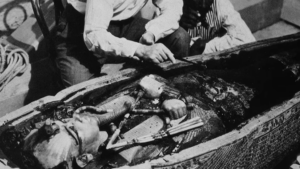
A military shelter built into the rock of Monte Cristallo in Italy shows survival engineering during World War I. Built at more than 6,562 ft of elevation, the installation served as a strategic point in the Alps, protecting soldiers from harsh weather and enemy attacks. British archaeologist Howard Carter carries out a close examination of a preserved remain from Pharaoh Tutankhamun around 1922.
The discovery of the intact site in the Valley of the Kings revealed unprecedented archaeological treasures, offering a detailed view of burial rites and the grandeur of Egypt’s 18th Dynasty. During the political conflicts in Bavaria in 1919, a communist militant faces a firing squad in Munich with calmness. The event took place after the fall of the Bavarian Soviet Republic, marking a harsh reaction against left-wing groups by German government forces.
A rare photograph from 1848 captures the tense scene in Paris, where a cobblestone barricades blocked narrow streets during the clashes of that year’s French Revolution. The pioneering record shows urban architecture surrounded by the silence of conflict zones, highlighting tactics of popular resistance. The Boot Hill Memorial in Tombstone preserves tributes to Billy Clanton and brothers Tom and Frank McLaury.
The three were remembered after the famous OK Corral gunfight on October 26th, 1881. Those white headstones point to one of the most iconic episodes of westward expansion in America. Harry Longabaugh was immortalized as the Sundance Kid as part of a group known as the Wild Bunch during the late 19th century.
Born in 1867, he became involved in illegal acts before leaving for South America. His path ended on November 7th, 1908 in Bolivia. The iconic Flatiron Building stands out at the intersection of Fifth Avenue and 23rd Street after a severe snowstorm in 1913.
The Manhattan scene shows pedestrians and streetcars dealing with the heavy snow in front of the skyscraper’s innovative architecture. This record illustrates the harshness of urban winter in the early 20th century. In 1955, Times Square in New York displayed a giant metal structure filled with trash to confront pedestrians with litter thrown away improperly.
The sign warned that about 1,199 lbs of dirt and garbage were dropped on the ground every day, using the psychology of visual impact in public management. During the harsh summer of 1926 in Berlin, extreme heat led workers to seek creative ways to stay productive. The use of typewriters in watery settings reflects German urban adaptation.
Administrative daily life found a temporary refuge in public swimming pools. A woman holds another woman’s clothing so she can look over the Grand Canyon cliff in 1880. Their mutual help in the face of that vast geological landscape reveals both the fascination and the danger of early tourist exploration in the American West, where untamed nature demanded respect and caution from pioneering visitors.
Visitors pose at the edge of Glacier Point in Yosemite Valley in 1887. The image captures the vastness of American wilderness and the courage of tourists who ventured onto high cliffs to take in the panoramic view, marking the early days of tourism in national parks. In British Columbia, Canada, around 1919, visitors cross the Capilano Suspension Bridge over a gorge surrounded by dense forest.
Made with wooden planks and metal cables, the structure connected trails and walking areas. The photograph shows the height of the span and adventure tourism in the early 20th century. A worker manually assembles Linotype plates for printing a newspaper in 1942.
The careful process of physical layout, involving metal type and engravings, was essential for spreading news during the global conflict, reflecting the peak of the analog printed communication era. An early electric car model is charged at a basic station in 1905, revealing that the search for alternatives to fossil fuels goes back more than a century. This technological record highlights the pioneering infrastructure needed to support the first electricity-powered vehicles.
Engineer Walter Christie presents his mechanical innovation in 1907. The 20-liter Christie V4 stands out for its transverse engine and front-wheel drive, a technical rarity for the time. This racing vehicle represented boldness on the track and the pursuit of speed records in motor racing.
Driver Camille Jenatzy operates the iconic electric automobile La Jamais Contente in 1899. With its aerodynamic projectile shape, the vehicle entered history as the first road car to pass the 62-mph barrier, a technological milestone that pushed the limits of its era. A nanny guides an innovative motorized baby carriage through the streets of England in 1922.
The device included a small rear platform for the operator, reflecting the technological experiments of the interwar period to make everyday tasks easier with mechanical help. A woman driver shows curiosity while examining the seat belt in her vehicle during the 1950s. The device was a recent innovation in the auto industry at the time, reflecting the beginning of a new awareness of passenger protection and the evolution of car interior design.
A woman driver uses a brush to clean the screen guard installed over the front grill of her automobile in 1957. The accessory was common at the time to prevent insects from damaging the radiator on trips, showing practical vehicle maintenance solutions at roadside stops. A chaotic web of telephone wires crosses the streets of Pratt, Kansas in 1911.
This scene of early over-industrialization shows the disorderly growth of American urban infrastructure, where technological demand exceeded the city’s ability to organize things in an attractive and functional way. A health officer in Liverpool uses a measuring tape to check the width of a narrow alley in 1907. This sanitation inspection aimed to fight overcrowding and poor ventilation in working-class housing in Victorian England, where urban planning became vital in controlling epidemic disease.
A young street vendor offers shoelaces on a New York sidewalk in 1910. With the basket at his feet and a few items in his hands, he represents the informal trade that pulsed through American cities in the early 20th century. This record documents street work during the industrial era.
A classroom at the Emerson School for Girls in Boston is recorded around 1850, revealing the educational environment for girls of that time. Located in Massachusetts, the institution focused on teaching young women during a period of expanding academic access and strengthening educational training in the United States. Maud Odell challenged social norms by becoming one of the first women to drive taxi cabs through the streets of New York in 1923.
This historical record captures the driver while working on vehicle maintenance, highlighting women entering professional fields previously dominated by men. Two children enjoy themselves in a sophisticated pedal car on the street in 1922. The metal toy displays a detailed design that imitates the luxury automobiles of the era, including a closed cabin and spoke wheels.
This record captures the evolution of children’s leisure items during the 1920s. The Dakota building, opened in 1884 on New York’s Upper West Side, is shown in 1890 as an icon of German Renaissance architecture. Designed by Henry Janeway Hardenbergh, the building was one of the city’s first luxury apartment houses, turning what had been an isolated area into an address of world prestige.
On July 20th, 1899, the area around King’s Cross in London buzzed with the movement of carriages and the first double-decker buses. Signs for Great Northern Railway Station guided travelers through the urban chaos, marking the height of the Victorian era and the logistical importance of British railroads. Westminster Bridge in London buzzed with electric street cars and horse-drawn carriages in 1910.
The record features the statue of Boudica prominently, while the buildings in the background shape the skyline of an imperial metropolis leading innovations in public transportation and urban infrastructure. A man rides through the streets of Battersea in London on a high-wheeled bicycle in 1934. The use of that older model in the middle of the 1930s shows how technologies from the previous century still remained amid British urban modernization, contrasting with new traffic lights and brick buildings.
A stone church in Detroit, built more than a century ago, goes through a rare cleaning process on its outer facade. The build-up of industrial soot over 134 years had hidden the original color of the material. The work reveals the contrast between the city’s industrial past and historic preservation.
In Brussels, late 19th century engineering searched for unusual ways to promote cycling. Members of the committee for the seventh exhibition test a giant bicycle designed for 12 riders in 1899. The vehicle shows a collective effort to popularize two-wheeled transportation in Belgium.
Visitors rest on a couch at the Louvre Museum in 1950, showing physical exhaustion after walking through the vast art galleries in Paris. The scene highlights the contrast between the solemnity of the classical works on the walls and human vulnerability, reflecting the growing popularity of cultural tourism in Europe. The inside of a Pan American Martin Clipper in 1936 shows the luxury and spaciousness of airline cabins in the golden age of commercial aviation.
With comfortable seats and generous legroom, the aircraft offered an exclusive transoceanic travel experience for elite passengers. Impressive cactus specimens in Baja California amazed explorers in 1895, showing the biodiversity of the Mexican desert. The monumental scale of the vegetation contrasted with the human figure, highlights botanical adaptation in arid regions during 19th century naturalist expeditions.
Comedians Stan Laurel and Oliver Hardy appeared dressed as sailors during a production in 1929. The pair, known worldwide as Laurel and Hardy, were living through the peak of the transition to talking pictures, strengthening the physical comedy and creative writing that defined entertainment in that decade. The cast of the Barnum and Bailey Circus gathered in New York in 1924 for this iconic publicity photograph.
The troop shows an impressive range of performers who traveled the world amazing crowds with rare abilities. This record captures the golden age of traveling entertainment. Dancers from the Moulin Rouge cabaret get ready in a dressing room full of mirrors and costumes in Paris in 1924.
The image reveals the behind-the-scenes world of French nightlife in the 1920s, capturing the glamorous atmosphere and the careful makeup work that came before the famous performances. Actress Fay Webb appears in a relaxed moment beside her pet goose in 1925. The use of unusual accessories on the animal reflects the eccentric and promotional spirit of Hollywood’s golden age of silent film.
The interaction reveals the search for creative publicity through charismatic figures. Three practitioners of the ancient art of kyudo trained their precision with longbows in Japan in 1890. The technique requires mental discipline and strict posture, both central elements for Japanese archers.
The record preserves martial tradition during a period of intense cultural transformation in the country. Dressed in traditional fur clothing, an Inuit man shows an expression of pure wonder while listening to music on a phonograph in 1922. The ethnographic record highlights the meeting between ancestral Arctic survival traditions and the modern sound technology that was spreading around the world at the time.
A young French student carrying his school bag stops in front of a shop window in Paris to watch the careful work of a watchmaker. The scene captures childhood curiosity in the face of the traditional craft of watchmaking, a technical skill passed down through generations that demands extreme precision and patience. A young woman carefully searches through library catalog cards during the 1970s.
That manual information system was the equivalent of Google at the time, requiring patience and physical organization to find titles and authors among drawers full of small cards. A technology enthusiast appears in 1984 focused on transferring files from his old Commodore 64 to his first Apple computer. The scene captures a moment of transition in personal home computing, showing the complexity of the systems and the design of electronic equipment in that decade.
A coffee shop in Los Angeles displays unique themed architecture in 1934, standing out because of a giant coffee cup on top of the building. The establishment offered quick snacks at affordable prices, reflecting the culture of programmatic design that aimed to attract customers amid urban traffic. A woman operates an electric floor polishing machine in a home setting during the 1950s.
The device reflects the rapid modernization of households after the war and the rise of new technologies aimed at everyday convenience, transforming home maintenance routines. A Victorian era woman uses a motorized simulator to practice horseback riding skills in the early 1900s. The device uses a side saddle to maintain the etiquette of the time while training balance.
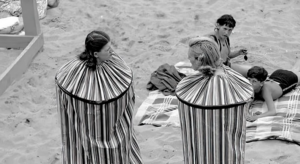
This unusual technology served as an urban alternative for the physical and technical preparation needed for traditional riding. Beach goers use portable striped fabric booths to change clothes with privacy on a public beach during the 1930s. This creative mobile changing room solution reflects the social customs of the time combining practicality with the strict modesty that shaped behavior by the seaside.
Two children pose in handmade Halloween costumes in the United States in 1930. The use of paper masks and improvised pumpkins reflects the popular traditions of the time in a setting of limited resources. This visual record shows how the holiday was celebrated in rural areas.
Artist Pablo Picasso and former President Harry Truman appear in a cordial handshake in Vallauris, France in 1958. The meeting took place in front of a rustic building symbolizing the unlikely connection between the leading figure of cubism and the former American political leader. Robert Wadlow, recognized as the tallest man in all of history, poses elegantly beside his family in a record from the 1930s.
At an impressive 8. 92 ft tall, his monumental height stands out in an extraordinary way in the home setting showing the unique genetic condition that made him a world-famous figure. Sigmund Freud appears flanked by his uniform sons in 1916 amid the tensions of that time.
The austere portrait captures the intersection between the private life of the father of psychoanalysis and the military civic duty of his children, reflecting the family and social pressures of Europe in that era. Nine European kings posed together for the first and only time in London on May 20th, 1910 for the farewell ceremony of King Edward VII. The image captures a moment of political and monarchical transition, bringing together leaders of several nations in a formal setting before major global transformations.
A silver coin from ancient Greece displays the face of the goddess Athena and the iconic owl, symbol of wisdom and of the city of Athens. In that society, paying taxes was voluntary. But wealthy citizens contributed out of civic responsibility and social pressure to support the maintenance of local democracy.
Workers gather in 1882 at Frédéric Auguste Bartholdi’s workshop in Paris for the construction of the Statue of Liberty. Giant pieces of copper and plaster fill the building, revealing the monumental scale of the project that would be sent to the United States as a lasting symbol of friendship between nations. A veteran hunter poses with his hunting dog in Mason County, Kentucky in 1890.
The black and white record captures rural life in the interior of the United States in the late 19th century, where hunting was essential both for survival and for managing local land. Annie Oakley stood out as the leading sharpshooter of Buffalo Bill’s Wild West Show. Born in 1860, she showed exceptional skill that challenged the gender expectations of the Victorian era.
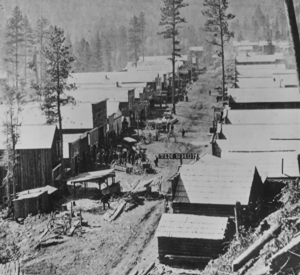
Her participation in world tours helped shape the mystical image of the Old West for a global audience. Deadwood emerged as an illegal mining camp in the mid-1870s, drawing thousands of prospectors searching for fortune in South Dakota Territory. This early aerial view reveals the rows of wooden structures that would become one of the most untamed settlements in the West.
Martha Canary, widely known as Calamity Jane, was a fearless frontier figure who challenged the conventions of her time. Known for her skills as a shooter and storyteller, she traveled through the American West, leaving behind legends that still live on in popular culture today. A sophisticated board game belonging to Pharaoh Tutankhamun reveals the richness of entertainment in ancient Egypt more than 3,000 years ago.
The piece carved from ivory shows detailed hieroglyphs on its sides and a functional drawer for storing the playing pieces, demonstrating the high level of craftsmanship of that time. The imposing facade of the Gem Theater, owned by businessman Al Swearengen, dominates the city scene of Deadwood in 1878. The building worked as an entertainment center and variety theater in Dakota Territory.
The movement of carriages in front of the place illustrates the active life of the frontier. Workers in Idaho lay a water pipeline made entirely of wood in 1891. The use of wooden staves reinforced with iron bands was a common engineering solution in the American West to make water transport possible in regions undergoing industrial growth.
If you enjoyed this video and want to support the channel, please use the Super Thanks tool below. Your contribution helps us keep bringing you amazing historical content. Thank you so much for your support and see you in the next video.
Note: Some content was generated using AI tools (ChatGPT) and edited by the author for creativity and suitability for historical illustration purposes.