
UK Defence Funding Clash Highlights Strains Over Spending and Welfare
Prime Minister Andy Burnham has faced intense political pressure over military spending timelines and welfare priorities, exposing a sharp division in Westminster over how Britain will finance its future armed forces.
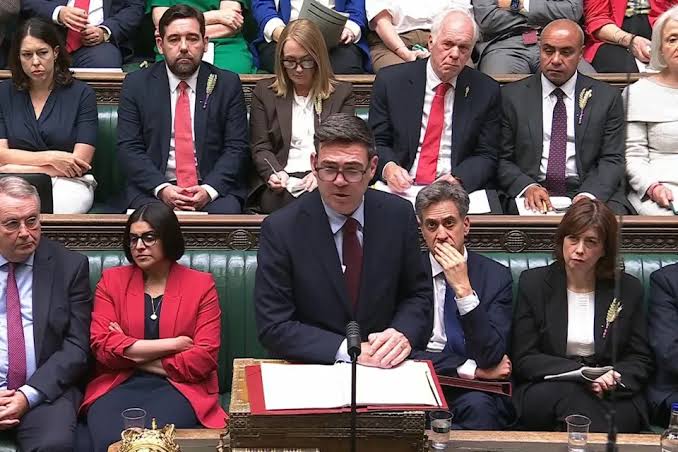
The debate over Britain’s national security has returned to the forefront of Westminster politics following a high-stakes confrontation in Parliament. Prime Minister Andy Burnham defended his government’s approach to military expenditure during a heated exchange at Prime Minister’s Questions, pushing back against accusations that his administration is moving too slowly on defence.
The dispute has laid bare a fundamental political conflict between the governing administration and the Conservative opposition over where additional billions of pounds should be sourced. While critics argue that current funding timelines leave the country vulnerable amid rising international tensions, the government insists that strengthening national security must not come at the direct expense of social welfare.
As NATO demands a clear, credible path toward long-term spending targets, the unfolding debate has forced policymakers to confront difficult fiscal trade-offs that extend far beyond standard parliamentary rhetoric.
The PMQs Clash: Speed Versus Social Security
The parliamentary friction intensified when Conservative leader Kemi Badenoch challenged Burnham over the exact speed at which his government intends to increase military expenditure.
According to parliamentary reporting, Burnham reaffirmed the UK’s long-term commitment to spending 3.5% of GDP on defence by the year 2035, noting that an intermediate target of 3% would be formally announced next year. Badenoch argued that global security pressures—including ongoing tensions involving Russia and the Falkland Islands—require a much more aggressive acceleration of military investment.
The core disagreement was not whether Britain should spend more on defence, as both major parties support higher military budgets. Instead, the fierce debate centered on how rapidly those funds should rise and where the additional capital should originate.
The political flashpoint arrived when Burnham rejected suggestions that increased military budgets should automatically trigger deep cuts to social support.
“We do everything to support our national security, but it can’t come at the expense of social security,” Burnham told MPs.
Badenoch countered by asserting that the nation must prioritize immediate defence needs over excessive spending on domestic welfare programs. Reports indicate the opposition has proposed roughly £10 billion in additional defence funding financed directly through sweeping welfare reforms, a mechanism Burnham’s administration has firmly rejected.
NATO’s Pressure and the Multi-Billion-Pound Fiscal Gap
The political debate is unfolding against a backdrop of mounting international expectations. NATO Secretary General Mark Rutte has urged the UK to provide a concrete, credible trajectory of annual budget increases to meet the alliance’s 3.5% defense target over the next decade.
Current official projections estimate that British defence expenditure will reach approximately 2.7% of GDP by the 2028-29 financial year. Closing the remaining gap to hit the final target could require nearly £30 billion in additional annual military spending.
Finding that magnitude of funding presents a formidable fiscal challenge for the Treasury. To deliver on the promised expansion without severe cuts elsewhere, ministers face a difficult combination of choices, including increased borrowing, tax adjustments, departmental reallocations, or alternative financing structures.
In an effort to explore innovative funding methods, the government has examined participating in a Canada-led Defence, Security and Resilience Bank. Following discussions with Canadian Prime Minister Mark Carney, British officials have expressed interest in mechanisms designed to expand defense-industrial capacity without relying entirely on immediate conventional government borrowing.
Assessing the State of Britain’s Armed Forces
Underpinning the financial debate are persistent questions regarding military manpower and operational readiness.
While political critics frequently claim that Britain’s armed forces have hit historic lows, official statistics from the House of Commons Library and the Ministry of Defence reveal a more nuanced picture. House data indicated full-time UK armed forces personnel stood at about 148,600 in April 2026, down from roughly 186,000 in April 2012.
However, broader MOD metrics—which incorporate regular personnel, Gurkhas, and volunteer reserves—showed a total strength of 182,980 service personnel by July 2026. This figure includes 137,480 UK Regular Forces personnel, alongside 73,660 regular army troops.
Significantly, total service strength has begun a modest recovery after reaching a low point of 180,780 in July 2025, marking an increase of over 2,200 personnel over a twelve-month period.
Despite these stabilization signs, military leaders emphasize that modern defense requires vastly more than raw troop counts. General Sir Gwyn Jenkins, head of the Royal Navy, has highlighted the urgent need to accelerate naval capabilities, advanced warships, and unmanned autonomous systems to counter growing maritime threats and safeguard critical undersea infrastructure.
Modern military requirements demand sustained capital investment across submarines, aircraft, cyber capabilities, air-defense systems, and extensive ammunition reserves, meaning that headline spending figures do not instantly translate into operational deployment capacity.
Competing Visions for the Future of the State
The ongoing dispute in Westminster ultimately reflects fundamentally different philosophies regarding the role of government spending.
The opposition maintains that a deteriorating global security landscape leaves no room for hesitation, arguing that delayed funding compromises national safety and demands immediate structural savings from domestic programs.
The government counters that protecting citizens economically through a robust social safety net is inseparable from comprehensive national resilience, warning that aggressive welfare rollbacks would inflict severe hardship on vulnerable households.
As policymakers work to reconcile international alliance expectations with domestic economic realities, the central question remains unavoidable: how will Britain successfully finance its ambitious military expansion over the coming decade?
How do you think the government should balance the rising financial demands of national defense against the preservation of domestic public services?