
King Charles III, the Coronation Oath, and the Battle Over Britain’s Religious Identity
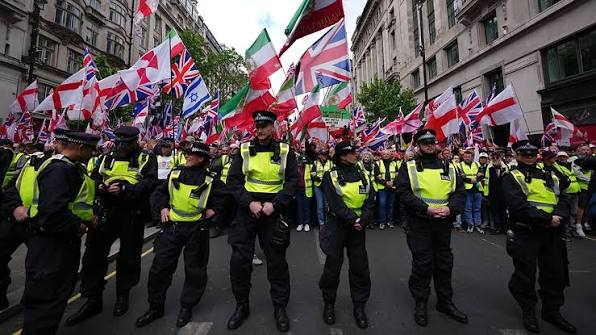
A provocative claim circulating alongside images of King Charles III and demonstrations near Buckingham Palace has reignited a fundamental question: can a monarch who swore to protect Britain’s Protestant constitutional settlement also publicly embrace a country of many faiths?
For critics, the King’s interfaith language represents a troubling departure from the Crown’s Christian foundations.
For supporters, it is precisely what a constitutional monarch of modern Britain is expected to do.
The historical and legal record suggests that the controversy is far more complicated than angry accusations imply—and reveals a profound distinction between what the King actually swore and what his critics believe that oath requires.
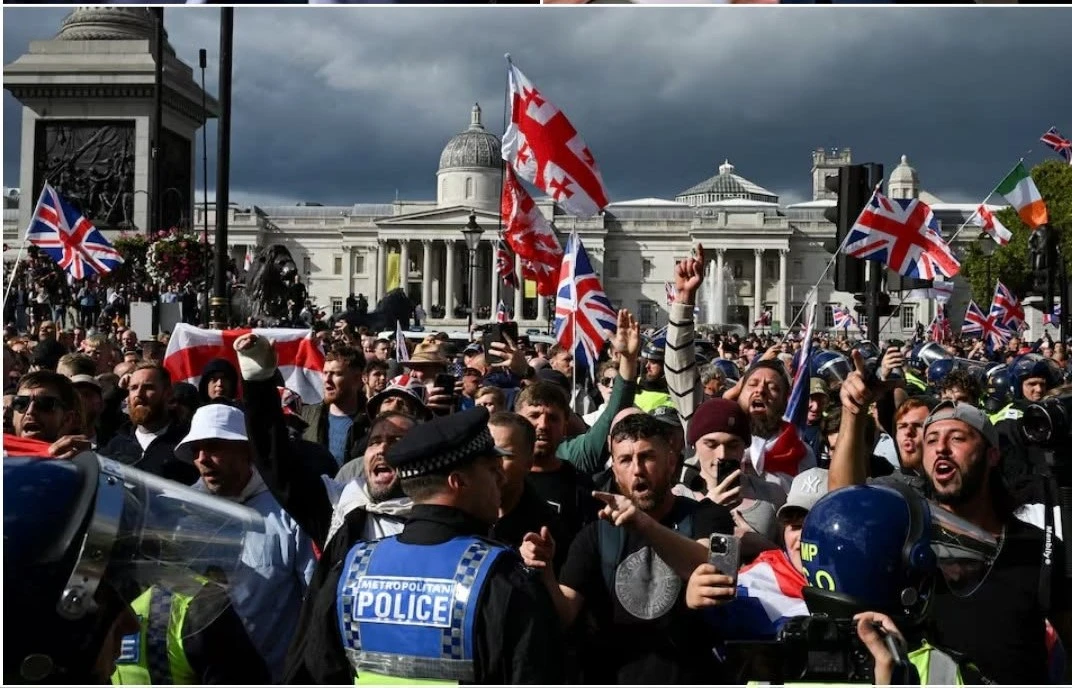
A Confrontation That Symbolises a Much Larger Argument
Calling a King a “traitor” outside Buckingham Palace is about as dramatic a political accusation as it is possible to make.
The word immediately evokes betrayal: betrayal of country, constitution, religion, or people.
That is why claims that a protester stood outside the Palace and accused King Charles III of betraying his coronation oath have attracted intense public attention.
Yet before deciding whether such an accusation has merit, two separate questions must be answered.
First, can the specific confrontation described in viral posts be independently verified with reliable dates and details?
Second, regardless of the rhetoric of an individual protester, has King Charles actually violated the religious promises he made when he ascended the throne?
While anti-monarchy and anti-establishment protests are a familiar sight around London landmarks—such as demonstrators shouting slogans during major national events—individual viral claims often combine unrelated photographs to construct a powerful narrative.
What can be examined much more confidently, however, is the argument behind the accusation.
That argument goes straight to the heart of an unresolved tension within modern British public life.
Charles is simultaneously the constitutional guardian of an established Christian church and the symbolic head of state of one of the most religiously diverse countries in Europe.
What Did King Charles Actually Swear?
Examining the actual wording and requirements of the coronation is the essential starting point, as accusations of breaking an oath are meaningless without looking at the oath itself.
Charles III was crowned at Westminster Abbey on May 6, 2023.
The ceremony was unmistakably Christian from beginning to end.
The King was presented with the Holy Bible, took statutory oaths, and was anointed by the Archbishop of Canterbury within a traditional liturgical framework of Christian prayers, scripture, and hymns.
Most importantly, Charles did not renounce Britain’s Protestant constitutional settlement.
During the ceremony, he made the statutory Accession Declaration, formally declaring himself a faithful Protestant and promising to uphold enactments securing the Protestant succession.
The Royal Family’s official guidance states that the sovereign remains “Defender of the Faith and Supreme Governor of the Church of England.”
The coronation oath explicitly requires the monarch to maintain the Church of England’s established settlement, doctrine, worship, and discipline.
Critics are entirely correct that King Charles occupies a specifically Christian constitutional office.
The disagreement, however, lies in what flows from that fact.
Why Interfaith Engagement Has Become Politically Charged
One of the primary contentions raised by critics concerns the King’s respectful engagement with non-Christian communities, including the use of traditional greetings or visits to places of worship.
When a British monarch acknowledges religious minorities respectfully, supporters view it as standard civic leadership.
Critics, however, often interpret the symbolism differently, questioning why the Supreme Governor of the Church of England should adopt terminology or gestures associated with other faiths.
This concern frequently intersects with broader, unrelated anxieties about immigration, demographic change, and the perceived erosion of Britain’s traditional identity.
Yet the constitutional question is much narrower: does greeting or engaging with citizens of different faiths violate the King’s coronation oath?
There is no legal basis for concluding that it does.
Nothing in the oath requires the monarch to refuse respectful engagement with Muslims, Jews, Hindus, Sikhs, Buddhists, or non-believers.
The Comparison with Queen Elizabeth II
Comparisons with Queen Elizabeth II often surface in these debates, given her deeply personal and publicly visible Christian faith throughout her seven-decade reign.
Elizabeth promised at her 1953 coronation to maintain the Protestant Reformed religion established by law and preserve the Church of England.
For many Britons, she came to represent a national institution openly rooted in Christian tradition.
However, Elizabeth also lived through a period of immense social transformation.
During her reign, Britain became substantially more religiously diverse.
She met leaders of many faiths, emphasized religious tolerance, and never interpreted her role as requiring hostility toward other traditions.
The difference between mother and son is largely one of emphasis and rhetorical style rather than a complete theological reversal.
Elizabeth spoke frequently and personally about her Christian faith, particularly in her annual Christmas broadcasts.
Charles has generally placed greater public emphasis on interfaith coexistence, while still explicitly affirming his personal Christian faith—such as in his 2025 Easter message and a 2026 address to the United States Congress describing Christianity as his “firm anchor and daily inspiration.”
What Happens Next in the Debate Over Britain’s Crown
The controversy surrounding King Charles III touches on questions that modern societies continue to struggle with: how historic institutions adapt to demographic change without losing their foundational identity.
As long as Britain maintains an established church alongside a pluralistic population, these structural tensions will remain part of national life.
Whether the Crown’s current approach is viewed as inclusive bridge-building or a dilution of heritage depends entirely on one’s perspective on tradition and change.
How do you think constitutional monarchies should balance historic religious traditions with modern multicultural societies?