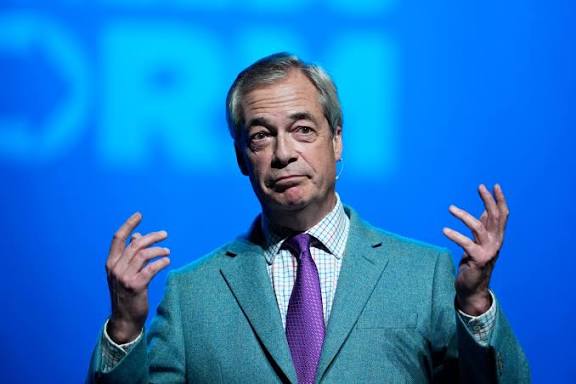

Crypto Billionaires Inject £72 Million Into Reform UK, Shaking British Politics
The massive donations from Ben Delo and Christopher Harborne give Nigel Farage’s party unprecedented financial muscle, immediately intensifying the debate over political funding and the balance of power in Westminster.
British politics has been shaken by an extraordinary financial injection into Reform UK, after two cryptocurrency billionaires delivered donations on a scale never previously seen in modern UK party politics.
Ben Delo, the British co-founder of cryptocurrency exchange BitMEX, initially gave Nigel Farage’s party £36 million, marking what is widely described as the largest single donation to a British political party on record.
Within hours, another major Reform supporter and cryptocurrency investor, Christopher Harborne, matched Delo’s contribution with a second £36 million payment. Together, the two transactions gave Reform UK a staggering £72 million financial boost.
The development has instantly intensified the national debate over whether enormous private donations are altering the balance of power in British democracy.
What Happened: A Record-Breaking Political Funding Surge
The sheer scale of the money is difficult to overstate in the context of British elections.
Associated Press reported that the combined £72 million amounts to approximately $97 million, a figure that exceeds all donations received by British political parties during the entire previous calendar year combined.
For a party historically viewed as an insurgent movement operating outside Britain’s traditional two-party structure, access to this level of funding fundamentally changes what Reform can realistically attempt ahead of the next general election.
Reports surrounding Ben Delo’s decision indicate that his original intention was to provide Reform with roughly £1 million every month through to the final possible date for the next general election in 2029.
Instead, he transferred the entire amount upfront.
That decision coincided with ongoing debates in Parliament regarding potential new restrictions on political finance, overseas-linked donations, and cryptocurrency funding.
By transferring the capital immediately, Delo appears to have ensured that Reform secured its financial standing before any prospective legislative changes could complicate future contributions.
Why It Matters: Reshaping the Electoral Landscape
From a purely electoral perspective, £72 million equips Reform with capabilities that smaller British political parties rarely possess.
Britain’s first-past-the-post electoral system has historically penalized parties whose support is geographically broad but insufficiently concentrated. Winning millions of votes nationally does not automatically translate into winning parliamentary constituencies.
To convert national popularity into Westminster seats, a party needs more than a charismatic leader; it requires sophisticated local infrastructure.
With its new financial reserves, Reform can now accelerate several critical operational efforts:
-
Constituency Organization: Recruiting and paying professional local organizers in strategically vital areas.
-
Candidate Vetting: Implementing rigorous background checks and training programs for future parliamentary candidates.
-
Voter Data & Technology: Investing in advanced canvassing software, voter databases, and direct-mail operations.
-
Policy Development: Hiring specialized researchers and policy experts to build detailed legislative platforms.
-
Digital Advertising: Deploying continuous advertising campaigns rather than relying solely on traditional media cycles.
Both the Conservative Party and the Labour Party face strategic complications from this shift.
The Conservatives compete directly with Reform for overlapping voters on issues such as immigration, national sovereignty, taxation, and cultural policy.
Previously, a primary argument against smaller parties on the British right was their lack of nationwide operational depth. That structural disadvantage is rapidly diminishing.
Meanwhile, Labour cannot treat Reform’s rise as exclusively a Conservative problem, given Reform’s ongoing appeal in working-class communities and post-industrial constituencies that have historically voted Labour.
The Donors: Backgrounds and Motivations
At the center of the financial surge is Ben Delo, whose fortune stems from the digital-assets industry.
While Delo has previously donated smaller sums to Reform, his background has attracted considerable scrutiny.
In the United States, Delo pleaded guilty in 2022 to violating the Bank Secrecy Act in connection with anti-money-laundering compliance failures at BitMEX. He was later granted an unconditional presidential pardon by Donald Trump.
Under current British electoral rules, these past legal proceedings do not disqualify an eligible donor from contributing to a political party, but they have fueled sharp criticism from political opponents.
Explaining his motivation, Delo argued that Reform should have a fair opportunity to compete with Britain’s established political forces.
He criticized defenders of the current political system, characterizing mainstream parties as part of a political “cartel,” and stated that his goal was to ensure a level playing field where insurgent movements are not crippled by continuous fundraising struggles.
Christopher Harborne’s role adds another layer of political visibility.
Harborne was already one of Reform’s most substantial financial backers before matching Delo’s £36 million contribution.
Nigel Farage has faced independent parliamentary scrutiny regarding a separate £5 million personal gift from Harborne, which Farage maintains was used exclusively for personal security.
Reform leadership has consistently disputed any suggestion of wrongdoing, asserting that all donations strictly comply with electoral law.
Different Perspectives on Political Funding
The massive financial infusion has sharply divided political reactions across Westminster.
Reform UK and its supporters defend the donations as entirely lawful and view them as proof that serious economic figures believe Reform is a viable governing alternative.
Nigel Farage declared himself honored and humbled by the confidence shown in the party’s platform to reverse what he terms Britain’s national decline.
Proponents argue that established parties have relied on wealthy donors, corporate networks, and trade unions for decades, making large donations to an insurgent party a necessary corrective rather than an anomaly.
Critics and opposition groups, including the Liberal Democrats and transparency campaigners, view the situation differently.
They argue that when individual donors can provide a political organization with resources surpassing historical party fundraising totals, it creates an imbalance of political access and influence.
Critics have renewed urgent demands for strict caps on political donations to protect British democracy from the perceived political leverage of extreme wealth.
The Government’s Dilemma and Regulatory Hurdles
The British government now faces a difficult legislative and political challenge.
Proposing restrictive donation laws immediately after Reform secures £72 million risks being framed by Farage and his supporters as an incumbent establishment changing the rules to handicap a rising political challenger.
Conversely, inaction leaves ministers vulnerable to accusations that Britain permits billionaires to exert outsized influence over the political process.
Cabinet minister Angela Rayner has indicated that the government is examining potential donation limits as part of broader systemic electoral reforms.
However, any regulatory changes face complex legal hurdles, particularly regarding whether new restrictions could apply retroactively to funds already received or require parties to return completed donations.
Legal experts note that until Parliament finalizes legislation and relevant electoral authorities issue definitive guidance, claims that the £72 million will be confiscated remain speculative.
Furthermore, Britain’s strict election spending limits prevent parties from simply deploying unlimited funds during officially regulated campaign periods.
Consequently, Reform’s strategic advantage is likely to manifest primarily in long-term infrastructure building rather than last-minute advertising blitzes.
What Happens Next
The road to the next general election—scheduled no later than 2029—will test whether financial firepower can successfully translate into parliamentary representation.
While Ben Delo and Christopher Harborne have provided unprecedented resources, money alone cannot guarantee disciplined organization, popular candidates, or public trust.
The ultimate verdict rests with British voters, who will decide whether the £72 million war chest finances the construction of a credible government-in-waiting or simply marks the most expensive political disruption in modern British history.
Interactive Discussion Question
How do you think unprecedented multi-million-pound donations from private individuals affect public trust in the fairness of British elections?