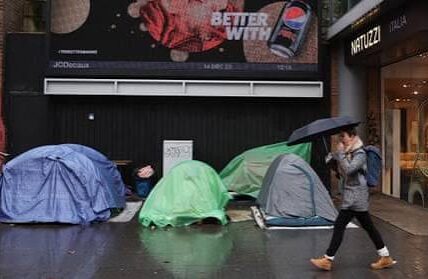

The Decanting of the Displaced: Inside Britain’s Quietest Domestic Battleground
Across three decades of reporting from conflict zones, backroom policy corridors, and fractured border towns across three continents, I have learned a fundamental rule about domestic statecraft: governments do not solve structural crises when they run out of money; they relocate them.
Nowhere is that reality playing out with more quiet volatility than across the British countryside. From the chalk downlands of Oxfordshire to the coastal flats of East Sussex, the United Kingdom’s asylum crisis has moved out of city-center budget hotels and straight into rural market towns, decommissioned military barracks, and suburban cul-de-sacs. What the government frames as a pragmatic, cost-saving operational pivot is, in reality, a high-stakes stress test of social trust, community capacity, and democratic consent.
The Policy Pivot: Moving Away from the “Hotel Era”
For years, the visual shorthand of Britain’s asylum breakdown was the commercial hotel. At the absolute peak of the crisis, the Home Office had requisitioned roughly 400 commercial hotels across the country, accommodating approximately 56,000 asylum seekers at an eye-watering daily cost to the public purse.
Now, the government is executing an aggressive drawdown. On August 12, the Home Office announced that an additional 13 hotels had been emptied and decommissioned, returning the properties to commercial hospitality and community use. According to parliamentary statements delivered earlier this summer, the total footprint has fallen to fewer than 170 hotels housing approximately 21,000 individuals.
ASYLUM HOTEL FOOTPRINT: THE SCALE OF THE DRAWDOWN
Peak Usage:         [========================================] ~400 Hotels (~56,000 People)
Current (Mid-2026): [================>] <170 Hotels (~21,000 People)
Net Reduction:      Over 57% decrease in operational hotel sites
The headline narrative presented by Whitehall is one of fiscal recovery and administrative efficiency. But shutting down hotels does not evaporate the human beings inside them while their claims await adjudication. It necessitates a massive, nationwide relocation effort.
The “Mixed Model” Framework
Home Secretary Shabana Mahmood has framed this transition around an emerging “mixed model” of asylum accommodation. Rather than concentrating large populations in high-density hotel clusters, the state is shifting toward a diversified portfolio:
-
Private Dispersed Properties: Contracting residential housing units across a wider geographic map.
-
Medium-Scale Accommodations: Utilizing repurposable assets like former student housing blocks.
-
Large-Scale Institutional Facilities: Repurposing large state-owned real estate, most notably surplus Ministry of Defence (MoD) military bases.
The foundational argument driving this shift is geographical and economic equity. For decades, lower-income urban centers and post-industrial towns—primarily in the North and Midlands—bore a disproportionate share of asylum housing because property and procurement costs there were low. Wealthier southern shires and rural enclaves remained largely insulated.
To break this pattern, the government is reviewing historical rental caps that previously locked the Home Office out of affluent housing markets, signaling an explicit intent to place asylum accommodation into areas that have historically seen very few arrivals.
The Friction Points: Capacity, Consultation, and Council Housing
As the state widens its procurement net, the friction on the ground has intensified:
-
The Military Base Backlash: Sites across East Sussex, Suffolk, Oxfordshire, North Yorkshire, and Essex have been placed under active assessment. The proposed repurposing of MoD Bicester in Oxfordshire, for instance, has ignited fierce pushback from local officials and residents over how a rural district’s medical practices, transport networks, and schools can absorb sudden population increases. While the Home Office insists that sites remain subject to exhaustive feasibility, design, and security reviews before final sign-off, local communities often view the exploratory phase as a fait accompli.
-
The Consultation Paradox: By protocol, the Home Office coordinates with local council leadership and statutory partners before procuring dispersed properties. However, individual residents and neighborhood groups are intentionally excluded from direct prior notification. The Home Office defends this policy on critical safeguarding grounds: publishing specific residential addresses risks making vulnerable occupants the targets of targeted intimidation and far-right protests. For neighbors, however, discovering that a house on their street has been repurposed overnight without public input fosters a sharp sense of disenfranchisement.
-
Social Housing Safeguards: In an attempt to quell persistent rumors that asylum seekers are taking municipal housing stock, ministers issued an explicit parliamentary guarantee in February: “New council housing will not be used by asylum seekers under any circumstances.” Nevertheless, procurement of private rental stock inevitably exerts indirect pressure on local rental supply.
-
Conditionality and Enforcement: Alongside changes in physical housing, the Home Office has moved to tighten eligibility rules. Under measures rolled out in March, applicants found to be working illegally, committing specific offenses, or possessing sufficient independent financial resources face immediate withdrawal of state-funded accommodation and support stipends.
2. My Professional Perspective
(By an Investigative Analyst with 30 Years on the Migration & Policy Beat)
To understand what is actually happening in Britain today, you have to peel back the layers of ministerial talking points and see the deeper structural machinery at work. I have watched migration policy evolve across five different prime ministerial tenures, and the current dynamic is not merely a housing reorganization—it is an exercise in political risk dispersal.
1. The Geometry of the “Quiet Relocation”
When a government announces it is closing asylum hotels, the public hears a story of systemic resolution. But in investigative journalism, our first question is always: Where does the baseline volume go?
Hotels were politically catastrophic for the government because they were hyper-visible. A hotel sits on a high street, in a town square, or along a major bypass. It has a sign out front, staff who talk, and a distinct footprint that makes it an effortless focal point for television cameras, community frustration, and political agitation.
Dispersed housing and fenced-off military bases solve the political optics problem: they make the crisis invisible again. Dispersing people in twos and threes into private suburban rentals or behind the barbed-wire perimeters of rural MoD barracks removes the concentrated media flashpoint. It transfers the political cost away from national evening news bulletins and fractures it into dozens of diffuse, localized parish council arguments that rarely make national headlines.
2. The Overlooked Reality: The Bureaucracy of Procurement
The public debate is routinely framed as a moral binary: compassionate integration versus nativist pushback. What this binary conveniently ignores is the shadow industry of private procurement.
As the Home Affairs Select Committee pointed out in its blistering January critique, the state’s legacy of asylum housing has been plagued by deeply flawed commercial contracts. Billions in public funds have flowed to private facilities management contractors who operate with minimal local accountability.
THE ASYLUM HOUSING ECOSYSTEM
[Home Office / Westminster]
       │
       ▼ (Directs policy & sets budgets)
[Private Facilities Contractors]
       │
       ├─► Private Rental Acquisitions (Dispersed Housing) ──► Strains local rental stock
       ├─► Decommissioned MoD Sites (Large-Scale)         ──► Strains rural public services
       └─► Commercial Assets (Student Housing/Medium Sites)──► Creates local zoning friction
When private contractors enter a tight regional rental market with guaranteed taxpayer backing, they inadvertently distort local housing dynamics. Even if council homes are off-limits, acquiring private rentals reduces the overall pool of affordable housing available to local working families. When local citizens push back, their practical anxieties about rental inflation, oversubscribed General Practitioner (GP) surgeries, and rural bus routes are often unfairly conflated with ideological hostility.
3. The Unresolved Dilemma: The Base vs. The Village
Placing hundreds of men in remote, rural military encampments represents an acute operational paradox that Whitehall has yet to solve.
From an administrative perspective, former military bases look ideal on a spreadsheet: they are state-owned, spacious, and secure. But drop a population of 800 to 1,200 individuals—who are legally free to come and go, yet prohibited from working and have limited financial support—several miles outside a quiet rural village with one small grocery store and an hourly bus service, and you create an institutional pressure cooker.
You isolate vulnerable people who have fled trauma in environments that lack legal support networks, cultural services, and mental health infrastructure, while simultaneously overwhelming the fragile civil resources of the host community. It is a model designed for administrative convenience, not human reality.
The British government finds itself trapped inside a geometric puzzle of its own making. It must simultaneously satisfy four competing demands:
-
Fiscal Responsibility: Slashing the ruinous costs of commercial hotel contracts.
-
Geographical Equity: Ensuring poorer towns do not bear the entire weight of national policy.
-
Local Consent: Reassuring communities that their local services, safety, and infrastructure will not be compromised.
-
Humanitarian & Legal Duty: Providing dignified, safe, and lawful sanctuary to those seeking asylum.
Moving people out of hotels was the easy half of the equation; any administration can terminate a commercial lease if it is willing to spend the political capital. The true test of governance lies in what replaces them. If the “mixed model” simply shifts the pressure from urban hotel lobbies to under-resourced rural villages and already stretched suburban rental markets, it will not cure the underlying fracture—it will simply spread the friction into every corner of the country.
A Question for the Public Square
When a national humanitarian obligation directly collides with the finite capacity of local infrastructure, who gets to decide what constitutes a “fair share”—the planners in the capital who manage the spreadsheets, or the communities tasked with living out the consequences on the ground?