
The Ledger of Broken Promises: Rachel Reeves, the Pensioner Revolt, and the High-Stakes Battle Inside Whitehall
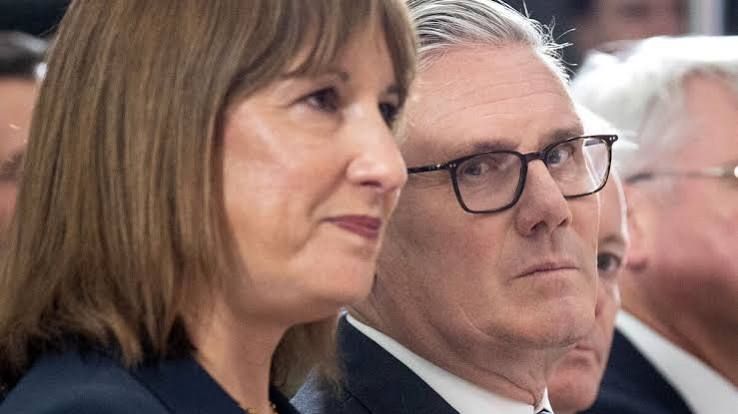
Under the hot tungsten lights of the BBC’s Studio B in Central London, politics is rarely conducted with subtlety, but on a fraught Sunday morning, Rachel Reeves took a gamble that sent immediate shockwaves through Westminster.
Facing veteran interrogator Laura Kuenssberg, the Chancellor of the Exchequer—already battling circulating rumors of an imminent reshuffle and mounting dissent across parliamentary backbenches—leaned forward into the camera lens. Her objective was clear: mount a full-throated defense of her fiscal stewardship against an electorate growing increasingly uneasy over the cost of living.
Instead, her words triggered an immediate political firestorm.
“I have had to make hundreds and hundreds of choices as Chancellor, and they haven’t always been easy choices,” Reeves told the Sunday morning audience, her delivery measured, almost defensive. “But if you are a pensioner watching this programme today, then you have had two increases in your state pension, significantly higher than the increase in prices. I do know that pensioners are better off after two years of this Labour government.”

Within minutes of broadcast, the political counter-assault was launched. Conservative rivals and pensioner advocacy groups seized upon the Chancellor’s remarks, framing them not as a statement of economic fact, but as an audacious dismissal of the financial squeeze felt by millions of elderly citizens across the British Isles.
Leading the charge, Shadow Work and Pensions Secretary Helen Whately accused Reeves of outright “gaslighting” an entire generation.
“Rachel Reeves is gaslighting pensioners once again,” Whately stated, speaking directly to the press in an incendiary rebuttal. “Thanks to her, many pensioners are being dragged into paying tax. That comes on top of rising prices driven by her disastrous policies and high energy bills courtesy of net-zero zealot Ed Miliband.”
Whately immediately revived the wound that has defined Reeves’ tenure since her very first weeks at Number 11 Downing Street: the decision to means-test and effectively strip the universal Winter Fuel Payment from millions of vulnerable retirees. “Labour showed their true colors when they tried to take the winter fuel allowance from millions of pensioners,” Whately argued, claiming that only the Conservatives could “be relied on to back pensioners and deliver a stronger economy and stronger country.”
Shadow Chancellor Sir Mel Stride doubled down on the critique, assessing Reeves’ tenure with unsparing finality: “I am afraid her scorecard is very low when it comes to securing the economic future of our country.” Stride also broadened the offensive toward the internal factional maneuvering visible inside Labour, warning that any transition toward alternative leadership figures—such as Greater Manchester Mayor Andy Burnham—would offer little relief, cautioning that Burnham is “clearly going to lean more into tax, more into borrowing.”
Yet the cracks in the defense were not solely visible from the opposition benches. Even within Labour circles, the tension between government messaging and grassroots reality was palpable. Appearing on public panels, Labour MP Miatta Fahnbulleh, widely viewed as a pivotal ideological ally in the evolving leadership conversation, offered a frank admission: “People are impatient for change. The pace and scale of it needs to be much greater to meet the demands of the country.”
Meanwhile, looming over the entire debate is the status of the State Pension “Triple Lock”—the statutory guarantee that pensions rise each year by inflation, average wage growth, or 2.5%, whichever is highest. While figures like Andy Burnham have consistently reaffirmed their commitment to the Triple Lock as a core manifesto pledge, the clash over Reeves’ defense illustrates a much broader existential crisis: How does a modern democratic government maintain solvency without tearing apart the delicate social contract negotiated with its elder citizens?
\
Over three decades covering finance ministries, backroom coups, and election battlegrounds from Washington to Fleet Street, you learn to identify the exact moment an administration loses touch with the street. It rarely happens because of an intricate line item buried on page 142 of a Treasury Red Book. It happens when a politician looks into the camera and tells the public they are experiencing prosperity when their bank accounts and utility bills scream the exact opposite.

What we witnessed with Rachel Reeves is not a routine messaging error; it is a masterclass in the dangerous political art of selective balance sheets.
The Arithmetic of Illusion: The Stealth Drag
To understand the fury ignited by Reeves’ television appearance, one must look past the headline numbers and examine what Whitehall insiders call the “mechanics of fiscal drag”—an economic maneuver designed to extract revenue silently.
When Reeves claims that state pensioners are “better off” because the headline State Pension rose via the Triple Lock above the consumer price index, she is citing real percentage figures. But she is omitting the structural trap waiting for them on the other side of that raise: frozen income tax thresholds.
Consider the mathematics that Treasury officials understand intimately:
-
The UK personal income tax allowance has been frozen at £12,570.
-
As the state pension increases year-on-year under the Triple Lock, it pushes retirees closer to, or directly over, this static baseline.
-
The result is that millions of older Britons—many of whom have no other substantial private savings—find themselves classified as income-tax payers for the first time in their lives.
What the government gives with the right hand via statutory pension indexation, the Treasury claws back with the left hand via HMRC tax receipts. When you factor in the simultaneous loss of the Winter Fuel Allowance—worth between £200 and £300 tax-free during the coldest months—the net ledger for an average low-to-middle-income retiree turns negative.
To tell that citizen they are objectively “better off” is an exercise in political cognitive dissonance. It isn’t just tone-deaf; it weaponizes statistical technicalities against lived human experience.
The Anatomy of the Winter Fuel Scar
In journalism, you quickly discover that certain policies carry symbolic weight far beyond their fiscal value. The Winter Fuel Payment, introduced in the late 1990s, was never merely an energy subsidy. In the collective British consciousness, it was a covenant: a societal recognition that those who spent fifty years working, paying national insurance, and building the country’s infrastructure should never have to choose between a hot meal and a heated room.
When Reeves moved to means-test the benefit almost immediately upon taking office, the Treasury scored a relatively modest immediate saving. But the political cost was catastrophic. It instantly alienated a demographic that votes with higher turnout rates than any other slice of the electorate.
By framing her tenure as one that “protected” older people, Reeves tore open that unhealed wound. For an investigative observer, watching a Chancellor attempt to rewrite the emotional narrative of their most controversial budget cut is a clear signal of an administration in crisis communications mode.
The Whitehall Succession Game
Beyond the immediate policy debate lies an equally intense, shadowed battle for power within the corridors of Westminster.
Sir Mel Stride’s mention of Andy Burnham, paired with MP Miatta Fahnbulleh’s calculated admission that “the pace and scale… needs to be much greater,” is not accidental political noise. It reveals a party machinery that is already anticipating the post-Reeves era.
When a Chancellor is publicly tagged by insiders as fighting for survival, every public appearance becomes an audition for survival rather than a routine government update.
-
Reeves was speaking not just to the pensioners at home, but to the nervous backbench MPs whose majorities depend on suburban and rural constituencies with heavy pensioner populations.
-
Her defiant stance was an effort to convince her own parliamentary colleagues that the economic strategy is sound and defensible on the doorsteps.
-
The swift, coordinated conservative pushback and the lukewarm, qualifying statements from internal Labour voices indicate that the defense failed to land.
The broader tragedy here is that the structural challenge facing Britain’s welfare state cannot be solved by spin or factional rivalry. Every developed western economy—from the United States with Social Security and Medicare to Australia’s superannuation disputes—is wrestling with the identical demographic reality: an aging population supported by a proportionately shrinking workforce.
Instead of an honest national conversation about how we fund long-term care and dignified retirement amid sluggish productivity growth, the public is treated to soundbites that attempt to disguise real-terms austerity as unearned generosity.
Political power is built on trust, but economic security is felt in the bones.
When an elderly widow sits at her kitchen table in Yorkshire or the Midlands, lowering her thermostat to single digits while looking over a newly arrived tax notice, no amount of Treasury charts or prime-time rhetoric can convince her that she is thriving.
Governments fall not when their policies fail in theory, but when their version of reality diverges so completely from the lived lives of their citizens that dialogue becomes impossible. Rachel Reeves’ appearance on national television did not quiet the storm surrounding her tenure; it clarified the stakes.
As Westminster prepares for its next political chapter and factions maneuver for control of the nation’s economic steering wheel, a profound, urgent question hangs over the debate:
Can any modern democratic government deliver fiscal responsibility without breaking faith with the very generation that built the society it seeks to manage?