
The Fortress and the Channel: Inside the Ceuta Border Collapse and Nigel Farage’s Warning for Britain
On the Mediterranean coast of North Africa sits Ceuta, a tiny, rocky Spanish enclave measuring barely seven square miles. Hemmed in by towering double-fences topped with razor wire on one side and the deep blue waters of the Alboran Sea on the other, this European outpost has long stood as one of the world’s most stark geographical anomalies: a direct physical border between continental Africa and the European Union.
On Thursday, that border did not merely strain—it collapsed.
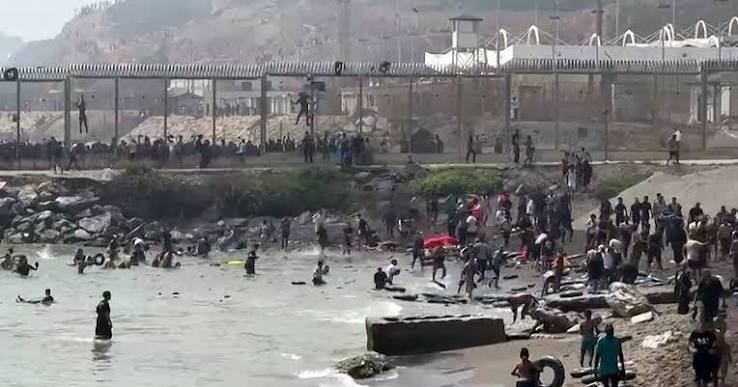
What began in the early morning hours as a steady stream quickly transformed into a human tide. Thousands of migrants—predominantly young men, accompanied by women, teenagers, and families—entered the water along the Moroccan shoreline near the town of Fnideq. Wearing wetsuits, clutching plastic inflatables, or relying purely on physical stamina, they swam around the jagged stone breakwaters at Tarajal that mark Spain’s southern sovereign boundary. Observers on the beaches reported seeing hundreds of individuals in the water at any given moment, their heads bobbing amid the swell as they strove to reach Spanish soil.
                     GEOPOLITICAL SNAPSHOT: THE CEUTA CORRIDOR

       [ MAINLAND EUROPE / UK ] <==== Calais / English Channel
                   ^
                   |  (Intra-European Transit Routes)
                   |
             [ SPAIN (Mainland) ]
                   ^
                   |  (Strait of Gibraltar Transit)
                   |
         +--------------------+
         |   CEUTA ENCLAVE    |  <=== Unprecedented surge of thousands
         +--------------------+       swimming past border barriers
                   ^
                   |  (Border Fence / Sea Crossings)
                   |
            [ MOROCCO / SUB-SAHARAN AFRICA ]
On the beach, the scene was one of total disarray. Droves of exhausted swimmers crawled onto the sand, stripping off soaked clothing or discarded flippers before running toward the city’s urban center. Local law enforcement and emergency services found themselves utterly overwhelmed.
Rachid Sbihi, a representative for Spain’s Civil Guard (Guardia Civil) in Ceuta, delivered a stark assessment of the unfolding crisis:
“It’s not possible to give precise numbers, but there are thousands of migrants crossing… the border had totally collapsed.”
Local authorities in Ceuta described the reality as “absolute chaos”. As municipal infrastructure buckled under the weight of thousands of unscheduled arrivals, city officials called on the national government in Madrid to declare a national emergency. In response, Spanish Prime Minister Pedro Sánchez dispatched military units to reinforce security, bolster police presence, and assist humanitarian agencies struggling to manage the crisis.
The tragedy was not without human cost. Emergency responders confirmed that dozens of individuals lost their lives during the chaotic crossing, either drowning in the rough currents surrounding the breakwater or suffering fatal injuries in violent surges near the coastal perimeter.
The British Echo: Farage Signals the Alarm
As images of the beachheads in Ceuta began circulating across global news networks, the political reverberations were felt instantly across Europe—most acutely in Westminster.
Nigel Farage, leader of Reform UK and Member of Parliament for Clacton, seized upon the unfolding border breach to issue a stark, uncompromising warning to the British public. Farage connected the distant crisis on the North African coast directly to the shores of Southern England, projecting that the events in Ceuta represented the front end of a supply line that would inevitably lead to the English Channel.
“Those scenes you are seeing in Spain today, many of those young men, lots of them dangerous will be heading towards Calais and coming to our country too. It’s time to wake up everybody. Just have a look at these scenes… tens of thousands, maybe more, breaking into that little part of Spain. The authorities seemingly powerless to act.”
— Nigel Farage, Leader of Reform UK
Farage framed the border collapse not merely as a localized administrative failure, but as an existential threat, calling it a “battle for the future of our civilisation.”
Reform UK’s leadership echoed this thesis, arguing that European migration policy creates powerful structural incentives—often referred to as “pull factors”—that drive illegal crossings. Farage pointed specifically to historic policy decisions within Southern Europe, including Spain’s previous legislative moves toward regularizing undocumented residents, as sending an implicit signal to prospective migrants: get across the border, and eventually you will be allowed to stay.
Zia Yusuf, Reform UK’s home affairs spokesman, amplified the warning, explicitly linking European border vulnerabilities to Britain’s domestic resources:
“Thousands of migrants are invading Spanish territory. Many will now make their way to enjoy Britain’s welfare state. We must secure our borders. It’s Reform or bust.”
Key Chronology & Facts at a Glance
-
Location: Ceuta, a Spanish sovereign enclave on the North African coast bordered by Morocco.
-
The Mechanism: Thousands of migrants bypassed land barriers by swimming around the Tarajal breakwaters or utilizing small inflatable vessels.
-
Operational Reality: Spanish Civil Guard reported a total border collapse; local authorities requested a national emergency declaration.
-
Government Intervention: Madrid deployed Spanish armed forces to bolster local police and provide emergency aid.
-
Casualties: Multiple fatalities reported at sea and along coastal structures during the rush.
-
Political Fallout in the UK: Reform UK leadership argued that arrivals in Spain will migrate north toward Calais and attempt cross-Channel boat journeys into the United Kingdom.
================================================================================
                    INVESTIGATIVE ANALYSIS FRAMEWORK
================================================================================

 [SURFACE NEWS HEADLINE]              [DEEPER GEOPOLITICAL REALITY]
  "Migrants Swim Across Border"    ==>  Moroccan Border Calibration & Leverage
  "Authorities Powerless"         ==>  Legal Bottlenecks & Judicial Rulings
  "Direct Route to Calais"        ==>  Secondary Movement Complexities
================================================================================
Having spent three decades covering conflict zones, international summits, and human displacement corridors from Sub-Saharan Africa to the Balkans, I have learned one fundamental truth about migration reporting: the headline tells you what happened, but it rarely tells you why it happened at that precise minute.
When news editors broadcast footage of thousands of young men scrambling onto a Mediterranean beach, the public sees a sudden, chaotic wave of humanity. But in the world of geopolitical intelligence and investigative analysis, sudden waves of this magnitude almost never happen by accident. Border breaches of this scale are systemic events—and to understand what unfolded in Ceuta, we must pull back the curtain on the hidden mechanisms that media soundbites consistently miss.
1. The Weaponization of the Border Gate
The primary detail overlooked by standard mainstream reports is the geopolitical relationship between Madrid and Rabat. Ceuta and its sister enclave Melilla are historical flashpoints. Morocco has long laid diplomatic claim to both territories, viewing them as relics of European colonialism on African soil.
In border control operations around Ceuta, Spain relies almost entirely on Moroccan security forces to maintain the “outer ring” of perimeter defense. When Moroccan authorities strictly patrol their side of the border, virtually no one gets through. When they relax their stance—or actively stand down—the border collapses within hours.
We saw this exact dynamic play out during the historic 2021 crisis, when thousands entered Ceuta in a single day following a diplomatic rift over Western Sahara. The current surge did not materialize out of thin air. It occurred against the backdrop of complex diplomatic negotiations between Europe and North African states regarding border funding, security intelligence, and legal status disputes. When a border breaks this swiftly, it is rarely just a story of migrant determination; it is a story of state-level strategic calibration.
2. The Legal Catalyst: The Supreme Court Threshold
Beyond geopolitical chess, there is a legal catalyst that media headlines largely omitted: recent legal developments within the Spanish judiciary.
Smuggling networks operate like agile, highly opportunistic logistics firms. They monitor legal precedents far more closely than the average citizen. Recent Spanish Supreme Court rulings regarding maritime interceptions established strict procedural parameters around how individuals arriving by sea must be processed, restricting immediate pushbacks at the water’s edge.
Transnational human trafficking syndicates seized on these legal nuances immediately. Through encrypted messaging groups across North and West Africa, traffickers broadcast messages claiming that reaching Spanish water by swimming guaranteed entry into the European legal apparatus. The surge in Ceuta was not merely spontaneous; it was a targeted commercial campaign run by trafficking networks exploiting a specific legal vulnerability.
3. Deconstructing the “Domino Theory”: Ceuta to Calais
Nigel Farage’s assertion—that the men swimming ashore in Ceuta will land on the beaches of Kent within weeks—is a powerful political narrative. But as a journalist who has tracked human smuggling routes from North Africa up through Europe, I must analyze this premise with rigorous objectivity.
Is there a direct pipeline from Ceuta to Calais? Yes, but it is neither simple nor instantaneous.
+--------------------------------------------------------------------------+
|                  THE REALITY OF SECONDARY MOVEMENT                       |
+--------------------------------------------------------------------------+
|  [STAGE 1]  Arrival in Enclave (Ceuta)                                  |
|              -> Subject to strict administrative & geographical isolation|
|                                                                          |
|  [STAGE 2]  Transfer to Mainland Spain                                   |
|              -> Requires identity verification, asylum claim, or order   |
|                                                                          |
|  [STAGE 3]  Transit Across the Schengen Zone                             |
|              -> Crossing international borders under heightened surveillance|
|                                                                          |
|  [STAGE 4]  Arrival in Calais Encampments                                |
|              -> Requires payment to secondary Channel-crossing networks  |
+--------------------------------------------------------------------------+
-
Geographical Isolation: Reaching Ceuta is not the same as reaching mainland Europe. Ceuta is an enclave on the African mainland. To reach Madrid, Paris, or Calais, a migrant must cross the Strait of Gibraltar. Spanish authorities subject ferry travel and sea transport from Ceuta to the Spanish mainland to rigorous identity checks. Thousands remain stuck in enclave processing centers for months, if not years.
-
Schengen Impediments & Internal Border Checks: Even when individuals reach mainland Spain, traveling through France toward Calais involves navigating increasingly strict internal border checks re-established by EU member states concerned with secondary migration.
-
Financial and Operational Barriers: Moving along this supply chain requires significant capital. Human smugglers charge separate fees at every transit leg—from North Africa to the enclaves, from enclaves to mainland Europe, and finally from Northern France across the English Channel.
Farage’s “Domino Theory” correctly identifies the ultimate ambition of many migrants who view Britain as their final destination due to language, family ties, or perceived labor market dynamics. However, translating a border collapse in North Africa into an immediate, automated surge in Northern France oversimplifies a complex, multi-stage human and legal bottleneck.
4. What Questions Remain Unanswered?
As journalists, our responsibility is to demand answers to the questions political leaders prefer to ignore:
-
What is the real capacity of European border infrastructure? If a small enclave can be completely overwhelmed in 12 hours, what does that say about the readiness of European migration management as a whole?
-
Who is funding and directing the maritime smuggling rings? While politicians argue over national sovereignty, the transnational criminal networks organizing these crossings operate with near impunity, generating millions in profit off human desperation.
-
What is the long-term strategic plan for bilateral cooperation? Europe continues to outsource its border security to third-party nations. What happens when those nations decide the deal no longer serves their interest?
The crisis in Ceuta is a dramatic manifestation of the profound geopolitical and socio-economic fault lines defining the 21st century. On one side of the Tarajal breakwater lies a continent grappling with demographic shifts, economic anxieties, and political fragmentation. On the other lies millions of young people seeking opportunity, safety, or simply a viable future.
Nigel Farage’s warnings strike a chord with millions of citizens because they speak to a real sense that modern states have lost control over their physical borders. Yet, focusing solely on the political fallout in Westminster risks obscuring the broader reality: borders cannot be secured by soundbites alone.
Until Western nations address the twin forces driving this crisis—the commercial networks profiting from human transport and the diplomatic leverage exercised by transit nations—scenes like those in Ceuta will repeat. The collapse in Ceuta is not just a warning for tomorrow; it is a mirror reflecting the fundamental challenges facing sovereign nations today.
A Question for Reflection
When a nation’s borders can be overwhelmed in a matter of hours, where does the real responsibility lie—with the political leaders failing to enforce the law, the criminal networks exploiting human hope, or a international legal system structurally unequipped for the modern age?
For deeper visual context on how these border dynamics unfold in real time, watch this Q&A analysis on Reform UK’s deportation and border control plans. This detailed briefing highlights how political movements are formulating their border security proposals in direct response to the escalating migration challenges across Europe.