

The Taboo Alliance: Border Dynasties and the Rorting of the Commonwealth
The Alliance Across the Oceans
It was an interview recorded not in the sterile, air-conditioned press galleries of Canberra, but on the ground in the United Kingdom, where the fault lines of Western immigration policy are currently fracturing at their highest velocity. One Nation leader Senator Pauline Hanson sat down for a raw, wide-ranging podcast interview with the controversial British commentator and street-level activist Tommy Robinson.
The broadcast, released to the public on Thursday, instantly shattered the quiet consensus of the Australian political landscape, cutting directly into the rawest nerves of the nation’s domestic anxieties.
[Interview in the UK] ──> [White Australia Policy Critique] ──> [NDIS Fraud Exposure] ──> [Political Realignments]
During the near hour-long exchange, Hanson did not mince her words, directly connecting the current socio-demographic frictions pinning down major Australian cities to a precise historical pivot point: the systematic dismantling of the landmark White Australia Policy in the 1970s.
The Core Indictment: From Assimilation to Exploitation
The exchange reached its highest temperature when Robinson pushed the Queensland Senator on the visible rise of street-level social disharmony and gang violence unfolding across urban Australia. He asked bluntly how a nation historically famous for its hardline, isolated border controls could find itself facing complex, multi-ethnic public safety crises.
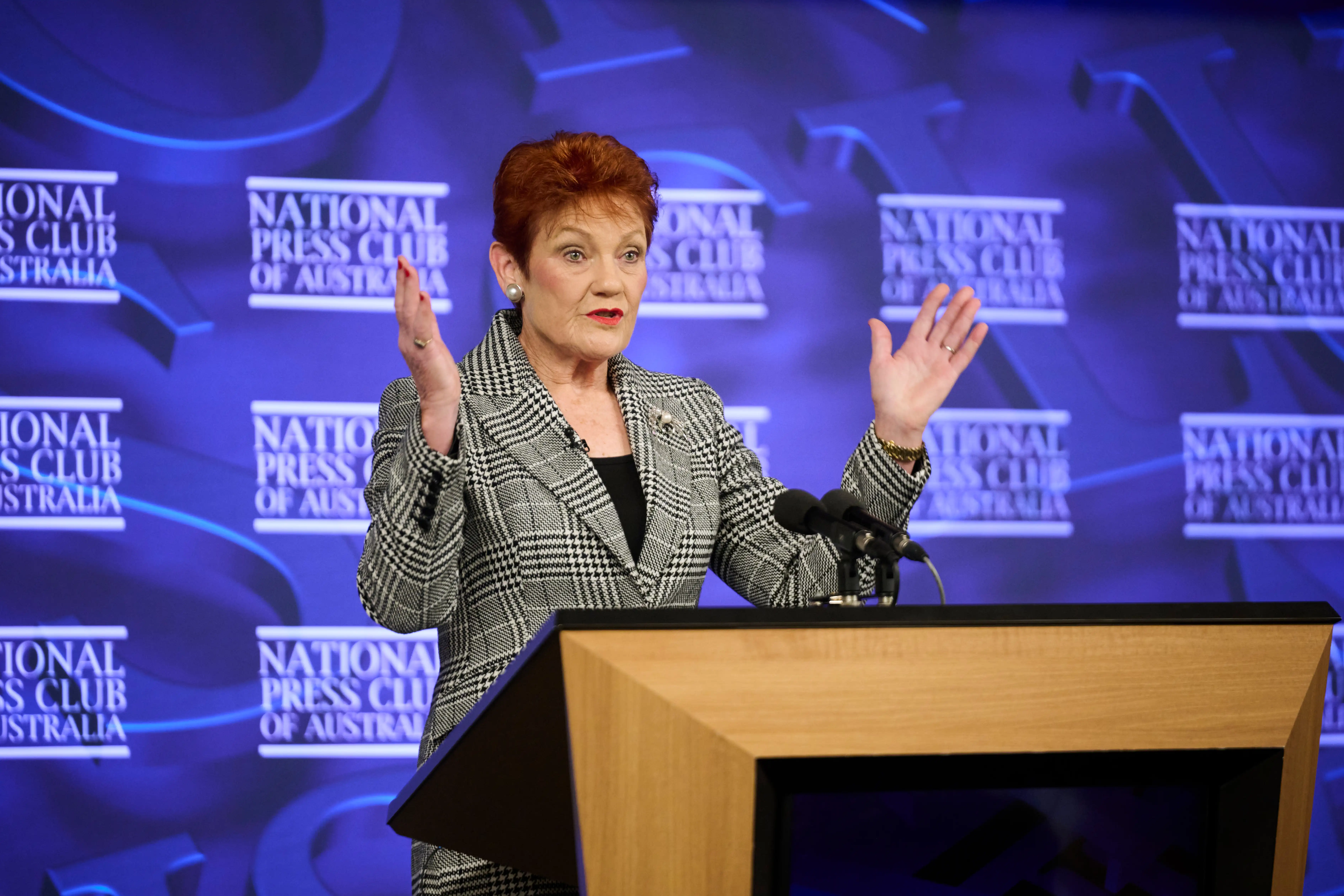
Hanson traced the root of the problem back to the legislative environment of 1973 under the Whitlam administration. She argued that the total abolition of the traditional entry frameworks triggered an uncontrolled demographic shift, moving away from the highly functional post-war European migration waves—such as the Italians, Germans, and Polish arrivals—who, despite severe language barriers, committed completely to assimilation, hard physical labor, and integration into the existing Anglo-Celtic social contract.
Hanson contrasted that historic wave with what she characterized as a modern influx of migrants entering the Commonwealth purely to exploit its generous structural safety nets.
She specifically targeted the National Disability Insurance Scheme (NDIS)—a massive welfare system that has rapidly bloated to encompass nearly 800,000 active participants, costing the Australian taxpayer an astronomical $50 billion annually.
The Geographics of the NDIS Rort
When Robinson pressed for specifics regarding whether the state tracks the cultural or religious backgrounds of those draining the welfare pool, Hanson made an explicit, volatile connection. While acknowledging that “other Aussies” are also engaged in systemic non-compliance, she declared that it is an open secret within major metropolitan hubs that specific, highly concentrated Muslim suburbs house a disproportionate number of NDIS claimants.
[Welfare/NDIS Frameworks] ──> [Organized Crime Infiltration] ──> [Suburban Concentration of Fraud]
The political response from the Albanese government was immediate. Speaking on ABC Radio National, Health and NDIS Minister Mark Butler fiercely rejected the Senator’s assertions, labeling them a “baseless smear” and claiming that he had never once been presented with departmental data indicating that any specific nationality or faith was overrepresented within the scheme’s participant database.
| Stakeholder / Agency | Public Rhetoric | Operational / Forensic Reality |
| Senator Pauline Hanson | Attributes systemic welfare decline to the end of the 1973 integration frameworks | Highlights highly localized, suburban networks exploiting NDIS payouts |
| NDIS Minister Mark Butler | Denounces demographic claims as an un-Australian, baseless smear campaign | Maintains that no official internal data registers cultural overrepresentation |
| Federal Fraud Fusion Taskforce | Focuses on high-tier criminal networks compromising public systems | Multi-agency raids expose deep links to Middle Eastern organized crime syndicates |
The Forensic Data Trail

Despite the federal government’s public dismissals, independent forensic and investigative analyses conducted earlier this year tell a far more complex story. Geographical breakdowns of NDIS fraud investigations have revealed a stark, uncomfortable correlation: the worst-performing postcodes for systemic exploitation are concentrated heavily within Western Sydney and outer Melbourne—traditional Labor heartland seats that double as home to the country’s highest percentages of recent migrant and Middle Eastern populations.
Furthermore, federal law enforcement operations have increasingly verified that Middle Eastern organized crime syndicates have systematically pivoted away from traditional illicit trades to target the highly lucrative, low-oversight structures of the NDIS.
A string of recent, high-profile prosecutions has brought these realities into sharp relief. In March, a Melbourne disability support company executive and a Somali mother-of-seven were jailed for their roles in multi-million-dollar syndicate scams.
Simultaneously, the multi-agency Fraud Fusion Taskforce has executed coordinated raids across Sydney and Adelaide, seizing luxury homes and asset portfolios belonging to foreign-born fraudsters who have siphoned off tens of millions of dollars meant for Australia’s most vulnerable disabled citizens.
Realignments and Dynasties
Beyond the explosive border debate, the interview offered a rare, highly strategic look into the shifting internal mechanics of the Australian populist right. Hanson made two massive political disclosures:
-
The Abbott Reconciliation: She revealed that she has established a functional, private “friendship” with former conservative Prime Minister Tony Abbott, signaling a profound realignment between mainstream conservative outcasts and the populist fringe.
-
The Hanson Succession: She publicly designated her own daughter, Lee Hanson, as a highly capable and potential future leader of One Nation, laying the blueprint for a multi-generational political dynasty capable of outlasting her own frontline career.
My Professional Perspective
When you spend thirty years covering the volatile underbelly of national identity politics, you learn that figures like Pauline Hanson do not operate in a vacuum. The political class and the mainstream media will inevitably treat her podcast appearance with Tommy Robinson as a simple, shocking act of fringe extremism—a standard, crude repetition of racial politics designed to provoke outrage.
But if you analyze this broadcast as an investigative journalist who has watched the systemic erosion of Australia’s state infrastructure, you realize something far more profound is taking place. Hanson is tapping into an incredibly dark, unacknowledged truth that the technocratic elite in Canberra are desperately trying to suppress: the total, structural collapse of the Australian welfare state under the weight of unvetted multicultural management.
1. The Taboo of the 1973 Pivot
Let us confront the historical ghost that Hanson dragged into the light. To the modern, progressive Australian ear, the White Australia Policy is a relic of pure, unadulterated shame. But from an analytical standpoint, its abolition in 1973 under Gough Whitlam wasn’t just a moral shift; it was a total reconfiguration of the country’s economic and social architecture.
The post-war European migration waves succeeded not because the arrivals shared a skin color, but because they entered a country that possessed an absolute, non-negotiable expectation of cultural assimilation. You worked, you learned the language, and you subordinated your previous national loyalties to the preservation of the Commonwealth.
When the state transitioned away from assimilation to the modern, bureaucratic doctrine of multiculturalism, it fundamentally altered the terms of the social contract. It created a system where distinct communities could live entirely parallel lives, maintaining separate cultural ethics, distinct languages, and isolated social structures within geographic enclaves like Western Sydney. The violent African youth gangs and insular suburban enclaves that Tommy Robinson referenced are not aberrations; they are the logical, structural consequence of a state that abandoned the enforcement of a singular national identity fifty years ago.
2. The NDIS as a Syndicate Cash Cow
The most devastating portion of Hanson’s indictment centers on the NDIS—and here, the investigative facts support her rhetoric far more than the government dares to admit. The National Disability Insurance Scheme was conceived as a beautiful, compassionate monument to Australian egalitarianism. But in its execution, the managerial class built a multi-billion-dollar administrative sieve.
Because the system was engineered with virtually zero forensic oversight, designed to distribute cash packages rapidly to maximize political popularity, it became the single most attractive target for organized crime in Southern Hemisphere history.
The Criminal Evolution: Traditional Middle Eastern crime syndicates didn’t stop importing drugs because they developed a conscience; they stopped because they realized they could make $50 million raiding the NDIS with zero physical risk and almost no chance of federal prosecution.
The official denial from Minister Mark Butler—his claim that there is no data indicating cultural overrepresentation—is a masterclass in bureaucratic obfuscation. The Home Office and the NDIA deliberately do not collect granular ethnic or religious data on fraud convictions precisely because they know the resulting maps would ignite a total domestic political firestorm.
But you cannot hide the court dockets. When the Fraud Fusion Taskforce consistently raids asset portfolios, medical supply fronts, and phantom care agencies in the outer suburbs of Sydney and Melbourne, they are pulling back the curtain on a profound safeguarding catastrophe. The hard-earned tax dollars of working-class Australians, meant to provide basic dignity to paraplegics and disabled children, are being weaponized to fund luxury properties, international assets, and organized crime rings.
3. The Abbott Alliance and the Dynastic Blueprint
We must also analyze the profound structural shift occurring within the mechanics of One Nation itself. The revelation that Hanson has formed a functional alliance with Tony Abbott is a major strategic development. Abbott represents the traditional, muscular, Catholic right wing of the Liberal Party—a faction that feels completely alienated by the modern, corporate, focus-group-driven iteration of the Coalition.
By bridging the gap between an ex-Prime Minister and the populist fringe, Hanson is building a formidable, cross-factional ideological bloc. This is no longer a localized protest movement; it is the construction of a permanent, institutional counter-elite.
Furthermore, by positioning her daughter Lee Hanson as the hereditary heir to the One Nation crown, Pauline is thinking in terms of decades rather than election cycles. She understands that the socioeconomic fractures tearing at Australia’s borders are going to worsen exponentially over the next twenty years. She is building a political dynasty engineered to inherit the ruins of public trust when the mainstream parties finally buckle under the weight of their own systemic failures.
Unanswered Questions for the Federal Cabinet
As this international podcast interview continues to generate intense friction across the Tasman, three critical questions remain unanswered by the state:
-
Where is the geographic audit? Why does the National Disability Insurance Agency refuse to publish a comprehensive, transparent postcode-by-postcode breakdown of audited funds and proven fraud cases?
-
What is the operational reality of the Fraud Fusion Taskforce? What percentage of the current 600+ active investigations involve providers linked directly to transnational organized crime networks or foreign-born syndicates?
-
How deep does the Union/Labor nexus run in these seats? To what extent are the multi-billion-dollar NDIS allocations in Western Sydney serving as a quiet, indirect economic subsidization framework for the voter bases that keep the current administration in power?
The Twilight of the Welfare State
What Pauline Hanson’s British interview exposes is not merely a collection of explosive policy disagreements; it is the slow, agonizing twilight of the great Australian egalitarian dream. A welfare state can only survive if it is anchored within a high-trust society. The citizens must believe that everyone paying into the bucket is operating under the same moral framework, the same respect for the law, and the same commitment to the collective good.
When you import millions of individuals without demanding assimilation, and then hand over the keys to the treasury via unvetted, multi-billion-dollar schemes like the NDIS, the high-trust model disintegrates. It transforms the state into a vast, undefended carcass, picked clean by opportunistic syndicates, while the native working class is left to foot the ever-expanding bill.
A Thought-Provoking Reality
When the media circus surrounding this podcast eventually dissipates, the demographic and economic arithmetic remains completely unchanged. Australia is rapidly approaching a moment of profound reckoning where it will be forced to choose between the preservation of its borderless multicultural ideology and the literal survival of its economic solvency.
We must look past the immediate discomfort of Hanson’s historical references and look directly into the cold, structural reality of our current trajectory.
If an advanced Western democracy reaches a historical point where its political leaders are forced to spend billions of dollars of public revenue creating specialized multi-agency taskforces just to stop foreign-born crime syndicates from robbing its disabled children, has its 50-year experiment with open-door multiculturalism actually succeeded—or has it simply imported the exact social collapse it was built to avoid?