Clash on the Right: Hanson vs Taylor — Policy Copying, Foreign Meetings, and the Battle for Disillusioned Voters
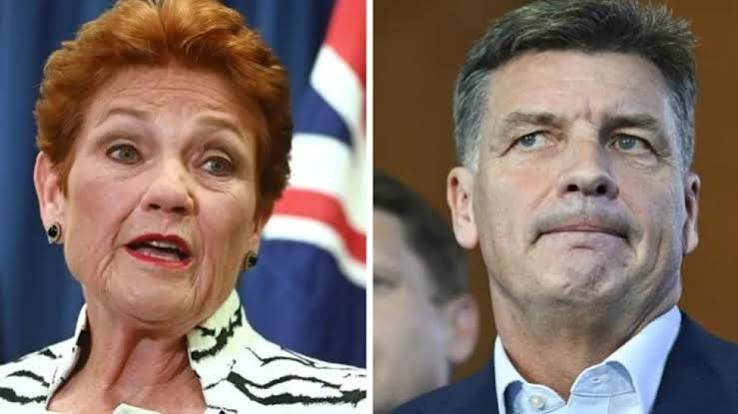
Australian politics is witnessing an increasingly bitter battle for the support of conservative and working‑class voters who feel abandoned by the major parties. At the centre of this clash is the rivalry between the Liberal‑National Coalition and Pauline Hanson’s One Nation — a contest that has now erupted into open argument over policy, credibility, and alliances.
The latest exchange began when Opposition Leader Angus Taylor launched a direct attack on One Nation, warning voters that its policies would bring long‑term economic damage. Within hours, Pauline Hanson fired back from the other side of the world, accusing the Coalition of stealing her party’s ideas — while her meetings in the United Kingdom have drawn fresh scrutiny from critics.
Main Events

Taylor’s Warning
Speaking in Sydney on Thursday night, Opposition Leader Angus Taylor delivered his strongest rebuke yet to One Nation and the voters considering switching their support. He acknowledged that many Australians were frustrated by cost‑of‑living pressures, high interest rates, and what they saw as ineffective leadership from Labor.
“I understand why some Australians think the way out is to blow the system up,” Taylor said. “But believe me — a moment of satisfaction is not worth an eternity of pain.”
He claimed One Nation’s policies were a “random grab bag” of inconsistent ideas that, if implemented, would push inflation higher, force interest rates up further, and add around $20,000 per year to the average new mortgage repayment. His message was clear: One Nation offers protest, not solutions.
Hanson’s Retort
From a moving vehicle on a British highway, Pauline Hanson recorded a video response, turning the argument back on the Opposition Leader. She argued that far from being unworkable, many of the Coalition’s current policies were copied directly from One Nation.
“Look at your budget reply speech — you picked up and repeated a lot of One Nation’s policies,” she said. “Reducing immigration… on net‑zero targets… you followed our lead. So don’t tell people they won’t work — that’s not true at all.”
Instead of fighting each other, Hanson called for unity: “The Australian people are crying out for change. Listen to them, Angus. Stop denigrating One Nation and let’s work together to get rid of Labor and the Greens.”
Controversial UK Meetings
While the policy debate rages, Hanson’s visit to the UK has raised separate concerns. During her trip, she has already recorded an interview with Stephen Yaxley‑Lennon, known publicly as Tommy Robinson — founder of the anti‑Islam group the English Defence League and a figure widely described as far‑right or extremist.
Robinson has criminal convictions including for passport fraud and assault, and is linked to fringe online platforms as well as Russian state‑affiliated media. His interview last month with Australian presenter Karl Stefanovic led to Stefanovic being sacked by the Nine Network.
Robinson praised Hanson online, saying their joint podcast would be released soon. Hanson is also scheduled to meet former UKIP leader and leading Brexiteer Nigel Farage at a conservative conference in London, further expanding her international contacts.
Critics argue these meetings risk normalising radical views and linking One Nation to groups outside Australia’s mainstream political traditions. Supporters, however, see them as an opportunity to build alliances with like‑minded voices who share concerns over immigration, sovereignty, and global governance.
Key Facts
- Clash: Opposition Leader Angus Taylor says One Nation policies would cause economic damage; Pauline Hanson replies that the Coalition copied her party’s ideas.
- Policy claims: Hanson points to immigration reduction and a slower approach to net‑zero emissions as examples where the Coalition has shifted toward One Nation positions.
- Economic warning: Taylor estimates One Nation’s plans could add $20,000 per year to average new mortgage costs.
- UK visit: Hanson has met Tommy Robinson and will meet Nigel Farage; Robinson has a history of controversy and criminal convictions.
- Strategic aim: The fight is over which party will capture the growing number of voters dissatisfied with both Labor and the Coalition.
My Professional Perspective
Having followed Pauline Hanson’s political career from its beginnings in the 1990s and watched the shifting dynamics of the Australian right over decades, I can tell you this: This fight is not just about policies — it is a battle for the soul of conservative politics and for the voters who feel no one speaks for them.
What Most Analysts Miss
Three key points lie beneath the shouting.
First, Hanson’s claim of policy influence holds more truth than many admit. For years, One Nation was dismissed as a protest party with no real impact. But over time, its core concerns — immigration levels, the pace of energy transition, cost of living, and national sovereignty — have moved from the fringe into mainstream debate. Whether by copying or by adapting to changing voter sentiment, the Coalition has indeed shifted its language and policies closer to where Hanson has stood for a long time. That is why she feels justified in saying: “You followed us.”
Second, Taylor’s warning reveals deep fear within the Coalition. The Opposition knows that every vote that goes to One Nation makes it harder to defeat Labor at the next election. Taylor’s description of “an eternity of pain” is not just an economic argument — it is an attempt to convince voters that choosing One Nation means throwing away their chance of effective government. The fact that he feels the need to make such a strong attack shows just how much support One Nation has regained.
Third, the UK meetings raise a different kind of question. Nigel Farage is a familiar, if divisive, figure in international conservative circles. But meeting Tommy Robinson crosses a line for many. It gives opponents an easy target: they can paint Hanson as aligned with radical, anti‑mainstream figures. For One Nation, this is a trade‑off — the meetings bring media attention and support from the party’s base, but also risk alienating moderate voters who are open to its policies but not its alliances.
The Deeper Meaning of the Conflict
This clash tells us that the traditional two‑party system is breaking down — and not just on the left with the Greens. On the right, voters are splitting into two groups:
- Those who still believe the Coalition is the only realistic way to form government.
- Those who feel the major parties are all the same, and are willing to back One Nation to send a message, even if it means no immediate change in government.
The arguments about “copied policies” and “bad economics” are just the surface. At heart, this is about trust. Voters are asking: Which leader actually believes what they say? Who will fight for us, not just for power?
Why This Matters Beyond Parliament
- For the Coalition: It faces a dilemma — if it moves too far to the right to stop Hanson, it risks losing moderate voters. If it stays in the centre, it risks losing voters to One Nation.
- For One Nation: It has the momentum, but faces the challenge of turning protest votes into credibility. Controversial international links can help energise its base, but may stop it from growing into a broader political force.
- For voters: They now have more choice — but also more confusion. The question is no longer just “Labor or Coalition”, but “What kind of change do I want, and which party can actually deliver it?”
Unanswered Questions

- Is the Coalition’s shift on issues like immigration and energy a genuine change, or just an election‑year tactic?
- Will Pauline Hanson’s meetings in the UK help or harm her party’s standing among mainstream Australian voters?
- Can the two sides on the right ever work together, or will their rivalry only guarantee Labor remains in power longer?
Beyond the Headline
In the end, this clash confirms one reality: Pauline Hanson and One Nation are no longer just a side note in Australian politics — they are a major factor shaping every debate, every policy, and every election strategy.
Whether you agree with them or not, their rise is a direct result of millions of Australians feeling unheard. The Coalition’s choice is simple: adapt to that reality, or continue fighting it — and risk being overtaken.
Conclusion

The exchange between Angus Taylor and Pauline Hanson is more than just a political squabble. It marks a defining moment for the right in Australia.
Taylor warns of economic chaos; Hanson claims her ideas are now mainstream policy. Meanwhile, her travels abroad bring both new alliances and new controversy.
For voters, the choice is becoming clearer: Do you want the familiar, established parties, even if they change slowly? Or do you want a more radical voice, even if it comes with more risk and uncertainty?
That is the question that will shape the next chapter of Australian politics — and it will be answered at the ballot box.