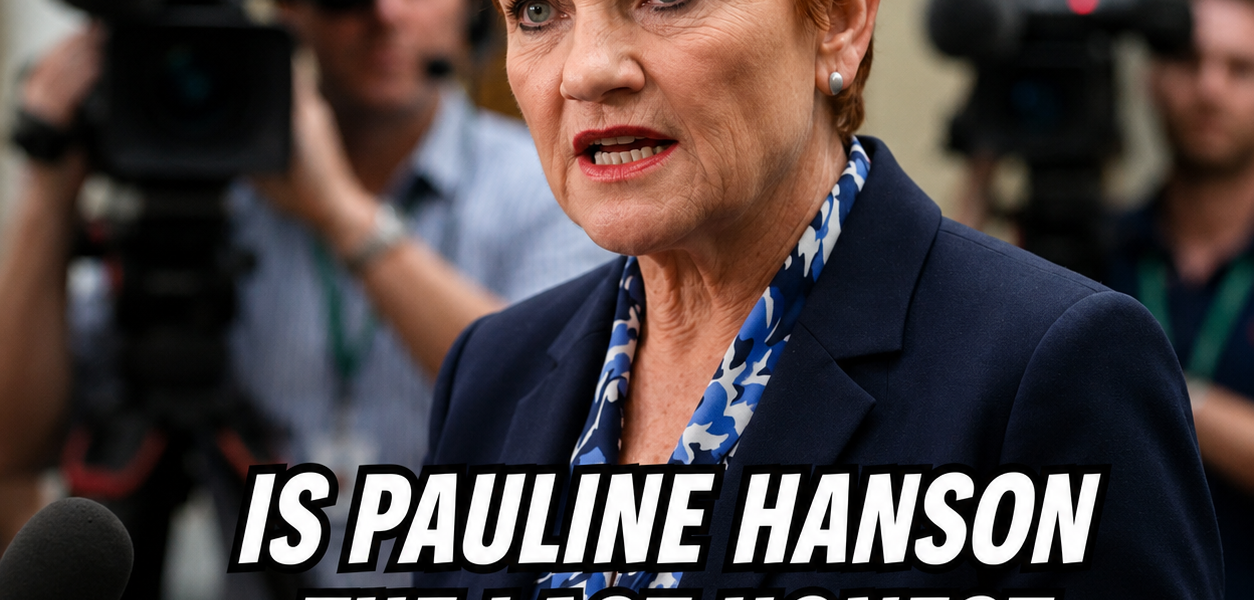
Australia at a Crossroads: The Rise of Pauline Hanson and One Nation’s Moment. u1

Pauline Hanson and One Nation: Is Australia Witnessing a Historic Political Realignment?
Australia’s political landscape appears to be entering one of its most volatile periods in decades.
Rising living costs, persistent housing shortages, concerns about energy prices, pressure on public services and continued debate over immigration have created an environment in which many voters are reassessing their traditional political loyalties.
At the centre of that shift is Pauline Hanson and Pauline Hanson’s One Nation, which has experienced a significant rise in public support during 2026.
According to recent polling, One Nation has reached 27% of the national primary vote, placing it firmly among Australia’s major political forces rather than the fringe position it occupied for much of its history. (The Australian)
That momentum has coincided with several high-profile political developments.
Former Nationals leader Barnaby Joyce joined One Nation, giving the party one of Australia’s most experienced regional politicians. Meanwhile, One Nation achieved a historic breakthrough by winning the Division of Farrer by-election, securing its first directly elected seat in the federal House of Representatives. (ABC News)

Taken together, these developments suggest that dissatisfaction with Australia’s established political parties has created opportunities that would have seemed unlikely only a few years ago.
Pauline Hanson’s Political Longevity
Few Australian politicians have experienced a career as turbulent—or as resilient—as Pauline Hanson.
First elected to federal Parliament in 1996 before establishing One Nation in 1997, Hanson has remained one of Australia’s most recognisable political figures despite repeated electoral defeats, controversies and political isolation.
Her return to the Australian Senate in 2016 marked a remarkable political comeback.
Nearly three decades after first entering national politics, Hanson remains leader of the party she founded.
In late 2025, the party also began simplifying its public branding from “Pauline Hanson’s One Nation” to simply “One Nation,” a move widely interpreted as an attempt to broaden its appeal beyond its founder while retaining its established identity.
Why Support Appears to Be Growing
Supporters argue that One Nation’s recent momentum reflects long-standing public frustration rather than a sudden political phenomenon.
Among the issues frequently identified by supporters are:
- Cost-of-living pressures.
- High immigration levels.
- Housing affordability.
- Energy prices.
- Concerns over government regulation.
- Regional economic decline.
- National sovereignty.
Many One Nation voters describe themselves as feeling overlooked by successive governments.
The party has particularly targeted regional communities, farmers, small-business owners, tradespeople and outer-suburban voters who believe economic and cultural concerns have received insufficient political attention.
Whether or not one agrees with One Nation’s policy solutions, there is little doubt that the issues it highlights resonate with many Australians experiencing financial pressure.
Energy Policy Remains Central
Perhaps no policy area better illustrates One Nation’s political identity than energy.
The party advocates:
- Ending net-zero commitments.
- Expanding coal production.
- Increasing domestic gas development.
- Investigating nuclear power.
- Reducing energy costs through greater use of Australia’s natural resources.
Supporters argue Australia should take greater advantage of its abundant coal, gas and uranium reserves rather than relying heavily upon renewable energy technologies.
Critics respond that delaying emissions reduction could expose Australia to greater long-term economic and environmental risks while discouraging investment in emerging industries.
The debate reflects broader divisions evident throughout many developed economies as governments seek to balance affordability, energy security and climate policy.
Immigration and Housing
Immigration has remained one of Hanson’s defining political issues since the 1990s.
Today, the discussion increasingly intersects with Australia’s housing shortage.
One Nation argues that reducing net migration would ease pressure on housing supply, infrastructure and public services.
The party has also proposed:
- GST relief on building materials.
- Greater protection for Australian farmland.
- Restrictions on foreign ownership of strategic assets.
- Faster infrastructure delivery.
Supporters believe these measures would help restore home ownership opportunities for younger Australians.
Critics argue that Australia’s housing shortage has multiple causes—including planning restrictions, construction costs and insufficient housing supply—and caution that immigration policy alone cannot resolve the problem.
Barnaby Joyce’s Defection
Barnaby Joyce’s decision to join One Nation represented one of the most significant political developments of the year.

As a former Deputy Prime Minister and former leader of the National Party of Australia, Joyce brought decades of ministerial experience and deep connections throughout regional Australia.
His move suggested that dissatisfaction within conservative politics had extended beyond voters into senior political figures themselves.
For One Nation, Joyce’s arrival provided additional credibility among rural and agricultural communities.
For the Coalition, it represented another challenge at a time when conservative politics is becoming increasingly fragmented.
A Historic Electoral Breakthrough
Polling gains became tangible electoral success with One Nation’s victory in the Farrer by-election.
Businessman David Farley became the first One Nation candidate directly elected to the House of Representatives after winning the seat previously held by the Liberal Party. (ABC News)
Although one lower-house seat does not transform Australia’s parliamentary balance immediately, symbolically the victory was significant.
It demonstrated that One Nation could convert growing polling support into electoral representation outside the Senate.
Political analysts will now watch closely to determine whether Farrer represents an isolated success or the beginning of a broader electoral trend.
Criticism and Continuing Controversy
No assessment of Pauline Hanson would be complete without acknowledging the substantial criticism she continues to attract.
Opponents argue that plain speaking should not be confused with factual accuracy or effective policy.
Over the years, Hanson has faced criticism over statements concerning race, immigration, climate change and public health.
Critics argue that some of her rhetoric has contributed to social division or oversimplified complex policy challenges.
Others note that Australia’s Parliament already contains numerous independent and minor-party representatives advocating for communities they believe have been neglected.
Supporters counter that Hanson’s willingness to discuss politically sensitive issues distinguishes her from politicians they perceive as constrained by party discipline or political caution.
This divide has remained remarkably consistent throughout her career.
My Professional Perspective
Pauline Hanson’s current political resurgence tells us at least as much about Australia as it does about Pauline Hanson herself.
Political parties rarely experience sustained growth simply because of charismatic leadership.
More often, they benefit when significant numbers of voters become dissatisfied with existing political choices.
That appears to be the broader story unfolding in Australia.
Cost-of-living pressures, housing affordability, energy prices and regional economic concerns have created fertile political conditions for parties promising substantial change.
One Nation has successfully positioned itself as the principal beneficiary of that frustration.
However, there is an important distinction between growing public support and governing successfully.
Campaigning often rewards simple messages.
Government requires detailed implementation.
Reducing migration, expanding energy production or cutting regulation may prove politically popular with some voters, but each objective involves practical, legal, fiscal and administrative complexities that extend well beyond campaign rhetoric.
Another noteworthy development is the changing nature of conservative politics in Australia.

For many years, dissatisfaction on the political right primarily benefited the Liberal–National Coalition.
Increasingly, however, voters dissatisfied with mainstream conservative parties appear willing to consider alternatives.
Barnaby Joyce’s move to One Nation symbolises that broader shift.
Perhaps the most important question is whether One Nation’s support represents a temporary protest or a lasting realignment.
History provides examples of both.
Some populist movements experience rapid growth before fading.
Others permanently reshape national politics by forcing established parties to adjust their policies.
It is still too early to determine which path One Nation will follow.
Finally, Pauline Hanson’s greatest political achievement may not ultimately be measured by whether she ever leads a government.
It may instead be measured by how effectively she has influenced the national conversation.
For nearly thirty years, immigration, regional disadvantage, national identity and energy policy have remained central themes of her political message.
Regardless of whether Australians support or oppose her, many of those issues now occupy a far more prominent place in mainstream political debate than they did when One Nation was first established.
That influence should not be underestimated.
Conclusion
One Nation’s recent rise marks one of the most significant developments in Australian politics in recent years. Strong polling, Barnaby Joyce’s high-profile defection and the party’s historic victory in the Farrer by-election suggest that it has moved beyond its long-standing role as a protest movement to become a more consequential force in national politics. (ABC News)
Supporters view Pauline Hanson as a consistent advocate for issues they believe the major parties have neglected, including immigration, energy security, housing affordability and regional development. Critics argue that while these concerns are genuine, the party’s proposals often oversimplify complex policy challenges or remain insufficiently developed for government.
Whether One Nation can sustain its momentum will depend on more than opinion polls. As expectations rise, the party will face greater scrutiny over the practicality, affordability and long-term consequences of its policies.
The broader significance extends beyond one leader or one party. Australia’s evolving political landscape reflects deeper questions about economic security, national identity and public confidence in traditional institutions. The next phase of this debate will be shaped not only by political messaging but by which parties can persuade voters that they have credible solutions to the challenges confronting the country.
The defining question may therefore be this: is One Nation’s rise the peak of a protest movement, or the beginning of a lasting realignment that reshapes Australian politics for a generation?