
Australia’s Multicultural Future Under the Spotlight: Why the Debate Has Become About More Than Immigration
Few issues cut more deeply into a nation’s identity than the question of who it is, what it stands for, and how it should evolve. In Australia, that conversation has once again moved to the center of national politics after Prime Minister Anthony Albanese forcefully defended multiculturalism, describing it as an essential part of the country’s identity and insisting Australia “has never been a monocultural society.”
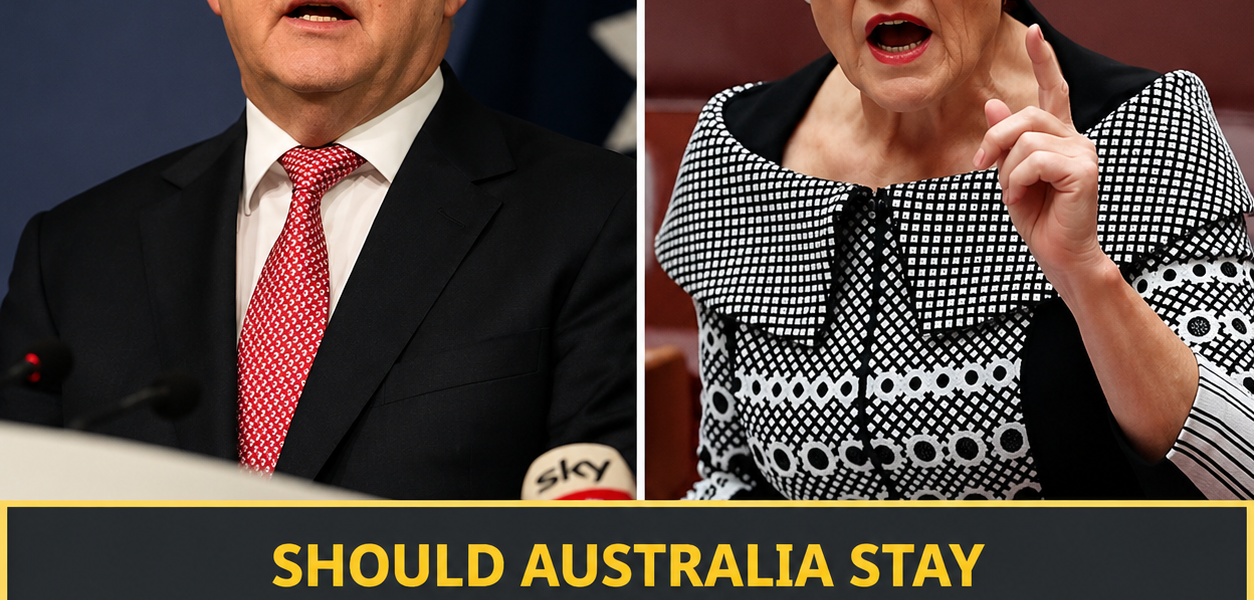
His comments were not made in isolation. They came amid renewed criticism of Australia’s immigration and integration policies from Pauline Hanson and One Nation, who continue to argue that the nation should place greater emphasis on a shared Australian culture. Hanson has repeatedly maintained that her position is not about opposing migrants or preventing people from celebrating their cultural heritage. Instead, she argues that everyone who settles in Australia should place Australian laws, values, customs, and national identity above all other affiliations.
The exchange has quickly grown beyond a disagreement between political leaders.
It has become a broader national discussion about immigration, housing affordability, infrastructure, economic pressure, population growth, and the kind of country Australians want to leave for future generations.
The debate is no longer simply about multiculturalism.
It is increasingly about Australia’s future.

Albanese Defends Australia’s Multicultural Identity
Prime Minister Anthony Albanese has consistently argued that multiculturalism represents one of Australia’s greatest strengths.
Responding to criticism from One Nation, Albanese rejected suggestions that Australia should move toward a single dominant cultural identity.
Instead, he argued that diversity has always been woven into Australia’s national story.
According to the Prime Minister, modern Australia has been built by successive generations of migrants who arrived from every corner of the world seeking opportunity, security, and a better future for their families.
Over decades, those migrants have helped build Australia’s economy, strengthened its workforce, enriched its education system, and contributed to its international reputation as one of the world’s most diverse democracies.
Supporters of Albanese’s position argue that multiculturalism does not weaken national unity.
Rather, they believe it allows Australians from different backgrounds to preserve elements of their heritage while remaining united by common democratic institutions, equal rights under the law, civic responsibility, and respect for Australian values.
For them, diversity and national unity are not opposing ideas.

They are complementary.
One Nation Presents a Different Vision
Pauline Hanson and One Nation have long advocated a different approach to national identity.
While critics often characterize the party as opposing multiculturalism altogether, Hanson has consistently framed her argument differently.
She says Australia should encourage cultural integration rather than cultural separation.

Her position centers on the belief that newcomers should fully embrace Australian customs, values, legal principles, and social expectations while treating cultural traditions as secondary to a common national identity.
Supporters argue this approach strengthens social cohesion by ensuring Australians share a common civic culture regardless of ethnic or religious background.
They contend that strong integration helps reduce social fragmentation and reinforces trust between communities.
Critics, however, argue that Australia’s multicultural framework already requires migrants to obey Australian law and participate in Australian society while allowing them to maintain their cultural traditions.
From their perspective, Australia’s diversity has been one of its defining national successes rather than a source of division.
Immigration Pressures Fuel a Larger Debate
Although multiculturalism dominates the headlines, many voters appear to be focused on something broader.
Across Australia, concerns about rising living costs continue to dominate public discussion.
Housing affordability has deteriorated significantly in many cities.
Rental markets remain under pressure.
Infrastructure projects struggle to keep pace with population growth.
Hospitals, schools, transport systems, and essential public services face increasing demand.
For many Australians, these everyday challenges have become intertwined with conversations about immigration.
Some argue Australia’s migration program has expanded faster than housing supply and public infrastructure can accommodate.
Others caution against attributing complex economic challenges solely to migration, noting that housing shortages, planning restrictions, construction costs, labor shortages, and interest rates all contribute to current affordability problems.
This distinction is important.
The debate increasingly revolves not around whether immigration benefits Australia, but whether population growth is being managed in a sustainable way.
Why the Political Stakes Continue to Rise
The issue has become increasingly significant as One Nation continues attracting support from voters dissatisfied with both major parties.
Questions surrounding migration levels, border security, national identity, and economic pressure are expected to remain central issues heading toward Australia’s next federal election.
Political analysts note that Labor, the Coalition, and minor parties alike face growing pressure to present detailed policies rather than broad slogans.
Australians increasingly want practical answers to difficult questions.
How many migrants can Australia successfully accommodate each year?

Can housing construction keep pace with population growth?
How should governments strengthen integration while respecting cultural diversity?

What policies will improve affordability for younger Australians struggling to enter the housing market?
These questions extend well beyond ideological differences.
They concern the practical management of a growing nation.

A Debate That Reflects Broader Global Trends
Australia is far from alone.
Across Europe, North America, and parts of Asia, governments are confronting similar debates over immigration, integration, labor shortages, population growth, and national identity.
Countries face the difficult task of balancing economic needs with infrastructure capacity.
Businesses often seek additional workers.
Governments aim to stimulate economic growth.
Communities simultaneously worry about housing shortages, healthcare access, transport congestion, and maintaining social cohesion.
Australia’s debate therefore reflects broader international pressures rather than a uniquely Australian phenomenon.
The challenge lies in balancing competing priorities without reducing complex issues to simplistic political narratives.
My Professional Perspective
Having covered politics for decades, I believe this story is often misunderstood because the public conversation tends to focus on labels rather than underlying concerns.
The headline asks whether Australia should remain multicultural.
Many voters, however, appear to be asking a different question altogether.
Can Australia continue expanding its population while ensuring housing, infrastructure, healthcare, education, and public services keep pace?
Those are not necessarily the same debate.
Supporters of multiculturalism often emphasize Australia’s remarkable success in integrating migrants over many decades.
The evidence supporting those contributions is substantial.
Migrants have played significant roles in building businesses, strengthening universities, filling workforce shortages, advancing medical research, and enriching Australian cultural life.
At the same time, concerns expressed by critics cannot simply be dismissed as hostility toward diversity.
Many Australians raising questions about migration point instead to practical issues they experience every day.
Longer hospital waiting times.
Higher rents.
Difficulty purchasing a first home.
Traffic congestion.
Pressure on public transport.
Rapid changes within local communities.
Whether immigration is the primary cause of those challenges remains contested among economists and policymakers.
Yet politically, perception often matters almost as much as statistical analysis.
When people feel their standard of living is becoming harder to maintain, they naturally seek explanations—and political leaders are expected to provide credible solutions.
Another overlooked aspect of this debate concerns national identity itself.
Australia has historically demonstrated a remarkable ability to integrate successive waves of migrants while maintaining stable democratic institutions.
That achievement did not happen automatically.
It required investment in education, language support, employment opportunities, civic participation, and strong legal institutions.
Maintaining social cohesion in the future will likely require continued attention to those same foundations.
Perhaps the greatest mistake politicians could make would be framing the issue as a simple choice between multiculturalism and national unity.
Most Australians appear to value both.
They want a country that welcomes newcomers while also ensuring everyone respects Australian laws, democratic principles, equality before the law, and shared civic responsibilities.
Those goals need not be mutually exclusive.
The more difficult challenge lies in determining how immigration policy, infrastructure investment, housing supply, and integration programs can work together effectively.
Political slogans alone will not answer those questions.
Detailed policy will.
Looking Ahead
With the next federal election still some time away, the debate over multiculturalism is unlikely to fade.
Instead, it is expected to merge increasingly with discussions surrounding housing affordability, economic growth, infrastructure planning, workforce shortages, and Australia’s long-term population strategy.
Both supporters and critics of current immigration settings agree on at least one point.
Australians deserve clear, transparent policies that explain not only how many people the country can welcome but also how governments intend to provide the homes, transport networks, schools, hospitals, and employment opportunities necessary to support continued growth.
Ultimately, this debate is not simply about culture.
It is about confidence.
Confidence that Australia can continue welcoming people from around the world while preserving social cohesion, strengthening economic opportunity, and maintaining the quality of life that has long attracted migrants to its shores.
The conversation sparked by Prime Minister Albanese and Pauline Hanson reflects a nation asking fundamental questions about its future.
The answers will likely influence far more than the next election.
They may help shape Australia’s identity for decades to come.
Whether Australians ultimately favor maintaining the current multicultural framework, strengthening integration requirements, adjusting immigration levels, or pursuing a combination of these approaches, one reality is becoming increasingly clear.
The country is entering a period of serious reflection about who it is today—and who it wants to become tomorrow.