One Bowl of Her Stew on a Cold Night—The Rancher Never Looked at Another Woman. t1

One Bowl of Her Stew on a Cold Night—The Rancher Never Looked at Another Woman

The cold had come down off the divide 3 days early that autumn, and by the time the eastbound let off its one passenger at Tamarack, the trough by the depot wore a skin of ice thick enough to hold a thrown stone. Cora Larkin came down the iron steps with both hands full and the wind taking the breath straight out of her chest.
Her gray wool coat had gone thin at the cuffs. A man’s muffler wound twice around her throat. Her boots resoled once already and past taking a second mending. In one hand she carried a tin trunk roped shut, the latch broken somewhere west of Bismarck. In the other she held a split willow basket with a cloth tied down over the top, and under the cloth, folded in flour sacking, lay a black iron pot that had been her mother’s and her mother’s mother’s before that.
The one thing she had carried out of every hard place she had ever been made to leave. She set the trunk on the boards, looked up the single street the town allowed itself, and the street looked back at her the way towns look at a woman who has arrived alone with all she owns in her two cold hands. A man stood waiting under the depot eve with his collar up and his thumbs hooked in a good wool vest.
He was past 40 and gone soft through the middle, side whiskers oiled flat, a watch chain heavy enough to anchor a skiff. This was Asa Crandall, who kept the freight office and half the mercantile, and who had set three lines in a St. Paul paper asking for a wife. He looked Cora over the way a man looks at a horse he has already decided against.
“You’re the Larkin woman,” he said. It was not a question, and he kept his hands where they were. “I am,” she said, “Mr. Crandall. You’re older than the letter let on.” He pitched it loud, the way a man says a thing he wants the boards to carry. “Heavier, too. I wrote for a young woman, a girl to keep a house 20 years and fill it with sons, not a widow with the road still on her boots.
” A freight hand by the dock laughed into his glove and Crandall warmed to the sound of it. I’ll be plain since plain talk is cheap out here. I’ve no use for you. Wait for the westbound Thursday and ride back the way the railroad fetched you. Cora did not give him what the freight hand wanted. Not tears and not temper.
She stood with the wind worrying her hem and let the words land and slide off her the way sleet slides off slate. Against the depot wall, out of the worst of the wind, a boy sat hunched, the agent’s grandson by the look of him. Eight or nine, blue about the mouth, his coat two sizes outgrown and not a scrap of wool at his neck.
While Crandall was still talking, Cora crossed to the child, unwound the muffler from her own throat, and wrapped it twice around his, tucking the ends down into his coat with the plain sure hands of a woman who had warmed children before. “There,” she told him low, “that will keep the cold off you till you’re home.
” Then she straightened, lifted her trunk again, and that was the whole of the answer Asa Crandall got from her. If this story is touching your heart, take a moment to hit that like button and subscribe. Drop a comment and let me know where you’re watching from. And if a woman in your family came west with nothing and built a home, share her name in the comments. I read everyone.
What Crandall could not have read off the road on her was where that road had carried her to bring her here. Cora had been raised over a drover’s boarding house in eastern Ohio, where her mother fed harvest crews and trailmen and anyone else who came in off the pike with coin or a hard luck story. And Cora had learned to potter at her mother’s elbow before she was tall enough to see down into it.
She learned that a tough cut fed more men than a tender one if you gave it the hours it asked for. A little fat and a little flour could be made to stand in for a great deal of money. And a hungry man would forgive a cold room and a hard bench if what you set in front of him tasted like somebody had meant it.
At 19, she married Daniel Larkin, a steady man with more hope in him than sense, and the two of them went west to prove a claim on the high Dakota grass. They had four hard years out there and one good one. And in the good one a daughter came, a small dark-headed girl they named Mercy, who laughed before she could sit up on her own.
The fever came through the second spring after that. It took Mercy in 3 days and Daniel in five, and Cora dug both graves under the same cottonwood and did not have the breath left over to weep until the digging was done. The bank took the claim that winter for the note Daniel had signed against it, and there was no one left in the world to take Cora in.
Years before the fever, in a bad winter of ’79, a railroad survey crew had been caught by an early storm 2 miles off the Larkin claim, 12 men with no provision laid by, and Cora had cooked for those men out of next to nothing for the better part of 2 months and never lost a one of them to hunger or to cold.
She had not thought of it then as anything but what a person did for her neighbor. Those men had come up to her claim shanny out of the white with their beards frozen to their collars, and she had fed them on a barrel of beans, a side of salt pork gone mostly to rind, and whatever the snares brought in, and she had made a soup of melted snow and cracked bones go around a crew of 12 and somehow stretched it to the morning the road opened.
They had wanted to pay her when they went, and she had told them to keep their wages and send her a letter come summer to say they had got home safe, and three of them had, and she kept those three letters folded into the lid of the very trunk that sat roped on the depot boards behind her now. When Crandall’s three lines reached her by way of a posted notice in town, she answered them, not because she had any hope left in her, but because it was a door, and she had run clean out of doors. She did not beg. She never had.
She had spoken to the depot agent at every stop along the line as if he were a man worth her courtesy, because he was, and she had given a starving dog at one platform the rind off her only cheese, and she had meant to keep on living that way until something made her stop. Now, she stood in Tamarack with the cold coming on like a wall, and the one man who had a reason to keep her telling the whole town she was nothing.
The agent’s name was Pruitt, an old hand with a kind enough face worn hard by winters. Cora asked him plainly what a night at the boarding house ran, and whether there was work to be had against it, scrubbing or cooking or any honest thing. Pruitt looked at her, and then he looked at the muffler around his grandson’s neck, and his face did a thing it had not done while Crandall was talking.
“Boarding house is the Widow Sexton’s,” he said. “She wants her coin up front, and she’s near full with drummers caught off the road. Cold like this brings them all in to roost.” He said it gently, but it was a no all the same. By then a second man had come out of the mercantile and stood under the awning with a list in his fist, and the snow starting to find his shoulders.
He was tall and worn down close to the bone, a year and some past his own grief, and wearing it where it did not show to a stranger, a rancher by his boots, and by the way he held his hat in both hands. He had come to town for flour and salt and lamp oil off a list his hired man’s sick wife had written out for him, and to ask the doctor what more could be done for her, and he had meant to be gone before the weather closed the road.
He had her all of it, Crandall’s plain talk and the frayed hand’s laugh and the agent’s gentle no, and he had said nothing because he was a man who had let his own house go cold from the inside and did not trust himself to set anyone else’s right. Crandall, having dismissed her once, could not seem to leave it alone because the town was watching and he wanted to stand in it as the wrong party.
“Don’t any of you take her in on my account,” he said to the boardwalk at large. “I brought her nothing. I owe her nothing. A man advertises honest and the agency sends him a beggar in a borrowed coat and that is no fault of his.” Two women on the mercantile step put their heads together and whispered behind their gloves. The freight hands grinned.
Cora set the basket down at her feet with both hands, the way you set down a thing you need to be careful with, and she did not drop her eyes from the street. The snow thickened while they argued over her as if she were freight gone unclaimed. Pruitt came out and said there would be no more trains until the line was dug clear, maybe two days, maybe four by the look of the sky.
The widow Saxton sent word by a boy that she was full and would not turn a paying drummer out for a woman with no coin, storm or no storm. Somebody asked Crandall straight, since he had fetched her all this way, would he not stand her the price of a room for the few nights until the westbound ran again.
“I’ll not throw good money after a bad bargain,” he said, loud enough for the boards to carry it. “She is no concern of mine.” And there he nailed himself to it in front of the whole town, which was the kind of thing he would come to wish he had not done. The cold that was coming would kill a person caught out in it overnight. Cora had nowhere to go.
She did not beg for a place. She told Pruitt she would sit up by the depot stove in the waiting room if he would allow it and be no trouble to a soul and Pruitt looked sorry and looked like a man whose own house was already full of his daughter’s family and did not answer her right away.
The light was going fast the way it goes in that country once the sun drops behind the divide and the cold came down another notch with it, the kind of cold that stops being weather and starts being a thing with intent. A storekeeper’s wife crossing the street with her baskets load when she saw Cora standing there and looked at her and looked away and went on.
And that was the worst of it somehow, not the cruelty but the turning away, the way a whole town could decide a person was already gone and quit seeing her while she stood there breathing in front of them. Cora pulled her thin coat closer and did not let her chin drop. She had buried a husband and a daughter under one tree with her own two hands.
She was not going to be undone by a cold street and a soft man’s tongue. That was when a tall man came down off the boardwalk into the snow. He crossed to Cora and took his hat off, which a man does not do in a storm without a reason. “Ma’am,” he said, “name’s Gideon Marsh. I run cattle 8 miles north up the Tamarack road.
” He spoke flat and slow, picking the words out one at a time like a man and used to handling them. “I have a sound team and a good wagon and a stove that draws and a roof that holds. I’ve two children out there that haven’t had a fit supper since my hired man’s wife took sick and nobody to do for them but me and I’m no hand at it.
” He turned the hat in his fingers. “There’s a bed and a fire for as long as this weather holds you. I’d ask you to cook and mind the young ones while you’re under my roof and nothing past that. No claim on you and none met. You would be doing me the favor.” He said it plain and hard so the town could not make it into a thing it was not.
And a freight hand had stopped their grinning. Cora looked at him a long moment. A strange man and 8 miles of road in a storm and a house she did not know. And she waited against the depot stove and the killing cold and she found that the man’s eyes did not slide off of the way every other pair in that street had.
“I can cook,” she said, “and I’m good with children, Mr. Marsh. I’ll earn the roof.” “It’s Gideon,” he said, “get up out of the weather then.” He took a rope trunk before she could lift it, and he carried the willow basket like he understood there was something inside it worth carrying gentle, and he handed her up onto the wagon bench and laid the buffalo robe across her knees without her having to ask.
The 8 miles took near 3 hours behind the team with the snow coming sideways and the road gone under white, and Gideon Marsh said perhaps a dozen words the whole way, which suited her, for she had a dozen of her own. He told her his wife’s name had been Helen, and that she had been gone a year the past harvest, that the boy was Toby and was 10, and had got hard the way boys do when there is no one left to be soft for them, and that the girl was Nell and was five and had stopped talking much since the burying and would not eat right for anyone. His hired man was Otis Pratt, he
said, and Otis’s wife Della had always done the cooking and the mending for the house along with her own, and Della was laid up bad now with her lungs and a baby coming wrong, which was the whole reason the house had gone to ruin, and the whole reason he had been in town to play the doctor.
Then he ran clean out of words, and Cora let him be and watched the country come at them out of the storm. The ranch house showed itself at last as a low square of dark with one window lit yellow against all that white, and Cora’s chest did a thing she had not let it do in a long while at the plain sight of a lamp burning in a window for somebody to come home to.
Inside, the house was cold the way a house gets cold when the warmth has gone out of more than the stove. There was ash banked gray in the firebox and the smell of the place where no one had cooked a real meal in a long time, scorched coffee and dust and coal grease all soaked into the walls. Two children stood at the foot of the stairs and stared at her.
The boy in front with his jaw set hard as his father’s and his eyes saying plain that she was not wanted and would not be, and the little girl half behind him with a rag doll gone limp in her fist and a face so still it hurt to look at. This is Mrs. Larkin, Gideon said stamping the snow off his boots. She’ll cook and see to you while the weather is down. Mind her.
We don’t need minding, Toby said. I’ve been managing. You burned the last of the side meat, Gideon said not unkind. And you put salt in Nell’s milk thinking it was sugar and she would not drink it. Mind her. The boy went red and said nothing. And that was the nearest thing to a welcome the house had in it.
Corra did not ask the children to like her and did not try to make them. She took off her thin coat and rolled her sleeves and went to the cold stove like it was an old quarrel she knew how to settle. She cleaned the firebox down to bare iron and laid the fire the way it wanted laying and had a drawing hot inside a quarter hour and the kitchen began by inches to stop being a tomb.
She took a lamp to the root cellar and the cold shed and read what the place had the way another woman might read a letter. A hindquarter of venison hung in the shed frozen hard and good. In the cellar bins there were parsnips going soft at the tips but sound. Onions sprouting their green, a heap of turnips, a crock of beef dripping gone white, a sack of flour half spent, salt in a box, a heel of bread dried past eating on its own and a little crock of sorghum.
From her own basket she took a tin no bigger than her palm and in it the dried sage and the wild things she gathered and put by wherever she lit because a woman who can find the herbs can make a poor larder taste like a kind one. She cut the venison off the bone in good chunks and dried each piece on a cloth for meat will not brown if it goes wet into the pot.
She rendered a little of the dripping till the bottom of her mother’s iron pot shown and she browned the meat hard and slow in two batches so the pieces took color instead of stewing pale and gray and she scraped up the dark sweet crust off the iron with a splash of water and let it cook down again, building the bottom of the pot the way her mother had stood over her shoulder to teach her 30 years gone.
She set it all to simmer low with water and a knob of the sorghum to cut the gamey edge, and she went out and in by the clock as the dark came down, putting the onion in when its hour came and the turnip after it, and the parsnip last of all so it would not go to mush. A pinch of her sage rubbed fine between her palms, the salt by tasting and not by guessing.
She set the dry bread to soak in a little of the broth for it thicken the whole of it kind and smooth. While the stew found its simmer, she got the flour down and cut lard into it with two knives the way her mother had, quick so the warmth of her hands would not spoil it, and she rolled it out and cut the rounds with the rim of the glass and set a pan of biscuits in the oven box to brown because a stew without something to sop it up was only half a kindness done.
While she worked she hummed, low and without thinking about it, the old tune to abide with me, the same way her mother had hummed over that same pot. The house filled up slow with the smell of it, meat and onion and sage and something underneath that a body could not put a name to but knew all the same, and the smell went up the stairs and got under the closed doors.
Toby drifted in first, pretending he had only come for water and then forgot to leave, standing against the wall with his arms crossed and his nose working in spite of him. Nell came after, small and silent, drawn down the stairs by a smell her body remembered from before the year went cold, and she stood in the kitchen doorway with a doll hanging forgotten at her side and watched the steam come off the pot.
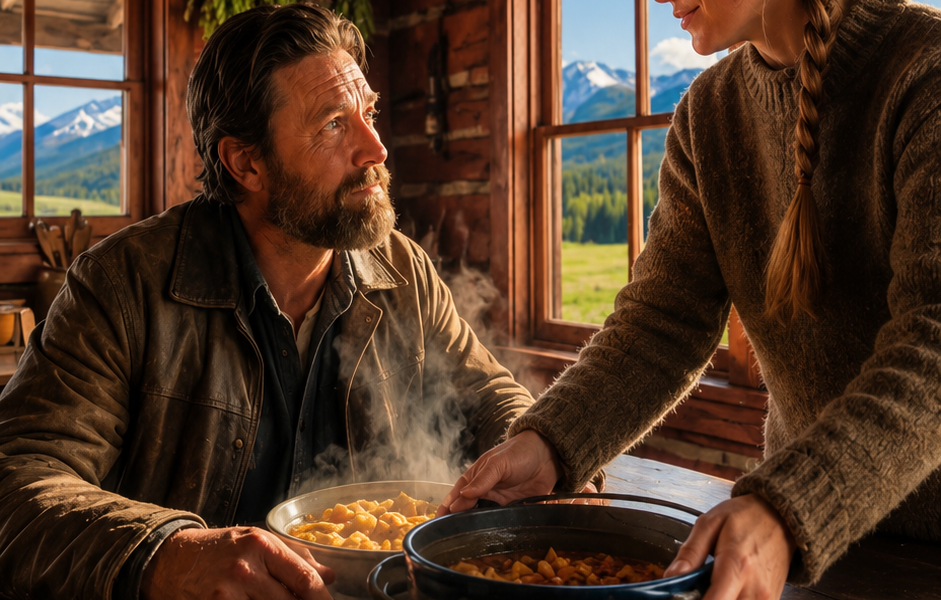
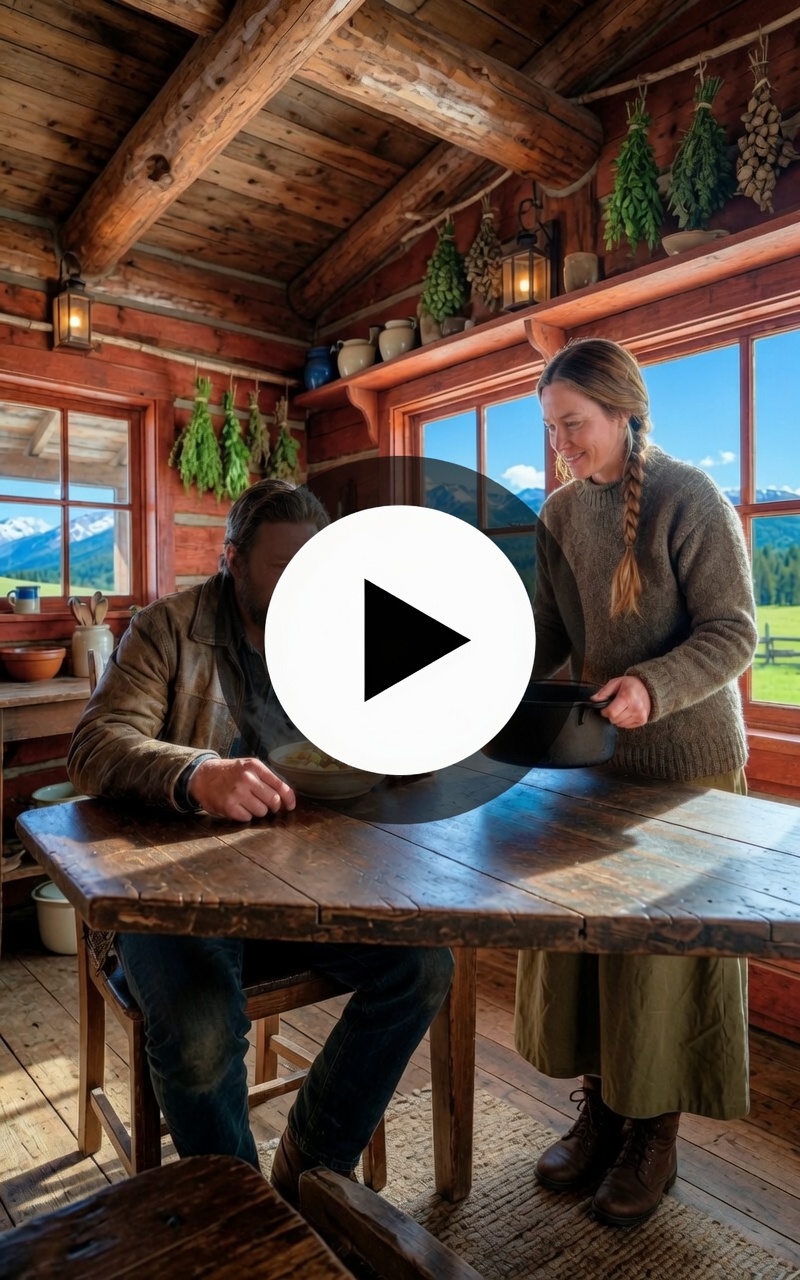
Otis Pratt came over from the bunkhouse stamping snow, and behind him, wrapped to the chin in a quilt and leaning on his arm, came Della, pale and thin and breathing careful, who had caught the smell of it clear across the yard and would not be kept to her bed. By full dark, the storm was screaming around the eaves fit to tear the roof clean off, and inside the kitchen had gone gold with lamplight and warm through for the first time in a year, and Cora set the table the way a table is meant to be set and ladled out the stew. She filled a bowl for each child
and one for Otis, and she carried one careful across to Della, and she set the last in front of Gideon Marsh, and then she stood back against the dry sink with her hands folded and let the food do what words could not. If you’re still with us on this porch, do this story a kindness.
Hit subscribe and turn on the bell. These quiet stories don’t get told if you don’t share them. Tag someone who loves a true frontier story in the comments. Let them know we’re telling these the way they deserve to be told. Toby took one mouthful and went still, and then he ate with both elbows on the board and his head down like a boy who had been hungry a great deal longer than one day, like a boy eating his way back toward something he had lost.
Nell lifted her spoon in her small fist and took three slow mouthfuls, and then she set the spoon down and looked up at Cora across the steam, and in a voice gone rusty from a year of not being used, she said, “It tastes like the kitchen used to.” Nobody moved. Della had her hand pressed to her mouth.
Then Nell looked across the table at her father and said, smaller still, “Papa, can she stay until it stops being cold?” The wind filled up the long quiet that came after. Gideon Marsh sat with his spoon halfway to his mouth and his jaw working and his eyes gone bright and hard. A whole year of holding the roof of himself up coming loose over a bowl of stew on a cold table, and he set the spoon down without a sound and got up and went to the black window and stood with his back to the room so his children would not see his face. He stood there a while. When he
spoke it was low and rough and not quite steady, and he did not turn around. “Helen used to brown it like that,” he said. “Nobody’s done it right since she went.” And that was the night the thing in him that had been looking past the whole world, past every face in three counties, came to rest on the woman at his sink and did not look away again.
Nobody hurried to fill the quiet, and Cora did not try to. She let the children finish and ladled Toby a second bowl when he held it out without quite being able to ask for it, and then a third, and she carried a little more across to Della, who ate every drop of it and then sat with the empty bowl in her lap and cried without making any noise.
“You’ve a gift,” Della said when she could. “Plain as a plain woman says a true thing. These babies have been pining a year, and I’ve been too poorly to do for them, and Otis can’t boil water, God love the man. You’ve a gift, and the Lord sent you in a storm, and I’ll thank him for it nightly.” Otis Pratt took his hat off in the kitchen, which Cora had never once seen a working man do for a meal, and he held against his chest and said only, “Ma’am.
” But the way he said it carried the whole of what he meant. When the bowls were scraped clean and the pots set to keep on the back of the stove for the morning, Nell came and stood at Cora’s skirt and put up her arms, and Cora looked to Gideon, who had got his face back in order, and he gave one short nod.
So Cora carried the child up the old stairs and got her in her gown and tucked the quilts close and sat on the edge of the rope bed in the dark, and Nell would not let go of her hand. “Will you sing the one you were humming?” the girl said, “the church one.” And Cora sang it low, all the verses of it she knew, until the small fingers loosened in hers and the child’s breath went long and even.
And then she sat a while longer than she needed to, because it had been 2 years since there had been a small hand in hers in the dark, and she had not known until that minute how much of her had gone hungry for it. Toby was harder, the way the older ones always are. He let her bank the fire in the boys’ room and did not thank her.
But as she went out he said to the dark, not quite to her, “My ma sang that one.” “Did she?” Cora said. “It’s a good one for sleeping.” “Yeah,” the boy said. “I guess it is.” Downstairs Gideon had built up the stove and set two cups of coffee on the table, real coffee made the right way, and he stood up when she came in, which she was not used to, and pulled out the chair for her, which she was not used to, either.
They sat a while without saying much, the storm walking up and down the roof, and at last he said, looking at his cup and not at her, “You’ll stay while it holds. There’s no asking you out into that, and I would not.” “I’ll stay and earn it,” she said, and he said, “You earn a year of suppers tonight.
” And neither of them said anything more, but it was a good quiet, the kind a house comes into when something that was broken in it is started very slow to knit back together. The storm held them in four days, and four days was enough. Cora woke before the rooster each morning and had the stove hot and the coffee made before the household stirred, and she cooked the way she had always cooked, like she mended, and the house warmed from the kitchen outward.
She found Helen’s mending basket where it had been pushed into a corner and worked through it in evening. The children’s clothes that had gone unpatched the year, and she let the children carry wood and crack eggs and stir the pot, because a child who helps with a thing comes to feel it is partly his own.
Toby thawed by inches the way a creek does in spring, a hard grumble first, then a careful question, then a morning when he forgot himself and laughed at something Otis said and looked half frightened at the sound of it coming out of him, and Cora let him be, and And the fourth day he was carrying her the water before she had to ask, and standing close at the stove to watch her hands work.
Nell trailed her room to room like a duckling and talked after that first night in a small steady stream, mostly about her mother and her doll, and whether the sky would ever quit being white. And Cora answered every word of it as if it mattered, because to the child it did. Gideon was out in the worst of the weather most of the day, breaking ice on the troughs and forking hay to the cattle drifted up against the windbreaks.
And he came in at dusk with his face raw and his shoulders gone white, and ate what she set down like a starved man, being careful not to let it show, and watched her with the children over the top of his cup. And a thing he’d shut off a year back came on again in him, slow against his own will. For he was a man who had let his house go cold out of grief, and was afraid clear through of his own hope. He did not say any of it.
He was not a man built for saying, but he started finding reasons to be in the kitchen, mending a harness he could just as well have mended in the barn. And once she turned from the stove and caught him looking at her the way a man looks at a window with a lamp in it after a long cold ride. And they both looked away, and the stew kept on its low simmer at the back of the stove as if it had always belonged there.
On the third night Nell woke screaming out of a dream she could not say out loud. And it was Cora the child reached for in the dark and not her own father. And Cora held her and walked the cold floor with her until the crying wore itself down to hiccups and then to sleep. And when she looked up Gideon was standing in the doorway in his stocking feet with a look on his face she would not understand for some while yet.
The next morning Toby brought her a flat tin that had been shoved to the back of a high shelf. And inside it were his mother’s receipts written out in a careful cramp hand on the backs of seed envelopes and feed bills. And he He on the table in front of Cora without a word and stood there scuffing the floor with the toe of his boot.
I want to open it, the boy said at last. But ma wouldn’t want it just sitting up there going to nothing. You can use it. If you want to. Cora took the tin up in both hands like the thing it was. I’d be honored to, she told him. And she meant it. And the boy nodded once, fierce and red about the ears, and bolted out to the barn before either of them had to say one word more.
On the fifth day, the sky broke hard and blue and the men dug the road out and there was nothing for it but to go to town for Della’s medicine and the flour they had burned through and Cora rode in on the wagon bench beside Gideon with Nella asleep against her arm. Word had got around Tamarack the way word does in a snowbound town with nothing else to chew on.
And the word had Crandall’s hand all over it. For he’d spent four days saving his own face by spoiling hers. The way he told it on the boardwalk, the Larkin woman was a schemer who, having failed to land a man of means, had got her hooks into a grieving widower gone soft in the head from sorrow and meant to cook her way into her ranch and the land under it.
He told it often and there were those who half believed him. When Gideon pulled the team up before the mercantile, Crandall was there on the step with two of his freight men and an audience and he could not let it pass. Marsh, he called out, swelling with it. I’d have a care was I you. That one couldn’t catch a husband honest. So, she’s catching one off his grief instead.
You feed a stray once, it never does leave your stoop. The freight men laughed on cue. The two whispering women had come out onto the step to watch. Crandall stood there at the top of his own ladder, more sure of himself than he had any cause on earth to be. Gideon Marsh handed the lines to Toby and stepped down into the cold street and crossed to the foot of the mercantile steps and he did not raise his voice, which made the whole boardwalk lean in to catch what he had to say.
This town let a woman stand out in a killing storm with nowhere to lay her head, he said, and not one of you would give her a stove to stand beside. She came to my house and fed my children their first true supper in a year and got my girl to eat and got my boy to laugh and asked me for nothing at all while she did it.
She has a place at my table for as long as she will keep it and she will keep it as long as I’ve got a word to say in the matter. He let that sit on them. And you’ll mind how you speak of her in my hearing, Crandall, you and your men both. I will not say it to you twice. Old Pruitt, the agent, had come up the street with his grandson and the boy still had Cora’s first muffler wound twice around his neck and Pruitt said, into the quiet, loud enough for the boards, I’ll tell you what kind of woman she is. She stood right there in the
cold with that man telling the whole street she was worth nothing. And the first thing she did with her own two hands was take the scarf off her own neck and wind it around my grandboy because he was freezing and not one of the rest of you had thought to look down and see it. That’s the schemer you’re standing there talking about, Asa.
Crandall’s mouth worked and nothing came out of it worth the hearing. And then a thing happened that Crandall could not have stopped if he had known to be afraid of it. A railroad man had come off the dugout morning train and stood at the edge of the crowd. A survey foreman named Ames, broad and gray and weathered down to leather, who had been working a line up the valley and had stopped to see what the fuss was about.
He had been looking hard at Cora since he came up and now he pushed his hat back off his forehead and said, well, I will be. Mrs. Larkin. He came forward and took her hand off the wagon bench in both of his and shook it like she was somebody worth the trouble. Boys, he said, turning to the street, I don’t know what this gentleman has been telling you, but let me set the account straight because I owe this woman my life and the lives of 11 other men besides.
Winter of ’79, my survey crew got caught by an early storm 2 miles off the Larkins claim. No provision laid in and the road shut, and we would have starved or froze inside the month, every last one of us. This woman fed 12 grown men out of an empty larder for the best part of 2 months and never let a one of us go to bed hungry and never took a cent for it and made it taste like Sunday dinner besides.
Best hand with a pot I ever ate from and I have eight in three territories now. Any man that turned her out into a storm and called her a beggar, he said, and he looked square at Crandall while he said it, does not know what walked right past him in the dark. The street had gone very quiet. Then somebody at the back said, “Lo, is that a fact?” And somebody else took his hat off and the two whispering women found the grace to look down at their own boots.
And Asa Crandall stood there at the top of his steps grown all at once small, a man who had advertised for a wife and then turned away in front of his whole town the one good woman the railroad itself would stand up and vouch for. And there was nothing left for him to do but go back inside his office and shut the door, which he did and the sound of that door shutting was the sound of the story starting on its way to the next town and the one past that.
Cora did not gloat over any of it. It was not in her and never had been. She climbed down and went to where Della’s eldest girl waited by the mercantile, a thin child who had been sent in for medicine. And she put into the girl’s hands a paper of horehound candy she had bought with two of her own last coins before any of this began for the sick woman’s children.
And she told the girl to mind the ice on the steps going home. Then she bought a proper wool muffler off the mercantile shelf and walked it down the street to the depot and gave it a Pruitt’s grandson and took her own back off his neck and the boy grinned up at her with his whole cold face and that was all the victory she let herself take out of the day which is the kind that lasts a person the longest.
One of the two women who had whispered on the mercantile step that first day came out to the wagon before they drove off. A Mrs. Coons who kept the dressmaker’s shop and she stood with her hands folded in front of her and said she had spoken out of turn that day and was sorry for it.
And that her own mother had come out to the territory a widow with two little ones and nothing else to her name and she did not rightly know what had made her forget it. Cora told her there was no harm done that a kind word would not mend and asked after the woman’s mother and the two of them stood and talked a minute about the old days the way women will and when the wagon finally pulled away Mrs.
Coons lifted her hand to it and Cora lifted hers right back. By the time the deep cold of January came down over the country Cora Larkin had been at the Marsh near two months and the house no longer remembered how to be the tomb it had been. The kitchen ran warm from dawn to dark and there was bread set to rise on the back of the stove most nights and the children had filled back out in their faces and in their voices.
Nell took to calling her Cora and then one evening tired and half asleep against her at the table called her mama without seeming to notice she had done it all and Cora did not correct her and did not make a thing of it. Only smoothed the child’s hair down and let the name lie where it had fallen. Toby had got to be a boy again loud and underfoot and quick to plant himself between Cora and anybody in town who looked at her sideways of which there were fewer with every week that passed for the story Ames had told had run the
whole county over and people who had whispered now nodded to her at the church door and a few had the plain decency to bring a thing by the wagon and say to her face that they had been wrong. The matchmaking ants of the district who had hovered a year around a widowed rancher with good land and two children put it about that Gideon Marsh, now that he had been seen to look up from his grief, might do far better for himself than a penniless widow with a road still in her hands.
Gideon, when this was said anywhere in his hearing, did not appear to hear a word of it. He had stopped looking the night of the stew, and he did not start again. And a body could no more have turned his head toward another woman than turn the tamarack to run uphill. He courted her the only way he knew how, which was slow and without ever once putting a word to what he was doing.
By being there, by warming her side of the bench, by leaving a jar of the last late asters he had found, God knew where, on the sill above her dishpan, and never the once admitting he had set them there. One night by the stove, with the children long asleep above them, she told him about Daniel. And about the little girl Mercy under the cottonwood, names she had not said out loud in year, because to say them was like pressing down on a bone that had set wrong.
He did not try to mend it, and he did not try to talk her out of the hurt of it. He filled her cup and put another stick in the fire, and sat near her in the quiet, and let her say the names over as many times as she needed to say them. And that was worth more to her than any words he could have gone hunting for.
“I didn’t come here looking for this,” she told him. “I came because I was clean out of doors to knock on.” “I know it,” he said. “I wasn’t looking either. Helen had all the looking that was in me, I thought, and took it with her.” He turned the cup in his hands. “Then you fed my girl one bowl of stew, and she ate it, and asked me could you stay till it stopped being cold.
” He looked up at her then, straight on. “It has stopped being cold in this house, Cora. I would not have it go back the way it was. Stay on past the thaw. Stay for good, if you’ll have a quiet man and a worn-out ranch, and two children who already believe you hung the moon. She looked at the lamp, and at the bread rising under its cloth, and at the door the children slept behind, and she found that the fear she had carried so long, the old sure knowledge that a woman like her did not get chosen, that she was a thing to be made use of and not a thing
to be wanted, had gone out of her sometime in those two months without her ever marking the hour of it, the way a fever breaks in the night, and you only know it has gone by the cool of the morning. “I’ll have him,” she said, “and the ranch, and the children. I’ll have a whole of it.
” They were married in the little frame church when the worst of the winter had loosed its grip, no grand thing made of it. The children stood up front, and Della on Otis’s arm well enough by then to stand a morning, and Ames had sent word he would come back through to see it done and did, and stood up as a witness with his hat held over his heart.
Nell carried a fistful of dried everlastings down the short aisle because there were no flowers to be had in that season, and held them the whole service through like they were the finest thing she had ever been trusted to carry. And Toby stood up straight beside his father in a shirt Cora had let out and pressed that morning.
And when the preacher said the words that made it final, the boy let out a long breath like he had been holding it the better part of year, which he likely had. There was coffee and dried apple cake after in the church hall, and the same townsfolk who had stood by while she froze on the depot boards now came up and shook her hand, and Cora let them because a grudge was a cold thing to carry into a marriage, and she meant to start this one warm.
And when the spring at last broke green across that hard country, Cora Larkin Marsh stood at her own stove in her own kitchen with a small girl underfoot and a boy hauling in the water, and a quiet man hanging his hat by the door, her mother’s iron pot on the fire, and a good supper coming up to the boil in it, and the lamp lit gold in the window for the family riding home.
And she understood at last that she had not been rescued by any man, that she had walked into that house the very same woman who had stood out on the depot boards with everything she owned held in her two cold hands, and that the only thing that had changed in all of it was that here, finally, somebody had looked at her and had not stopped looking.
And that being seen for what she had always been was the whole of what she had ever wanted in this world and had long since stopped letting herself believe she would get. Outside, the snow let go of the eaves and ran, and inside the pot ticked and steamed on the iron, and Nell leaned warm against her side, and Gideon Marsh sat out on the step in the last of the light and watched his own lit window the way a man watches a thing he means to keep hold of, and Cora pulled the door to soft against the cold.
And the house held onto its warmth, and it was enough, and it was hers. Thank you for staying until the last word. If this story moved you, the next one is already up on your screen. Go get a watch. And if you haven’t yet, subscribe and join the porch. We’re telling stories about women who carried more than the world ever knew. See you in the next one.
Note: Some content was generated using AI tools (ChatGPT) and edited by the author for creativity and suitability for historical illustration purposes.