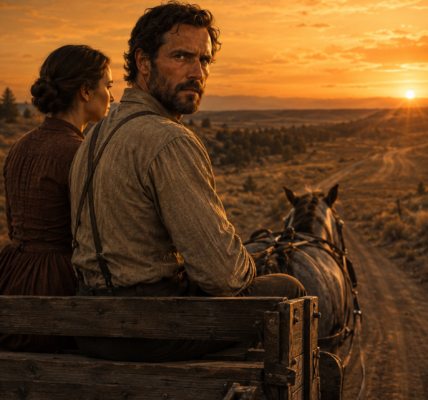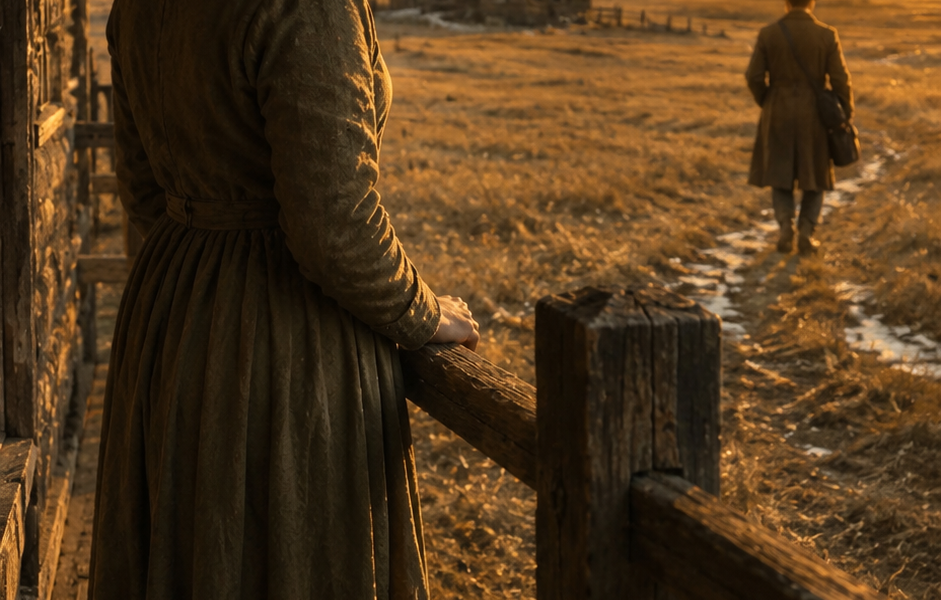
The wind came out of the west like it remembered something it had been told never to forget. t1

The wind came out of the west like it remembered something it had been told never to forget.
Long before the sun climbed high enough to burn the frost off the plains, Dry Creek was already awake to a silence that felt wrong—too clean, too deliberate, as if the night itself had been wiped away by careful hands. Even the cattle refused to move at first light, standing shoulder to shoulder in the low pasture as though waiting for permission to exist again. And at the edge of town, where the road split into three directions and none of them promised mercy, a woman stood still enough that passing riders later swore she was part of the fence line until she blinked.
No one knew her name yet.
But names, in places like this, were only ever borrowed until the truth decided what to call you.
She carried no visible weapon, which made the deputy uneasy in a way he could not explain. Her coat was plain wool, her boots dust-worn from a journey that left no polite explanation behind it. But it was her eyes—steady, unblinking, already measuring the town like a map she had seen before in a dream she refused to forget—that made men look away too late.
Dry Creek had seen strangers before.
What it had not seen was someone who looked like they had come back for something that never stopped waiting.
And beneath that thought, buried deeper than the graves behind the church, was the real fear nobody spoke aloud: that she wasn’t lost.
She was returning.
She stepped off the wagon at exactly noon, though no one would later agree on who brought her in or where she had boarded. The driver said nothing. The horse refused to look at her. Even the dust seemed to settle differently once her boots touched the ground, as if the earth itself had recognized a debt coming due.
A trunk followed her down.
Old canvas. Reinforced brass fittings. The kind of thing that survives fires, floods, and men who lie about what they’ve seen.
No one helped her carry it.
No one offered to.
That was mistake number one in Dry Creek.
Mistake number two was assuming she would need help.
She walked past the general store without looking in, past the saloon where laughter died mid-breath as she crossed the window’s reflection, and past the church where the bell rope swung slightly though no wind touched it. Every step she took seemed to pull something tighter beneath the town’s surface, like a knot slowly remembering how to strangle.
Behind her, someone whispered a name they thought belonged to her.
They were wrong.
The name she carried was older than Dry Creek.
Older than the railroad that pretended it built the West.
And it had been written in ink that never faded because it was written on something that never forgave.
She stopped only once before reaching the end of Main Street.
At the hitching post stood a man who did not belong to the town’s present. His beard was too gray for the way his eyes moved. His hands were too steady for someone who had lived honestly. He watched her approach as though he had been expecting her for years and hated himself for being right.
“You shouldn’t be here,” he said.
It was not a warning.
It was recognition.
She tilted her head slightly. “That depends on what you think I am.”
He looked at her trunk instead of her face.
“That’s what they all said too.”
The words hung between them like a rope not yet pulled tight.
Before she could answer, the church bell rang once.
Not the full chime.
Just a single strike.
Accidental, some would say later.
But accidents don’t make men reach for guns at the same time.
She noticed it immediately—the shift in posture across the street, the way conversations stopped mid-word, the way a curtain moved and then stayed still as if the person behind it had chosen not to breathe.
Something had been disturbed.
Something buried.
And she had not yet even asked a question.
The ranch came into view before she ever reached it.
That was how land worked out here—it didn’t announce itself gently. It revealed itself like a confession forced out under pressure. The fence line leaned in places where time had stopped respecting it. The gate hung half-open as if it had been waiting for someone brave enough to decide whether it still mattered.
But it was the ground that told the story first.
Because the earth remembers what people try to forget.
She stepped onto the property without hesitation.
That was mistake number three for anyone who thought ownership meant safety.
A man was already there.
Not waiting.
Guarding.
He stood near the barn with the posture of someone who had learned early that violence rarely announces itself politely. His coat was dusted with sawmill shavings, his hands marked by labor that didn’t apologize for leaving scars. He didn’t speak at first. He only watched her the way a man watches a storm deciding where to land.
“You lost?” he finally asked.
She looked past him at the barn, at the collapsed fence line, at the soil that had been turned and re-turned until it no longer remembered what it used to grow.
“No,” she said quietly. “I was sent.”
That answer made something shift in his expression—small, almost imperceptible, but real enough to matter.
“By who?”
She placed her hand on the trunk.
“That depends on what you believe this place is.”
Silence answered her.
Not because he had nothing to say.
Because he knew better than to say it.
That evening, she found the first mark.
Not carved into wood.
Not written on paper.
But pressed into the soil beneath the barn where the ground had been disturbed recently enough to still feel unfinished. She knelt, brushing away dirt with the calm patience of someone who had done worse things with her hands.
A metal plate.
Old.
Government stamped.
Faded serial numbers half-buried beneath rust.
And beneath it, something worse.
A second layer of soil that did not belong to the ranch.
Something compacted.
Hidden.
Deliberate.
She stood slowly.
And for the first time since arriving, she understood what no one in Dry Creek had dared to say aloud.
This land was not empty.
It was covering something.
The man from the barn appeared behind her again, closer this time.
“You found it,” he said.
It wasn’t a question.
She didn’t look at him.
“What is it?”
He hesitated too long.
“That depends on whether you want the truth… or the version that keeps you alive.”
The wind shifted.
Somewhere in the distance, a horse screamed.
Not in fear.
In warning.
And from the direction of the town, a single lantern flickered to life where no light should have been burning at this hour.
She realized then that she had not been brought here to investigate anything.
She had been brought here to decide whether the secret beneath Dry Creek would remain buried…
Or finally breathe again.
And someone—somewhere in the dark between barn and town—had already decided she would not leave alive with either answer.
The lantern in the distance did not belong to any honest hand in Dry Creek.
That much was clear before she even turned her head.
It burned low, hooded, moving along the ridge line like a patient eye searching for something it already knew it had lost. No man working late would carry light that carefully. No ranch hand would bother hiding it from the wind. This was a light meant for not being seen—used by people who had learned that visibility was the first step toward burial.
The man beside her noticed it too.
His jaw tightened in a way that suggested memory, not surprise.
“They’ve started early this year,” he said quietly.
“Started what?”
He didn’t answer right away. Instead, he walked toward the barn door and closed it halfway, as if sound itself had become dangerous.
“Digging,” he said finally.
The word didn’t belong in a ranch conversation.
Not the way he said it.
Not the way the wind suddenly seemed to listen.
She looked back at the disturbed ground beneath the barn—the rusted plate, the compacted soil, the hidden layers like pages of a book no one had been meant to open again.
“Who is ‘they’?” she asked.
The man hesitated long enough that hesitation became its own answer.
Then, softer: “The ones who built this place.”
Dry Creek did not exist the way towns were supposed to exist.
That realization settled into her slowly, like cold working into bone.
Towns were supposed to grow outward—roads, families, trade, mistakes, time.
But Dry Creek felt… assembled.
Like something built quickly and then convinced to stay quiet afterward.
A place not born, but arranged.
The man finally crouched beside her, lowering his voice until it barely survived the air between them.
“You ever wonder why the ground here never gives up anything?”
She didn’t respond.
Because she already had.
She just hadn’t yet known the question mattered.
A gust of wind rolled through the barnyard, carrying dust that smelled faintly metallic. Not iron from tools. Something older. Something deeper. Like earth that had once been forced to forget what was buried inside it.
The man continued.
“Fifteen years ago, this valley wasn’t a town. It was a survey camp. Railroad men, surveyors, a few federal engineers… and a preacher who said he’d come west to build something ‘clean.’”
He spat the word clean like it tasted wrong.
“Then one night, the camp disappeared.”
She looked up sharply. “Disappeared how?”
He didn’t meet her eyes.
“That depends who you ask. Official report said fire. Accident. Everyone dead, bodies too burned to identify.”
“But?”
“But there was no fire damage on the north ridge.”
The silence that followed was not empty.
It was full of things neither of them wanted to name yet.
The lantern on the ridge flickered again, moving closer.
Closer than before.
Watching.
Listening.
Waiting.
She stood slowly.
“You said the preacher built this town.”
The man nodded once.
“Reverend Thomas Whitlock.”
The name hit the air like a thrown stone striking still water.
Something in her expression changed—but only for a fraction of a second. Not shock. Recognition. The kind that comes when pieces of a long-unsolved equation finally begin aligning into something horrifyingly simple.
She reached into her coat.
Not for a weapon.
For paper.
A photograph, worn at the edges, unfolded carefully like something sacred and dangerous.
Four figures stood in front of a half-finished homestead.
A man.
A woman.
A child.
And behind them, just slightly out of focus, a fifth shape standing too far back to belong in the frame.
The man beside her froze when he saw it.
“That house,” he whispered.
She didn’t look away from the photo.
“You recognize it.”
“I’ve seen it in the ground.”
Her eyes lifted sharply.
“What does that mean?”
He swallowed once, hard.
“It means some of those buildings you think were built here… weren’t built at all.”
Another gust passed through the yard.
This one colder.
Carrying something heavier beneath it.
A sound.
Faint at first.
Then unmistakable.
Hammering.
Not metal on metal.
Metal on stone.
From beneath the earth.
The barn seemed suddenly smaller.
The sky suddenly too close.
The man stood quickly now, urgency replacing caution.
“You shouldn’t have come back here,” he said.
“I didn’t come back,” she replied.
“I was never here before.”
That was when the first shot cracked through the valley.
Not aimed at them.
Not yet.
A warning shot.
It split the night above the barn and shattered the hanging lantern in a burst of glass and fire, plunging them into sudden darkness lit only by distant ridge light and whatever hell was now waking beneath Dry Creek.
The man grabbed her arm.
“We move now,” he said.
“Why?”
Because whoever is digging tonight isn’t looking for treasure anymore.
He paused.
They’re finishing what they started fifteen years ago.
They ran.
Not toward town.
Away from it.
Because both of them understood something neither had yet said aloud: whatever was buried under Dry Creek was not meant to stay buried—and someone was willing to kill every witness twice to keep it that way.
Behind them, the earth shifted.
Not metaphorically.
Physically.
A deep, slow movement beneath the barn like something large turning in its sleep after years of silence.
And then—
A second sound.
Closer.
A voice from the ridge.
Calm.
Familiar.
Reverend Whitlock.
“You were told not to dig,” it said gently, almost disappointed.
Like a man correcting children.
The man beside her froze instantly.
She didn’t.
Because she already understood something far more dangerous than fear.
Fear was what men felt before the truth arrived.
And the truth had just stepped out of the dark.
“You’re late,” the voice continued.
“We already finished the town once.”
Silence.
Then the sound of multiple rifles being raised at once.
And beneath the ground—
Something answered.
A final shift.
As if Dry Creek itself had just remembered what it was built on.
And decided it was time to open again.
Note: Some content was generated using AI tools (ChatGPT) and edited by the author for creativity and suitability for historical illustration purposes.