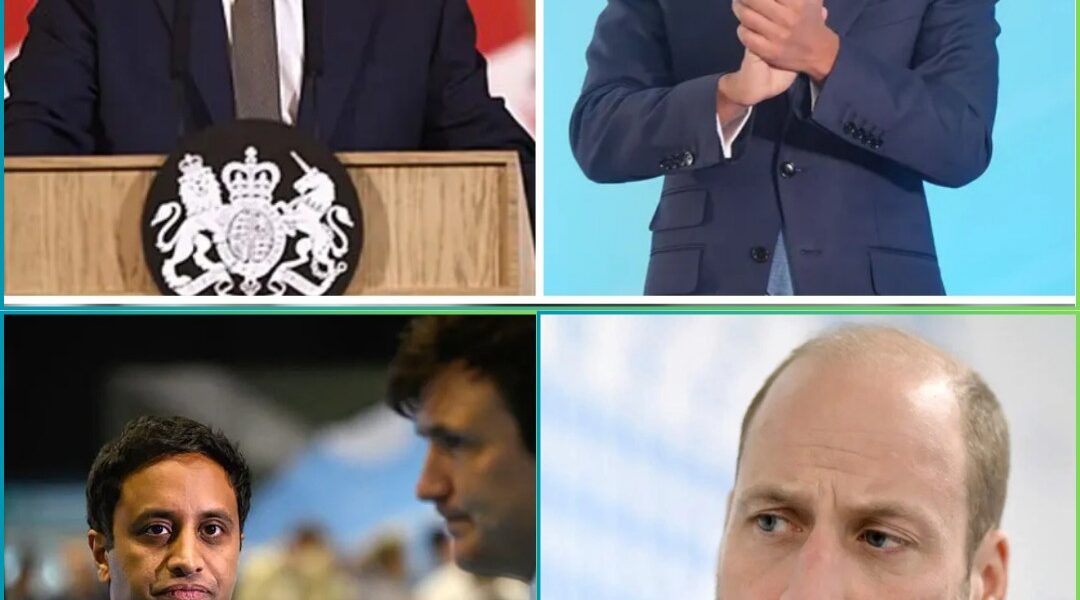

The Prince William “Truth Bomb” That Never Happened: How a Viral Political Claim Exposed a Bigger Crisis of Trust Online
Few public figures command as much attention in Britain as Prince William. As heir to the British throne and one of the most recognizable members of the Royal Family, almost anything attributed to him has the potential to generate headlines across the world.
That reality helps explain why a viral social media post claiming Prince William had launched a blistering political attack on the British government spread so rapidly online.
The post, shared across multiple platforms, alleged that the Prince of Wales had finally broken his silence and delivered what supporters described as a political “truth bomb.”
According to the viral narrative, William had supposedly criticized welfare spending, questioned taxpayer-funded support for non-citizens, challenged the leadership of Prime Minister Keir Starmer, and publicly endorsed arguments associated with political figures and commentators involved in ongoing debates about immigration and government spending.
The language used in the posts was dramatic.
Phrases such as “Enough Is Enough,” “Truth Bomb,” and “William Finally Speaks Out” were prominently featured, giving readers the impression that a major constitutional moment had unfolded.
For many users scrolling quickly through social media feeds, the story appeared believable.
After all, Britain has been engaged in intense debates surrounding immigration, welfare reform, public spending, taxation, and national identity for years.
The political atmosphere remains highly charged.
Against that backdrop, a claim that a senior royal had finally decided to intervene directly in political discussions seemed sensational—but not impossible to some readers.
The problem is that there is no evidence it happened.
No verified speech exists.
No official statement exists.
No credible interview exists.
No reputable news organization has reported that Prince William made any of the comments attributed to him.
The alleged remarks appear to originate from engagement-driven social media content rather than verified journalism.
As fact-checkers and researchers began examining the claims, a familiar pattern emerged.
The viral content combined real political controversies with fabricated quotations attributed to a globally recognized public figure.
This approach is increasingly common in the modern information environment.
Rather than inventing an entirely fictional event, creators often take genuine public concerns and attach them to a famous personality.
The result is content that feels emotionally authentic even when the underlying claims are unsupported.
In this case, the political themes were real.
Britain continues to debate welfare spending.
Immigration remains one of the country’s most divisive issues.
Questions about public trust, government accountability, and economic pressures dominate political discussion.
However, the attribution to Prince William was unsupported.
That distinction is crucial.
The controversy also highlights why members of the British Royal Family attract unique attention whenever political issues are involved.
Unlike elected politicians, senior royals operate under long-established constitutional conventions requiring political neutrality.
Their public role is designed to transcend party politics.
While they frequently champion charitable causes and social initiatives, direct intervention in partisan disputes is exceptionally rare.
That is especially true when discussions involve current government leaders or active political controversies.
For Prince William to publicly condemn a sitting prime minister or endorse a specific ideological position would represent a significant departure from constitutional tradition.
Such a development would immediately dominate headlines across Britain and internationally.
The absence of credible reporting alone raises serious questions about the authenticity of the viral claim.
Had such remarks genuinely been made, they would have been impossible for major news organizations to ignore.
Instead, the story appears to have spread primarily through social media ecosystems where sensational content often travels faster than verification.
The speed of that spread is remarkable.
Within hours, users were debating statements that had never been authenticated.
Supporters celebrated comments that may never have been spoken.
Critics condemned positions that may never have been expressed.
The discussion itself became detached from reality.
The focus shifted from what Prince William actually said to what people wanted him to have said.
That distinction reveals a great deal about the current state of public discourse.
The story ceased being about the Prince of Wales.
Instead, it became a reflection of broader frustrations already present within society.
People projected their own concerns onto a respected public figure.
In doing so, many treated an unverified narrative as confirmation of beliefs they already held.
The incident serves as another example of how quickly misinformation can transform into perceived truth when it aligns with existing political emotions.
My Professional Perspective
After more than three decades covering politics, public institutions, media systems, and the British monarchy, I believe the most important aspect of this story is not the fabricated quote itself.
It is the reason so many people were willing to believe it.
That question deserves closer examination.
Historically, misinformation succeeded because information was scarce.
Today, misinformation often succeeds despite an abundance of information.
People are surrounded by news, commentary, podcasts, social media feeds, video clips, and opinion pieces.
Yet trust in institutions continues to decline.
When trust erodes, verification becomes less important than emotional resonance.
In other words, many people do not ask, “Did this happen?”
They ask, “Does this feel true?”
The alleged Prince William comments illustrate this phenomenon perfectly.
The viral post succeeded because it echoed existing frustrations.
Many Britons are concerned about the cost of living.
Many are worried about housing affordability.
Others are frustrated by debates surrounding immigration, welfare spending, public services, and taxation.
The fabricated quotes reflected those concerns.
As a result, the content felt believable even without evidence.
This is one of the defining characteristics of modern misinformation.
The most effective falsehoods are rarely completely invented.
They are built around genuine emotions.
Another overlooked detail is the symbolic role Prince William plays in British society.
Unlike politicians, who are often polarizing, the Prince of Wales occupies a position associated with continuity, stability, and national identity.
Attaching controversial opinions to him provides instant credibility among audiences inclined to trust him.
Creators of viral content understand this dynamic.
That is why public figures with high recognition are frequently used as vehicles for fabricated statements.
The story also reveals a growing challenge facing constitutional monarchies.
The Royal Family’s traditional neutrality depends upon a public understanding that royals are not active participants in party politics.
When false political statements circulate widely, they risk creating confusion about that role.
Even if debunked later, misinformation can leave lasting impressions.
Research repeatedly shows that first impressions are remarkably resilient.
Many people remember the original claim long after forgetting the correction.
That reality makes misinformation particularly powerful.
Perhaps the most revealing aspect of this episode is what it tells us about the current relationship between audiences and information.
The social media economy rewards outrage.
It rewards certainty.
It rewards emotional intensity.
Verification, context, and nuance are slower and less dramatic.
As a result, fabricated stories often enjoy a significant advantage over factual reporting during the crucial first hours after publication.
The Prince William story follows this pattern precisely.
A dramatic headline generated immediate engagement.
Fact-checking arrived later.
By then, millions had already encountered the claim.
The larger lesson is not simply that misinformation exists.
Most people already understand that.
The deeper lesson is that misinformation increasingly succeeds by exploiting genuine concerns.
It borrows the language of real problems while offering fictional evidence.
That combination can be extraordinarily persuasive.
Conclusion
The viral claim that Prince William delivered a sweeping political rebuke of the British government may have captured enormous attention, but there is no credible evidence supporting the alleged remarks.
No verified speech, interview, or official statement confirms the claims.
Instead, the story appears to be another example of how emotionally charged political narratives can spread rapidly when attached to a trusted public figure.
Yet the significance of the incident extends beyond one fabricated quote.
It highlights a growing challenge facing democratic societies: the difficulty of distinguishing between authentic information and content designed primarily to provoke engagement.
The themes discussed in the viral post—welfare spending, immigration, political trust, and economic pressure—are genuine issues facing Britain today.
But the attribution of those views to Prince William remains unsupported.
That distinction matters.
Because in an era where millions receive news through algorithms rather than editors, misinformation no longer succeeds by inventing entirely new realities.
It succeeds by blending fragments of truth with powerful emotional narratives.
And that raises a question every citizen should consider:
When a story perfectly confirms what we already believe, are we more likely to verify it—or simply share it?
The answer may determine how vulnerable modern societies become to the next viral political fiction.