
“We Are a Christian Nation!” — Tommy Robinson’s Rally Ignites a Fierce Battle Over Faith, Identity, and the Future of Britain
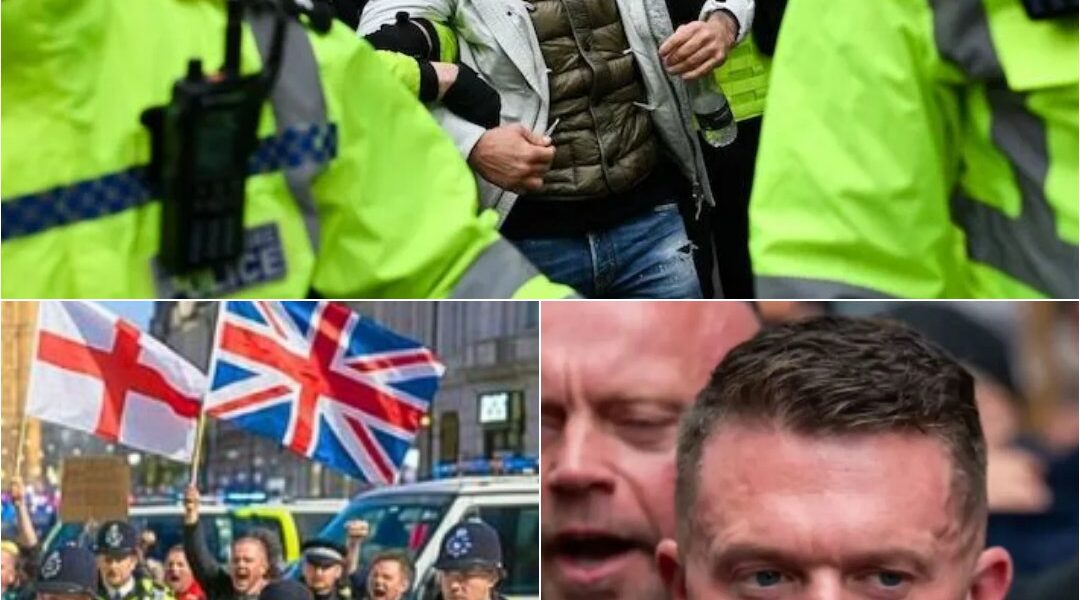
A major political and cultural controversy has erupted in the United Kingdom after anti-Islam activist Tommy Robinson used a large London rally to promote what supporters describe as a defense of Britain’s Christian heritage and what critics view as an increasingly confrontational campaign against multiculturalism and Islam.
The event, held under the banner of the “Unite the Kingdom” movement, drew tens of thousands of supporters to central London and featured speeches focused on Christianity, immigration, national identity, free speech, and concerns about social change in Britain. Estimates of attendance varied, with police placing turnout at roughly 60,000 people, while organizers claimed significantly higher figures.
The rally highlighted a growing trend within parts of Britain’s nationalist movement: the increasing use of Christian identity as both a religious and political symbol.
Throughout the event, speakers repeatedly emphasized that Britain’s foundations were built upon Christianity and warned that those foundations were being weakened by demographic changes, mass migration, and what they described as the erosion of traditional values. Observers noted the widespread display of Christian symbols, large crosses, religious banners, and chants of “Christ is King” among sections of the crowd.
However, while the rally’s organizers presented the gathering as a defense of British culture and religious heritage, critics accused the movement of promoting anti-Muslim sentiment and exclusionary nationalism. Several commentators and researchers described the event as part of a broader far-right political movement increasingly wrapped in Christian language and symbolism.
The Nigeria Speech That Captured Attention
One of the most discussed moments of the rally involved speeches concerning the persecution of Christians in Nigeria.
Tommy Robinson argued that Western governments, media organizations, and religious institutions have failed to speak out strongly enough about violence affecting Christian communities in parts of Africa and the Middle East.
During the event, a Nigerian Anglican bishop addressed the crowd and described attacks on Christian communities in parts of Nigeria. Robinson declared that Christians facing violence abroad should not be ignored and accused major institutions of remaining silent about their suffering. Reports from the rally confirm that concerns about violence against Christians in Nigeria became a major theme of the event.
The issue itself is not invented.
Violence involving extremist groups and communal conflicts in parts of Nigeria has been extensively documented by international organizations, religious groups, and security analysts for many years.
However, controversy emerged over how those concerns were presented.
Critics argued that genuine concern for persecuted Christians was being mixed with broader political messaging about immigration, Islam, and national identity within Britain.
Supporters rejected that criticism, arguing that the suffering of Christians globally deserves greater international attention regardless of who raises the issue.
“Christian Britain” Versus Multicultural Britain
The most politically explosive aspect of the rally involved repeated assertions that Britain is fundamentally a Christian nation.
Several speakers argued that Christianity is not merely one religion among many but the foundational culture upon which British society was built.
According to speeches delivered at the event, Britain’s laws, traditions, institutions, and values were portrayed as inseparable from its Christian heritage.
For supporters, this message represents an effort to preserve cultural continuity.
They argue that many Western nations are experiencing a crisis of identity and that a return to traditional values would strengthen social cohesion.
Critics, however, see a different story.
They argue that modern Britain is a pluralistic democracy composed of people from many faiths and backgrounds.
From this perspective, defining British identity primarily through Christianity risks marginalizing millions of citizens who do not share that faith.
This disagreement sits at the heart of one of the most important cultural debates currently unfolding across Europe.
Allegations of Anti-Muslim Rhetoric
The most controversial element of the rally involved comments about Islam and immigration.
Tommy Robinson has long been known for criticism of Islam, immigration policies, and what he describes as failures of multiculturalism.

Human rights organizations, anti-racism groups, religious leaders, and many political figures have repeatedly accused Robinson and associated movements of promoting anti-Muslim narratives.
Critics argue that framing national decline as the result of Muslim immigration fuels suspicion toward entire communities rather than addressing specific policy concerns.
Several church leaders have also expressed concern about Christianity being used as a political weapon in cultural conflicts. Religious figures from multiple denominations have warned against linking Christian faith with exclusionary nationalism or hostility toward minorities.
Supporters of Robinson strongly reject accusations of hatred.
They insist that criticism of Islam as a belief system should not automatically be equated with hostility toward Muslims as individuals.
That distinction remains one of the most fiercely contested issues surrounding Robinson’s activism.
Growing Political Significance
The significance of the rally extends beyond the speeches themselves.
The event reflects broader political currents emerging across Britain and much of the Western world.
Questions surrounding immigration, integration, national identity, religious heritage, and social cohesion have become increasingly central to political debate.
What once existed on the political margins now occupies a far more prominent place in public discussion.
The large turnout demonstrated that concerns about cultural identity resonate with a substantial portion of the population, even as opponents strongly reject the movement’s conclusions.
My Professional Perspective
After three decades covering political movements, religious conflicts, immigration debates, and identity politics across Britain, Europe, Australia, and North America, I believe the headline many people are seeing is not actually the real story.
The deeper story is not Tommy Robinson.
The deeper story is the growing struggle over who gets to define national identity in the modern West.
This Is About More Than Religion
Many observers will view this controversy as simply Christians versus Muslims.
That interpretation is far too simplistic.
The real divide is between two competing visions of society.
One vision argues that nations require a dominant cultural identity to survive.
Supporters believe shared traditions, common values, and historical continuity are essential for social stability.
The other vision argues that modern democracies can successfully unite people from multiple backgrounds without requiring cultural uniformity.
Supporters believe citizenship and democratic values matter more than religious or ethnic origins.
This debate is unfolding not only in Britain but across Europe, North America, and Australia.
Why Christianity Has Become Political Again
One of the most fascinating developments in recent years has been the return of Christianity as a political symbol.
For decades, religious participation declined throughout much of Western Europe.
Yet as immigration and identity debates intensified, Christianity increasingly re-emerged as a cultural marker.
Many people now invoke Christianity less as a theological commitment and more as a symbol of national heritage.
This creates a profound tension.
Religious leaders often emphasize compassion, reconciliation, and universal dignity.
Political activists frequently emphasize borders, identity, and cultural preservation.
The result is an ongoing struggle over what Christianity represents in public life.
That struggle was clearly visible at this rally.
The Nigeria Question
Another important issue deserves serious attention.
Violence against Christian communities in parts of Nigeria is a legitimate concern that receives less international attention than many other global conflicts. Numerous organizations have documented attacks by extremist groups and ongoing security challenges affecting both Christian and Muslim communities in certain regions.
However, there is a danger when genuine humanitarian concerns become fused with domestic political agendas.
Once that happens, audiences may begin questioning motives rather than focusing on victims.
The suffering of civilians should not become a political tool for any side.
The Risk of Identity Politics From Every Direction
Much public discussion focuses on identity politics from the political left.
Yet identity politics can emerge from the right as well.
Whenever political movements define citizenship primarily through religion, ethnicity, ancestry, or cultural background, difficult questions inevitably arise.
Who belongs?
Who decides?
What happens to those who do not fit the preferred identity model?
These questions become especially important in multicultural democracies.
Britain today is dramatically different from Britain fifty years ago.
Whether that transformation represents success, failure, or something in between depends largely on one’s political perspective.
But the demographic reality itself cannot be reversed through rhetoric alone.
What Many People Are Missing
The most overlooked aspect of this story is that both sides are responding to genuine concerns.
Supporters of Robinson often express fears about social fragmentation, cultural change, crime, and national identity.
Many of those concerns are sincerely held.
Opponents fear discrimination, religious hostility, and the normalization of exclusionary politics.
Those concerns are also sincerely held.
The challenge for democratic societies is finding a way to address legitimate anxieties without turning minority communities into scapegoats.
That is where many political movements struggle.
Conclusion
Tommy Robinson’s latest rally has become far more than a political gathering.
It has become a symbol of a much larger conflict over identity, religion, immigration, and the future direction of Britain.
Supporters see a movement defending a nation they believe is losing touch with its roots.
Critics see a movement that risks deepening division by framing cultural change as a civilizational threat.
The debate is unlikely to disappear anytime soon.
Across Britain, Europe, Australia, and North America, similar arguments are becoming increasingly common.
Questions once considered settled are being reopened.
National identity, religious heritage, immigration, integration, and social cohesion are once again at the center of political life.
The challenge now is whether these debates can be conducted without demonizing entire communities or reducing complex issues to simple slogans.
Because the most important question raised by this controversy is not whether Britain has Christian roots.
History already answers that.
The real question is this:
Can a modern democratic nation preserve its historic identity while embracing the diversity of the society it has become—or will those two visions continue to collide for years to come?