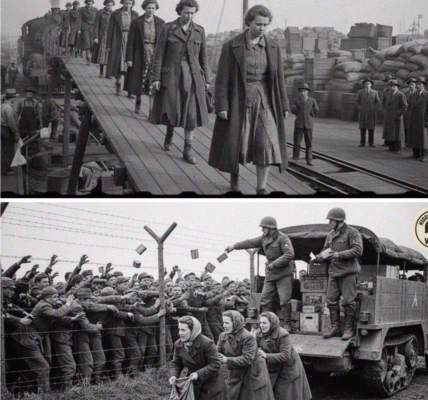
Some photographs do not need a long caption to make us stop and look.
A column of prisoners stretching across the barren landscape of North Africa. Soldiers standing beside a wounded horse in a field hospital. Civilians watching as German forces enter their city. A man wearing the insignia of Nazi Germany, yet using that very symbol to protect people whom his own regime did not consider equals. And then, four years later, on the deck of an American battleship in Tokyo Bay, representatives of a defeated empire bow over a document only a few pages long and sign their names.
At first glance, these appear to be unrelated moments.
But placed beside one another, they tell a larger story: World War II was not shaped only by armies, battles, and maps. It was also shaped by ordinary people caught inside an era from which there was no easy escape.

And sometimes, history is seen most clearly not in moments of victory, but in the moments when human beings are forced to confront the consequences of war.
In early 1941, in North Africa, one of the first major battles demonstrated how quickly a military force could lose its position and its freedom.
Bardia was a small Libyan port on the Mediterranean coast, near the Egyptian border. Before the war, Italian forces had built an extensive defensive system around the town and port. It was not simply an insignificant point on a map. It was part of Italy’s defensive network in North Africa.
After Italy entered the war in June 1940, Italian forces advanced into Egypt and captured Sidi Barrani. But that advance soon turned into a series of reversals. By the end of the year, British and Commonwealth forces had begun their counteroffensive.
Then Bardia became a target.

On January 3, 1941, forces of the Australian 6th Division began their assault. One attack moved against the western side of the defenses while another force attacked from the south.
What followed happened faster than anyone looking at the massive fortifications might have expected.
By January 4, much of Bardia had been captured.
On the morning of January 5, the remaining resistance in the southern sector came to an end.
But the most striking part of the battle was not simply that a fortified position had fallen.
It was the number of men who surrendered.
Australian War Memorial records indicate that Australian forces captured roughly 40,000 Italian prisoners at Bardia, while another account estimates that approximately 36,000 Italian soldiers were taken prisoner and around 1,000 were killed.
That transformed the military victory into something else entirely.
Instead of images of advancing armies and triumphant formations, there were now long columns of prisoners moving along the roads.
Men who had once carried rifles and stood inside defensive positions could no longer decide where they were going.
They could only keep walking with thousands of others.

A photograph of prisoners leaving Bardia can easily be viewed as a symbol of victory.
But look at it long enough, and it begins to tell another story.
War can transform a man from soldier into prisoner in a matter of hours.
And for those on the other side, victory was not without a price.
The Australian 6th Division suffered casualties during the battle, including men killed and wounded.
That is one of the paradoxes of military history.
A battle can be summarized in two words:
Victory won.
But behind those two words are individual costs.
Some never came home.
Some returned carrying wounds.
Some became prisoners.
And some survived only as faces in photographs that generations later would struggle to identify.
But North Africa was not the only place where war created such images.
Across Europe, the conflict was increasingly penetrating civilian life.

Cities were occupied.
Families were displaced.
Children saw weapons lying in the streets.
Things that had once belonged to the adult world—rifles, uniforms, military vehicles—suddenly appeared in the lives of children.
One of the most haunting images associated with Berlin in 1945 shows children surrounded by weapons left behind after the city’s collapse.
There is no need to invent a private story for each child in the photograph.
The circumstances themselves are enough.
War had come all the way into the city.

It was no longer somewhere beyond the horizon.
It was in the streets.
In the neighborhoods.
In the homes.
And in childhood.
That was one of the fundamental changes brought by modern warfare: the distance between the battlefield and civilian life became increasingly fragile.
A family could begin the morning living in an ordinary house and end the day with that same house standing dangerously close to the front line.
A child could learn the sound of aircraft before understanding why those aircraft were crossing the sky.
An adult could begin the day with work and end it searching for somewhere to take shelter.
And when the war ended, those people could not simply return to the world that had existed before 1939.
That world was gone.
Another image from this period takes us somewhere completely different: Nanjing, China, in late 1937.
Here, war was not simply a confrontation between military units.
It became a catastrophe for civilians.

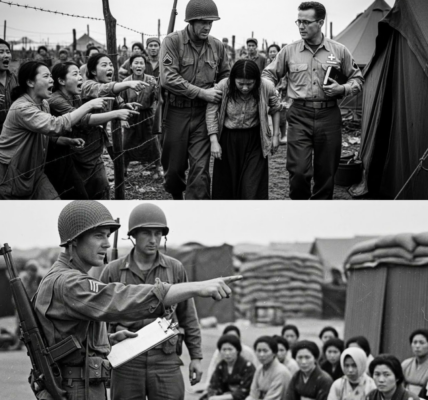
When Japanese forces captured Nanjing, a safety zone was established to protect people who could not escape the city. Among those involved in efforts to protect civilians was John Rabe, a German businessman and member of the Nazi Party.
That detail makes the story uncomfortable in a very particular way.
Because Rabe was not an uncomplicated heroic figure.
He was a member of a regime that would become responsible for some of the greatest crimes of the twentieth century.
Yet in Nanjing, he participated in efforts to protect Chinese civilians.
Historical records show that Rabe used his German status and position to intervene when he encountered threats against civilians. He also participated in the work of the Nanking Safety Zone, which became a refuge for large numbers of people.
This is where history becomes difficult to categorize.

Human beings do not always fit neatly into the simple labels that later generations want to place upon them.
A person can belong to a brutal political system and still perform acts that save lives.
That does not erase the nature or responsibility of the regime to which that person belonged.
But it reminds us that history is made by individual human beings facing individual choices.
And sometimes, even in an age when loyalty, nationalism, and ideology possessed extraordinary power, an individual could still choose to act differently.
That is not a way of romanticizing war.
Quite the opposite.
It shows how difficult the choices created by war could become.
Another image in the original collection shows a Jewish Brigade soldier holding an artillery shell bearing an inscription that referred to it as a “gift for Hitler,” during the period of 1944–1945 in Italy.

The image contains a striking reversal of symbolism.
During war, weapons are manufactured to destroy.
Yet human beings often turn objects of war into messages.
A shell can become an answer.
A rifle can become a symbol.
A flag can represent hope to one side and fear to another.
But behind those symbols remains the cold reality: war is carried out with real objects, against real people.
Perhaps that is why an apparently small image—a soldier holding a shell—can sometimes tell us more than a speech.
It shows that war does not exist only on maps.

It exists in the hands of soldiers.
In the equipment they carry.
In the words they write upon those objects.
And in the memories they carry home after the shooting stops.
By 1944, the war in Europe had entered its decisive phase.
Following the Allied landings in Normandy, Allied forces began advancing deeper into France.
One photograph preserved from July 4, 1944, shows medical personnel from the U.S. 2nd Armored Division pausing beside a sign created by local French citizens to thank them.
The image is tiny compared with the enormous battles taking place across Normandy.
There is no tactical map.
No arrows showing the direction of an offensive.

No massive statistics.
There are simply soldiers, a road, and a message of gratitude.
Yet moments like this help us understand something important.
To people living under occupation, Allied soldiers were not merely a military force moving across territory.
They were evidence that a period of their lives might finally be coming to an end.
War, in the eyes of generals, can be measured in kilometers gained.
In the eyes of a civilian, it may be measured by a single question:
When can we live normally again?
That question never appears on a military map.
But it exists in almost every city through which war passes.
By 1945, that question was finally beginning to receive an answer.
But the answer did not arrive in a single moment.
In Europe, Germany surrendered in May.
In the Pacific, the war continued.

Battles were still being fought.
People were still dying.
Then, in August, Japan announced its acceptance of the terms of surrender.
But history still required an official moment to record the end.
That moment came on the morning of September 2, 1945.
Tokyo Bay.
USS Missouri.
Representatives of Japan came aboard.
Leading the Japanese delegation were Foreign Minister Mamoru Shigemitsu and General Yoshijiro Umezu.
They had come to sign the Instrument of Surrender.
There was no longer a battlefield.
No advancing army.
No city under bombardment.
Only a table, a document, and signatures.
Yet those signatures would become one of the most recognizable images of the twentieth century.
According to the U.S. National Archives, on September 2, 1945, Shigemitsu signed on behalf of the Japanese government, while Umezu signed on behalf of Imperial General Headquarters. General Douglas MacArthur accepted the surrender on behalf of the Allied powers.
The ceremony took place shortly after 9 a.m.
It was brief.
The USS Missouri was not a stage.
It was a battleship.
And on that deck, representatives of two sides of the war stood before a document whose significance was far greater than the individuals themselves.
After nearly six years of global conflict, the guns of the Second World War were finally falling silent.
But there is something particularly striking about that moment.
No one standing on that deck could know exactly how history would judge them in the decades to come.
For those aboard the ship, it was an official ceremony.
For people living in devastated cities, it was the end of an era.
For prisoners being liberated, it might have been the moment when they finally understood that they would be going home.
For families who had lost loved ones, the war was ending, but the loss would not end with a signature.
And for millions of others, peace created an entirely new question:
What happens after the war?
Because peace does not mean that everything immediately returns to normal.
Cities must be rebuilt.
Soldiers must return.
The wounded must learn how to live with what happened to them.
Survivors must face their memories.
People driven from their homes must find somewhere to live.
New governments emerge.
Borders change.
Societies divided by war must find ways to survive in a transformed world.
Even those who never fought directly could carry the war with them.
A child who grew up hearing air-raid sirens was no longer the same child who had existed in 1939.
A soldier returning from the battlefield was no longer the same person who had left home years earlier.
A family that had lost someone would spend the rest of its existence learning how to live with that absence.
That is why historical photographs matter for reasons beyond simply telling us what happened.
They show us what war did to people.
A column of prisoners at Bardia.
A field hospital where a wounded horse is being treated.
A safety zone in Nanjing.
Children among the ruins of Berlin.
A thank-you sign beside a road in Normandy.
And finally, Japanese representatives standing aboard the USS Missouri.
These are not, in the strictest sense, one single story.
But they are fragments of the same age.
An age in which humanity created warfare on a scale never before seen, while at the same time producing acts of courage, rescue, sacrifice, and compassion that cannot be reduced to statistics.
That is why it is important to distinguish between what a photograph actually proves and the story we want to tell from it.
A photograph does not tell us exactly what the person inside it was thinking.
It does not give us permission to invent dialogue.
It does not transform speculation into fact.
But when placed within an accurate historical context, a photograph can open a door.
Behind the prisoners at Bardia is a battle.
Behind the signatures aboard the Missouri are nearly six years of war.
Behind a child standing among the ruins of Berlin is the collapse of a regime and a city.
Behind a man protecting civilians in Nanjing is the disturbing complexity of human behavior during an age of ideology.
And behind all of them are millions of lives whose names we will never know.
Perhaps that is what makes old photographs haunting in such a different way.
We see a moment.
But the person inside the photograph lived an entire life before and after that moment.
A soldier may appear in the frame for only a second.
A prisoner may be only one face among thousands.
A child may have stood before the camera for only a few moments.
But for them, it was not “a historical photograph.”
It was their life.
And history, ultimately, is not simply a collection of beautiful or powerful photographs.
History is what remains after the people inside those photographs are gone.
In 1945, when the final signatures were placed upon the Instrument of Surrender aboard the USS Missouri, the Second World War had, for all practical purposes, come to an end.
But the world it left behind was no longer the world that had entered the war.
A new international order emerged.
New powers rose.
Old empires weakened.
Societies had to rebuild.
The memory of war became part of the politics, culture, and daily lives of generations.
And the photographs remained.
Bardia.
Nanjing.
Normandy.
Berlin.
Tokyo Bay.
They are separated by thousands of kilometers.
But when placed beside one another, they tell a simple truth.
War begins with human decisions.
It is carried out by human beings.
And ultimately, human beings are the ones who must live with its consequences.
Perhaps that is why these photographs still carry such weight decades later.
They do not ask us to relive the past.
They simply ask us not to forget that the past was once someone’s present.
And when we look at those faces, perhaps the final question is not who won.
Perhaps the more important question is this:
After everything humanity paid during the Second World War, what have we truly learned from the images that remain?
Some content was generated using AI tools (including ChatGPT) and edited by the author for creativity, storytelling, and historical illustration purposes. Historical facts and key details should be verified against reliable historical sources. Any AI-generated or reconstructed visuals are intended for illustrative purposes and should not be interpreted as original historical photographs or archival evidence.