
Why Vietnam’s Door Gunners Were Considered Expendable
November 14th, 1965. Central Highlands of South Vietnam. 10:48 in the morning. Major Bruce Kandle is at the controls of his unarmed UH1 Huey, descending through haze and smoke toward a small clearing. The maps label landing zone X-ray. He’s already made multiple runs today. His helicopter has taken hits.
The aluminum skin over his right shoulder has a hole in it the size of a fist. He knows exactly what is waiting below. Three North Vietnamese regiments, somewhere between 1,600 and 2,000 soldiers, have encircled the first wave of American troops. The radio is a wall of overlapping voices, wounded, pinned down, overrun on the eastern perimeter, requesting immediate extraction.
Medevac helicopters have already been turned back by ground fire so intense it was described in afteraction reports as continuous. The landing zone is not defended. It is surrounded. Crannle descends anyway. What happens over the next 14 hours will earn him the Medal of Honor, but not for four more decades. The army will take until 2007 to formally recognize what he did that day.
That gap, 42 years between the deed and the recognition, tells you something important about how Vietnam processed its helicopter crews. But this video is not about Bruce Kandle. This is about the young men sitting in the open doors on either side of his helicopter. The ones with no names in most history books.
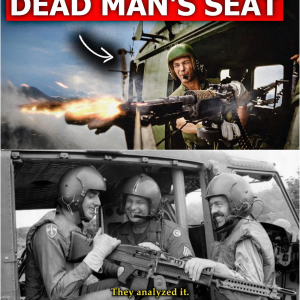
The ones sitting on nothing, literally the edge of the cabin floor, legs dangling over open air with an M60 machine gun suspended on rubber cords, firing at tree lines they can barely see, while AK47 rounds punch through the aluminum fuselage 6 in from their heads. Their armor is a ceramic plate strapped to their chest.
Their protection from the flanks and from above is nothing at all. The aircraft they’re riding is not armored. Their position has no cover. They cannot move, cannot duck, cannot maneuver. They can only fire and keep firing until either the mission is done or they are not. They were called door gunners.
Think about what the title actually means. Not a pilot with an enclosed cockpit and an ejection seat. not infantry with terrain and foxholes. A man whose entire job is to sit in an open hole in the side of a flying machine, 60 feet above people who are actively trying to shoot him out of it with the mechanical task of suppressing enemy fire so that other men can land safely and fight.
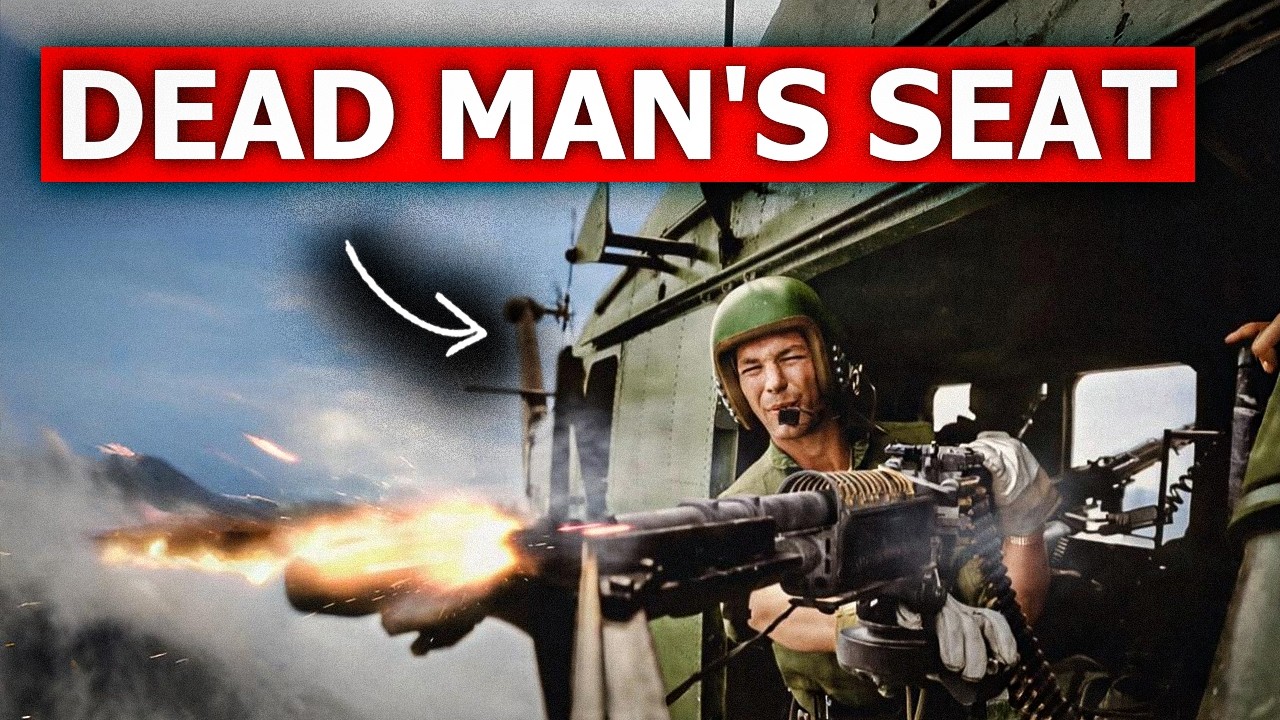
His value to the mission is not his survival. His value is his fire. The moment he stops firing, the mission is at risk. His survival is secondary to the trigger pull. The United States Army knew the door gunner casualty rate from the very first year of helicopter combat in Vietnam. They tracked it. They analyzed it.
They wrote formal combat studies about it. And then this is the part that should stop you cold. They classified the position as operationally essential and kept it exactly as it was. Here is the number that anchors everything that follows. Approximately 2,74 non-pilot helicopter crewmen were killed in Vietnam.
Door gunners and crew chiefs were the majority. Over 10 million flight hours logged and a casualty system that the Army’s own analysts described in language careful enough to survive in official records as structurally unsolvable within current mission parameters. Structurally unsolvable. That phrase is doing extraordinary work.
It means we have identified the problem. We understand the problem and we cannot fix it without changing the mission and the mission is not changing. So the problem continues to understand why a military superpower with virtually unlimited resources looked at that calculation and said acceptable. To understand why the door gunner position was maintained for 11 years at casualty rates that would shut down any modern military operation within weeks.
We need to go back to where it started, not in Vietnam, in a design office in Fort Worth, Texas, where someone decided a utility helicopter needed to carry troops into combat, and nobody in that room was thinking about who would sit in the door. Part one, the birth of the expendable position. The bell uh one Irakcoy was not designed as a weapon.
That fact is critical to everything that follows. When the US Army first fielded it in the late 1950s, the designation was HU1, helicopter utility. The crews shortened it to Huey. The name stuck, and so did the original purpose, medical evacuation, troop transport, logistic support in terrain too rough for vehicles.
The army was thinking about Korea, about mountains and rivers, and the nightmare of getting supplies to men on foot in impossible terrain. The Huey was the answer to a logistics problem. Nobody was modeling what happens when the people on the other side of the ridge have rifles. The first American advisers began arriving in Vietnam in force in 1962.
The Huey came with them. And almost immediately, the crews discovered something the design specifications had not addressed. When you fly a slow, lowaltitude helicopter into a clearing and contested jungle, the enemy can hear you coming from half a mile away. They can range their weapons while you’re still on approach.
They can wait until the final 30 seconds of descent. When you’re slowest, lowest, and most committed to the landing and then open fire. The helicopter that was designed to be a bus had arrived in a war where the bus stop was always a kill zone. The crews improvised immediately. Soldiers held M14 rifles out the door and fired at tree lines.
Someone mounted a machine gun on a floor bracket using hardware store bolts. Someone else rigged a system with cargo straps and found that a freehanging weapon could cover a wider arc than a bolted mount. None of it was in any manual. None of it had been tested, qualified, or doctrine approved. It was $200 engineering solutions applied to a million-dollar problem by men who understood that if they didn’t solve it themselves, they were going to die.
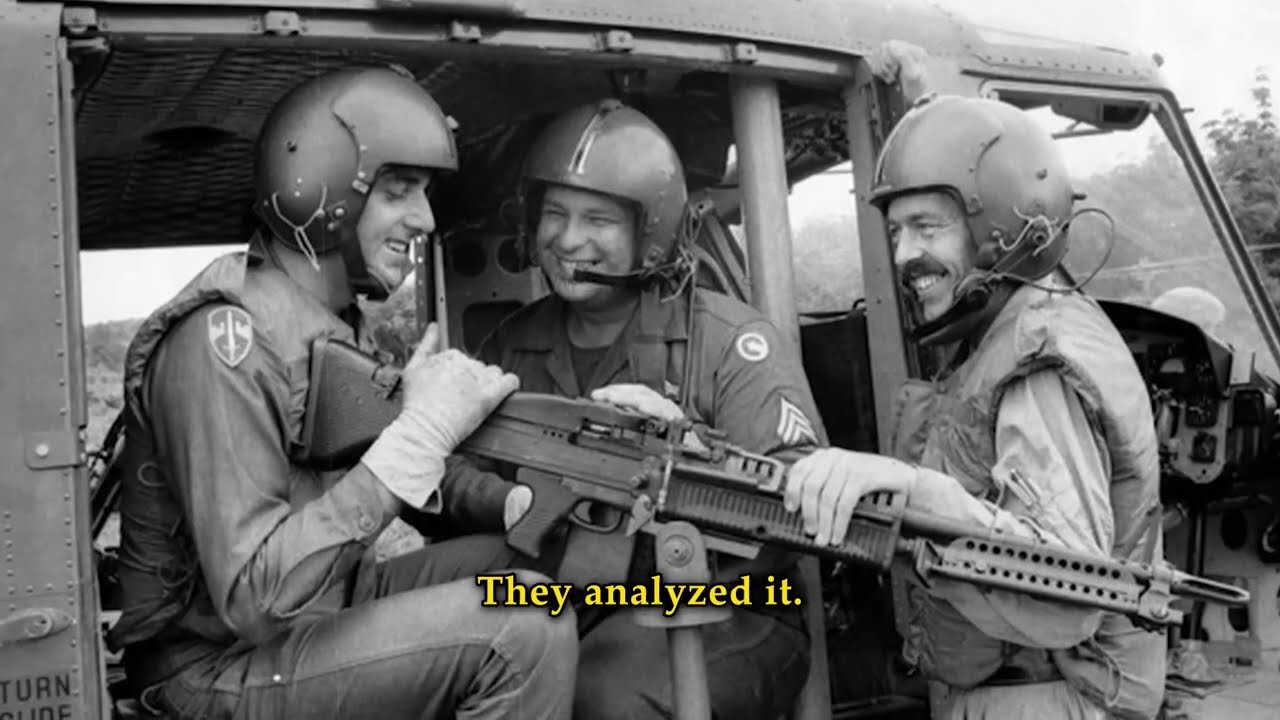
By 1963, the Army formalized what the crews had invented. The M60 machine gun, 7.62 62 mm beltfed capable of 600 to 700 rounds per minute in theory and about 100 in controlled combat bursts would be mounted on bungee cord suspension systems on both sides of every troop carrying Huey. The man operating it was the door gunner.
His mission provide suppressive fire during the final approach and landing to keep enemy heads down during the 30 seconds when the helicopter was most vulnerable. Here is the engineering truth about that position stated plainly. To suppress enemy fire effectively, the door gunner must lean out of the aircraft to engage targets below and to the sides.
The bungee cord system, which replaced the original fixed pintle mount, specifically to give more range of motion, requires him to extend further from the cabin to track moving targets. The farther he extends, the more effective his fire. The farther he extends, the more of his body is outside the aircraft’s aluminum frame, which is in any case thin enough that an AK-47 round passes through it without significant deceleration.
The adaptation that made door gunners more effective made them more exposed. Every improvement to the weapon system, every tactical refinement to their technique moved in the direction of greater lethality and greater vulnerability simultaneously. This was not accidental. It was the logical consequence of putting a man with a gun in an open door and asking him to reach farther.
The army’s first formal casualty analysis of door gunner operations was completed in 1964. The findings were straightforward and for anyone paying attention, alarming. Door gunners were dying at rates that exceeded infantry machine gunners, a position already considered among the most dangerous on any conventional battlefield.
The reason was counterintuitive and unavoidable. Groundbased machine gunners could take cover. They could use terrain. They could shift positions after firing to avoid counterargeting. A door gunner could do none of these things. He was fixed in an open doorway in a predictable location on an aircraft flying a predictable approach pattern toward a known landing zone.
The enemy could range their weapons before the aircraft arrived. They could aim specifically at the open door. The 1964 analysis identified four structural vulnerabilities in the door gunner position, each independent of the others, each contributing to the casualty rate. First, fixed exposure. The door gunner cannot take cover.
This cannot be engineered away without replacing the open door configuration entirely, which would require a different aircraft. Second, predictable targeting. Helicopter approach patterns were standardized for operational reasons. They could be varied, but not eliminated. An enemy with even basic intelligence on American operations could predict the approach vector and preposition weapons accordingly.
Third, weight limitations. Armor that could meaningfully reduce door gunner casualties would weigh 200 to 300 additional pounds per aircraft side. At a critical troop capacity of eight soldiers, this would reduce the payload to six soldiers. Unit commanders had operational missions to complete. Most chose payload over protection.
Fourth, mission profile. Combat assaults required helicopters to fly low and slow during final approach and hover. There was no variation possible. The mission created the vulnerability. The report concluded in careful bureaucratic language that current mission parameters do not allow for elimination of structural exposure factors and door gunner positions.
Translated, the job was dangerous and they couldn’t fix it, not without changing the strategy. And the strategy was not changing. Private First Class Daniel Martinez was 20 years old and had been in Vietnam for 43 days when his unit assignment finally made it onto paper. He was from Laredo, Texas. He had enlisted partly because the Army recruiter had explained the $30 monthly hazard pay supplement for certain aviation positions and $30 was money his mother could use.
He qualified on the M60. He attended the twoe door gunner orientation. He was assigned to a Huey unit in the second core area of operations and flew his first combat insertion into a cold landing zone. No contact, no fire on a Tuesday morning. His fourth mission was different. On final approach, the helicopter, two positions ahead in the formation, took a direct RPG hit on the tailboom.
Martinez watched the rotor disc tilt, watched the aircraft spin in a controlled but clearly terminal fashion, watched it drop into the treeine 200 m short of the landing zone. There was no explosion, just a helicopter that had been flying and then was not. He kept firing at the treeine. That was his job.
The insertion was not complete. The mission continued. His helicopter landed, the soldiers jumped, and the Huey lifted away before Martinez had time to process what he had just seen. He processed it later. For years, in the way that men who see things like that process them, not all at once, but in fragments, at unexpected moments for the rest of their lives, Martinez survived his tour.
He filed no complaints about the door gunner position. He had understood the terms when he accepted the hazard pay. That is in its plainest form what the army was counting on. But the casualty mathematics that were already visible in 1964 were about to become impossible to ignore. Because 1965 brought LZ X-ray. And LZ X-ray would demonstrate with the brutal clarity of one of the bloodiest battles in American military history exactly why the door gunner position could not be changed.
Part two, the mathematics of expendability. By late 1964, the Army Aviation Intelligence Officers at every major helicopter unit in Vietnam were tracking a number that should have triggered an emergency response. Door gunners were dying faster than they could be replaced. Not marginally, substantially. In some units, complete door gunner turnover, every gunner either killed, wounded, or medically evacuated, was occurring within a six-month window.
The men training the replacements had been in country for perhaps 90 days. The replacements they were training would, by the mathematics already visible in the casualty data, be gone before the trainer’s own one-year tour ended. Understand what this does to institutional knowledge. In any dangerous occupation, experience is the primary survival mechanism.
The door gunner who has been under fire multiple times knows which approach angles are predictable, knows the sounds that precede an RPG launch, knows where the enemy positions historically sit relative to specific LZ configurations. That knowledge is not teachable in a classroom. It accumulates through survived missions and it takes months to develop.
The casualty rate was systematically destroying it before it could become useful. The army’s response to this finding was operationally to increase the training pipeline. More men through door gunner school faster qualification. The solution to the problem of door gunners dying was to produce more door gunners. This is the actuarial logic of expendability stated in its most direct form.
Not how do we make the position safer, but how do we ensure the position is always filled? The position’s function took priority over the occupant’s survival. This is not a criticism. It reflects a genuine operational necessity that has characterized infantry warfare since the invention of warfare, but it is important to name what it was.
Now look at the number that made its way into official army studies and still somehow changed nothing about the operational doctrine. Door gunners died at a rate of approximately 0.27 per thousand flight hours across more than 10 million flight hours logged by the helicopter fleet in Vietnam.
That produces roughly 2,700 non-pilot crew deaths, which matches the documented casualty figures. For comparison, infantry casualties in heavy combat zones averaged around 0.4 per thousand patrol hours. That comparison at first glance makes the door gunner position look less dangerous than being infantry. The army’s own analysts knew this comparison was misleading.
And why? An infantry solders per hour mortality rate includes all the hours he spent at base camp, on patrol, in cold areas, and transit on standown. When contact occurred, he had cover, terrain, the ability to maneuver, the ability to call for fire and break contact. His per hour mortality rate was an average across a wide range of threat conditions.
A door gunner’s per hour mortality rate was similarly averaged, but the variance was radically different. In a cold insertion, his risk was minimal. in a hot LZD in those 30 to 60 seconds of final approach and hover his instantaneous probability of being killed or wounded was among the highest of any position in the entire American order of battle.
You cannot build career planning around a per hour average when the distribution of risk is that extreme. What the data could not capture, what no analysis could capture, was the experience of being in that open door, knowing what the landing zone looked like, knowing the approach vector had been flown hundreds of times by the same unit, and was therefore known to any NVA intelligence officer worth his rank.
The men who sat in those doors understood something the casualty tables could not represent. The 30 seconds of approach to a hot LZD was not a statistical event. It was a specific terrifying personal encounter with the physics of their own vulnerability. And then November 14th, 1965 arrived and removed any remaining ambiguity about whether the position was worth maintaining.
LZ ZX-ray Dang Valley. The first battalion, 7th cavalry, approximately 450 men, was inserted by helicopter into a clearing at the base of Chu Pong Mountain. The intelligence assessment had indicated NVA presence in the area. What it had not indicated could not have indicated because no one had correctly read the scale of the staging was that elements of three NVA regiments, nearly 2,000 soldiers, had been operating from that mountain complex for weeks and were waiting.
Within 90 minutes of the first landing, the battalion was in contact on three sides. The helicopters kept flying, not because anyone made a heroic decision to keep flying, because there was no operational alternative. The 450 men on the ground needed reinforcement or they would be overrun. The wounded needed evacuation or they would die.
The ammunition resupply had to continue or the perimeter would collapse. Every hour the helicopters stopped flying was an hour the NVA had to close the ring. for the crews making those runs. 16 Hueies per wave. The 34 mile round trip from the forward staging area. Approach after approach into a landing zone that was under fire from the moment the lead helicopter entered the descent phase.
The situation was quantifiable in real time. Aircraft coming out of the LZ had visible bullet holes. Some had hydraulic fluid streaming from severed lines. Some did not come out at all. Major Bruce Kandle flew 22 missions into LZ X-ray on November 14th. Captain Ed Freeman flew alongside him mission after mission.
Both flew unarmed medical evacuation Hueies. The Red Cross on the nose that the Geneva Convention was supposed to protect in a battle where the Geneva Convention was irrelevant. Their door gunners carried only sidearms. The convention prohibited weapons on medical aircraft. So they descended without M60 suppressive fire into an LZ that was receiving automatic weapons fire from multiple directions and landed to load wounded.
Randle later described watching the tracers converge on his approach path. He flew through them anyway. What else was he going to do? The wounded were there. The mission was to get them out. By the end of the three-day battle at Elz X-Ray, 79 Americans were dead and 121 wounded. The helicopter damage was catastrophic.
And the lesson that army planners drew from the battle was not we must redesign the door gunner position. The lesson was the combat assault doctrine works. The door gunners made the insertions possible. The position is validated. Validated that word. The door gunner program with its documented casualties and its structurally unsolvable exposure problem was validated by a battle in which door gunners died making it work.
This is the core of what expendable means an operational context. Not that the army did not care about door gunner lives, but that the proof of the position’s value was the body count it produced in service of a successful mission. There was one more factor that the combat analysis of LZ X-ray and a dozen other major helicopter operations produced.
A factor that been identified in 1964, but whose full implications took until 1966 to become undeniable. The enemy was learning. And what they were learning was precisely targeted at the open door. Part three, the enemy learns. Here is something almost entirely absent from standard American military histories of the Vietnam War and something no documentary focused on helicopter crews has fully articulated.
The North Vietnamese Army was a learning institution. They did not fight the same battle twice. They analyzed American operations with the seriousness of a well-funded graduate program in applied military science. They collected data on approach vectors, timing, formation spacing, altitude profiles, and crew behavior under fire.
They developed, revised, and redistributed tactical doctrine based on what the data showed. And by 1965, the data showed something very specific. The open door was the helicopter’s most exploitable vulnerability. The NVA tactical development that emerged between 1964 and 1966 was not about anti-aircraft systems in the western sense.
They were not waiting for radar-guided missiles. They were constructing a systematic answer to the door gunner problem using what they had infantry weapons, heavy machine guns, and the patience to preposition them correctly. Here is the doctrine reconstructed from NVA training materials captured during the war and from American afteraction reports that described increasingly sophisticated enemy anti-helicopter tactics.
The door gunner is suppressed, not killed as the first objective. A suppressed door gunner is a door gunner who is not returning effect. If you can force him to take cover, lean back into the cabin, lose his firing angle, interrupt his trigger pull, the helicopter loses its defensive capability during the most vulnerable phase of flight.
A helicopter without effective door gun suppression is significantly more likely to abort the approach or take critical damage. The suppression sequence was engineered around the approach path. Heavy machine guns, typically the Soviet 12.7 millimeter DSHK, which the Americans called the 51 caliber, were prepositioned to open fire on the lead aircraft at maximum effective range during the final approach.
This forced the door gunners to engage forward. In aviation terms, they committed to the frontal threat. They leaned forward. They concentrated their fire and their attention on the direct threat. Then the RPG teams positioned on the flanks specifically to exploit the door gunner’s forward orientation fired into the open doors from the sides.
Think about the geometry of this. A door gunner firing forward is maximally exposed on his flanks. His ceramic armor plate protects the center of his torso. A flanking RPG round or the burst from a flanking machine gun hits him in the shoulder, the neck, or the side of the head. the areas his armor does not cover. This was not an accident. It was the result of study.
By 1966, NVA units operating near major American helicopter corridors had standing orders to engage the open doors specifically with the flanking element holding fire until the door gunners had committed to the frontal threat. The triangulated fire system, frontal heavy machine gun, flanking RPGs, auxiliary small arms from a third direction, had been developed into something close to a standard operational procedure. It worked.
Staff Sergeant Roy Bernett, 26 years old, crew chief and door gunner with the 229th Assault Helicopter Battalion, described his first encounter with coordinated anti-helicopter fire in a 1969 debriefing report that survives in Army aviation records. The 51 caliber opened up from the northwest treeine at about 300 meters out.
Standard heavy machine gun position, exactly where we expected it. Williams on the right door and I both shifted to suppress it. That was the correct response. That was what we were trained to do. We put fire on that position and I saw the tracers going in. Then two RPGs came from the southeast, the opposite flank almost simultaneously.
The first round went under us. The second hit the tail boom. We went into auto rotation. The left door, his door, had Williams firing into it at the moment of the flanking hit. Williams did not survive. Bernett requested a transfer to ground duty after his recovery. The request was denied. The unit was below minimum staffing on door gunners.
Bernett flew the rest of his tour in the same position. The denial of that transfer request is not a story of institutional callousness. It is a story of institutional math. There were not enough door gunners. Bernett was trained, experienced, and alive. The army needed trained, experienced, alive door gunners in open Huey doors.
The request was weighed against the operational need. The operational need won. This is the moment where expendable moves from being a doctrinal word to being a personal experience. for Bernett, for the replacement who flew his left door the next morning, for every door gunner who filed a request that the record show was denied.
The Army’s cost benefit calculation was not abstract. It was a piece of paper that came back stamped request denied. Now, here is the part that the Army’s engineering response, which was genuine, which was resourced, which produced real improvements, could not solve. Every tactical adaptation the army made to reduce door gunner casualties was met by an NVA adaptation that preserved the exposure window.
More Cobra gunships flying ahead of the troop carriers to presuppress landing zones. The NVA learned to hold fire until the Cobras had expended their ordinance and climbed away. Then engaged the incoming slicks during the window between Cobra departure and troop landing. Better armor on the Hueies, heavier RPG warheads, more direct approach to the LZ from multiple angles.
The NVA prepositioned on multiple vectors. The one thing the Army could not change, the mission profile itself, was the one thing the NVA was targeting. And by 1967, the NVA had added weapons to the equation that made the Door Gunner’s M60 operationally irrelevant as a suppression tool. 23 millimeter Zu 23 anti-aircraft cannons, 37 millimeter guns in some operational areas, crews served weapons with effective ranges and calibers that no M60 could reach or counter.
A door gunner whose job was to suppress enemy fire could not suppress a Zu23 from a Huey door. He could not reach it. He could not penetrate it. All he could do was hope the pilot saw it in time. The job of the door gunner had been overtaken by the enemy’s escalation. The army knew this. The army continued the program because the alternative was worse.
What was the army’s solution? An engineering answer that solved the wrong half of the problem in a single moment. One specific day, one specific pilot, one decision made in 30 seconds that revealed what the Door Gunner program was ultimately asking of the people inside it. Part four, the fix that wasn’t. In 1966 and 1967, Army aviation engineers developed a serious program to address helicopter crew vulnerability.
They were not ignoring the problem. They were applying genuine resources and engineering talent to it. The results were real improvements that were in every case insufficient. Ceramic floor armor kits reduced casualties from rounds coming up through the cabin floor. A documented kill pattern identified in the first two years of combat.
Retrofitted pilot seat armor addressed the chin bubble vulnerability where rounds entering through the plexiglass section below the pilot’s feet had been striking the lower body and killing crew at the controls. Armored fuel cells reduced catastrophic fire losses from rounds striking the fuel system in the lower fuselage. Each of these improvements saved lives.
The casualty data shows measurable reductions in specific wound patterns after each was implemented. And then comes the arithmetic that strangled the entire armor program. A fully loaded UH1D operating in Vietnam’s heat and humidity, factors that reduce rotor lift significantly, had a practical payload of roughly 2,200 pounds beyond fuel and basic crew.
Eight combat soldiers at average load came to approximately 1,600 pounds. A meaningful door gunner armor package. Shielding for the door position adequate to stop small arms fire added 250 to 350 lbs per side. The math was immediate and painful. Armor the door gunners and carry six soldiers or skip the armor and carry eight.
The unit commanders universally chose eight, not because they were indifferent to their door gunners, because they had an infantry battalion to support, because the missions were assigned based on troop capacity requirements, because carrying six instead of eight multiplied the number of helicopter runs required, and therefore multiplied the total time each aircraft spent in the threat envelope.
In the arithmetic of helicopter operations, reducing perload capacity to add crew armor might have saved the door gunner while killing more of the infantry who had to wait for the extra runs. This is the trap. This is why the problem was structurally unsolvable within current mission parameters. Every resource the army applied to door gunner protection was in direct competition with the resources the door gunner’s mission required to protect and everyone else.
The AH1 Cobra attack helicopter fielded in Vietnam beginning in 1967 was a genuine solution to part of the problem. It was purpose-built for fire support, tandem enclosed armored cockpit, stubwing weapon systems, no open doors, and it could fly ahead of the troop carrier formation to presuppressed landing zones before the Hueies arrived.
Door gunner casualties on combat assault missions where Cobra gunships provided dedicated support showed measurable improvement over unescorted operations. But the Cobras could not be everywhere. The troop carrying Hueies still landed. The door gunners in those doors still sat in those open positions for every landing, every extraction, every medevac run.
The medevac runs were by any statistical measure the most dangerous missions in the helicopter fleet. and they illuminate what the Door Gunner program was actually asking of its people, not in the language of operational analysis, but in the language of one man’s choice on one specific afternoon, July 1st, 1964, near Vinlong in the Meong Delta.
Major Charles Kelly was 40 years old. He had fought in World War II as an infantryman, wounded at Aken, the only American soldier ever to hold both the combat infantryman badge and the combat medical badge simultaneously. And in Korea, Vietnam was his third war. He was commanding officer of the 57th medical detachment, the unit operating under the radio call sign dust off.
He had been in Vietnam since January and had been fighting two battles simultaneously. The one in the air against the enemy and the one in Saigon against a bureaucracy that wanted to use his medevac helicopters for general utility missions. On July 1st, his radio received a call for emergency evacuation. South Vietnamese soldiers badly wounded in an active contact situation. Hot landing zone.
The American adviser on the ground radioed Kelly three times as he descended. The message was the same each time. Too dangerous. Abort. Turnaround. Kelly’s response. Calm, flat, immediate, was the same each time. When I have your wounded, he maintained the descent. A single round entered through the open door and struck him in the heart.
He died at the controls. His co-pilot managed to keep the helicopter from a fatal crash. The crew survived. Kelly did not. He was the 149th American to die in Vietnam. He was postumously awarded the Distinguished Service Cross. When I have your wounded became the operational motto of every medevac unit in Vietnam, not as a marketing slogan, as a doctrine, a statement of priority that said in five words what the position required.
The wounded come first. The mission comes first. Your life is the price you accept when you take the seat. Dust off crews operating under that doctrine flew into hot LZ’s without gunship support, without door gun armament on the medical aircraft, sustained by the Red Cross on the nose, and the understanding that if they turned back, someone died on the ground instead.
The casualty rate among dust off crews was, per mission type, the highest in the helicopter fleet. They knew this. They flew anyway because someone had to. That phrase someone had to is the final and most honest answer to the question this video is asking. The door gunner position was maintained not because the army did not know the cost, but because the alternative cost was higher, not to the army as an institution, to the men of the ground who needed the landing zones opened, needed the wounded evacuated, needed 30 more seconds of suppressive fire. This
is the transfer that was being made every day across every helicopter unit in Vietnam. Door gunner lives for infantry lives. Crew lives for wounded lives. One category of American soldier bearing a disproportionate share of the operational risk so that another category could survive their mission. The army did not invent this exchange.
It is as old as warfare. But in Vietnam, for the first time, it was documented in such precise operational terms. So many flight hours, so many door gunner casualties per landing zone type, so many lives traded per insertion completed that it became impossible to pretend the calculation was anything other than what it was, expendable, not as an insult, as an operational designation.
And just when the full weight of that designation might have collapsed the program, just when the casualty rates had climbed high enough that the army’s own reviews were questioning whether the door gunner system could be sustained, one man on one night did something that had never been done before. Something that illustrated with complete clarity what the men in those open doors were ultimately willing to do.
Part five, the verdict. June 18th, 1968. night near the village of Appgo Kong, northeast of Saigon. A four-man long range reconnaissance patrol, call sign Darkhorse, is in a rice patty in total darkness. No cover, no concealment, surrounded by their best count by more than a hundred enemy fighters who are closing the perimeter.
Their ammunition is critically low. The rescue helicopter dispatched to extract them has turned back. Too much ground fire, no viable approach. First, Lieutenant Larry Taylor is at altitude in his AH1G Cobra attack helicopter. Two seats, no cargo space, weapon systems and pilot, nothing else. He and his wingman have been working this contact for 35 minutes.
Rocket runs, minigun bursts, artillery coordination, trying to buy time for a rescue that keeps not arriving. Taylor’s ammunition runs out. His wingman’s ammunition runs out. The patrol is still there. The enemy is still closing. Taylor looks at the geometry of his aircraft. There is no cargo bay. There’s no way to carry passengers internally.
There’s nothing in any manual, any training syllabus, any doctrine document that addresses this situation. He radios down to the patrol. Get to the extraction point. I’ll be on the ground for 10 seconds. Find a place in my ship. He lands under fire in the rice patty. Four men sprint to the helicopter. They grab whatever they can reach in the dark.
Rocket pods on the stub wings, the landing skids below the fuselage. Two men on the skids, one on the rocket pod, one pressed against the fuselage wherever he can hold. Taylor lifts off. He carries them several miles to the nearest safe location and sets them down, all four alive. For this action, First Lieutenant Taylor was originally awarded the Silver Star.
55 years later, in September 2023, President Biden upgraded that award to the Medal of Honor. The citation describes Taylor’s actions as going beyond the requirements of duty and beyond any established doctrine. There’s no procedure in any Army aviation manual for what he did on June 18th, 1968. He made it up. Four families owe the next 55 years of their lineage to the fact that a man in a Cobra attack helicopter decided there is no manual was not a reason to leave them in a rice patty.
Taylor died in January 2024 at 81 years old, having lived long enough to receive the recognition he had earned more than half a century earlier. The gap between the deed and the recognition, 55 years, is almost exactly the same as the gap in Brucele’s case. 42 years for 55 for Taylor. That gap is not coincidence.
It is the systematic pattern of a war that processed its helicopter crews as operational assets first and human beings second and that required generations of distance before it could begin to account for what it had asked of them. Here is the final accounting of the door gunner program in Vietnam. Not the emotional accounting.
That one has no final number, but the operational one. Approximately 2,74 non-pilot helicopter crewmen killed across all services over 11 years of helicopter combat operations. Door gunners and crew chiefs constituted the majority. Roughly 5,000 helicopters destroyed or damaged beyond repair out of approximately 12,000 deployed.
Over 10 million flight hours logged. Average time from wounding to medical treatment in Vietnam under one hour. In World War II in Korea, that time was measured in days. That last number is what the Door Gunner program purchased. The revolutionary reduction in evacuation time from days to under an hour is estimated to have saved tens of thousands of American lives during the war.
Wounds that would have been fatal in any previous conflict became survivable because a helicopter could reach the wounded within 60 minutes. That capability rested entirely on the helicopter’s ability to land in contested territory, which rested on the door gunner’s ability to suppress the landing zone, which rested on a man sitting in an open door with an M60 and accepting what that position cost.
The trade is uncomfortable to describe because it was a trade. The army was exchanging door gunner lives for infantry lives, not recklessly. The equipment improvements, the tactical refinements, the Cobra gunship introduction, all demonstrate genuine effort to reduce the cost. But structurally, the trade continued throughout the war because the alternative, not landing, not evacuating the wounded, not inserting the reinforcements, produced a higher casualty rate on the infantry side.
One death in the door to prevent three deaths on the ground. That is the operational mathematics the army was running. And the door gunners by and large understood this. The oral histories, the memoirs, the debriefing reports, the interviews conducted decades later by military historians across all of them runs the same thread. They knew the position was dangerous.
They flew anyway, not because they were unaware of the risk, but because they understood what stopping meant for the men below. The army eventually drew a specific lesson from Vietnam, and it is visible in every helicopter fielded since. The UH60 Blackhawk, which replaced the Huey in the 1980s, eliminated the open door gunner position, as it existed in Vietnam.
Its crew served weapons fire from reinforced cabin windows with partial protection, not open doorways with none. Crew members have body armor that covers more of the body. The aircraft has defensive systems, radar warning receivers, missile approach warning systems, countermeasures dispensers that give the crew options the Huey crew never had.
Every one of those improvements traces directly to a specific documented vulnerability identified in Vietnam. The body armor improvements traced to the wound pattern studies done on door gunner casualties in 1966 and 1967. The window-mounted weapons traced to the tactical studies that documented the exposure cost of the open door.
The defensive electronic systems traced to the loss analysis of aircraft downed by radarg guided weapons beginning in 1967. The door gunners of Vietnam paid the tuition for every one of those lessons. Their deaths produced the data. Their deaths drove the requirements. Their deaths documented in casualty reports filed and largely forgotten in the immediate aftermath became the engineering specifications for a safer generation of helicopter.
They did not know they were writing those specifications. They were trying to get through the next insertion. Back to November 14th, 1965. LZ X-ray. Bruce Kandle is making his final approach of the day. The 22nd, the helicopter’s airframe so damaged that his crew chief has started counting bullet holes as a distraction from thinking too hard about what each one represents.
In the left door, a replacement door gunner who has been in Vietnam for 6 weeks is firing at a treeine he’s been briefed on, but never personally observed. He does not know that the position he is sitting in was formally identified as a structural casualty risk in an army analysis 18 months ago. He does not know that the $30 supplement in his pay represents the army’s calculation of the acceptable compensation for an accepted risk.
He knows two things. The M60 is in his hands and the soldiers below need 30 more seconds of cover to clear the landing zone perimeter. He fires.Randle Crannle pulls the aircraft out and climbs away. The tree line falls below and behind. The crew chief on the right door checks his arm. A graze manageable. The door gunner on the left does not stop firing until the LZ is no longer visible. Alive this time.
That this time is what the door gunner program ran on for 11 years. Not heroism in the promotional sense. Not indifference to survival. a specific understanding held by men who had thought about it carefully and accepted what they found that the job required sitting in the open door that someone had to sit there that if they stopped sitting there the men below paid a price they would not be able to pay.
The United States Army considered door gunners expendable because in the operational logic of the war it was fighting. The door gunner position was too important to protect at the expense of the mission it served. That is not a comfortable verdict. It was not designed to be comfortable. It was designed to be effective.
The men in those open doors were effective. They paid for it. History has taken its time acknowledging the bill. If this forensic look at one of the most underreported stories in American military history was worth your time. Hit the like button. It tells the algorithm this kind of serious analysis deserves to reach people who care about getting the history right.
Subscribe if you want the next chapter because the story of what the Door Gunner program produced, the medevac revolution, the helicopter doctrine reforms, the equipment changes written in the blood of men whose names are not in any headline is a story that goes much deeper than one video can reach. I’ll see you there.
And remember, systems win wars, but systems are built from human beings who understood the cost and showed up anyway.
Note: Some content was generated using AI tools (ChatGPT) and edited by the author for creativity and suitability for historical illustration purposes.