
Why This ‘Ugly’ British Pipe Was The Most Feared Weapon In Occupied Europe
Hello and welcome back to the channel. Imagine this. It’s 3:00 in the morning. A farmer in occupied France stands alone in a dark field. He’s watching the sky, waiting. If German patrols find him here, he’ll be shot. No trial, no questions. Then he hears it. The distant rumble of an RAF bomber. His heart pounds.
A dark shape falls from the aircraft. A parachute opens. Inside that container is something that will change his life forever. An ugly metal tube that looks like plumbing supplies. But this ugly tube is about to turn ordinary civilians into an army that terrified the Nazi regime. This is the classified story of the Sten gun.
And trust me, what happened next is far more dramatic than you might expect. In the summer of 1940, Britain faced a crisis that few people knew about. Yes, everyone knew about Dunkirk. Everyone knew the army had lost its weapons. But there was another problem, a secret problem, one that Churchill himself called the most urgent matter of the war.
He had created a new organization called the Special Operations Executive or SOE. Its mission sounded simple. Support resistance movements across occupied Europe. Sabotage German operations. Create chaos behind enemy lines. Simple mission. Impossible problem. Across France, Norway, Denmark, Holland, Belgium, Poland, and a dozen other countries.
Thousands of brave people wanted to fight back. They were organized. They were motivated. They were ready to die for freedom. But they had nothing to fight with. Absolutely nothing. The Germans had confiscated all civilian weapons. Anyone caught with a gun faced execution, not prison, execution. SOE needed to arm these secret armies.
Hundreds of thousands of weapons. Weapons simple enough for a school teacher or a baker to use. Here’s the problem nobody talks about. Britain barely had enough weapons for its own soldiers. After Dunkirk, there was nothing to spare. literally nothing. Churchill demanded a solution anyway. He famously said he wanted Europe set ablaze, but you cannot start a fire without matches.
And Britain had no matches to give until two engineers came up with an idea so crazy their own commanders called it an embarrassment. The War Office issued a classified brief to the Royal Small Arms Factory at Enfield. The requirements sounded impossible. Actually, they sounded insane. The weapon must be cheap enough to produce in vast quantities.
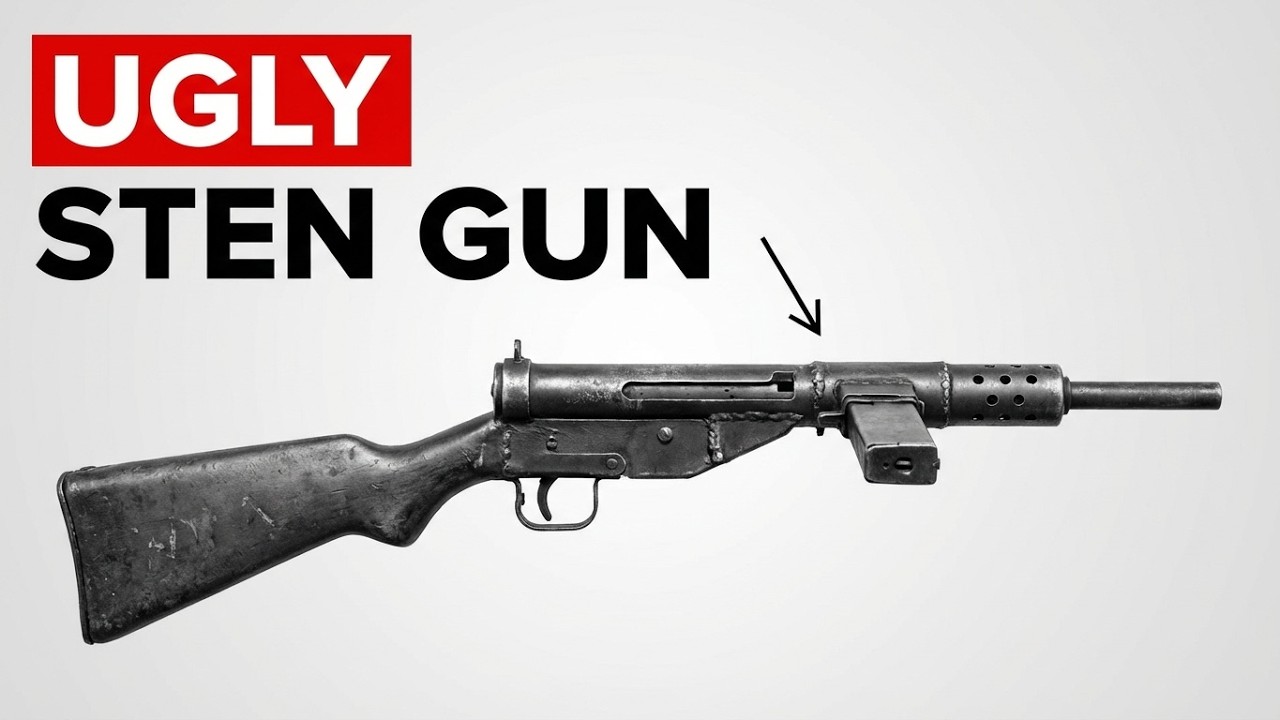
It must be simple enough for untrained civilians to operate. It must be easy to conceal. It must be repairable with basic tools from any village workshop. and it must use ammunition that could be stolen from German soldiers. Two engineers received this secret brief. Major Reginald Shepard and Harold Turpin. Most engineers would have laughed and asked for realistic requirements.
These two said they’d have a working prototype in weeks, not months, weeks. They worked in secret. They stripped away everything unnecessary. No wooden stock, no polished finish, no precision parts, just a metal tube, a simple mechanism, and a folding stock made from steel rod. When military officers first saw it, one reportedly said, and I quote, “This is an insult to British engineering.
” He wasn’t wrong. It looked like a plumber had a nervous breakdown. But then they heard the price. Two pound each, less than a restaurant meal in London. Let me put that in perspective. One American Thompson submachine gun cost 200. For that same money, Britain could make 100 stens, 100 weapons instead of one.
The mathematics of the secret war had just changed completely, and the Germans had no idea what was coming. But here’s what the history books don’t tell you. The production method was even more revolutionary than the weapon itself. This chapter might be the most important. Pay attention because this is where Britain did something genuinely brilliant.
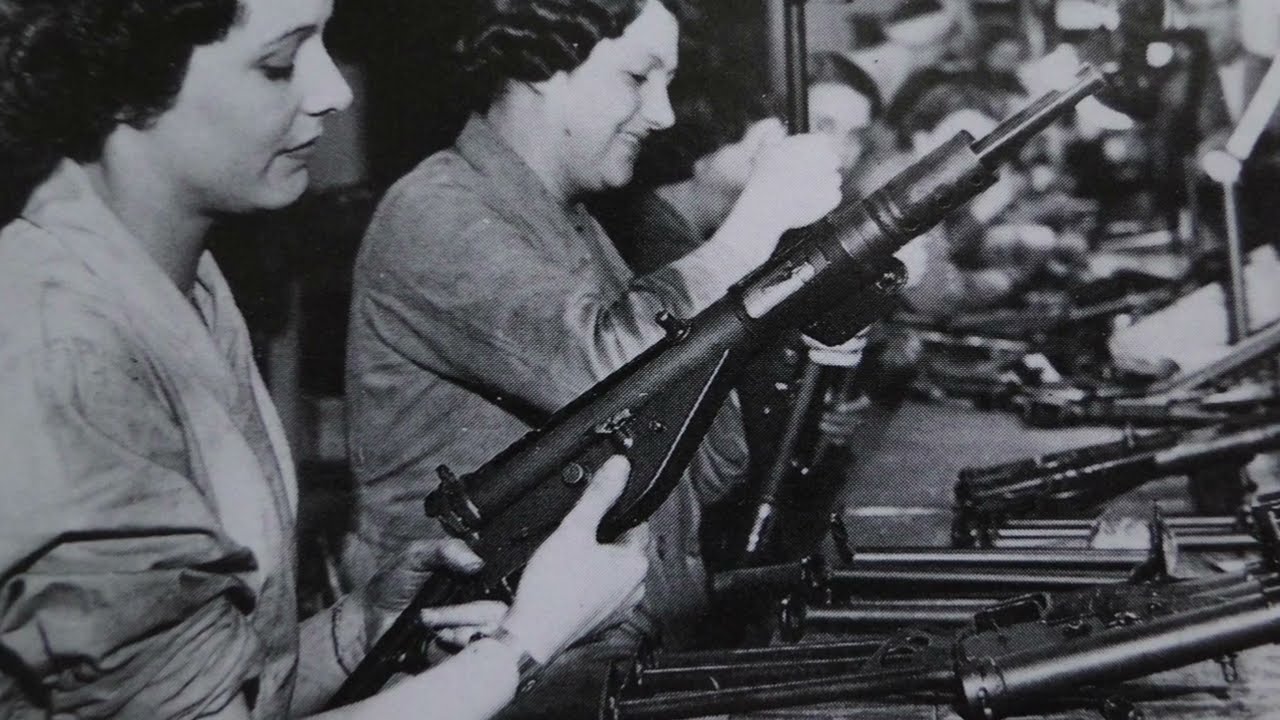
The Sten didn’t require a specialized weapons factory. The parts could be manufactured almost anywhere. The main body was a simple steel tube. Any factory making pipes or bicycle frames could produce them. Other components were stamped from sheet metal using basic machinery. Here’s the genius part.
The government spread production across hundreds of small workshops. No single location held the complete manufacturing process. A workshop in Birmingham made tubes. A factory in Manchester stamped trigger guards. A garage in Leeds bent the stocks. Only the final assembly teams knew what they were actually building.
If German spies discovered one workshop, they’d find nothing useful, just plumbing supplies. Workers were told they were making parts for agricultural equipment. Don’t ask questions, just make the parts. At peak production, British factories produced 20,000 stands every week. 20,000 every single week.
But the official numbers were kept classified. The Germans were never to know. Now, here’s where it gets really clever. And honestly, this is the part that most documentaries completely ignore. SEE agents carried detailed blueprints into occupied Europe. They didn’t just drop weapons. They taught local craftsmen how to build stens.
A blacksmith’s forge could produce the metal parts. A carpenter’s workshop could make the wooden grips. Any mechanic could assemble them. Secret sten factories appeared everywhere. In sellers beneath ordinary houses, in backrooms of bakeries, in forest camps hidden from German patrols. The Nazis controlled the official economy.
They controlled the factories. They controlled the supply chains. But they couldn’t control every shed, every seller, every garage in Europe. And that was their fatal mistake. The weapons kept multiplying. Like a virus, the Germans couldn’t stop. But producing weapons was only half the battle. Getting them to the resistance was even more dangerous.
What happened next cost many brave pilots their lives. This is the most dramatic part of the story. The secret midnight drops that armed an underground army. RAF special duty squadrons flew the most dangerous missions of the war. Not bombing runs, something far more secretive. They flew at night, no lights, low altitude to avoid German radar.
One mistake meant death. Their cargo was not bombs. Their cargo was hope. Metal containers packed with stens, ammunition, explosives, and radio equipment. Each container could arm dozens of resistance fighters. Below, in the darkness of occupied France or Norway or Poland, small groups waited in hidden fields, watching the sky, hearts pounding.
One wrong signal and German patrols would find them. That meant torture, then execution. Not just for them, but for their families. The operations had code names, carpet bagger, Jedberg, and most famously Rat Week. Let me tell you about Rat Week. Because this is where everything came together. Summer of 1944, just before D-Day.
The Allies needed chaos behind German lines when the invasion began. In just a few weeks, thousands of containers dropped across France. Each one packed with stens and ammunition. The numbers are staggering. By D-Day, an estimated 100,000 resistance fighters in France alone were armed with British weapons. 100,000 secret soldiers armed with ugly metal pipes waiting for the signal.
On the night before Normandy, they rose up. Telephone lines cut, railway tracks destroyed, German convoys ambushed, officers assassinated in their beds. German commanders panicked. They diverted troops from the invasion beaches to deal with the chaos behind their lines. Those ugly stands were tying down entire German divisions.
Divisions that should have been fighting Allied soldiers on the beaches. The same story repeated across Europe. Norway, Denmark, Holland, Belgium, Poland, Yugoslavia, Greece. Everywhere the Nazis occupied, stens appeared in the hands of farmers, teachers, factory workers, housewives, teenagers. An army of shadows that the Germans could never fully suppress.
But I have to be honest with you now because this story has a darker side. The Stan had serious problems and those problems killed people. Sometimes the wrong people. No secret weapon is perfect. And the Sten’s flaws were sometimes fatal. The most dangerous problem will shock you. The Sten could fire on its own. The simple mechanism meant if you dropped it or knocked it hard, it might discharge.
There are documented cases of S SEE agents killed by their own weapons during parachute drops. Imagine that. You survive the dangerous flight over occupied territory. You jump into the darkness and your own gun kills you on landing. S SOE developed modified versions with better safety features, but thousands of the original flawed models were already in resistance hands.
There was no way to recall them. The second problem was jamming. The magazine design was flawed. If fully loaded with 32 rounds, the spring pressure caused feeding problems. The gun would jam at the worst possible moment. Experienced agents learned to load only 28 rounds. This information passed through secret channels, but not everyone received the message.
Some resistance fighters died because their weapons failed when they needed them most. The third problem might seem minor, but it was deadly. The Sten had a distinctive sound. German soldiers quickly learned to recognize it. In urban combat, that sound could give away your position. Fire a sten, and the Germans knew exactly what you were holding and where you were hiding.
Despite all these flaws, the resistance kept using them. Why? Because a flawed weapon in your hands is infinitely better than no weapon at all. And the impact of these ugly, unreliable pipes, that’s what we need to talk about next. Because the Germans themselves documented how terrified they were. Let me share something most people have never heard.
After the war, Allied forces captured German military documents, internal reports, officer communications, strategy discussions. These documents reveal how seriously the Germans feared the Sten. Specific orders were issued warning troops about the weapon. Security protocols were tightened across all occupied territories.
Curfews were extended. Random searches increased. One German officer wrote that occupation duty had become impossible. Any civilian might be armed. Any building might hide a weapons cache. His men were exhausted and terrified. The numbers tell the story. Britain produced nearly 4 million stens. 4 million.
Tens of thousands dropped behind enemy lines. Thousands more built in secret workshops across Europe. The exact figures remain unclear even today. Many records were deliberately destroyed for security. Many secret factories were never officially documented. What we know for certain is this. The Sten changed the nature of occupied Europe.
It gave resistance movements real firepower, not just pistols and hunting rifles. Actual military capability. And here’s something remarkable. After the war, many stends were hidden rather than surrendered. Resistance fighters buried them in forests, concealed them in walls, hid them in attics. Why? because they remembered occupation.
They wanted to be prepared if it ever happened again. To this day, stens are occasionally discovered across Europe. Construction workers find them in demolished buildings. Farmers unearthed them in fields. Each discovery is a message from the past, a reminder of ordinary people who risked everything for freedom. The Sten gun was never elegant.
It was never reliable. It jammed. It misfired. It sometimes killed the wrong people. But it armed an underground army when nothing else could. Hundreds of thousands of ordinary people became fighters because Britain gave them an ugly metal pipe and said, “Resist.” That farmer in the dark field waiting for the parachute drop.
He wasn’t just receiving a weapon. He was receiving the power to fight back. That’s what the vault holds, not just weapons. Stories of courage, sacrifice, and resistance. Thank you very much for watching. If you found this video interesting, please subscribe. We have many more classified stories waiting to be revealed. Take care and I’ll see you in the next
The German Gun British Tankers Named ‘The Eighty-Eight’ — And Hoped They’d Never Meet
France, June 1944. A British Cromwell tank advances down a narrow road. Commander Lieutenant James Crawford scans the hedge. No movement. No German infantry. The road ahead looks clear. He never sees the gun. Never sees the muzzle flash. Just a streak coming impossibly fast. The shell hits before he can shout.
The Cromwell’s turret rings like a bell. Metal screams. The interior fills with smoke and burning. Crawford’s gunner is dead. His loader is screaming. They never had a chance to return fire. Just a flash from 1500 yd and they were done. The weapon that killed them was not designed for this. It was an anti-aircraft gun built to shoot down RAF bombers at 20,000 ft.
The Germans had pointed it at British tanks instead. By any conventional standard, using an anti-aircraft gun against armor made no sense. The gun was too heavy, too slow to move, too awkward for ground combat. It was also the deadliest anti-tank weapon of the entire war. British tankers called it the 88. And every crew that heard its crack and lived learned one lesson.
If you see the 88, you are already too close. If you hear it fire, you are already dead. The problem facing German forces in 1941 was unexpected. The Vermock had swept across Europe with speed and violence. Poland fell in weeks. France collapsed in 40 days. But in North Africa, German armor encountered something they were not prepared for.
British Matilda tanks with armor too thick for standard German anti-tank guns to penetrate. The 37mm pack gun bounced shells off Matilda frontal armor. The 50mm struggled at anything beyond point blank range. German tank commanders reported shooting Matildas repeatedly with no effect. The British tanks kept coming. The armor advantage was crushing German anti-tank doctrine.
German forces needed something with dramatically more penetrating power. But developing a new anti-tank gun would take months. Manufacturing would take even longer. The problem needed an immediate solution. The answer came from Field Marshall Irwin Raml. He ordered his forces to use 88mm flack guns in the ground roll. The Flack 18 and Flack 36 were anti-aircraft weapons designed to shoot down high altitude bombers.
They fired an 88mm shell at nearly 3,000 ft per second. That velocity was intended to reach aircraft at 20,000 ft against ground targets. It was devastating. The first use came at Hafaya Pass in 1941. German forces dug in 88mm flack guns with clear fields of fire. British tanks advanced, expecting to face standard anti-tank weapons. Instead, they met shells that punched through their armor at ranges they thought were safe.
British commanders reported tanks burning at distances where German guns should have been harmless. The 88mm could penetrate 100 mm of armor at 1,000 yd. The Matilda carried 78 mm of frontal protection. The math was brutal. British tanks were being destroyed before they could even get their own guns in range. The technical specifications explain why the 88 was so effective.
The gun fired a 9 kg shell at 840 m/s. The velocity generated enormous kinetic energy. When that shell hit armor, it did not just penetrate. It created catastrophic damage inside the target. Spalling metal fragments killed crews even when the shell did not fully breach the armor. The barrel was over 5 m long. This gave the shell time to accelerate and stabilize.
Accuracy at long range was exceptional for the period. Trained crews could hit targets at 2,000 yards consistently. The gun weighed 5 tons in firing position. This was far heavier than purpose-built anti-tank guns. Moving it required a truck or halftrack. Setting it up took time and effort, but once positioned, the 88 commanded enormous areas of terrain.
A single gun could deny entire valleys or road networks to enemy armor. The high profile was a significant weakness. The 88 stood tall when deployed. This made it visible and vulnerable to artillery. German crews learned to dig pits to lower the silhouette. They positioned guns in hull down positions behind ridges.
They used buildings and terrain for cover, but the gun’s size meant it could never be truly concealed the way smaller anti-tank guns could hide. British tank crews developed an almost superstitious fear of the weapon. The 88 had a distinctive sound. The crack of the shell breaking the sound barrier was sharper and louder than other guns. Veterans learned to recognize it instantly.
That sound meant taking cover. That sound meant death was reaching out from distances you could not fight back against. At Gazala in June 1942, Raml used 88s as the backbone of his defensive positions. British armor attacked expecting to overwhelm German positions with numbers. Instead, they ran into carefully positioned 88mm guns that destroyed British tanks at extreme range.
The British lost over 200 tanks in days of fighting. The 88 had proven it could stop massed armor attacks. In Normandy after D-Day, the 88 became the lynch pin of German defensive tactics. A single gun positioned to cover a road junction could stop an entire British armored column. Tank commanders knew that advancing down a road covered by an 88 was suicide.
They called for artillery. They called for air support, but infantry assaults against dug in 88 positions were costly and slow. Lieutenant Bill Bellamy of the eighth King’s Royal Irish Hussars described encountering an 88 position near Cain. His Sherman troop was advancing when the lead tank exploded. The crack of the 88 was unmistakable.
Bellamy ordered his driver to reverse immediately. They backed into cover before the gun could fire again. Two other Shermans were not as quick. Both were destroyed in seconds. The psychological impact extended beyond the immediate battlefield. British tank crews knew their Shermans and Cromwells were outmatched.
The Sherman’s 75mm gun could penetrate perhaps 75 mm of armor at 500 yd. The 88 could kill a Sherman at 2,000 yd. British crews were fighting from a position of technological inferiority. Every time they faced the 88, German forces used the 88 in every theater. In North Africa, it dominated open desert warfare. In Italy, it covered mountain passes and river crossings.
In Normandy, it anchored defensive positions in the bow cage. On the Eastern Front, it stopped Soviet armor attacks. The 88 was everywhere German forces needed to stop tanks. The comparison with Allied anti-tank weapons shows the gap clearly. The British 6 pounder could penetrate 79 mm at 1,000 yd.
The American 76mm gun managed about 90 mm at the same range. Both were adequate against medium German armor. Neither could match the 88’s reach or penetration. The 88 could kill at ranges where Allied guns could not even respond. The Soviet 85mm gun came closest to matching the 88. It fired a similar size shell at comparable velocities, but Soviet 85mm anti-tank guns were less common than the 88 in German service.
The Soviets relied more on massed anti-tank guns of smaller calibers and overwhelming numbers rather than individual weapon superiority. The 88 had limitations beyond its size and weight. The high velocity ammunition was expensive and complex to manufacture. Supply could not always keep pace with demand.
The gun required a trained crew of at least six men to operate effectively. Training took time Germany did not always have as the war progressed. The flat trajectory that made the 88 so accurate also limited its utility in some terrain. In heavily forested areas or urban environments, the gun needed clear lines of sight. It could not lob shells over obstacles the way howitzers could.
This meant positioning was critical. A poorly placed 88 was just a very large target. But in open terrain with good fields of fire, the 88 was unmatched. North African deserts, French farmland, Eastern European steps. Anywhere tanks could maneuver, the 88 could dominate. Production numbers tell the story of the 88’s importance.
Germany manufactured over 20,88mm flack guns during the war. Not all were used in the anti-tank role. Many remained dedicated air defense weapons, but thousands were deployed in the ground combat role, where they became the most feared anti-tank weapon in the German arsenal. The gun continued evolving throughout the war.
The Flak 37 improved on the earlier models. The Flak 41 increased barrel length and shell velocity even further. These later variants could engage targets at even greater ranges with even more penetrating power. After the war, the 88’s influence on anti-tank gun design was profound. Every major military recognized that long range high velocity guns were essential for defeating modern armor.
The concept of using large caliber high velocity weapons became standard doctrine. The British developed the 17 pounder partly in response to facing the 88 in North Africa. American gun designers studied captured 88s to understand their effectiveness. Soviet forces increased their emphasis on 85mm and larger anti-tank weapons.
The 88mm flack gun was never intended to be an anti-tank weapon. It was designed to shoot down aircraft. But when German forces pointed it at British armor in 1941, they discovered something that would change armored warfare, a gun that could kill tanks at ranges those tanks could not fight back. A weapon that created fear out of proportion to its numbers. France, June 1944.
Lieutenant Crawford’s crew abandons their burning Cromwell. They never saw the gun that killed them. Never had a chance to return fire. Just a flash from 1500 yards away and they were done. The 88mm flack gun was too heavy to be a proper anti-tank weapon. Too tall to hide, too slow to move quickly. It was also the deadliest tank killer of the Second World War.
British tankers called it the 88. And that name carried the weight of every crew that heard its crack and did not live to tell the story. That was German engineering. That was the 88. And the sound of its shell breaking the sound barrier became the last thing thousands of Allied tank crews ever heard.