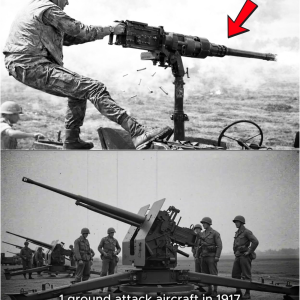

Why the American M2 Browning .50 Cal Was Feared in Every War
In the year 2015, inside a military storage facility somewhere in the United States, a single M2 Browning 50 caliber machine gun was officially removed from active service. It carried serial number 324. The 324th M2 ever produced. It had served continuously for 94 years. It was older than every single soldier who had ever fired it, and it still worked.
But the story of that machine gun, the story of the M2 Browning, begins in a place so far removed from Triumph that no one at the time would have believed what it would become. Because in 1933, the entire United States military owned just 990 of them. No one knew what to do with the thing. It was too heavy for infantry to carry, too hot to fire for more than a few seconds before the barrel threatened to crack, too bulky for any aircraft of the period to lift off the ground.
The man who designed it had died 7 years earlier without ever seeing it work the way he intended. The whole program looked like an expensive dead end with no future and no purpose beyond bolting it to a concrete pad at the edge of a coastline and hoping enemy planes flew close enough to hit.
Less than 10 years later, the M2 would be manufactured on a scale that dwarfed every other heavy weapon in Allied service and find its way onto everything with wings, tracks, or wheels. The Germans would want it so badly they would draw up plans to manufacture its ammunition from captured weapons. The Japanese would never field anything that came close.
And a single bullet, one round of 50 caliber Browning machine gun ammunition would set a sniper record that stood for 35 years. fired not from a rifle but from the very machine gun no one had wanted. That story will come later. And perhaps the most extraordinary detail of all is this. The M2 Browning in service today is almost identical to the one drawn on paper more than a 100 years ago.
So what transformed an unwanted failure into the longest serving weapon in American military history? And how did a cartridge born from the enemy’s own creation become the nightmare that consumed them? to understand that you have to go back to the war that changed everything. The First World War introduced industrialized killing on a scale the world had never imagined.
Machine guns mowed down entire battalions in minutes. Artillery cratered the Earth until the landscape looked like the surface of the moon. And through it all, every single machine gun on every side of the conflict fired the same caliber ammunition as the standard infantry rifle. That was sufficient for most of the targets a machine gun was expected to destroy.
Soldiers, horses, wooden structures, thin walls, then armor appeared. The Germans introduced the Junker’s Jword ground attack aircraft in 1917. A machine built with a steel bathtub surrounding the cockpit that made it immune to rifle caliber fire. Armored vehicles and tanks rolled across the trenches with increasing frequency, shrugging off bullets that would have killed a man 10 times over.
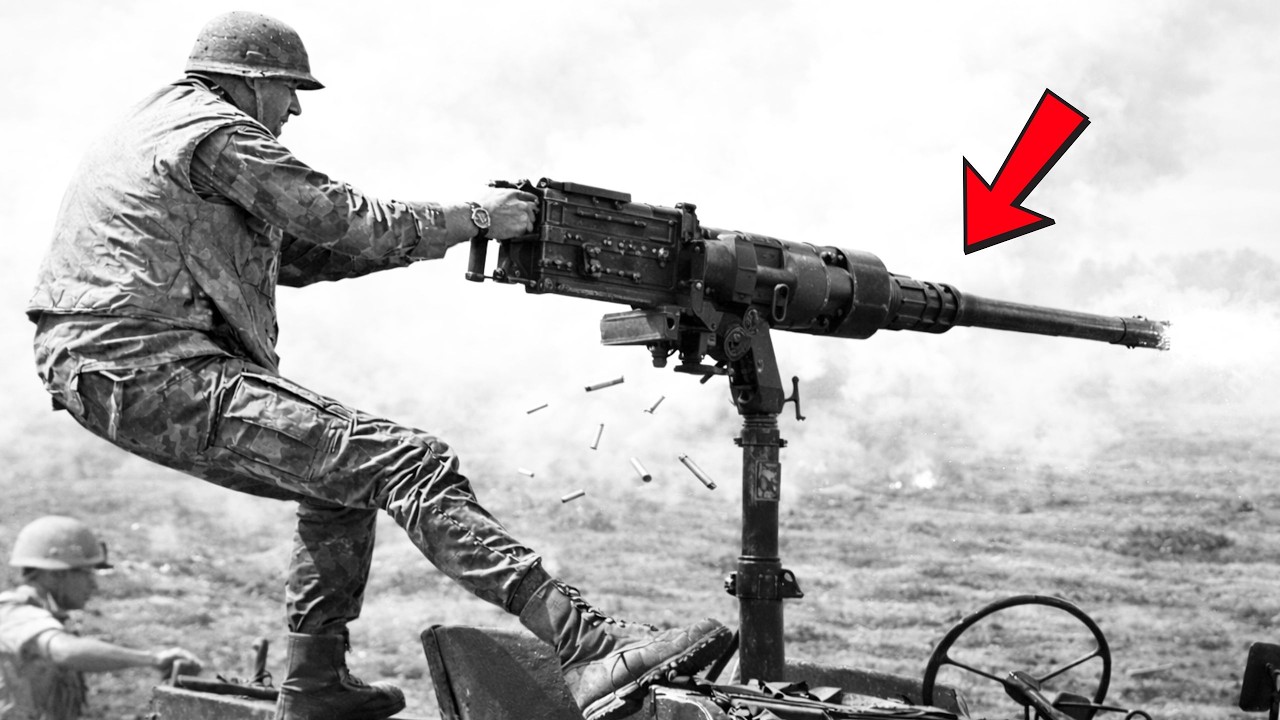
It became obvious that armored planes and armored vehicles were not temporary experiments. They were the future and every rifle caliber machine gun in the Allied inventory was powerless against them. General John J. Persing, commander of the American Expeditionary Forces in Europe, recognized the threat before most.
Sometime around July of 1917, Persian sent out a requirement for a new weapon. The specifications were aggressive, a caliber of at least half an inch, a muzzle velocity exceeding 2700 ft per second. The weapon had to be capable of destroying tanks and shooting down aircraft, but also effective against anything else on the battlefield.
Nothing in the American arsenal came close to meeting those numbers. It was by any reasonable measure an impossible ask. And the ask went to John Moses Browning. If you or someone in your family served alongside the M2 Browning in any of America’s wars, we want to hear that story. Drop it in the comments below and tell us which conflict and where you served.
Those stories matter more than you know. Now, to understand why John Browning was the man the army turned to, you have to understand who he was by 1917. He was not a hobbyist. He was not a tinkerer who got lucky. By the time Persing specifications landed on his workbench, Browning had already designed nearly every automatic weapon the United States military would carry into the Second World War.
The M1917 water cooled machine gun, the Browning automatic rifle, the M1911 pistol that would serve for 75 years. He was the man the military called when they had a firepower problem no one else could solve. And this time the problem was bigger than anything he had faced before. Browning went to work alongside his collaborator Fred T. Moore.
Their approach was characteristically practical. Rather than designing something entirely new from scratch, they took the M. 1917, a 30 caliber machine gun already proven for its reliability under the worst conditions imaginable. And they scaled the entire thing up. Larger receiver, heavier bolt, stronger recoil mechanism, everything bigger, everything reinforced, everything designed to handle a cartridge that did not yet exist.
Winchester took on the task of developing the ammunition. Their starting point was a scaled up version of the 306, the standard American military cartridge. But the real breakthrough came from the enemy. American forces on the western front captured several German mouser tawware 1918 anti-tank rifles along with their ammunition.
The German cartridge was a 13.2 mm round and its performance numbers were remarkable. A muzzle velocity of 2700 ft per second, an 800 grain bullet, the ability to penetrate 1 in of hardened steel armor at a range of 250 yd. Those numbers matched almost exactly what Persing had demanded. Winchester studied the captured German round and used its specifications to refine their own 50 caliber cartridge.
Frankfurt Arsenal later took over final development. The result was the 50 BMG, the 12.7 by 99 mm cartridge, one of the most lethal rounds ever created. And here is the irony that sits at the foundation of this entire story. The Germans created the anti-tank cartridge. They built a singleshot boltaction rifle for it.
Essentially a scaled up mouser infantry rifle. They understood the concept. They recognized the need, but they never managed to build a machine gun that could fire it. John Browning took their idea, improved upon it, and turned it into a weapon that would come back to devastate the very army that had inspired it.
The enemy’s bullet, refined and perfected by American engineering, would become the instrument of their own destruction. They just did not know it yet. The first prototype 50 caliber machine gun underwent trials on October 15th, 1918, almost a full month before the armistice that ended the First World War on November 11th.
The results were discouraging. Rate of fire fell below 500 rounds per minute. Muzzle velocity reached only 2300 ft per second, well short of the 2700 Persing had specified. The gun was heavy, difficult to control. The recoil made accurate fire a distant ambition rather than a practical reality, and it was not powerful enough to reliably penetrate the armor it had been designed to defeat.
Winchester continued refining the ammunition. They pushed the muzzle velocity up to 2750 ft per second. The gun entered limited production as the M1921A water cooled heavy machine gun, intended primarily for anti-aircraft defense. But the list of problems grew longer with every test. The water cooled version weighed approximately 121 pounds when filled with water.
The air cooled variant was lighter at around 84 lb, but the barrel overheated so quickly that it could only handle roughly 75 rounds before risking a fracture. Ammunition fed only from the left side, making it nearly impossible to mount inside the cramped turrets of early tanks and armored vehicles. With the 44lb M3 tripod, the total ground setup weighed between 130 and 170 pounds before counting a single round of ammunition.
And 50 BMG rounds are not light. Infantry could not realistically operate with this weapon. Aircraft of the period could not carry it. Early armored vehicles could not fit it. For years, the only practical application was fixed coastal anti-aircraft defense, bolted to concrete, pointed at the sky, waiting for planes that might never come.
And then on November 26th, 1926, John Moses Browning collapsed and died in the workshop of Fabri National in Leazge, Belgium. He was 71 years old. The 50 caliber machine gun was still an unfinished project. A weapon searching for a purpose that no one could define. The greatest firearms designer in American history would never see his final creation work the way he had envisioned it.
He would never know that it would serve for over a century. He would never know that it would fly on bombers over Germany, ride on tanks across North Africa, float on warships in the Pacific, and be carried into deserts and mountains and jungles on six continents across six major wars. He would never know any of it. There is a particular kind of tragedy in creating something whose significance you never live to understand.
Browning gave the United States the firepower to win the largest war in human history, the M1917 machine gun, the BAR, the M1911 pistol, and the foundation of the M2. He armed an entire nation for a conflict that had not yet begun. And he died before the first shot was fired. That is a legacy measured not in awards or recognition, but in the quiet accumulating weight of lives saved in battles won by weapons that outlived their maker by generations.
But Browning had done something in his design of the M2 that perhaps even he did not fully appreciate while he was alive. He built it so that anyone could operate it. Not a specialist, not a trained marksman, not an expert in heavy weapons. Any soldier, any sailor, any person who found themselves behind it in a moment when survival demanded action could pull the trigger and the gun would do the rest.
It was in a way that no one intended the most democratic weapon ever made. And that accidental democracy would matter more than anyone could foresee. Browning’s death did not kill the project. Between 1927 and 1932, Dr. SH Green took over the research, studying every flaw of the M. in 1921 and every need of the armed services. Green solved the two problems that had crippled the weapon for a decade.
The first was a single receiver design that could be converted into seven different types of 50 caliber machine guns simply by swapping jackets, barrels, and components. More critically, the new receiver allowed ammunition to feed from either the right or the left side. This meant the same gun could now be mounted in any position on any platform with only minor modification.
Right side of a tank turret, left side of an aircraft wing, top of a naval vessel, anywhere. The second solution addressed the overheating problem that had plagued the air cooled barrel from the beginning. Instead of the water cooling system that was rapidly going out of fashion, Green’s team developed a heavier, thicker barrel that dissipated heat far more effectively.
This variant became the M2HB, heavy barrel, 84 lb, a rate of fire between 450 and 575 rounds per minute, an effective range exceeding 2,000 y. In 1933, Colt began manufacturing the M2. By 1937, the experimental use restriction was lifted entirely. The weapon that no one had wanted was finally ready. It just needed a war. The mechanical heart of the M2 beats on the short recoil principle.
When a round fires the barrel and bolt begin locked together and travel rearward as a unit. This keeps the cartridge case fully supported while chamber pressure is still at its peak, preventing the case from rupturing during extraction. After approximately 10 mm of travel, the barrel stops. The bolt continues rearward on its own, pulling the spent case out and ejecting it.
That rearward movement compresses the recoil spring, which then drives the bolt forward again, strips a fresh round from the disintegrating link belt chambers, it and fires. The cycle repeats for as long as the trigger is held down. It is not a complicated concept, but making it work reliably at this scale with a cartridge, this powerful generating forces this extreme was the engineering challenge that consumed Browning and his successors for nearly two decades.
Before we follow the M2 into combat, consider the sheer energy of the cartridge it fires. The 50 BMG delivers between 10,000 and 15,000 foot-lbs of energy at the muzzle. That is roughly four times what a 306 produces. Compared to the 8 millimeter mouser round that the German MG42 would later fire and essentially any other infantry weapon of the period.
The 50 BMG generates 5 to 10 times more energy. At 100 yards, it penetrates approximately 1 in of hardened steel armor plate. A brick wall will not stop it. A sandbag bunker will not stop it. Very little that a soldier can hide behind will stop it for long. The ammunition was designed for versatility. Ball was the standard round of copper jacket with the lead core more than sufficient to ruin anyone’s day.
Armor-piercing rounds carried a hardened steel or tungsten core marked with a black tip capable of punching through the side armor of light tanks and vehicles. Armor-piercing incendiary added a compound that ignited anything flammable once it penetrated. Armor-piercing incendiary tracer added a burning element in the base so the gunner could see where rounds were landing and adjust fire.
The most common belt configuration loaded one tracer every fifth round with the rounds in between alternating between ball and armor piercing. A single burst carried every capability at once. Penetration, ignition, visibility, destruction. Now, the M2 was ready, but no one in the late 1930s knew exactly how or where this weapon would make its name.
Before 1933, just 990 sat in American armories, while the 30 caliber machine gun remained the workhorse. But as Germany rearmed with armor and firepower that clearly outmatched what the Americans possessed, the need for heavy machine guns became urgent. When Germany invaded France, American Ordinance issued contracts worth over $60 million to produce the M2 across four variants.
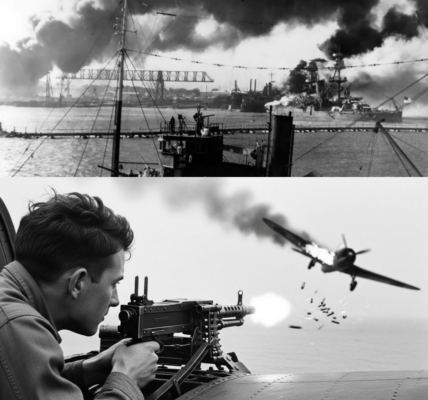
And then the M2’s combat debut arrived in the most unexpected way possible on a quiet Sunday morning in Hawaii at a place the whole world would soon know by name. December 7th, 1941, Pearl Harbor. Doris Miller woke at 6 in the morning aboard the battleship USS West Virginia. He was 22 years old. Born October 12th, 1919 in Waco, Texas.

The third of four sons born to sharecroers Connory and Henrietta Miller. His grandparents had been slaves. Miller stood 6′ 3 in tall and weighed over 200 lb. a former high school fullback built like the farmwork that had shaped his youth. He had enlisted in the United States Navy in September of 1939 to earn money for his family.
In the segregated Navy of that era, Africanameans were restricted to a handful of non-combat roles. Miller was a mess attendant. He cooked. He served food. He collected laundry. He was never trained on any weapon aboard the ship. That morning, Miller finished serving breakfast and was gathering officers laundry when the first torpedo struck the West Virginia at 7:57 a.m.
The Japanese carrier Akagi had launched the attack. In total, seven torpedoes and two bombs would hit the battleship. Miller ran to his assigned battle station, the anti-aircraft battery magazine amid ships, and found it destroyed by torpedo damage. He went topside. The scene on the bridge was chaos.
Captain Mvin Sharp Ben, the ship’s commanding officer, had been struck by shrapnel, and was bleeding heavily. Miller, with the strength of a man who had spent his life hauling hay bales and tackling running backs, helped carry the wounded captain to a more sheltered position behind the bridge. Benian refused to leave his post.
He would bleed out and die there. He was later awarded the Medal of Honor postumously. Two Browning M250 caliber anti-aircraft machine guns stood unmanned on the aft section of the bridge. Lieutenant Frederick H. White ordered Miller to help him and in Victor Delano load and operate the weapons. White and Delano showed Miller how the guns worked.
Delano expected Miller to feed ammunition belts while someone else fired. But when Delano’s attention was drawn away for a moment, he looked back to find Miller behind the starboard gun, firing it into the sky full of diving Japanese aircraft. Dory Miller had never touched an M2 Browning in his life. He had never been trained on any machine gun.
He had never been given the opportunity, but the gun did not require a certificate. It did not ask what school he had attended or what color his skin was or whether the United States Navy considered him worthy of holding a weapon. In a military that told him he was fit only to serve food and wash laundry, the M2 Browning told him nothing at all.
It simply waited for someone to stand behind it. And on that burning morning in Pearl Harbor, Dory Miller was that someone. He fired for approximately 15 minutes. He fired until the ammunition ran out. In the chaos of explosions, torpedo strikes, and strafing runs, Miller was officially credited with downing at least one Japanese aircraft, though he and other eyewitnesses claimed between four and six.
When asked afterward how he managed to operate the weapon with no training, Miller said simply, “It was not hard. I just pulled the trigger and she worked fine. I had watched the others with these guns. I guess I fired her for about 15 minutes. I think I got one of those planes. When the gun went silent, Miller did not stop. He turned to the wounded.
He pulled injured sailors through water covered with burning oil from the shattered battleship Arizona nearby. He dragged men to the quarter deck in safety. The West Virginia was sinking, settling into the shallow harbor bottom. Of her 1541 crew members, 130 were killed and 52 wounded. Dory Miller was one of the last three men to leave the ship.
He and his surviving shipmates swam 3 to 400 yardds to shore, dodging patches of flaming oil and strafing from Japanese fighters still circling overhead. On May 27th, 1942, Admiral Chester W. Nimtt’s commander and chief of the Pacific Fleet personally presented Miller with the Navy Cross aboard the aircraft carrier USS Enterprise at Pearl Harbor.
Nimtt said that this marked the first time in the conflict that such high tribute had been made in the Pacific Fleet to a member of his race and that he was sure the future would see others similarly honored for brave acts. Dory Miller did not survive the war. On November 24th, 1943, he was aboard the escort carrier USS Liscom Bay off Buritari Island during the Battle of Makin when a Japanese submarine torpedo struck the ship’s bomb magazine.
The explosion sank the Liscom Bay in 23 minutes. Of 900 crew members, only 272 survived. Miller was among the dead. He was 24 years old. In January of 2020, the United States Navy announced that its newest Gerald Ford class nuclear super carrier, Civin 81, would be named the USS Doris Miller. It will be the first aircraft carrier in American history, named for an enlisted sailor.
John Browning designed the M2 to defeat tanks and shoot down aircraft. He never imagined that his gun would give a black mess attendant with no training the chance to fight as an equal in a segregated Navy. He never imagined that the simplicity of his design, the fact that anyone could operate it would become its most profound characteristic.
Browning built a machine. But what Miller proved at Pearl Harbor was something deeper than engineering. He proved that courage does not require permission. And the M2, with its brutal simplicity, was the instrument that made that proof possible. Pearl Harbor awakened America. And it awakened the M2 Browning.
When Germany declared war on the United States days after the attack, the M2 went into mass production at a pace that staggered the industrial world. Contracts expanded, factories toolled up. The weapon that had languished for two decades as an experimental curiosity was suddenly the most wanted piece of hardware in the American arsenal.
every halftrack, every tank, every tank destroyer, every armored car, every landing craft, every patrol boat, and even jeeps would carry at least one, always with plenty of ammunition. And very soon, the Germans would discover that no amount of engineering brilliance on their side could answer what the Americans had bolted to the roof of every vehicle in their inventory.
The M2 Browning went to war on wings first. The aviation variant designated the A/M2 was a completely different animal from the ground version that sat on tripods and turrets behind sandbags. The barrel was shorter and thinner to save weight. And this was possible because the cooling problem that tormented gunners on the ground simply did not exist at altitude.
An aircraft traveling at several hundred miles hour through freezing air at 10 or 15 or 20,000 ft handle barrel cooling automatically. Every second of flight was a second of forced air refrigeration across the entire weapon. Heat was no longer the enemy. Time was and that is why the aviation M2 was tuned for speed.
While the ground version cycled at roughly 500 rounds per minute, the aircraft variant exceeded 850. Some configurations reached 1,200 rounds per minute, which put it squarely in the neighborhood of the German MG42 when measured purely by rate of fire. Except the M2 was throwing a bullet that was vastly larger and more powerful than anything the MG42 could chamber.
The reason for that extreme rate of fire was simple and ruthless. An enemy fighter crossing your gun site or a target on the ground during a strafing run while you are traveling at 300 miles per hour gives you perhaps one or two seconds of firing time. That is all. One heartbeat of opportunity.
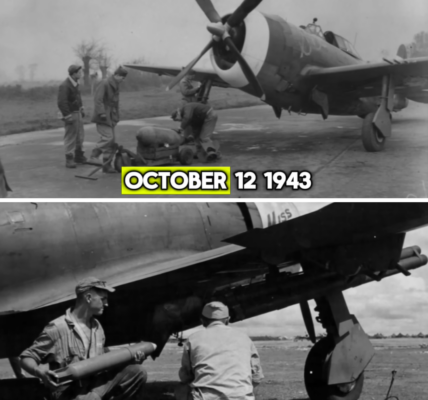
So you need as many rounds in the air as physically possible during that sliver of time. And that is why American fighters did not carry just one 50 caliber machine gun. They carried six or eight. The P47 Thunderbolt, that massive jugshaped Republic fighter that could absorb punishment like a flying tank, carried eight M250 caliber machine guns.
The P-51 Mustang, the F6F Hellcat, the F4U Corsair, each carried six. The Douglas A26 Invader took the concept to its logical extreme with up to 18 MM2s, eight packed into the nose, four in each wing, two in a dorsal turret. When an A26 opened fire, the combined output was a wall of half-in steel moving at nearly 3,000 ft per second.
The B17 Flying Fortress, the backbone of the American strategic bombing campaign over Europe, bristled with up to 1350 caliber machine guns positioned in turrets and flexible mounts covering every angle of approach. tail, ball turret underneath, waist positions on both sides, top turret, chin turret on later models, every one of them a Browning M2.
When a formation of Luftwaffa fighters dove on a B17 box formation, they flew into converging fields of 50 caliber fire from dozens of guns simultaneously. The 50 BMG was less powerful than the 20 or 30 mm autoc cannons mounted on some German fighters, but the Americans compensated with volume and ammunition capacity, and the 50 caliber round could still punch through an engine block or an armored pilot’s cabin.
It was more than sufficient to bring down any aircraft of the era. And when multiple guns concentrated their fire on a single ground target during strafing runs, the effect was devastating against hard targets as well. locomotives, armored cars, supply trucks, even tanks caught in the open with their thin top armor exposed to plunging fire from above.
But perhaps nowhere was the concentrated power of the 50 caliber more terrifying than in the M45 quad mount. Sometime around early 1944, a young man from Pittsburgh named Thomas Djankowski found himself assigned to an M16 multiple gun motor carriage. He was 20 years old, the son of a steel worker. His mother sold military uniforms in a factory that had been making women’s dresses before the war.
His older brother, Stfon, had been killed in North Africa in 1943 when a German artillery round hit his halftrack. Thomas had enlisted partly out of patriotism and partly out of the kind of cold, quiet fury that settles into a 19-year-old who has just buried his brother. The M16MGMC was an M3 halftrack with an M45 quadmount turret bolted on top.
The M45 was the brainchild of the WL Maxin Corporation of New York. Designed in 1943 to counter the relentless threat of German aircraft strafing Allied columns on the ground. The concept was straightforward. If one M250 caliber machine gun firing 500 rounds per minute was not enough to reliably hit a fastmoving airplane, then four of them firing simultaneously would be.
The M45 mounted four M2HB heavy barrel machine guns in pairs on each side of an electrically powered turret. The turret rotated a full 360° and elevated between -10 and positive 90° driven by an electric motor powered by two 6volt batteries recharged by a small gasoline generator. Combined rate of fire approached 2200 rounds per minute.
Each gun was fed from a tombstone shaped ammunition can holding 200 rounds and weighing 89 lb. Two loaders kept the cans full while the gunners sat in the center of the turret, peering through a spiderweb graduated sight and poured fire into the sky. Thomas was trained for the anti-aircraft role.
He practiced tracking fastmoving targets, leading them by the correct angle, firing the upper pair of guns while the lower pair cooled, then switching. The doctrine was clear. Protect the column from strafing. Deter enemy pilots from making low passes. fill the air with enough hot metal that no reasonable pilot would risk flying through it.
But by late 1944, something had changed. The Luftwaffa was dying. Allied air supremacy over Western Europe was nearly absolute. German fighters appeared less and less frequently over the front lines, and the soldiers operating the M45 quad mounts began pointing their guns at a different kind of target. They pointed them at the ground.
If this story of American engineering and courage reminds you of someone who served, share this video with them and hit subscribe so you do not miss the rest. We have much more to tell. Many decades later, a photographer in Tennessee named Ronnie Barrett would look at a picture of an M250 caliber machine gun silhouetted against a river patrol boat and wonder why no one had ever built a proper rifle around that cartridge.
His answer to that question would change modern warfare forever. But that part of the story is still a long way off. In the winter of 1944, the M2 had a more immediate appointment with history. December 1944, the Arden Forest, the Battle of the Bulge. The German counteroffensive crashed through Allied lines with the speed and violence that caught the entire Western Front off guard.
Panzer divisions and infantry poured through gaps in the American defenses. The weather was brutal. snow, fog, temperatures well below freezing. Air support was grounded. And in the chaos of the initial breakthrough, mobile anti-aircraft battalions equipped with M45 quad mounts found themselves reposition not to shoot at planes, but to shoot at the waves of German infantry advancing through the frozen landscape.
Thomas Djankowski sat in the gunner seat of his M16 halftrack somewhere in that frozen hell and squeezed the trigger. The sound of four 50 caliber Browning machine guns firing simultaneously is not something that can be adequately described with words. It is not a sound. It is a physical event.
The air itself seems to tear apart. The halftrack rocks on its suspension. Brass casings glowing orange with heat cascade out of the receivers in a continuous metallic waterfall. And at the receiving end, anything moving stops moving. The M45 earned its nicknames in the Arden. The men who operated it called it the meat chopper.
The Germans, those who survived encountering it, called it the kraut mau. It is difficult to advance infantry across open ground when 450 caliber machine guns are hitting your formation with precision from half a mile away. The heavy rounds punched through the stone walls of farmhouses. They shattered trees at trunk level. They turned the frozen earth into geysers of dirt and ice.
And they did it continuously. Gun pair alternating with gunpair for as long as the loaders could keep feeding ammunition. Then came March of 1945. Oppenheim. The Allies were preparing to cross the Rin River into the German heartland. The US Third Army needed the bridges intact. The Germans understood this and launched a desperate air assault.
248 German war plananes, one of the largest Luftwafa concentrations of the late war, attempted to destroy the bridge before Patton’s army could cross. American anti-aircraft artillery battalions masked their M45 quad mounts along the riverbank and opened fire. When the smoke cleared and the last German fighter had either been shot down or driven off, the quad mounts were credited with destroying roughly 30% of the entire attacking force.
The bridge was not touched. The third army crossed into Germany. Thomas Yankowski, if he survived the bulge and the rine and the final push into the collapsing Reich, would have come home to Pittsburgh carrying memories that no steel worker son should have to carry. The sound of those four guns. The sight of what they did to men caught in the open.
The weight of the 89lb ammunition cans that his loaders lifted over and over until their arms shook and their gloves were soaked through with sweat that froze in the winter air. He would not have talked about it much. that generation rarely did. Back on the ground across every theater the M2 served on Sherman tanks in a role that revealed the brutal pragmatism of armored warfare, the 50 caliber gun was mounted on the rear of the turret positioned so that it could not be aimed upward from inside the hatch.
A soldier had to stand on the engine deck fully exposed to enemy fire from every direction to operate it. This made the gunner the most vulnerable person on the tank, but it also gave him the ability to point his weapon anywhere. American tankers developed a technique they called recon by fire. Rather than wasting a precious main gunshell on every suspicious hedge building or tree line, the tank commander would order a short burst of 50 caliber into whatever looked wrong.
If someone was hiding behind that wall or inside that barn, one of two things would happen. Either they would return fire, revealing their position for the main gun, or they would stay hidden, and the 50 caliber rounds would find them anyway. At close range, the armor-piercing rounds punched through almost an inch of hardened steel.
A brick wall offered no meaningful protection. A sandbag bunker could be chewed apart in seconds if the gunner held the trigger long enough and kept his rounds on the same point. In the Pacific theater, the M2 found yet another role. Japanese tanks were built lighter and with thinner armor than their German counterparts.
The 50 BMG could penetrate the side armor of most Japanese tanks at combat ranges during bonsai charges when waves of Japanese infantry rushed American positions in terrifying human wave assaults. The M2 on its ground tripod became the last line of defense and the most lethal one. The psychological effect of that relentless thundering fire on men charging with bayonets across open ground was as devastating as the physical damage.
The 50 BMG filled a gap in the American arsenal that no other weapon could. It outranged every enemy machine gun. It outpowered every infantry weapon on the battlefield. It penetrated light armor that rifle caliber rounds bounced off. And it did all of this from a platform that could be bolted onto anything served by ammunition that was available in staggering quantities operated by any soldier who could reach the trigger.
Which brings us to the question that the 50 caliber sheer power inevitably raises. What does a round like this actually do when it hits a human body? According to Wound Ballistics research, the threshold for high energy tissue destruction begins at a projectile velocity of approximately 2,000 ft per second. The 50 BMG exceeds that threshold by nearly 50%.
When the round enters tissue, it compresses the flesh around it, violently transferring its enormous kinetic energy and creating what is known as hydraulic shock. The tissue is pushed outward in a temporary cavity far larger than the bullet itself. Then it snaps back. Every bullet does this to some degree.
With the 50 BMG, the temporary cavity is massive and the energy transfer is catastrophic. Soft organs in the path of the round or even near it are destroyed. And because of the shock wave that propagates through the body organs do not need to be directly struck to suffer severe damage. In practical terms, a hit anywhere near a limb’s major bones or blood vessels is not survivable without immediate surgery.
And even then, the limb is almost certainly lost. A hit to the torso or the head requires no further description. This is what the Germans faced on every front where Americans fought. And the asymmetry that decided the outcome was not merely technical. It was industrial. The German military never developed a heavy machine gun for ground use.
They relied on their general purpose MM G34 and MG42 superb weapons. firing the 8mm mouser cartridge or round that had served since the First World War. Those machine guns, especially the MG42, could fire faster than any Allied equivalent. Mounted on the Lefett tripod with its ingenious mechanical computer for setting range and zones of fire, they achieved precision that the Allies never matched at the infantry level.
But none of that mattered beyond a certain range because the 8mm mouser was a rifle caliber cartridge and the 50 BMG was something else entirely. At 2,000 yd, the 50 caliber round still carried enough energy to kill. The 8 mm was a memory at that distance. The Germans knew it. They wanted the M2 for themselves. They drew up plans to use captured M2 machine guns for the protection of their Yubot pins.
They developed schemes to manufacture 50 BMG ammunition to feed those captured weapons, but none of it materialized in any meaningful quantity. The nation that had created the anti-tank cartridge that inspired the 50 BMG was being consumed on every front, suffering critical shortages of raw materials, fuel, and manufacturing capacity.
They could not afford another weapons program. The cartridge they had invented had been turned against them, and they could do nothing but endure it. This was not limited to the soldiers on the ground. German dive bomber and fighter pilots attacking targets in the field discovered that their missions had become far more dangerous than they had been earlier in the war.
Every American vehicle had at least one M2 pointing skyward. A Stooka pilot diving on a column of Shermans in 1944 was flying into a forest of upward pointing barrels, every one of them capable of shredding his aircraft with a single wellplaced burst. By the time the last shot of the Second World War was fired in August of 1945, the M2 Browning had participated in every major engagement on every front.
It had flown on every American combat aircraft type. It had ridden on every American armored vehicle. It had floated on every class of American warship. The scale of its production had outpaced every other heavy weapon in the Allied inventory. And the men who had faced it, German and Japanese alike, respected it above almost any other weapon the Americans possessed.
But the story of the M2 was only half told. In Korea, it would serve again in the same roles, on tanks, on halftracks, on frozen hilltop positions, where the M45 quad mount would once more prove its worth against Chinese and North Korean infantry advancing in mass formations. The Korean War confirmed what the Second World War had already established.
The 50 caliber Browning was not a weapon for one conflict. It was a weapon for all conflicts. And then came Vietnam. A different war in every way. Jungle instead of desert. Guerilla instead of conventional. Ambush instead of front line. The M2 adapted again. mounted on gun trucks protecting supply convoys along roads laced with Vietkong ambushes on riverine patrol boats threading through the Meong Delta on base perimeters where the quad mount still served as the most terrifying thing a sapper could encounter in the dark. But it was in
Vietnam that someone would look at the M2 Browning, a weapon designed to shoot down airplanes and destroy light armor, and see something that no one else had ever seen. Not a machine gun, not an anti-aircraft weapon, not a vehicle-mounted suppression tool, a sniper rifle. Hill 55 rose out of the flat green landscape south of Daang like a fist pushed up through the earth.
It was not much of a hill by any standard except the one that mattered in Vietnam, which was that it offered a clear view of the surrounding terrain and the enemy who moved through it. In 1966, the first Marine Division sniper platoon operated from Hill 55. And the man responsible for building that platoon into something the North Vietnamese would learn to fear was Captain Edward James Land.
Land believed in snipers the way an engineer believes in precision. He understood that one well- aimed shot could accomplish what a 100 rounds of suppressive fire could not. He pushed the Marine Corps to develop snipers in every platoon, and he recruited the best marksmen he could find. Lan looked for a specific kind of man, not just someone who could shoot, because the Marines had plenty of those.
He wanted men with disciplined patience and the particular stillness of mind that allows a person to lie motionless for hours in heat and insects and fear, waiting for a single moment that might last less than a second. In 1966, Land found exactly what he was looking for. A staff sergeant from Arkansas, who had won the Wimbledon Cup the year before.
Carlos Norman Hathcock II was born on May 20th, 1942 in Little Rock, Arkansas. His parents separated when he was young, and he grew up in the small town of Win, raised by his grandmother, Myrtle, in a house where money was scarce and meals were not guaranteed. Hathcock taught himself to shoot out of necessity as much as passion. He hunted rabbits and squirrels with a singleshot 22 caliber rifle partly because he loved the woods and partly because his family needed the meat.
As a boy, he would take his father’s old war relic mouser and pretend he was a soldier playing in the hills and creek beds around win dreaming of the day he would become a United States Marine. On May 20th, 1959, his 17th birthday, Carlos Hathcock enlisted in the Marine Corps with his mother’s written permission.
He weighed 140 lb. Within a few years, he had broken nearly every marksmanship record the Marines kept track of. In 1965, he won the Wimbledon Cup at Camp Perry, Ohio. The most prestigious prize in American long range rifle, shooting a 1,000yard championship that separated the best from everyone else. Hathcock was the best.
He deployed to Vietnam in 1966 as a military policeman, a role that lasted about as long as it took him to volunteer for combat. He was transferred to the first marine division sniper platoon on hill 55 and from that day forward the war in his sector changed. Hathcock’s primary weapon was the Winchester model 70 chambered in 306 fitted with a standard 8 power unert scope.
He also used the M40 Remington 700 in308. But his methods were what set him apart. He moved through the jungle like water through grass. He could lie in the same position for days without being detected. He once lowcrolled 1500 yd across an open field over the course of three sleepless days to assassinate a North Vietnamese general, firing a single round from 700 yardds that struck the man through the heart, then vanishing into the treeine without being seen by the hundreds of soldiers who searched for him afterward.
Captain Land, who had recruited him and who understood what Hathcock was better than most, said simply that Carlos became part of the environment. He totally integrated himself. He had the patience, drive, and courage to do the job. The North Vietnamese in Vietkong called him long trunk, white feather. Because Hathcock wore a white feather tucked into the band of his bush hat, an act of defiance that amounted to daring the enemy to find him.
They put a bounty on his head. They sent a platoon of counter snipers specifically to hunt White Feather. When the Marines on Hill 55 learned about the bounty, many of them began wearing White Feathers in their own hats to confuse the enemy and protect their sniper. They made themselves targets so that Hathcock could continue his work.
One of Hathcock’s most famous engagements was against an enemy sniper who had been sent to kill him. The two men stalked each other through the jungle for days. Hathcock eventually spotted a glint of light in the vegetation, the reflection of the sun off a rifle scope. He fired a single round that passed through the enemy sniper’s own scope and into his eye, killing him instantly.
The geometry of that shot means that the enemy’s rifle was pointed directly at Hathcock at the moment he fired. They were aiming at each other simultaneously. Hathcock was simply faster. Staff Sergeant Bobby Ray Tanner watched all of this from closer than most. Tanner was 26 from Alabama, the son of a coal miner who had joined the Marines to escape the poverty that had swallowed everyone he knew growing up.
He served as a spotter in the sniper platoon, working alongside Hathcock on Hill 55, and he had seen enough by 1967 to understand that Hathcock operated on a level that most men could not reach. But even Tanner was skeptical when Hathcock turned his attention to the M2 Browning 50 caliber machine gun and announced that he intended to use it as a sniper weapon.
The idea was not entirely without precedent. Machine guns had been used for long range precision fire in Korea. But what Hathcock proposed was different. He wanted to mount a rifle scope on the M2 and fire it in singleshot mode at individual targets at distances that no conventional sniper rifle of the era could reach. Hathcock designed a scope mount and the metal workers of the Navy CBS, the construction battalions that built everything the military needed in Vietnam, from air strips to latrines, fabricated it from scratch.
They machined a bracket that attached an eight power unert scope to the top of the M2 HB receiver. The gun sat on its standard M3 tripod, stabilized with sandbags, and Hathcock zeroed it at 1,000 yards, then began working his way out. Tanner remembered the first time he watched Hathcock fire the M2 at a distant target through that juryrigged scope. The gun weighed 84 lb.
The tripod weighed 44. The scope was designed for a weapon that weighed 10. The entire setup looked like something a madman had assembled in a fever dream. But when Hathcock squeezed the trigger in singleshot mode, and the round struck exactly where he had aimed it at over 1,000 yards, Tanner stopped laughing. Hathcock made multiple kills with the scoped M2 at distances exceeding 1,000 yard.
But the shot that would enter the history books came in 1967 from an elevated position on a hillside overlooking a valley. Hathcock had been observing for three days. He had zeroed the M2 at 1,000 yards and calculated the adjustments needed for greater distances. A Vietkong fighter appeared in the valley below, pushing the bicycle loaded with weapons and supplies along a trail.
The distance was approximately 2500 yd, nearly 1 and a half miles. Hathcock settled behind the M2, placed the crosshairs on the target, and fired. The first round struck the bicycle’s front wheel, sending the fighter tumbling to the ground. Dazed but alive, the man scrambled to his feet. Instead of running, he picked up a rifle, chambered a round, and pointed it in the direction of the shot.
Hathcock fired again. The second round connected. The distance was approximately 2,286 m. It was the longest confirmed sniper kill in recorded history, shattering a record that had stood since 1874 when buffalo hunter Billy Dixon had made a shot at 1,538 yards during the second battle of Adobe Walls.
And Hathcock had done it not with a precision built sniper rifle, but with a belt-fed machine gun fitted with the scope that had been welded together by construction workers. That record would stand for 35 years. It was not broken until 2002 when Canadian sniper Aaron Perry of Princess Patricia’s Canadian Light Infantry made a shot at 2,310 m during Operation Anaconda in Afghanistan.
Perry held the record for only a few days before his teammate, Corporal Rob Furlong, exceeded it at 2,430 m. But both Perry and Furlong used purpose-built sniper rifles with modern optics and ballistic computers. Hathcock had used a machine gun, a borrowed scope, and the mathematical instincts of a boy who had learned to shoot by hunting squirrels in Arkansas.
Carlos Hathcock recorded 93 confirmed kills in Vietnam. He estimated the true number was between 300 and 400. The confirmation process required verification by the sniper spotter and a third party who had to be an officer. And in the chaos of jungle warfare, that standard was rarely met. On September 16th, 1969, the armored amphibious vehicle Hathcock was riding struck a landmine.
The explosion engulfed the vehicle in flames. Despite severe burns covering much of his body, Hathcock pulled seven fellow Marines from the wreckage before collapsing. He received the Silver Star for that action and was medically evacuated first to Tokyo and then to San Antonio for burn treatment. After Vietnam, even as his body was ravaged by the burns and a subsequent diagnosis of multiple sclerosis, Hathcock refused to disappear into retirement.
He helped established the Marine Corps Scout Sniper School at Quantico, Virginia, and helped design its curriculum. He trained snipers for the most elite units in the American military, including Seal Team 6 and Delta Force. Everything he had learned in the jungles of Vietnam. Every technique, every instinct, every lesson paid for in blood and patience, he passed on to the next generation.
He ensured that the knowledge would not die with him. Staff Sergeant Tanner served two tours in Vietnam before returning to the States with shrapnel scars on his shoulder and a set of medals he never displayed. He became a sniper instructor at Camp Leune, quietly passing along the trade craft he had absorbed from watching Hathcock work.
Neither man talked much about what they had seen. That generation of warriors rarely did. Carlos Hathcock died on February 22nd, 1999 at the age of 56. The Marines honored him by naming a rifle variant after him, the Springfield Armory M25 White Feather. But his most lasting legacy was not a weapon or a record.
It was the school at Quantico and the generations of precision marksmen who passed through it carrying skills that traced directly back to a skinny kid from Win, Arkansas, who had learned to shoot because his family was hungry. And the 50 caliber cartridge that Hathcock had used to make the impossible shot did not fade into history after Vietnam.
In the early 1980s, a photographer named Ronnie Barrett was working in Murreey’sboro, Tennessee, when he took a picture of a river patrol boat similar to the ones used in Vietnam. In the photograph, an M2 Browning 50 caliber machine gun stood silhouetted against the water, and Barrett found himself staring at it.
He realized that no rifle existed for that cartridge. The 50 BMG had been fired from machine guns for over 60 years, but no one had ever built a proper shoulder-fired rifle around it. Barrett had no engineering degree, no gunsmithing training, no manufacturing experience. He sketched his design on his dining room table and machined the first prototype in a gravel floored garage.
By 1982, the Barrett M82 was a functioning weapon. By 1983, he was selling them commercially. The Swedish Army placed the first military order for 100 rifles in 1989. In 1990, the United States Marine Corps bought approximately 125 for Operation Desert Shield. The US Army formally adopted it in 2003 as the M107. From a photographers’s garage to the battlefields of Iraq and Afghanistan, the 50 BMG cartridge that John Browning had developed alongside Winchester more than 60 years earlier now had a second life as a precision antimaterial round
capable of reaching out past 2,000 m with devastating accuracy. But the M2 itself carried a flaw into the 21st century that had followed it since the day Browning first assembled the prototype. And that flaw was a matter of life and death every time a gunner changed a barrel. When Browning designed the M2, the manufacturing technology of his era could not hold tolerances tight enough to precisely control two critical dimensions.
The first was head space, the distance between the bolt face and the base of the cartridge case when it is fully seated in the chamber. The second was timing, the exact moment the firing pin strikes the primer relative to the position of the recoiling parts in their cycle. Both had to be correct within extremely narrow margins.
If the head space was too tight, the round would not chamber or would fail to fire. If it was too loose, the cartridge case could rupture inside the chamber while the pressure was still at its peak, sending shrapnel and superheated gas in every direction and destroying the weapon. Browning’s solution was elegant for his time.
He made both head space and timing adjustable by the operator using a specialized gauge and a system of precisely counted click increments as the barrel was screwed in or out. Under controlled conditions with a trained gunner taking his time in a maintenance bay with good lighting and no one shooting at him. The procedure worked reliably under fire with the barrel glowing from sustained use.
incoming rounds snapping overhead mortar fragments pinging off the vehicle hull and distressed 19-year-old performing the procedure in darkness with hands that were shaking from adrenaline and fear. The situation was profoundly different. The common shortcut practiced across every theater from World War II through Iraq was to assume that the click count that had worked on the old barrel would work on the replacement and just mount it without checking.
Sometimes this assumption held. Sometimes it did not. And when it did not, the result was a ruptured cartridge case, an internal explosion, and a gunner catching shrapnel from his own weapon. This was not a design flaw. It was a brilliant solution to a manufacturing limitation that existed in 1918. But it persisted for 80 years because the fundamental design of the M2 never changed.
The gun was too good to replace and too proven to redesign. So generation after generation of American soldiers learned the headsp space and timing procedure cursed. It took shortcuts with it and occasionally paid the price. The problem of the exposed gunner persisted alongside it. From the Sherman tank in 1944 to the Humvey in 2004, the man behind the M2 stood up through a hatch with no armor around him.
The most visible and most vulnerable person in the convoy. For decades, there was no shield, no turret, no protection of any kind. The gunner simply stood in the open and trusted that he would not be the one who got hit. Before we come to the end of this story, I have to ask, which moment has hit you the hardest so far? Miller at Pearl Harbor firing a weapon he had never touched Hathcock’s impossible shot from a mile and a half away or what comes next? Tell us in the comments.
And if you have not subscribed yet, now is the time. We tell stories like this every week. On April 4th, 2003, near Baghdad International Airport, Sergeant First Class Paul Ray Smith was building a holding area for enemy prisoners of war, he was 33 years old. Born September 24th, 1969 in El Paso, Texas. Raised in Tampa, Florida, he had wanted to be a soldier for as long as anyone who knew him could remember.
He enlisted in 1989 and became a combat engineer, the kind of soldier who builds bridges so others can cross and blows doors so others can enter. He deployed to Saudi Arabia during the Gulf War, then to Bosnia, then to Kosovo. By 2003, he had served 13 years and carried the quiet authority of a man who had seen enough to know exactly what he expected from the soldiers under his command.
Before deploying to Iraq, Smith wrote a letter to his parents. There are two ways to come home, stepping off the plane and being carried off the plane. It does not matter how I come home because I am prepared to give all that I am to ensure that all my boys make it home. Smith was leading a 16-man detail from Bravo Company, 11th Engineer Battalion, Third Infantry Division.
They were using an armored combat earth mover to knock holes in the walls of a courtyard near a watchtowwer, creating an improvised prisoner holding area. Specialist Marcus Reyes, 22, from El Paso, Texas, the son of a Mexican-American family that had sent men into the army for three generations, was one of the 16. The work was routine.
The danger was not. Guards at the compound gate spotted movement. 50 to 100 Iraqi soldiers were advancing on their position. Within seconds, the construction detail was under fire from small arms rocket propelled grenades and 60 mm mortars. The Iraqis seized the watchtowwer and began firing down into the courtyard.
Smith’s 16 men were caught in a kill zone. Smith organized a defense with the speed of a man who had spent 13 years preparing for exactly this moment. two platoon, one Bradley fighting vehicle, three M113 armored personnel carriers. He moved under fire, engaging the enemy with his M16 throwing hand grenades, firing an AT4 anti-armour weapon.
When an RPG and a mortar round hit one of them, one3s, wounding all three crew members inside, Smith ran through the fire to pull them out. The Bradley expended its ammunition and was forced to withdraw to reload. Behind Smith’s position, more than 100 American soldiers lay in the task force forward aid station, many of them already wounded from earlier fighting.
If the Iraqis overran Smith’s line, they would reach the aid station. There was no fallback position. There was no reserve force. There was only a damaged M113 with an M2 Browning 50 caliber machine gun mounted on its exposed turret. Smith climbed up onto the M113. He positioned himself behind the M2. He was completely exposed.
No armor, no shield, no cover of any kind. Just a man standing in a hatch with a machine gun that had been designed 86 years earlier by a gunsmith who had died before it ever fired a shot in anger. Marcus Reyes was below throwing ammunition cans up to Smith. Smith opened the receiver, seated the belt, slammed the cover down, racked the charging handle, and opened fire.
The 50 caliber rounds tore into the Iraqi positions. Smith traversed the gun across the courtyard, the watchtower, the gate. He fired and reloaded and fired again. Below him, his men began to retake the tower. The wounded were evacuated from the aid station. The Iraqi assault wavered. Smith felt the impacts.
Shrapnel from enemy fire punched through the ceramic inserts of his body armor. He kept firing. Paul Ray Smith was not a machine gunner. He was a combat engineer. A man who built things. A man whose expertise was in construction and demolition, not in the sustained operation of crew served weapons under fire. But none of that mattered in the moment when a 100 wounded Americans behind his position needed someone to climb into an open hatch and hold the line.
The M2 did not ask for his military occupational specialty. It did not care that he was bleeding. It just needed someone. And Paul Ray Smith was that someone. When the firing stopped and his soldiers reached the M113, they found Smith slumped over the M2 Browning. His body armor had 13 bullet holes.
He had been struck in the neck and head. He was dead. Around the courtyard, between 20 and 50 Iraqi soldiers lay killed. Every wounded American in the aid station behind his position had been evacuated safely. Every one of his boys had made it. 5 days later, Baghdad fell. On April 4th, 2005, exactly 2 years after his death, President George W.
Bush presented the Medal of Honor to Smith’s 11-year-old son, David, at a White House ceremony. The boy let go of his mother’s hand and stood tall as the president placed the wood-framed plaque holding the nation’s highest award for valor into his small hands. It was the first Medal of Honor awarded during the Iraq War.
Smith’s widow, Burgett, a German woman he had met while stationed in Bamberg, later sponsored the commissioning of the USS Freedom. Their wedding rings and St. Christopher Medal were embedded in the ship’s mast. Smith had been cremated and his ashes were scattered in the Gulf of Mexico where he loved to fish. 86 years separated Dory Miller from Paul Ray Smith, a mess attendant on a sinking battleship and a combat engineer in a dusty courtyard outside Baghdad.
One was a black man in a segregated Navy who had never been allowed to touch a weapon. The other was a career soldier who had spent 13 years training for a moment he knew might come. Both climbed behind the same gun. Both fired until they could not fire anymore. One survived to receive his medal from an admiral.
The other was found draped over the receiver with 13 holes in his armor. The weapon was the same in both cases. The truth it proved was the same. Some tools outlast their makers because they are built well. The M2 outlasted its maker because it was built for a purpose so fundamental that no amount of time could make it obsolete. The purpose of standing between the people behind you and the people trying to kill them and doing it without asking who you are or whether you were trained for this.
In 2010, the M2A1 finally arrived and solved the headsp space and timing problem that had plagued the weapon for 80 years. Head space and timing are now factory set permanently into each barrel. To change a barrel, the gunner simply retracts the charging handle, slightly rotates the barrel using its carrying handle, and slides it out.
The new barrel goes in, locks into a J slot, and the weapon is ready to fire. No gauge, no click counting, no prayers in the dark. 80 years of accumulated risk eliminated in a single engineering revision. The problem of the exposed gunner was addressed by the common remotely operated weapon station known as CRS. The operator now sits inside the vehicle controlling the M2 with a joystick and a video screen that feeds from day and night cameras, a laser rangefinder, and computerized fire control.
No one has to stand in a hatch anymore. Other than those two changes, the M2 Browning is still the same weapon. Approximately 100 countries still use it. Nothing on the horizon suggests that will change in the foreseeable future. In 2015, the M2 Browning carrying serial number 324 was officially retired from active duty after 94 years of continuous service.
It was older than every soldier who ever fired it. It had served through more wars than any living person could remember. And when they pulled it from the inventory, it still functioned exactly as designed. Go back to July of 1917. Picture John Moses Browning, 61 years old, standing in his workshop, reading the specifications that General Persing’s office had sent him.
A caliber of at least half an inch, a muzzle velocity of at least 2700 ft per second. capable of defeating armored aircraft and tanks, effective against all other battlefield targets. An impossible ask from a desperate war. Browning never knew that the weapon he began designing that summer would give a black mess attendant the chance to fight as an equal at Pearl Harbor in a navy that considered him unfit for combat.
He never knew that a 20-year-old steel worker’s son from Pittsburgh would fire four of his guns simultaneously into German infantry at the Battle of the Bulge. He never knew that a hungry boy from Arkansas would strap a rifle scope onto his machine gun and make the longest sniper kill in history. He never knew that a photographer with no engineering training would build a sniper rifle in a garage inspired by the cartridge he had perfected.
He never knew that a combat engineer would climb onto a burning armored vehicle at Baghdad airport and fire his gun until he died, saving more than 100 American lives. He never knew that serial number three 24 would serve for 94 years and retire at an age older than most of the wars it had fought in.
He never knew any of it. He died in 1926 with the weapon still broken, still unwanted, still searching for a purpose. And yet everything he built into that design, the reliability, the power, the simplicity, the democracy of a weapon that any person could operate, regardless of their training or background or the color of their skin.
All of it was already there, waiting for Miller, for Hathcock, for Smith, for the millions of copies that would roll off assembly lines and go to war on six continents across the better part of a century. More than a hundred years after John Browning put pencil to paper, the M2 is still firing in more than a 100 countries in nearly the same configuration, and nothing suggests it will stop.
If that does not tell you everything you need to know about it, I do not know what
Note: Some content was generated using AI tools (ChatGPT) and edited by the author for creativity and suitability for historical illustration purposes.